
Bedknobs and Broomsticks (1971)
In wartime Britain, an apprentice witch and three evacuees turn a flying bed and a forgotten spell into an unlikely defence against invasion.
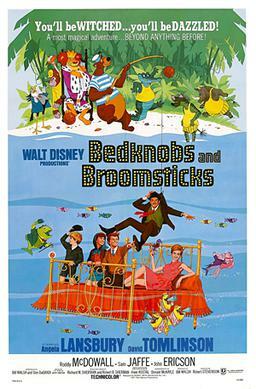
Bedknobs and Broomsticks (1971), directed by Robert Stevenson, is a Disney musical fantasy starring Angela Lansbury as Eglantine Price and David Tomlinson as the questionable professor Emelius Browne. Adapted from Mary Norton’s children’s books, it combines live-action performances with an animated island of talking animals and a distinctly British wartime setting. Its most compelling idea is that an amateur magician, dismissed as eccentric, may have something invaluable to contribute when ordinary institutions fail.
At a Glance
| Film | Bedknobs and Broomsticks (1971) |
|---|---|
| Director | Robert Stevenson |
| Studio | Walt Disney Productions |
| Source | Mary Norton’s The Magic Bedknob and Bonfires and Broomsticks, freely adapted |
| Principal cast | Angela Lansbury, David Tomlinson, Roddy McDowall, Sam Jaffe, Ian Weighill, Cindy O’Callaghan and Roy Snart |
| Songs | Richard M. Sherman and Robert B. Sherman |
| Setting | Britain during the Second World War, with journeys into animated fantasy |
| Runtime | Approximately 117 minutes at original release; later cuts and restorations vary |
| Genre | Wartime musical fantasy; live-action and animation |
Why This Film Matters
The film makes wartime domestic life the foundation of its fantasy. Three children evacuated from London have been sent to a household that feels unfamiliar and lonely. Their host is not a powerful sorceress but an adult struggling to learn magic from an unreliable correspondence course. As a result, the enchantment has to be practised, repaired and understood; it cannot simply make all difficulties vanish.
The story also connects magical knowledge to collective responsibility. Miss Price initially studies witchcraft to help defend her country, while the children and Emelius Browne become companions through an adventure that none of them would have chosen in advance.
The Story — Without Major Spoilers
In 1940, Charlie, Carrie and Paul are evacuated to a quiet village and placed with Eglantine Price, a woman whose private life contains an extraordinary secret. She is learning witchcraft, hoping to discover a spell powerful enough to resist an enemy invasion. Her training is interrupted, and she must track down Emelius Browne, the supposed master who supplied her lessons.
A magical bedknob allows the group to travel in impossible ways, carrying them towards a search for lost words of enchantment. Their travels include London and an island inhabited by animated animals, before events return to the very real dangers of wartime Britain. The plot alternates between comic spectacle and the practical problem of whether Miss Price can make her knowledge work when it matters.
Characters and Performances
Eglantine Price (Angela Lansbury) is serious, independent and increasingly courageous. Lansbury makes her credible precisely because she does not behave like someone accustomed to miracles. Emelius Browne (David Tomlinson) is charming but compromised, a showman whose relationship with magic changes as he sees what Miss Price can accomplish.
Charlie (Ian Weighill), Carrie (Cindy O’Callaghan) and Paul (Roy Snart) are the evacuees, each bringing a different response to displacement and wonder. Mr Jelk (Roddy McDowall) represents a more ordinary source of pressure on Miss Price’s private life. Other characters and the animated inhabitants of Naboombu expand the tale without belonging to one conventional royal court or sorcerous hierarchy.
The World on Screen
Miss Price’s coastal cottage and the nearby village are recognisably British, yet the enchanted bed can move through a world where everyday geography is no longer absolute. The trip to Portobello Road suggests a crowded, cosmopolitan marketplace where knowledge circulates through unlikely hands. The island of Naboombu is a deliberately animated world of talking animals and competing interests, not a realistic historical location.
The film’s visual effects are strongest when contrasting ordinary objects with impossible uses. A bed becomes a vehicle, a piece of writing can animate the inanimate, and armour that appears to belong to the past becomes active. The animation makes one island spectacular, but the most consequential magic occurs back among the people who need help.
Behind the Camera
Robert Stevenson also directed Mary Poppins, and the two productions share Disney’s live-action-and-animation techniques and songwriting team. The project’s history goes back to Disney’s acquisition of rights to Norton’s stories; development changed course as the studio worked on its musical fantasy films. The result was released in 1971 with Lansbury and Tomlinson at its centre.
Different releases have notably different running times. Disney’s D23 history records an original release version of about 117 minutes and a substantially shortened 1979 reissue. Restored versions have attempted to recover scenes and songs, so descriptions of the film’s pacing can depend on which edition a viewer has seen.
Mary Norton’s Books and the Film
Norton’s stories provide the apprentice witch, children and magical travel, but the screen adaptation gives the narrative a wartime mission and a different mix of musical comedy and spectacle. The animated island and some of the film’s most elaborate set pieces belong to Disney’s interpretation rather than being direct illustrations of the books.
That distinction is useful for readers exploring magical children’s fiction: the book’s charm rests largely on the friction between ordinary life and improbable lessons in witchcraft, while the film constructs a larger public adventure around the use of magical knowledge.
Themes and Critical Assessment
The strongest themes are learning, community and the unexpected value of people who are not treated as experts. Miss Price’s magic is neither effortless nor universally respected. The evacuees have practical insights of their own, and Emelius must confront the limitations of performing expertise he does not possess.
What works: Lansbury’s sympathetic and determined heroine, Tomlinson’s engaging fraud-turned-companion, the playful Naboombu sequences, inventive practical effects and the stirring use of enchanted objects in the finale. What works less well: uneven transitions between songs and quest, a sprawling middle section and a structure that feels different across the film’s various edits. It is more irregular than Mary Poppins, but it has a distinctive imaginative identity.
Related Films and Characters
Compare Mary Poppins (1964) for another Stevenson film that blends live actors and animated worlds, and Babes in Toyland (1961) for an earlier Disney musical in which inventions and animated objects become part of the action. These films share techniques and creative contributors, not a single story continuity.
Ideas for the Table
The apprentice’s last lesson: a village witch has incomplete instructions for a spell that could protect her neighbours. The players must find the missing knowledge, decide whether the lesson’s source can be trusted, and help test it before a deadline.
The moving bedroom: an ordinary bed can carry its passengers through otherwise inaccessible places, but each journey is governed by a rule the inventor has misunderstood. Learning those rules creates an open-ended expedition rather than a forced sequence of destinations.
The old armour awakens: forgotten equipment animates to defend a town. Different suits obey different orders, and the party must decide whether to release the protective magic after the danger passes.
For independent magical material, explore Animate Objects and the Animated Object entry for game interpretations of enchanted armour and other objects brought to life. The Construct Bestiary, spell archive and NPC collection offer further inspiration. These are independent game resources, not conversions of the film’s Substitutiary Locomotion spell or its named characters.
Production Deep Dive — Animation and the Restored Musical
Disney’s archival production photographs explain how the sodium-vapour process combined photographed actors with animated backgrounds. The AFI production record documents the visual-effects Oscar and the anniversary restoration, including new dialogue recordings by returning performers. The D23 anniversary exhibition illustrates surviving props and production objects. A library catalogue for the restored DVD identifies the making-of featurette Music Magic, featuring the Sherman brothers, Angela Lansbury and restoration specialist Scott MacQueen.
Sources and Credits
- D23 Disney Archives — Bedknobs and Broomsticks (plot, versions and cast).
- AFI Catalog — Bedknobs and Broomsticks (source books and production).
- Turner Classic Movies — Bedknobs and Broomsticks (production context).
Film images and characters remain the property of their respective rights holders. This is independent criticism with original fantasy-game suggestions.
Keep this reference growing
If this page helped with your reading or game, you can support its upkeep or explore the curated books.
Explore the Bookshop — epics, classics and stories behind imagined worlds.