
Phasma — The Nightmare That Walks
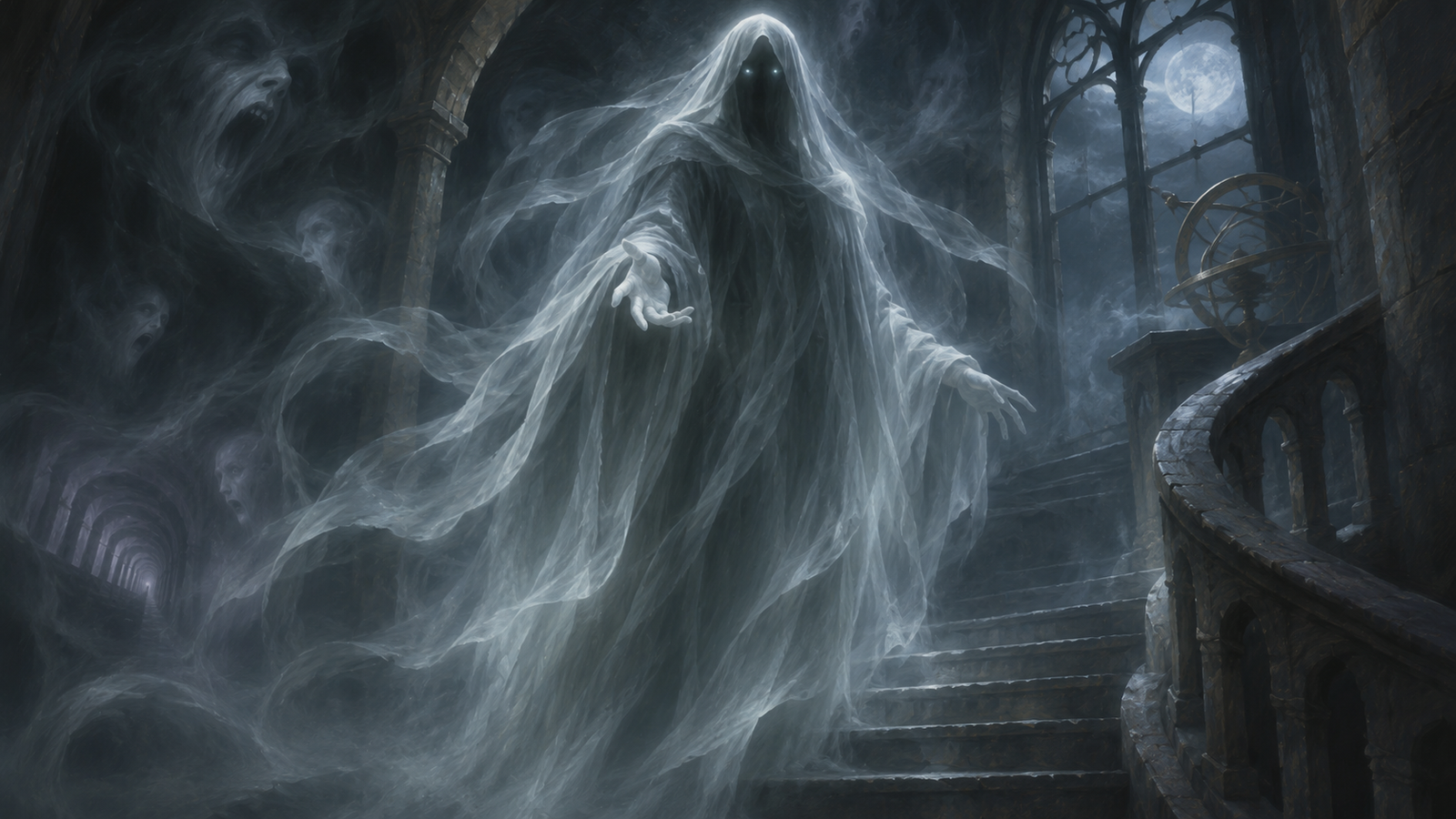
The apprentice was found at the foot of the tower stair, his hands raised to ward off an enemy no one else could see. Three days later, every servant who crosses that stair glimpses a monstrous face in the glass of the upper window. It changes from person to person. At dusk the apprentice himself appears, veiled in pale light, and reaches for the nearest living mind.
A Phasma is an incorporeal Undead born when a creature dies under the overwhelming terror of a murderous illusion. A lethal phantasm does not merely slay the body; in rare cases it imprisons the last moment of fear so completely that the victim rises again as a ghostly predator. The apparition feeds upon judgment and courage, weakening its victims before showing each the image it fears most.
The Phasma is no ordinary Ghost. It does not need a disputed inheritance or an unfulfilled promise. Its reason for remaining is the terror of the spell itself. Most haunt the place of death and show bitter hatred of the living, especially those who work illusions or other arcane magic. One can leave that place, but ordinarily returns to the familiar scene of its own final moment.
At a Glance
| Creature | Phasma — the ghost formed by a deadly magical nightmare |
|---|---|
| Nature | Medium incorporeal Undead; Chaotic Evil |
| Challenge | CR 12 in each of the complete rules panels below |
| Appearance | Translucent robes, a masked or featureless face and pale radiance |
| Haunts | The site of a fatal illusion, generally close to the place where its mortal body fell |
| Threat | Wisdom-draining touch, nightmare illusions, incorporeal flight and magical interference |
| Counterplay | Resist the illusion, protect a weakened companion, avoid its touch and expose its site to daylight |
| Distinction | Its visions are private fears, not independent monsters that can be attacked |
Phasma Statistics
Phasma — D&D 2024
Medium Undead, Chaotic Evil · CR 12 (8,400 XP; PB +4) · Original conversion
AC 17 (spectral ward); Initiative +5 (15); HP 171 (18d8+90); Speed 0 ft., Fly 40 ft. (hover).
| STR | DEX | CON | INT | WIS | CHA |
|---|---|---|---|---|---|
| 6 (−2) | 20 (+5) | 20 (+5) | 15 (+2) | 17 (+3) | 20 (+5) |
Saving Throws Dex +9, Wis +7, Cha +9; Skills Arcana +6, Deception +9, Intimidation +9, Perception +7; Damage Resistances Acid, Cold, Fire, Lightning, Thunder; Bludgeoning, Piercing and Slashing from nonmagical attacks; Damage Immunities Necrotic, Poison; Condition Immunities Charmed, Exhaustion, Frightened, Grappled, Paralyzed, Petrified, Poisoned, Prone, Restrained; Senses Darkvision 60 ft., Passive Perception 17; Languages those remembered from life.
Traits
Incorporeal Movement. The Phasma can move through creatures and objects as Difficult Terrain. If it ends its turn inside an object, it takes 5 (1d10) Force damage. It cannot transport another creature through a wall.
Sunlight Sensitivity. While in sunlight it has Disadvantage on attack rolls and Wisdom (Perception) checks relying on sight.
Trauma Echo. The Phasma recognises the site of its death and can imitate the spectral outline of its fatal illusion. The imitation has no separate actions or Hit Points.
Actions
Multiattack. The Phasma makes two Phantom Touch attacks.
Phantom Touch. Melee Attack Roll +9, reach 5 ft., one creature. Hit: 23 (4d8+5) Necrotic damage. The target must also make a DC 17 Wisdom Saving Throw or subtract 1d4 from its next Wisdom Saving Throw before the end of its next turn. The Phasma gains 5 Temporary HP on a hit; the Temporary HP do not stack.
Phantasmagoria (Recharge 5–6). Each living creature the Phasma can see within 30 ft. confronts the image of its worst fear and makes a DC 17 Wisdom Saving Throw. On failure it takes 36 (8d8) Psychic damage and becomes Frightened until the end of its next turn. On success it takes half damage and is not Frightened. A target whose save succeeds is immune to this Phasma’s Phantasmagoria for 24 hours. The illusion cannot kill without dealing enough damage to reduce HP to 0; it does not impose an automatic death effect.
Spellcasting. Spellcasting ability Charisma (save DC 17), requiring no material components: at will Detect Magic; 3/day each Dispel Magic, Protection from Evil and Good; 1/day Banishment. Each spell uses its normal action and Concentration rules.
Legendary Actions
The Phasma has two Legendary Action uses, restored at the start of its turn. It may use only one option at the end of another creature’s turn. Drift (1 Use): It flies up to half its Speed without provoking Opportunity Attacks. Hallucinatory Glance (1 Use): One creature it can see within 30 ft. makes a DC 17 Wisdom Saving Throw, taking 9 (2d8) Psychic damage on failure or half on success. Phantom Touch (2 Uses): It makes one Phantom Touch attack.
Original D&D 2024 CR 12 adaptation. A separate Frog God Games fifth-edition Phasma exists at CR 15; this standalone conversion is not that printed stat block and is not official Wizards of the Coast content.
Phasma — D&D 2014
Medium Undead, Chaotic Evil · CR 12 (8,400 XP) · Original conversion
Armor Class 17 (spectral ward); Hit Points 171 (18d8+90); Speed 0 ft., Fly 40 ft. (hover).
| STR | DEX | CON | INT | WIS | CHA |
|---|---|---|---|---|---|
| 6 (−2) | 20 (+5) | 20 (+5) | 15 (+2) | 17 (+3) | 20 (+5) |
Saving Throws Dex +9, Wis +7, Cha +9; Skills Arcana +6, Deception +9, Intimidation +9, Perception +7; Damage Resistances Acid, Cold, Fire, Lightning, Thunder; Bludgeoning, Piercing and Slashing from nonmagical attacks; Damage Immunities Necrotic, Poison; Condition Immunities Charmed, Exhaustion, Frightened, Grappled, Paralyzed, Petrified, Poisoned, Prone, Restrained; Senses Darkvision 60 ft., Passive Perception 17; Languages those remembered from life.
Traits
Incorporeal Movement. The Phasma can move through creatures and objects as Difficult Terrain. If it ends its turn inside an object, it takes 5 (1d10) Force damage. It cannot transport another creature through a wall.
Sunlight Sensitivity. While in sunlight it has disadvantage on attack rolls and Wisdom (Perception) checks relying on sight.
Trauma Echo. The Phasma recognises the site of its death and can imitate the spectral outline of its fatal illusion. The imitation has no separate actions or Hit Points.
Actions
Multiattack. The Phasma makes two Phantom Touch attacks.
Phantom Touch. Melee Attack Roll +9, reach 5 ft., one creature. Hit: 23 (4d8+5) Necrotic damage. The target must also make a DC 17 Wisdom saving throw or subtract 1d4 from its next Wisdom saving throw before the end of its next turn. The Phasma gains 5 Temporary HP on a hit; the Temporary HP do not stack.
Phantasmagoria (Recharge 5–6). Each living creature the Phasma can see within 30 ft. confronts the image of its worst fear and makes a DC 17 Wisdom saving throw. On failure it takes 36 (8d8) Psychic damage and becomes frightened until the end of its next turn. On success it takes half damage and is not Frightened. A target whose save succeeds is immune to this Phasma’s Phantasmagoria for 24 hours. The illusion cannot kill without dealing enough damage to reduce HP to 0; it does not impose an automatic death effect.
Spellcasting. Spellcasting ability Charisma (save DC 17), requiring no material components: at will Detect Magic; 3/day each Dispel Magic, Protection from Evil and Good; 1/day Banishment. Each spell uses its normal action and concentration rules.
Legendary Actions
The Phasma has two Legendary Action uses, restored at the start of its turn. It may use only one option at the end of another creature’s turn. Drift (1 Use): It flies up to half its Speed without provoking Opportunity Attacks. Hallucinatory Glance (1 Use): One creature it can see within 30 ft. makes a DC 17 Wisdom saving throw, taking 9 (2d8) Psychic damage on failure or half on success. Phantom Touch (2 Uses): It makes one Phantom Touch attack.
Original D&D 2014 CR 12 adaptation. A separate Frog God Games fifth-edition Phasma exists at CR 15; this standalone conversion is not that printed stat block and is not official Wizards of the Coast content.
Phasma — Pathfinder 1e
CE Medium Undead (Incorporeal) · CR 12 (XP 19,200) · Tome of Horrors Complete
Init +9; Senses Darkvision 60 ft., Perception +23; AC 20, touch 20, flat-footed 15 (+5 deflection, +5 Dex); HP 123 (13d8+65); Fort +9, Ref +11, Will +13; Defensive Abilities Channel Resistance +4, Incorporeal; Immune Undead traits.
Speed Fly 40 ft. (perfect); Melee Incorporeal Touch +14 (1d6 plus 1d6 Wisdom Drain); Special Attacks Phantasmagoria, Wisdom Drain; Space/Reach 5 ft./5 ft.
| STR | DEX | CON | INT | WIS | CHA |
|---|---|---|---|---|---|
| — | 20 (+5) | — | 15 (+2) | 17 (+3) | 20 (+5) |
BAB +9; CMB +14; CMD 29; Feats Alertness, Combat Casting, Flyby Attack, Improved Initiative, Iron Will, Lightning Reflexes, Quicken Spell-Like Ability (Protection from Good); Skills Bluff +21, Fly +13, Intimidate +21, Knowledge (one) +15, Perception +23, Sense Motive +23, Spellcraft +18; Languages one language known in life; Environment any, especially the scene of a fatal illusion; Organisation solitary; Treasure standard.
Spell-Like Abilities
Caster Level 13th. At will: Detect Good. 1/day each: Blasphemy (DC 22), Unholy Aura (DC 22). 3/day each: Dispel Magic, Protection from Evil, quickened Protection from Good. Spell-like abilities use the usual Pathfinder spell action and save rules.
Special Abilities
Phantasmagoria (Su; 2/Day). Every creature within 30 ft. sees a private image of its most terrible fear, as Phantasmal Killer at CL 13th. Each target makes a DC 21 Will save to disbelieve. A failed Will save is followed by a DC 21 Fortitude save; failure on both saves kills the target. Passing the Fortitude save instead inflicts 6d6 damage. A successful Will save grants immunity to this Phasma’s Phantasmagoria for 24 hours. The saves are Charisma-based, and the effect is a mind-affecting death phantasm.
Wisdom Drain (Su). Each successful Incorporeal Touch deals 1d6 Wisdom Drain as well as its damage. The Phasma gains 5 Temporary HP when it hits. Its ability to weaken a target does not grant an additional touch attack on that turn.
Phasma CR 12, d20PFSRD, sourced to Tome of Horrors Complete © 2011, Necromancer Games/Frog God Games; Scott Greene. This is a third-party Pathfinder creature, not a Paizo Bestiary monster. The order of Will and Fortitude saves follows the source’s Phantasmal Killer effect.
Phasma — D&D 3.5e
CE Medium Undead (Incorporeal) · CR 12 · Original 3.5e adaptation
Hit Dice 13d12 (84 HP); Initiative +9; Speed Fly 40 ft. (perfect); AC 20 (+5 deflection, +5 Dex), touch 20, flat-footed 15; Base Attack/Grapple +6/—; Fort +4, Ref +11, Will +13; Turn Resistance +4; Immune Undead traits; Space/Reach 5 ft./5 ft.
| STR | DEX | CON | INT | WIS | CHA |
|---|---|---|---|---|---|
| — | 20 (+5) | — | 15 (+2) | 17 (+3) | 20 (+5) |
Attack Incorporeal Touch +11 melee touch (1d6 damage plus 1d6 Wisdom Drain); Full Attack one Incorporeal Touch +11; Special Attacks Phantasmagoria (DC 21), Wisdom Drain; Feats Alertness, Flyby Attack, Improved Initiative, Iron Will, Lightning Reflexes; Skills Bluff +21, Hide +21, Intimidate +21, Listen +23, Sense Motive +23, Spot +23; Languages one language known in life; Environment any site of magical death; Organisation solitary; Treasure standard.
Spell-Like Abilities
CL 13th, Charisma-based. At will Detect Good; 3/day each Dispel Magic, Protection from Evil, Protection from Good; 1/day each Blasphemy, Unholy Aura. Use the D&D 3.5e versions of these spells and their normal action times.
Special Abilities
Phantasmagoria (Su; 2/Day). As a Standard Action, each living creature within 30 ft. must make a DC 21 Will save to disbelieve a personal deathly illusion. On failure it makes a DC 21 Fortitude save. Failure on both kills the target; success on Fortitude deals 6d6 damage instead. Success on Will grants immunity to that Phasma’s illusion for 24 hours. The effect is mind-affecting, fear, illusion (phantasm) and death magic; its DC is Charisma-based.
Wisdom Drain (Su). On a successful Incorporeal Touch the target suffers 1d6 Wisdom Drain and the Phasma gains 5 Temporary HP. The Temporary HP do not stack with themselves, and the touch requires a successful attack.
Incorporeal. It can move through solid objects using the normal 3.5e Incorporeal rules. Ghost touch and other appropriate attacks can strike it under those rules.
Original D&D 3.5e adaptation using Undead and Incorporeal rules. It has 13d12 HD, a distinct BAB and saves, and no Constitution score.
What Is Happening Right Now?
A court magician has failed to demonstrate a spell before a visiting noble. His rival was found dead shortly afterwards in a passage leading to the observatory. Within a week, the servants refuse to enter that passage: every visitor sees a different threatening figure, and several have collapsed without visible wounds. An apprentice who knew the deceased reports that a translucent body in gray robes sometimes appears after the vision fades. The magistrate has sealed the stair until the mage can explain the deaths.
How the Nightmare Returns
The Phasma recalls the fear that killed it more clearly than its life. Its face is hidden or absent, and a pale light outlines the form that the fatal spell left behind. It is drawn to the site of that last moment, usually within a short walk of the chamber or path where it died. Some possess enough memory to curse the spellcaster who killed them, but they seldom attempt reasoned conversation with other living people.
The Illusion and the Victim
Every victim sees a different enemy: a lost child, a dragon at the door, a feared judge, or an impossible version of the victim’s own death. Other observers may see only the gray-robed apparition. Its visions are not separate monsters, and the party cannot defeat one by attacking the image seen by a frightened ally. Those who resist its mental pressure can use the time to guide others clear or damage the spirit.
Running the Encounter
Begin with contradictory witnesses, each certain that the same place contains a different horror. Let the characters gather evidence that one spell killed the Phasma while leaving no blade wound. In combat the spirit passes through obstacles and drains weakened opponents with its touch. It then uses Phantasmagoria against a group whose confidence has already faltered. The four rules versions specify whether the effect inflicts ordinary damage or the source game’s lethal double-save, so the GM should never combine the versions.
Adventure Hooks
One Stair, Three Monsters
The watch reports a beast, a corpse and a burning woman in the same tower. The three witnesses saw different nightmares. The culprit is a Phasma guarding the threshold where its mortal self died.
The Magician’s Demonstration
A visiting scholar asks the party to retrieve spell notes from a shuttered observatory. The paper explains that two rival mages tried to prove which could cast Phantasmal Killer more reliably. One survived; the other has not remained dead.
The Name Behind the Mask
A bereaved family has been told the dead apprentice fled town. A face hidden by a white spectral mask appears near the site of the funeral. Exposing the original murder may identify the Phasma, but that knowledge will not turn a predatory Undead into an innocent messenger.
Travel and Authority
A local magistrate can seal a building after unexplained deaths, while a guild may deny that its own mages caused the haunting. The party may need permission to inspect the corpse, recover the original spellbook, and protect witnesses whose memories contradict one another. A false accusation against a neighbouring village can do as much damage as the spirit if the court believes every nightmare represents a living culprit.
Other Fears and Unquiet Dead
A Ghost often returns over unfinished duty; the Phasma rises from a lethal illusion. The Bleeding Spirit accuses the living through an entirely different sign. Phantasmal Killer is the spell most closely associated with its creation; Undead Bestiary contains further haunts and apparitions.
Sources and Licensing
The Phasma is a third-party fantasy monster from Tome of Horrors Complete (2011), originally authored by Scott Greene and distributed by Frog God Games/Necromancer Games. The Pathfinder CR 12 reference preserves its Incorporeal Touch, Wisdom Drain and lethal Phantasmagoria. A separate Frog God Games fifth-edition version uses CR 15; the original fifth-edition conversions above instead follow the CR 12 encounter premise, with their own clearly defined rules. The D&D 3.5e panel is also original. No claim is made that any of these are official Paizo or Wizards of the Coast monster stat blocks.
The existing site artwork is reused provisionally; its suitability and rights should be checked before replacing it in the media library. Original setting narrative and images are not designated Open Game Content merely because the underlying game mechanics may be openly licensed.
Full Open Game License 1.0a and Section 15 notices
OPEN GAME LICENSE Version 1.0a
The following text is the property of Wizards of the Coast, Inc. and is Copyright 2000 Wizards of the Coast, Inc (“Wizards”). All Rights Reserved.
1. Definitions: (a)”Contributors” means the copyright and/or trademark owners who have contributed Open Game Content; (b)”Derivative Material” means copyrighted material including derivative works and translations (including into other computer languages), potation, modification, correction, addition, extension, upgrade, improvement, compilation, abridgment or other form in which an existing work may be recast, transformed or adapted; (c) “Distribute” means to reproduce, license, rent, lease, sell, broadcast, publicly display, transmit or otherwise distribute; (d)”Open Game Content” means the game mechanic and includes the methods, procedures, processes and routines to the extent such content does not embody the Product Identity and is an enhancement over the prior art and any additional content clearly identified as Open Game Content by the Contributor, and means any work covered by this License, including translations and derivative works under copyright law, but specifically excludes Product Identity. (e) “Product Identity” means product and product line names, logos and identifying marks including trade dress; artifacts; creatures characters; stories, storylines, plots, thematic elements, dialogue, incidents, language, artwork, symbols, designs, depictions, likenesses, formats, poses, concepts, themes and graphic, photographic and other visual or audio representations; names and descriptions of characters, spells, enchantments, personalities, teams, personas, likenesses and special abilities; places, locations, environments, creatures, equipment, magical or supernatural abilities or effects, logos, symbols, or graphic designs; and any other trademark or registered trademark clearly identified as Product identity by the owner of the Product Identity, and which specifically excludes the Open Game Content; (f) “Trademark” means the logos, names, mark, sign, motto, designs that are used by a Contributor to identify itself or its products or the associated products contributed to the Open Game License by the Contributor (g) “Use”, “Used” or “Using” means to use, Distribute, copy, edit, format, modify, translate and otherwise create Derivative Material of Open Game Content. (h) “You” or “Your” means the licensee in terms of this agreement.
2. The License: This License applies to any Open Game Content that contains a notice indicating that the Open Game Content may only be Used under and in terms of this License. You must affix such a notice to any Open Game Content that you Use. No terms may be added to or subtracted from this License except as described by the License itself. No other terms or conditions may be applied to any Open Game Content distributed using this License.
3. Offer and Acceptance: By Using the Open Game Content You indicate Your acceptance of the terms of this License.
4. Grant and Consideration: In consideration for agreeing to use this License, the Contributors grant You a perpetual, worldwide, royalty-free, non-exclusive license with the exact terms of this License to Use, the Open Game Content.
5. Representation of Authority to Contribute: If You are contributing original material as Open Game Content, You represent that Your Contributions are Your original creation and/or You have sufficient rights to grant the rights conveyed by this License.
6. Notice of License Copyright: You must update the COPYRIGHT NOTICE portion of this License to include the exact text of the COPYRIGHT NOTICE of any Open Game Content You are copying, modifying or distributing, and You must add the title, the copyright date, and the copyright holder’s name to the COPYRIGHT NOTICE of any original Open Game Content you Distribute.
7. Use of Product Identity: You agree not to Use any Product Identity, including as an indication as to compatibility, except as expressly licensed in another, independent Agreement with the owner of each element of that Product Identity. You agree not to indicate compatibility or co-adaptability with any Trademark or Registered Trademark in conjunction with a work containing Open Game Content except as expressly licensed in another, independent Agreement with the owner of such Trademark or Registered Trademark. The use of any Product Identity in Open Game Content does not constitute a challenge to the ownership of that Product Identity. The owner of any Product Identity used in Open Game Content shall retain all rights, title and interest in and to that Product Identity.
8. Identification: If you distribute Open Game Content You must clearly indicate which portions of the work that you are distributing are Open Game Content.
9. Updating the License: Wizards or its designated Agents may publish updated versions of this License. You may use any authorized version of this License to copy, modify and distribute any Open Game Content originally distributed under any version of this License.
10. Copy of this License: You MUST include a copy of this License with every copy of the Open Game Content You Distribute.
11. Use of Contributor Credits: You may not market or advertise the Open Game Content using the name of any Contributor unless You have written permission from the Contributor to do so.
12. Inability to Comply: If it is impossible for You to comply with any of the terms of this License with respect to some or all of the Open Game Content due to statute, judicial order, or governmental regulation then You may not Use any Open Game Material so affected.
13. Termination: This License will terminate automatically if You fail to comply with all terms herein and fail to cure such breach within 30 days of becoming aware of the breach. All sublicenses shall survive the termination of this License.
14. Reformation: If any provision of this License is held to be unenforceable, such provision shall be reformed only to the extent necessary to make it enforceable.
15. COPYRIGHT NOTICE
Open Game License v 1.0a Copyright 2000, Wizards of the Coast, Inc.
System Reference Document Copyright 2000–2003, Wizards of the Coast, Inc.; Authors Jonathan Tweet, Monte Cook, Skip Williams, Rich Baker, Andy Collins, David Noonan, Rich Redman, Bruce R. Cordell, John D. Rateliff, Thomas Reid and James Wyatt, based on original material by E. Gary Gygax and Dave Arneson.
Phasma from Tome of Horrors Complete © 2011, Necromancer Games, Inc., published and distributed by Frog God Games; Author Scott Greene.
Tome of Horrors © 2018, Frog God Games, LLC; Authors Kevin Baase, Erica Balsley, John Barnhouse, Christopher Bishop, Casey Christofferson, Jim Collura, Andrea Costantini, Jayson Gardner, Zach Glazar, Meghan Greene, Scott Greene, Lance Hawvermale, Travis Hawvermale, Ian S. Johnston, Bill Kenower, Patrick Lawinger, Rhiannon Louve, Ian McGarty, Edwin Nagy, James Patterson, Nathan Paul, Patrick N. Pilgrim, Clark Peterson, Anthony Pryor, Greg Ragland, Robert Schwalb, G. Scott Swift, Greg A. Vaughan and Bill Webb.
Keep this reference growing
If this page helped with your reading or game, you can support its upkeep or explore the curated books.
Explore the Bookshop — epics, classics and stories behind imagined worlds.