
Ka Mummy — The Royal Spirit of the Tomb
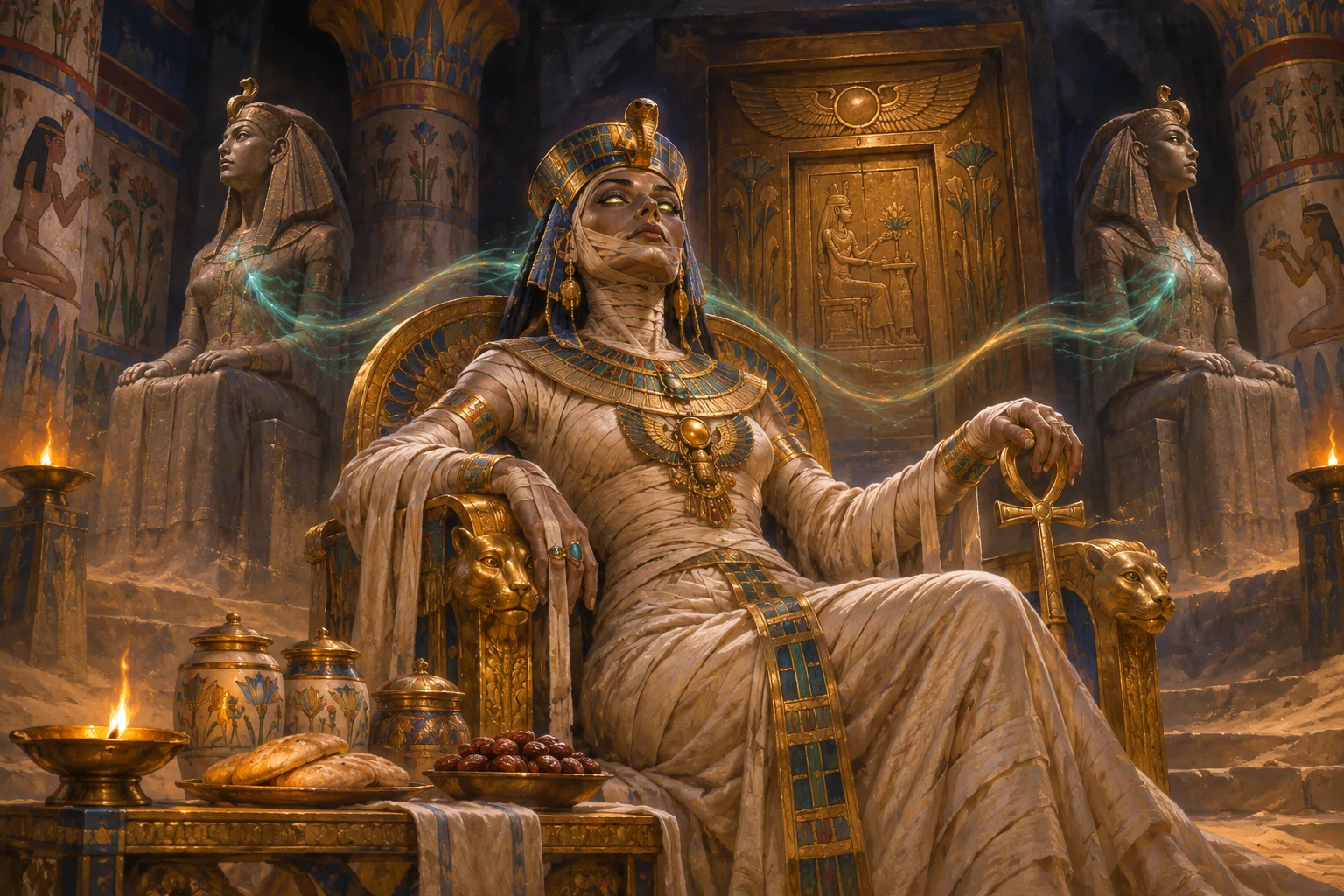
The offering table is laden with bread, dates and sealed jars. Beneath the wall painting, a narrow door is carved into the stone, though no passage lies beyond it. The dead queen sits upon a gilded seat facing the visitors. Her linen wrappings are spotless, and the uraeus upon her brow glimmers in the lamp-light. When the thief reaches for the burial seal, every statue in the chamber turns its head.
At a Glance
- Creature
- Ka Mummy — a royal guardian whose spirit can dwell in both its body and funerary statues
- Alignment
- Usually Lawful Neutral; an ancient ruler bound by oath and custom, sometimes benevolent or merciless
- Disposition
- Protects its tomb from desecration, but may welcome respectful guests, descendants and priests
- Haunts
- Hidden royal tombs, ancestral chapels, false-door sanctuaries and palaces of ancient Kemet
- Age
- Ancient, often surviving long beyond the dynasty whose rites first bound its spirit
- Signature Powers
- Royal curse, paralyzing dread, carved words of power, passage through spirit doors and divided spirit in stone guardians
- Counterplay
- Leave the funerary treasures undisturbed, restore offerings, negotiate through ancestral protocol, or destroy the statues that hold the spirit
- Threat
- CR 15 original D&D 3.5e interpretation; high-level tomb guardian in every edition
A Ka Mummy is not a corpse animated by an indiscriminate appetite. It was a ruler in life and remembers the oaths, laws and sacred duties of that reign. The oldest lie beneath dynasties whose names have passed into the stone. The judgment of Osiris, the rites of Anubis and the demands of Ma’at are living powers to such a guardian, not decorative inscriptions.
Its life-force may receive offerings at a false door or within a statue of the departed monarch. A visitor who brings bread, water or an honest genealogy can be heard. One who breaks a seal and steals from the dead may discover that the king has not forgotten how to pass sentence.
Ka Mummy Statistics
Ka Mummy — D&D 2024
Medium Undead, Lawful Neutral · CR 15 (13,000 XP; PB +5) · Original adaptation
AC 20 (enchanted burial linen); Initiative +2 (12); HP 255 (30d8+120); Speed 30 ft.
| STR | DEX | CON | INT | WIS | CHA |
|---|---|---|---|---|---|
| 25 (+7) | 14 (+2) | 18 (+4) | 16 (+3) | 16 (+3) | 20 (+5) |
Saving Throws Str +12, Wis +8, Cha +10; Skills History +8, Insight +8, Intimidation +10, Perception +8, Religion +8; Resistances Fire, Bludgeoning, Piercing and Slashing damage from nonmagical attacks; Immunities Necrotic and Poison damage, Charmed, Exhaustion, Frightened and Poisoned conditions; Senses Darkvision 120 ft., Passive Perception 18; Languages Ancient Egyptian, the ceremonial language of the realm and the principal tongues learned in life.
Traits
Royal Presence. When a creature first sees the Ka Mummy within 60 ft., it must succeed on a DC 20 Wisdom Saving Throw or be Frightened and Paralyzed for 1 minute. It repeats the save at the end of each turn, ending both conditions on success. A successful save grants 24 hours’ immunity to this Ka Mummy’s Royal Presence.
Spirit Doors. The Ka Mummy can pass through a false door or spirit door prepared for its burial as if a connected doorway opened there. The two ends must be within its own tomb complex; the door closes behind it. This movement does not provoke Opportunity Attacks.
Fragmented Spirit. Two stone guardian statues in the tomb contain parts of its spirit. Each uses the statistics of a Stone Golem. While at least one survives, destroying the body does not destroy the guardian’s spirit. The Ka Mummy reforms beside a surviving statue after 24 hours, gaining full HP. The statues cannot leave the tomb complex and are separate creatures in combat.
Actions
Multiattack. The Ka Mummy makes two Royal Slam attacks.
Royal Slam. Melee Attack Roll +12, reach 5 ft., one target. Hit: 20 (3d8+7) Bludgeoning plus 13 (3d8) Necrotic damage. A living creature hit makes a DC 20 Wisdom Saving Throw; failure imposes one Royal Curse, determined by rolling 1d8.
Royal Curse (1d8). Roll once when the creature fails the saving throw: (1) ill luck, −2 to attack rolls and saving throws; (2) withered legs, Speed 5 ft.; (3) withered arms, cannot use a held weapon or supply Somatic spell components; (4) disfigurement, Disadvantage on Charisma checks; (5) death wish, attackers have Advantage against the victim; (6) clouded reason, Disadvantage on Intelligence checks and saving throws; (7) biting vermin, takes 7 (2d6) Piercing damage whenever it casts a spell with an Action; (8) diminished body, its size becomes one category smaller (minimum Tiny) and weapon damage dice are reduced one step. Effects remain until Remove Curse, Greater Restoration or another successful curse-ending power is used. A creature already affected by this particular Ka Mummy’s curse does not roll another result until the previous one ends.
Carve a Word of Power (Recharge 5–6). The Ka Mummy inscribes one word upon a solid surface within reach. A creature of its choice within 30 ft. that can see the inscription makes a DC 20 Wisdom Saving Throw. On failure the Ka Mummy chooses one effect: Fear (Frightened for 1 minute), Pain (18 (4d8) Psychic damage and Incapacitated until the end of its next turn) or Obedience (Charmed until the end of its next turn and must obey one short, non-suicidal command). A creature repeats a Fear saving throw at the end of its turns.
Royal Command (3/Day). Up to three creatures within 60 ft. that can hear and understand the Ka Mummy make a DC 20 Wisdom Saving Throw. Failure: Charmed until the end of their next turn and compelled to obey one short, non-suicidal command.
Bonus Actions
Pass Through Stone. The Ka Mummy passes through a prepared Spirit Door within 10 ft. and arrives at its paired doorway.
Original D&D 2024 version adapted from an older CR 15 Ka Mummy concept. This is not a published official Monster Manual creature; its guardian statues are separate combatants.
Ka Mummy — D&D 2014
Medium Undead, Lawful Neutral · CR 15 (13,000 XP) · Original adaptation
AC 20 (enchanted burial linen); HP 255 (30d8+120); Speed 30 ft.
| STR | DEX | CON | INT | WIS | CHA |
|---|---|---|---|---|---|
| 25 (+7) | 14 (+2) | 18 (+4) | 16 (+3) | 16 (+3) | 20 (+5) |
Saving Throws Str +12, Wis +8, Cha +10; Skills History +8, Insight +8, Intimidation +10, Perception +8, Religion +8; Resistances Fire, Bludgeoning, Piercing and Slashing damage from nonmagical attacks; Immunities Necrotic and Poison damage, Charmed, Exhaustion, Frightened and Poisoned conditions; Senses Darkvision 120 ft., Passive Perception 18; Languages Ancient Egyptian, the ceremonial language of the realm and the principal tongues learned in life.
Traits
Royal Presence. When a creature first sees the Ka Mummy within 60 ft., it must succeed on a DC 20 Wisdom Saving Throw or be Frightened and Paralyzed for 1 minute. It repeats the save at the end of each turn, ending both conditions on success. A successful save grants 24 hours’ immunity to this Ka Mummy’s Royal Presence.
Spirit Doors. The Ka Mummy can pass through a false door or spirit door prepared for its burial as if a connected doorway opened there. The two ends must be within its own tomb complex; the door closes behind it. This movement does not provoke Opportunity Attacks.
Fragmented Spirit. Two stone guardian statues in the tomb contain parts of its spirit. Each uses the statistics of a Stone Golem. While at least one survives, destroying the body does not destroy the guardian’s spirit. The Ka Mummy reforms beside a surviving statue after 24 hours, gaining full HP. The statues cannot leave the tomb complex and are separate creatures in combat.
Actions
Multiattack. The Ka Mummy makes two Royal Slam attacks.
Royal Slam. Melee Weapon Attack +12, reach 5 ft., one target. Hit: 20 (3d8+7) Bludgeoning plus 13 (3d8) Necrotic damage. A living creature hit makes a DC 20 Wisdom Saving Throw; failure imposes one Royal Curse, determined by rolling 1d8.
Royal Curse (1d8). Roll once when the creature fails the saving throw: (1) ill luck, −2 to attack rolls and saving throws; (2) withered legs, Speed 5 ft.; (3) withered arms, cannot use a held weapon or supply Somatic spell components; (4) disfigurement, Disadvantage on Charisma checks; (5) death wish, attackers have Advantage against the victim; (6) clouded reason, Disadvantage on Intelligence checks and saving throws; (7) biting vermin, takes 7 (2d6) Piercing damage whenever it casts a spell with an Action; (8) diminished body, its size becomes one category smaller (minimum Tiny) and weapon damage dice are reduced one step. Effects remain until Remove Curse, Greater Restoration or another successful curse-ending power is used. A creature already affected by this particular Ka Mummy’s curse does not roll another result until the previous one ends.
Carve a Word of Power (Recharge 5–6). The Ka Mummy inscribes one word upon a solid surface within reach. A creature of its choice within 30 ft. that can see the inscription makes a DC 20 Wisdom Saving Throw. On failure the Ka Mummy chooses one effect: Fear (Frightened for 1 minute), Pain (18 (4d8) Psychic damage and Incapacitated until the end of its next turn) or Obedience (Charmed until the end of its next turn and must obey one short, non-suicidal command). A creature repeats a Fear saving throw at the end of its turns.
Royal Command (3/Day). Up to three creatures within 60 ft. that can hear and understand the Ka Mummy make a DC 20 Wisdom Saving Throw. Failure: Charmed until the end of their next turn and compelled to obey one short, non-suicidal command.
Bonus Actions
Pass Through Stone. The Ka Mummy passes through a prepared Spirit Door within 10 ft. and arrives at its paired doorway.
Original D&D 2014 version adapted from an older CR 15 Ka Mummy concept. This is not a published official Monster Manual creature; its guardian statues are separate combatants.
Ka Mummy — Pathfinder 1e
LN Medium Undead · CR 15 (51,200 XP) · Original conversion
Initiative +6; Senses Darkvision 60 ft., Perception +25; AC 29, touch 12, flat-footed 27 (+2 Dex, +17 natural); HP 161 (17d8+85); Fort +9, Ref +7, Will +15; DR 5/—; Resistances Fire 10; Immunity Electricity, Undead traits; Channel Resistance +4; Weakness Vulnerability to Fire.
Speed 30 ft.; Melee Slam +22 (1d8+13 plus Ka’s Curse); Special Attacks Despair (DC 22), Ka’s Curse (DC 24), Carve Symbol.
| STR | DEX | CON | INT | WIS | CHA |
|---|---|---|---|---|---|
| 28 (+9) | 14 (+2) | — | 16 (+3) | 15 (+2) | 19 (+4) |
BAB +12; CMB +21; CMD 33; Feats Ability Focus (Ka’s Curse), Cleave, Combat Expertise, Improved Critical (Slam), Improved Initiative, Improved Trip, Iron Will, Power Attack, Toughness; Skills Diplomacy +20, Intimidate +24, Knowledge (History) +23, Knowledge (Nobility) +23, Perception +25, Sense Motive +25, Spellcraft +23; Languages Ancient Egyptian and regional tongues.
Special Abilities
Despair (Su). A creature that sees the Ka Mummy makes a DC 22 Will save or is Paralyzed with terror for 1d4 rounds. Success grants immunity to the same Ka Mummy’s Despair for 24 hours.
Ka’s Curse (Su). A living creature hit by Slam makes a DC 24 Will save or suffers one curse (roll 1d8): 1 ill luck (−2 to attacks and saves); 2 withered legs (Speed 5 ft.); 3 withered arms (cannot manipulate objects or cast spells with Somatic components); 4 disfigured (−4 on Charisma-based skill checks); 5 death wish (−2 AC); 6 dimwitted (−4 Intelligence-based checks); 7 plagued by vermin (Concentration check DC 20+spell level to cast a spell); 8 shrunken (as Reduce Person). The curse persists until a successful Remove Curse or Break Enchantment check against DC 20.
Carve Symbol (Sp). As a Full-Round Action it can inscribe Symbol of Fear, Symbol of Pain or Symbol of Persuasion; caster level 17th, saving throw DC 14+spell level.
Fragment Spirit (Su). The Ka Mummy’s spirit resides in two prepared Stone Golem vessels. While at least one vessel remains, destruction of the mummy does not release the spirit. The spirit may direct the golems, but does not use its own curse or Despair while inhabiting them. A more powerful Ka can command one extra vessel for every two additional HD.
Spell-Like Abilities. CL 17th: At will Phase Door; 3/day Greater Command (DC 19).
Original Pathfinder 1e conversion of an older fan-adapted Ka Mummy; Paizo has not published this exact creature. The spell effects use Pathfinder 1e terminology.
Ka Mummy — D&D 3.5e
Usually Lawful Neutral · Medium Undead · CR 15 · Legacy d20 conversion
HD 17d12 (110 hp); Initiative +2; Speed 30 ft.; AC 23 (+2 Dex, +11 natural), touch 12, flat-footed 21; BAB/Grapple +8/+17; Attack Slam +17 melee (1d6+13/19–20 plus Ka’s Curse); Full Attack Slam +17; Space/Reach 5 ft./5 ft.
Special Attacks Despair, Ka’s Curse, Carve Symbol; Special Qualities DR 5/—, Darkvision 60 ft., Electricity immunity, Fire resistance 10, Turn Resistance +4, Undead traits, vulnerability to Fire, Fragment Spirit; Fort +5, Ref +7, Will +12.
| STR | DEX | CON | INT | WIS | CHA |
|---|---|---|---|---|---|
| 28 (+9) | 14 (+2) | — | 16 (+3) | 15 (+2) | 19 (+4) |
Skills Concentration +20, Diplomacy +8, Knowledge (History) +23, Knowledge (Nobility and Royalty) +23, Listen +22, Search +23, Sense Motive +22, Spot +22, Survival +2; Feats Ability Focus (Ka’s Curse), Cleave, Combat Expertise, Improved Critical (Slam), Improved Trip, Power Attack; Environment any ancient tomb; Organisation solitary or court (2–12); Treasure double standard.
Special Abilities
Despair (Su). A creature seeing the Ka Mummy makes a DC 22 Will save or becomes Paralyzed by fear for 1d4 rounds. A creature is immune to that mummy’s Despair for 24 hours after either result.
Ka’s Curse (Su). A victim hit by the Ka Mummy’s Slam makes a DC 24 Will save or suffers a lasting curse (roll 1d8): 1 ill luck (−2 on attacks, saves and checks); 2 withered arms or legs (arms cannot wield or supply Somatic components; legs give Speed 5 ft.); 3 scarred countenance (−4 Charisma-based skills); 4 mutated limbs (−4 Dexterity-based skills); 5 death wish (−2 AC); 6 dimwitted (−4 Intelligence-based checks); 7 plagued by vermin (Concentration check DC 20+spell level to cast); 8 shrinking (Reduce Person). The curse persists until Remove Curse or Break Enchantment succeeds on a DC 20 caster-level check.
Carve Symbol (Sp). In one Full-Round Action the mummy carves a Symbol of Fear, Symbol of Pain or Symbol of Persuasion; CL 17th, DC 14+spell level.
Fragment Spirit (Su). Two specially prepared Stone Golems hold pieces of the Ka’s spirit. Inhabiting a golem removes its normal body attacks and curses but grants the Stone Golem’s abilities. If the mummified body is destroyed, the spirit survives in these vessels until they too are destroyed. One additional vessel can be prepared for every two HD above 17.
Spell-Like Abilities. At will Phase Door; 3/day Greater Command (DC 19); CL 17th.
The site’s pre-existing D&D 3.5e CR 15 Ka Mummy, previously credited to Shade of the EN World Creature Catalog and based on the Ka from Dragon magazine no. 198 (1993). This is a fan conversion, not an official 3.5e Monster Manual creature.
What Is Happening Right Now?
Three generations of tomb-keepers have failed to make the offerings required by an ancient queen. The last priest has died, and a foreign collector has obtained the key to the sealed chapel. In the dead of night the carved false door begins to shine. The queen’s ka has awakened, not to murder every visitor, but to discover who has taken the sacred deeds of her kingdom from its burial chest.
The Ruler and the Tomb
Every Ka Mummy was once a person of rank: a ruler, a crowned consort or a powerful noble whose mortuary rites preserved a binding between body, offerings and remembrance. Some ruled justly and remember their people with care. Others administered cruel laws and now enforce them without mercy. The creature’s alignment and disposition should follow the actual deeds of the dead ruler, not the appearance of the wrappings.
In a Kemet tomb, food and drink may be set before an offering table; reliefs may record the promises made to the ruler’s spirit; a false door allows the ka to cross between the world of flesh and the hidden chamber of the dead. The spirit may inhabit a carved likeness or a statue of the departed monarch. The priests of Anubis know the rites that keep these passageways holy, and those who revere Ma’at know that an ancient oath may still bind a dynasty’s heirs.
When Visitors Enter
The Ka Mummy does not always attack. A traveller who enters in reverence, makes a suitable offering and asks a question worthy of the ruler may be rewarded with an answer. It is proud and distrusts empty flatteries; it remembers those who guarded its people and those who profited from their suffering. A truthful visitor may ask about lost roads, old alliances or a dynasty buried beneath the present one. The ancient ruler often answers with a gesture, a written command or a single word of judgment.
Thefts, desecration and insults to the tomb transform the audience into a terrible combat. The Ka Mummy curses a transgressor, moves through a prepared spirit door and sends the stone guardians to block the passage. Even when the body is defeated, the Ka may endure in the statues that still bear its likeness. The return of the dead is then a matter of vows, not merely remaining Hit Points.
Signs Before the Encounter
- Fresh bread has been placed upon an offering table no living priest admits visiting
- The inscription above a false door has changed from blessing to accusation
- A stone statue bears moisture upon its lips and turns towards a visitor
- Two identical royal figures appear in different parts of a tomb that ought to contain only one statue
- A map of lost canals has been scratched into the floor beneath a throne
Running the Royal Guardian
Begin with the court’s silence and the weight of ancient law. The Ka Mummy asks who entered and why. A convincing genealogy, a restored funerary gift or evidence of a grave-robber’s guilt may secure passage. An adventurer who shows disrespect may be cursed before the first weapon is raised, but the ruler does not waste its full power upon intruders who can still make restitution.
In battle it opens by frightening or cursing the boldest thief, then retreats behind spirit doors while stone vessels block the passage. The chamber’s secrets are part of the threat: a wall that resembles a blind end may admit the Ka; a statue that seemed decorative may become its last refuge. Destroying the wrapped body alone is seldom enough. A party that learns the location of the other vessels may choose to destroy them or to restore the rites and earn the ancient ruler’s consent to rest.
Adventure Encounters
The Stolen Decree. A royal document has vanished from a tomb. Its seal grants rights to water channels that still supply a living village. The Ka Mummy will answer the party’s questions only after the decree is returned, but the living governor refuses to surrender it.
The Two Statues. A queen’s mummy has been destroyed, yet the guards still hear her voice. One spirit vessel guards the chapel; another stands in the possession of a collector who has no idea what it contains. The heroes can seek an oath of peace or destroy both the vessels and their secrets.
The Forgotten Offering. A temple’s provisions have failed, and its guardians now curse every traveller who enters. A priest who restores the offering rites will be heard, but the men who stole the temple endowment have placed their wealth inside the tomb itself.
What the Dead Leave Behind
The treasure within a royal tomb need not be portable gold. It may include an accurate chronicle of a vanished kingdom, a painted account of the gods’ presence among its people, or a treaty binding the ancestors of living rulers. Taking such things by force risks breaking a sacred compact. A respectful visitor can leave with knowledge more valuable than any stolen jewel.
Sources and Licensing
The creature’s underlying concept of a ruler’s deathless ka, its carved words of power and its divided spirit appear in the Ka material associated with Dragon magazine no. 198 (1993). The original page credited Shade’s later D&D 3.5e adaptation on EN World. The four-edition presentation above preserves that older campaign variant and marks the other conversions as original. For historic background on the ka, offerings and false doors, see the Australian Museum’s account of connection with the dead. The relevant Mummy, Stone Golem and Remove Curse entries supply further context.
Return to the Undead Bestiary.
Full Open Game License 1.0a and Section 15 notices
OPEN GAME LICENSE Version 1.0a
The following text is the property of Wizards of the Coast, Inc. and is Copyright 2000 Wizards of the Coast, Inc (“Wizards”). All Rights Reserved.
1. Definitions: (a)”Contributors” means the copyright and/or trademark owners who have contributed Open Game Content; (b)”Derivative Material” means copyrighted material including derivative works and translations (including into other computer languages), potation, modification, correction, addition, extension, upgrade, improvement, compilation, abridgment or other form in which an existing work may be recast, transformed or adapted; (c) “Distribute” means to reproduce, license, rent, lease, sell, broadcast, publicly display, transmit or otherwise distribute; (d)”Open Game Content” means the game mechanic and includes the methods, procedures, processes and routines to the extent such content does not embody the Product Identity and is an enhancement over the prior art and any additional content clearly identified as Open Game Content by the Contributor, and means any work covered by this License, including translations and derivative works under copyright law, but specifically excludes Product Identity. (e) “Product Identity” means product and product line names, logos and identifying marks including trade dress; artifacts; creatures characters; stories, storylines, plots, thematic elements, dialogue, incidents, language, artwork, symbols, designs, depictions, likenesses, formats, poses, concepts, themes and graphic, photographic and other visual or audio representations; names and descriptions of characters, spells, enchantments, personalities, teams, personas, likenesses and special abilities; places, locations, environments, creatures, equipment, magical or supernatural abilities or effects, logos, symbols, or graphic designs; and any other trademark or registered trademark clearly identified as Product identity by the owner of the Product Identity, and which specifically excludes the Open Game Content; (f) “Trademark” means the logos, names, mark, sign, motto, designs that are used by a Contributor to identify itself or its products or the associated products contributed to the Open Game License by the Contributor (g) “Use”, “Used” or “Using” means to use, Distribute, copy, edit, format, modify, translate and otherwise create Derivative Material of Open Game Content. (h) “You” or “Your” means the licensee in terms of this agreement.
2. The License: This License applies to any Open Game Content that contains a notice indicating that the Open Game Content may only be Used under and in terms of this License. You must affix such a notice to any Open Game Content that you Use. No terms may be added to or subtracted from this License except as described by the License itself. No other terms or conditions may be applied to any Open Game Content distributed using this License.
3. Offer and Acceptance: By Using the Open Game Content You indicate Your acceptance of the terms of this License.
4. Grant and Consideration: In consideration for agreeing to use this License, the Contributors grant You a perpetual, worldwide, royalty-free, non-exclusive license with the exact terms of this License to Use, the Open Game Content.
5. Representation of Authority to Contribute: If You are contributing original material as Open Game Content, You represent that Your Contributions are Your original creation and/or You have sufficient rights to grant the rights conveyed by this License.
6. Notice of License Copyright: You must update the COPYRIGHT NOTICE portion of this License to include the exact text of the COPYRIGHT NOTICE of any Open Game Content You are copying, modifying or distributing, and You must add the title, the copyright date, and the copyright holder’s name to the COPYRIGHT NOTICE of any original Open Game Content you Distribute.
7. Use of Product Identity: You agree not to Use any Product Identity, including as an indication as to compatibility, except as expressly licensed in another, independent Agreement with the owner of each element of that Product Identity. You agree not to indicate compatibility or co-adaptability with any Trademark or Registered Trademark in conjunction with a work containing Open Game Content except as expressly licensed in another, independent Agreement with the owner of such Trademark or Registered Trademark. The use of any Product Identity in Open Game Content does not constitute a challenge to the ownership of that Product Identity. The owner of any Product Identity used in Open Game Content shall retain all rights, title and interest in and to that Product Identity.
8. Identification: If you distribute Open Game Content You must clearly indicate which portions of the work that you are distributing are Open Game Content.
9. Updating the License: Wizards or its designated Agents may publish updated versions of this License. You may use any authorized version of this License to copy, modify and distribute any Open Game Content originally distributed under any version of this License.
10. Copy of this License: You MUST include a copy of this License with every copy of the Open Game Content You Distribute.
11. Use of Contributor Credits: You may not market or advertise the Open Game Content using the name of any Contributor unless You have written permission from the Contributor to do so.
12. Inability to Comply: If it is impossible for You to comply with any of the terms of this License with respect to some or all of the Open Game Content due to statute, judicial order, or governmental regulation then You may not Use any Open Game Material so affected.
13. Termination: This License will terminate automatically if You fail to comply with all terms herein and fail to cure such breach within 30 days of becoming aware of the breach. All sublicenses shall survive the termination of this License.
14. Reformation: If any provision of this License is held to be unenforceable, such provision shall be reformed only to the extent necessary to make it enforceable.
15. COPYRIGHT NOTICE
Open Game License v 1.0a Copyright 2000, Wizards of the Coast, Inc.
System Reference Document Copyright 2000–2003, Wizards of the Coast, Inc.; Authors Jonathan Tweet, Monte Cook, Skip Williams, Rich Baker, Andy Collins, David Noonan, Rich Redman, Bruce R. Cordell, John D. Rateliff, Thomas Reid and James Wyatt, based on original material by E. Gary Gygax and Dave Arneson.
Pathfinder Roleplaying Game Core Rulebook Copyright 2009, Paizo Publishing, LLC; Author Jason Bulmahn, based on material by Jonathan Tweet, Monte Cook and Skip Williams.
Keep this reference growing
If this page helped with your reading or game, you can support its upkeep or explore the curated books.
Explore the Bookshop — epics, classics and stories behind imagined worlds.