
Divine Magic • Core Spell Reference
Symbol of Persuasion
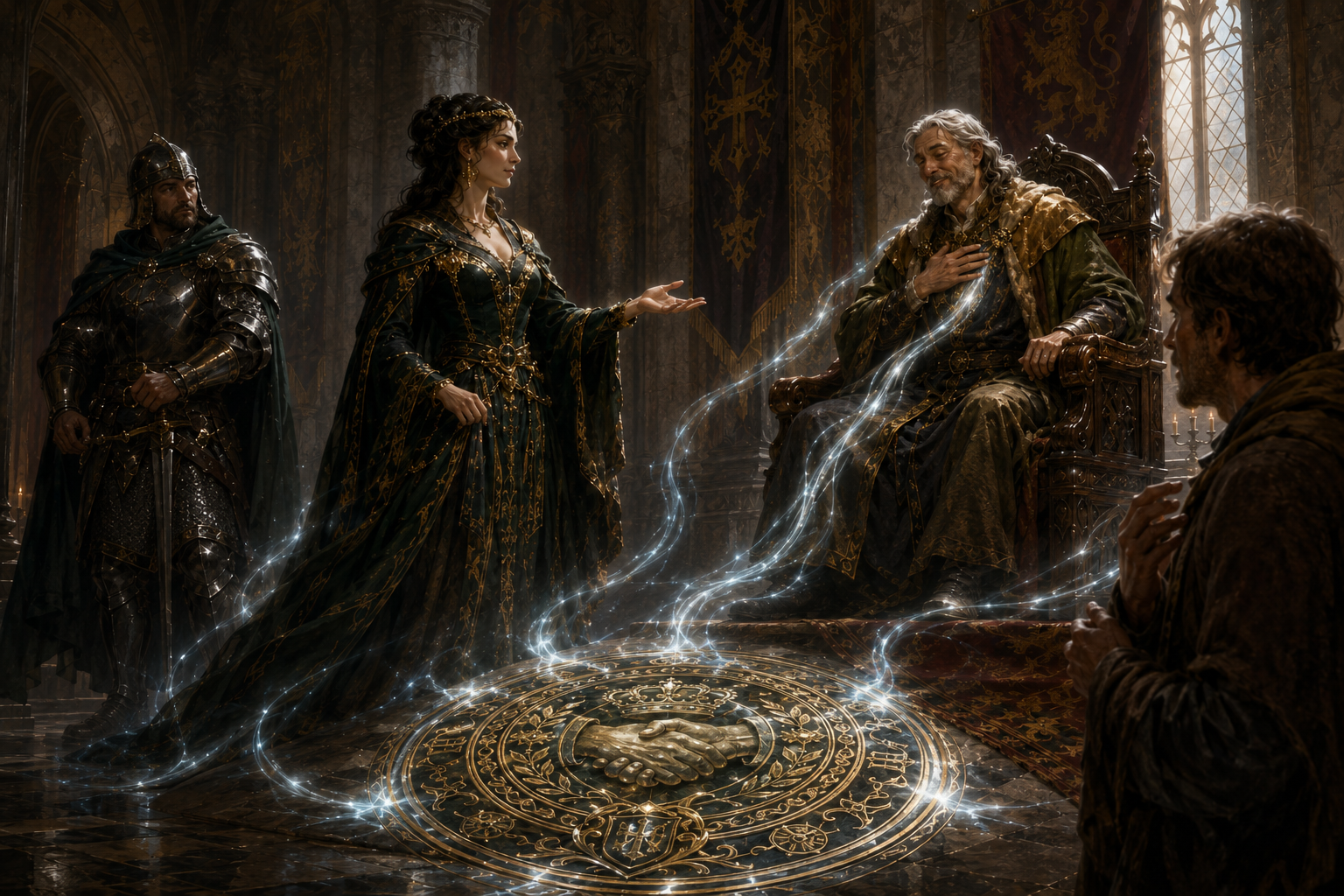
This is a legacy spell. The published Pathfinder and 3.5 mechanics appear below; fifth-edition characters use their own edition’s spell list.
Symbol of Persuasion at a Glance
| Pathfinder 1e | Level 6 |
|---|---|
| D&D 3.5e | Level 6 |
| Browse | Cleric spells • Cleric class |
Spell Rules
Symbol of Persuasion — Pathfinder 1e
Cleric spell level 6. Edition source.
| School | enchantment (charm) [mind-affecting] |
|---|---|
| Level | cleric 6, sorcerer/wizard 6 |
| Casting Time | 10 minutes |
| Components | V, S, M (mercury and phosphorus, plus powdered diamond and opal worth a total of 5,000 gp) |
| Range | 0 ft.; see text |
| Effect | one symbol |
| Duration | see text |
| Saving Throw | Will negates |
| Spell Resistance | yes |
Base Procedure
This spell allows you to scribe a potent rune of power upon a surface. When triggered, a symbol of death kills one or more creatures within 60 feet of the symbol (treat as a burst) whose combined total current hit points do not exceed 150. The symbol of death affects the closest creatures first, skipping creatures with too many hit points to affect. Once triggered, the symbol becomes active and glows, lasting for 10 minutes per caster level or until it has affected 150 hit points’ worth of creatures, whichever comes first. A creature that enters the area while the symbol of death is active is subject to its effect, whether or not that creature was in the area when it was triggered. A creature need save against the symbol only once as long as it remains within the area, though if it leaves the area and returns while the symbol is still active, it must save again.
Until it is triggered, the symbol of death is inactive (though visible and legible at a distance of 60 feet). To be effective, a symbol of death must always be placed in plain sight and in a prominent location. Covering or hiding the rune renders the symbol of death ineffective, unless a creature removes the covering, in which case the symbol of death works normally.
As a default, a symbol of death is triggered whenever a creature does one or more of the following, as you select: looks at the rune; reads the rune; touches the rune; passes over the rune; or passes through a portal bearing the rune. Regardless of the trigger method or methods chosen, a creature more than 60 feet from a symbol of death can’t trigger it (even if it meets one or more of the triggering conditions, such as reading the rune). Once the spell is cast, a symbol of death‘s triggering conditions cannot be changed.
In this case, “reading” the rune means any attempt to study it, identify it, or fathom its meaning. Throwing a cover over a symbol of death to render it inoperative triggers it if the symbol reacts to touch. You can’t use a symbol of death offensively; for instance, a touch-triggered symbol of death remains untriggered if an item bearing the symbol of death is used to touch a creature. Likewise, a symbol of death cannot be placed on a weapon and set to activate when the weapon strikes a foe.
You can also set special triggering limitations of your own. These can be as simple or elaborate as you desire. Special conditions for triggering a symbol of death can be based on a creature’s name, identity, or alignment, but otherwise must be based on observable actions or qualities. Intangibles such as level, class, HD, and hit points don’t qualify.
When scribing a symbol of death, you can specify a password or phrase that prevents a creature using it from triggering the symbol’s effect. Anyone using the password remains immune to that particular rune’s effects so long as the creature remains within 60 feet of the rune. If the creature leaves the radius and returns later, it must use the password again.
You also can attune any number of creatures to the symbol of death, but doing this can extend the casting time. Attuning one or two creatures takes negligible time, and attuning a small group (as many as 10 creatures) extends the casting time to 1 hour. Attuning a large group (as many as 25 creatures) takes 24 hours. Attuning larger groups takes an additional 24 hours per 25 creatures. Any creature attuned to a symbol of death cannot trigger it and is immune to its effects, even if within its radius when it is triggered. You are automatically considered attuned to your own symbols of death, and thus always ignore the effects and cannot inadvertently trigger them.
Read magic allows you to identify a symbol with a Spellcraft check (DC 10 + the symbol’s spell level). Of course, if the symbol is set to be triggered by reading it, this will trigger the symbol.
A symbol of death can be removed by a successful dispel magic targeted solely on the rune. An erase spell has no effect on a symbol of death. Destruction of the surface where a symbol of death is inscribed destroys the symbol but also triggers it.
Symbol of death can be made permanent with a permanency spell. A permanent symbol of death that is disabled or has affected its maximum number of hit points becomes inactive for 10 minutes, but then can be triggered again as normal.
Note: Magic traps such as symbol of death are hard to detect and disable. While any character can use Perception to find a symbol, only a character with the trapfinding class feature can use Disable Device to disarm it. The DC in each case is 25 + spell level, or 33 for symbol of death.
Changes and Additional Effects
Changes for this spell: all creatures within the radius of a symbol of persuasion instead become charmed by the caster (as the charm monster spell) for 1 hour per caster level.
Unlike symbol of death, symbol of persuasion has no hit point limit; once triggered, a symbol of persuasion simply remains active for 10 minutes per caster level.
Note: Magic traps such as symbol of persuasion are hard to detect and disable. While any character can use Perception to find a symbol, only a character with the trapfinding class feature can use Disable Device to disarm it. The DC in each case is 25 + spell level, or 31 for symbol of persuasion.
Symbol of Persuasion — D&D 3.5e
Cleric spell level 6. Edition source.
| School | Enchantment (Charm) [Mind-Affecting] |
|---|---|
| Level | Clr 6, Sor/Wiz 6 |
| Components | V, S, M |
| Casting Time | 10 minutes |
| Range | 0 ft.; see text |
| Effect | One symbol |
| Duration | See text |
| Saving Throw | Will negates |
| Spell Resistance | Yes |
Base Procedure
This spell allows you to scribe a potent rune of power upon a surface. When triggered, a symbol of death slays one or more creatures within 60 feet of the symbol (treat as a burst) whose combined total current hit points do not exceed 150. The symbol of death affects the closest creatures first, skipping creatures with too many hit points to affect. Once triggered, the symbol becomes active and glows, lasting for 10 minutes per caster level or until it has affected 150 hit points’ worth of creatures, whichever comes first. Any creature that enters the area while the symbol of death is active is subject to its effect, whether or not that creature was in the area when it was triggered. A creature need save against the symbol only once as long as it remains within the area, though if it leaves the area and returns while the symbol is still active, it must save again.
Until it is triggered, the symbol of death is inactive (though visible and legible at a distance of 60 feet). To be effective, a symbol of death must always be placed in plain sight and in a prominent location. Covering or hiding the rune renders the symbol of death ineffective, unless a creature removes the covering, in which case the symbol of death works normally.
As a default, a symbol of death is triggered whenever a creature does one or more of the following, as you select: looks at the rune; reads the rune; touches the rune; passes over the rune; or passes through a portal bearing the rune. Regardless of the trigger method or methods chosen, a creature more than 60 feet from a symbol of death can’t trigger it (even if it meets one or more of the triggering conditions, such as reading the rune). Once the spell is cast, a symbol of death’s triggering conditions cannot be changed.
In this case, “reading” the rune means any attempt to study it, identify it, or fathom its meaning. Throwing a cover over a symbol of death to render it inoperative triggers it if the symbol reacts to touch. You can’t use a symbol of death offensively; for instance, a touch-triggered symbol of death remains untriggered if an item bearing the symbol of death is used to touch a creature. Likewise, a symbol of death cannot be placed on a weapon and set to activate when the weapon strikes a foe.
You can also set special triggering limitations of your own. These can be as simple or elaborate as you desire. Special conditions for triggering a symbol of death can be based on a creature’s name, identity, or alignment, but otherwise must be based on observable actions or qualities. Intangibles such as level, class, Hit Dice, and hit points don’t qualify.
When scribing a symbol of death, you can specify a password or phrase that prevents a creature using it from triggering the effect. Anyone using the password remains immune to that particular rune’s effects so long as the creature remains within 60 feet of the rune. If the creature leaves the radius and returns later, it must use the password again.
You also can attune any number of creatures to the symbol of death, but doing this can extend the casting time. Attuning one or two creatures takes negligible time, and attuning a small group (as many as ten creatures) extends the casting time to 1 hour. Attuning a large group (as many as twenty-five creatures) takes 24 hours. Attuning larger groups takes proportionately longer. Any creature attuned to a symbol of death cannot trigger it and is immune to its effects, even if within its radius when triggered. You are automatically considered attuned to your own symbols of death, and thus always ignore the effects and cannot inadvertently trigger them.
Read magic allows you to identify a symbol of death with a DC 19 Spellcraft check. Of course, if the symbol of death is set to be triggered by reading it, this will trigger the symbol.
A symbol of death can be removed by a successful dispel magic targeted solely on the rune. An erase spell has no effect on a symbol of death. Destruction of the surface where a symbol of death is inscribed destroys the symbol but also triggers it.
Symbol of death can be made permanent with a permanency spell. A permanent symbol of death that is disabled or that has affected its maximum number of hit points becomes inactive for 10 minutes, then can be triggered again as normal.
Note: Magic traps such as symbol of death are hard to detect and disable. A rogue (only) can use the Search skill to find a symbol of death and Disable Device to thwart it. The DC in each case is 25 + spell level, or 33 for symbol of death.
Material Component: Mercury and phosphorus, plus powdered diamond and opal with a total value of at least 5,000 gp each.
Changes and Additional Effects
Changes for this spell: all creatures within the radius of a symbol of persuasion instead become charmed by the caster (as the charm monster spell) for 1 hour per caster level.
Unlike symbol of death, symbol of persuasion has no hit point limit; once triggered, a symbol of persuasion simply remains active for 10 minutes per caster level.
Note: Magic traps such as symbol of persuasion are hard to detect and disable. A rogue (only) can use the Search skill to find a symbol of persuasion and Disable Device to thwart it. The DC in each case is 25 + spell level, or 31 for symbol of persuasion.
Material Component: Mercury and phosphorus, plus powdered diamond and opal with a total value of at least 5,000 gp.
Why Symbol of Persuasion Is Dangerous in the World
Symbol of Persuasion is dangerous because it attacks public reality.
It does not merely protect a door. It changes who is believed, who is admitted, who is forgiven, who is obeyed, and who is treated as reasonable. A lethal ward leaves bodies and accusations. A persuasion ward leaves witnesses who may defend the person who trapped them.
A lord may set the symbol beneath an audience carpet so angry petitioners leave convinced he listened fairly. A temple may inscribe it before a forbidden reliquary so intruders become apologetic helpers. A wizard may hide it on a laboratory door so thieves return stolen evidence to him. A prince may place it behind a throne and let assassins become temporary defenders.
The spell’s power is limited, but those limits do not make it safe. A charmed creature keeps its memories, instincts, and loyalties, yet for the duration the caster is treated as trusted. In law, politics, espionage, war, inheritance, and temple authority, that can be enough.
Historical, Alchemical, and Mythic Context
Symbol of Persuasion is best understood as a magical fusion of three old powers: the persuasive word, the authoritative seal, and the written charm. It is not merely a ward that happens to charm people. It is a sign that argues without speaking. The creature who sees it is pushed toward a conclusion: this person is trustworthy, this request is reasonable, this authority has already been proven.
That makes the spell closer to rhetoric than brute mind control. Rhetoric shapes belief, judgement, and response in an audience. A Symbol of Persuasion turns that art into a trap. It removes the speech, the debate, and the visible speaker, leaving only the persuasive result. The victim does not feel conquered. They feel convinced.
The spell also belongs to the tradition of charms: words, signs, inscriptions, or ritual utterances believed to carry magical power. A spoken charm vanishes into the air; an inscribed charm waits. This symbol waits at the moment trust is most vulnerable, especially at thresholds of decision such as court seals, treaty chests, witness benches, prison gates, reliquary doors, throne canopies, embassy walls, and council floors.
Seals and signet marks give the spell its social edge. A seal persuades by recognised authority: it tells the viewer that a document, order, charter, judgement, treaty, or grant should be accepted because the proper power stands behind it. A Symbol of Persuasion corrupts that logic. It becomes a false seal of consent, not proof that authority is legitimate, but magic that makes legitimacy feel obvious.
The alchemical materials sharpen that identity. Mercury suggests changeable thought, reflection, fluid judgement, and dangerous brilliance. Phosphorus suggests hidden light and sudden ignition, the instant when a thought catches. Diamond and opal add splendour, refraction, wealth, and official beauty. Together, the components make the symbol feel like persuasive luxury: a glittering authority that bends the mind by making false trust appear refined, lawful, and inevitable.
In a late medieval fantasy world, this is why the spell is frightening. Charters, seals, oaths, heraldry, relic marks, guild signs, and court emblems help decide inheritance, testimony, safe-conduct, trade, sanctuary, and legitimacy. A spell that corrupts such a sign does not merely charm a few people in a room. It attacks the machinery by which society decides who should be believed.
For real-world reference on the ideas behind this spell, see Encyclopaedia Britannica on rhetoric as persuasive action, charms as magical expressions and written spell forms, sigillography and seals as marks of authentication, medieval European seals, mercury, phosphorus, alchemy, diamond, and opal.
Rules Sources and Licensing
The Pathfinder and 3.5 spell mechanics and their tables are Open Game Content under the Open Game License v1.0a. Artwork and original setting prose are excluded from that designation.
Open Game License v1.0a and copyright notices
Permission to copy, modify and distribute the files collectively known as the System Reference Document (“SRD”) is granted solely through the use of the Open Gaming License, Version 1.0a.
This material is being released using the Open Gaming License Version 1.0a and you should read and understand the terms of that license before using this material.
The text of the Open Gaming License itself is not Open Game Content. Instructions on using the License are provided within the License itself.
The following items are designated Product Identity, as defined in Section 1(e) of the Open Game License Version 1.0a, and are subject to the conditions set forth in Section 7 of the OGL, and are not Open Content: Dungeons & Dragons, D&D, Player’s Handbook, Dungeon Master, Monster Manual, d20 System, Wizards of the Coast, d20 (when used as a trademark), Forgotten Realms, Faerûn, proper names (including those used in the names of spells or items), places, Red Wizard of Thay, the City of Union, Heroic Domains of Ysgard, Ever-Changing Chaos of Limbo, Windswept Depths of Pandemonium, Infinite Layers of the Abyss, Tarterian Depths of Carceri, Gray Waste of Hades, Bleak Eternity of Gehenna, Nine Hells of Baator, Infernal Battlefield of Acheron, Clockwork Nirvana of Mechanus, Peaceable Kingdoms of Arcadia, Seven Mounting Heavens of Celestia, Twin Paradises of Bytopia, Blessed Fields of Elysium, Wilderness of the Beastlands, Olympian Glades of Arborea, Concordant Domain of the Outlands, Sigil, Lady of Pain, Book of Exalted Deeds, Book of Vile Darkness, beholder, gauth, carrion crawler, tanar’ri, baatezu, displacer beast, githyanki, githzerai, mind flayer, illithid, umber hulk, yuan-ti.
All of the rest of the SRD is Open Game Content as described in Section 1(d) of the License.
More information on the Open Game License can be found at www.wizards.com/d20.
The terms of the Open Gaming License Version 1.0a are as follows:
OPEN GAME LICENSE Version 1.0a
The following text is the property of Wizards of the Coast, Inc. and is Copyright 2000 Wizards of the Coast, Inc (“Wizards”). All Rights Reserved.
1. Definitions: (a)”Contributors” means the copyright and/or trademark owners who have contributed Open Game Content; (b)”Derivative Material” means copyrighted material including derivative works and translations (including into other computer languages), potation, modification, correction, addition, extension, upgrade, improvement, compilation, abridgment or other form in which an existing work may be recast, transformed or adapted; (c) “Distribute” means to reproduce, license, rent, lease, sell, broadcast, publicly display, transmit or otherwise distribute; (d)”Open Game Content” means the game mechanic and includes the methods, procedures, processes and routines to the extent such content does not embody the Product Identity and is an enhancement over the prior art and any additional content clearly identified as Open Game Content by the Contributor, and means any work covered by this License, including translations and derivative works under copyright law, but specifically excludes Product Identity. (e) “Product Identity” means product and product line names, logos and identifying marks including trade dress; artifacts; creatures characters; stories, storylines, plots, thematic elements, dialogue, incidents, language, artwork, symbols, designs, depictions, likenesses, formats, poses, concepts, themes and graphic, photographic and other visual or audio representations; names and descriptions of characters, spells, enchantments, personalities, teams, personas, likenesses and special abilities; places, locations, environments, creatures, equipment, magical or supernatural abilities or effects, logos, symbols, or graphic designs; and any other trademark or registered trademark clearly identified as Product identity by the owner of the Product Identity, and which specifically excludes the Open Game Content; (f) “Trademark” means the logos, names, mark, sign, motto, designs that are used by a Contributor to identify itself or its products or the associated products contributed to the Open Game License by the Contributor (g) “Use”, “Used” or “Using” means to use, Distribute, copy, edit, format, modify, translate and otherwise create Derivative Material of Open Game Content. (h) “You” or “Your” means the licensee in terms of this agreement.
2. The License: This License applies to any Open Game Content that contains a notice indicating that the Open Game Content may only be Used under and in terms of this License. You must affix such a notice to any Open Game Content that you Use. No terms may be added to or subtracted from this License except as described by the License itself. No other terms or conditions may be applied to any Open Game Content distributed using this License.
3.Offer and Acceptance: By Using the Open Game Content You indicate Your acceptance of the terms of this License.
4. Grant and Consideration: In consideration for agreeing to use this License, the Contributors grant You a perpetual, worldwide, royalty-free, non-exclusive license with the exact terms of this License to Use, the Open Game Content.
5.Representation of Authority to Contribute: If You are contributing original material as Open Game Content, You represent that Your Contributions are Your original creation and/or You have sufficient rights to grant the rights conveyed by this License.
6.Notice of License Copyright: You must update the COPYRIGHT NOTICE portion of this License to include the exact text of the COPYRIGHT NOTICE of any Open Game Content You are copying, modifying or distributing, and You must add the title, the copyright date, and the copyright holder’s name to the COPYRIGHT NOTICE of any original Open Game Content you Distribute.
7. Use of Product Identity: You agree not to Use any Product Identity, including as an indication as to compatibility, except as expressly licensed in another, independent Agreement with the owner of each element of that Product Identity. You agree not to indicate compatibility or co-adaptability with any Trademark or Registered Trademark in conjunction with a work containing Open Game Content except as expressly licensed in another, independent Agreement with the owner of such Trademark or Registered Trademark. The use of any Product Identity in Open Game Content does not constitute a challenge to the ownership of that Product Identity. The owner of any Product Identity used in Open Game Content shall retain all rights, title and interest in and to that Product Identity.
8. Identification: If you distribute Open Game Content You must clearly indicate which portions of the work that you are distributing are Open Game Content.
9. Updating the License: Wizards or its designated Agents may publish updated versions of this License. You may use any authorized version of this License to copy, modify and distribute any Open Game Content originally distributed under any version of this License.
10. Copy of this License: You MUST include a copy of this License with every copy of the Open Game Content You Distribute.
11. Use of Contributor Credits: You may not market or advertise the Open Game Content using the name of any Contributor unless You have written permission from the Contributor to do so.
12. Inability to Comply: If it is impossible for You to comply with any of the terms of this License with respect to some or all of the Open Game Content due to statute, judicial order, or governmental regulation then You may not Use any Open Game Material so affected.
13. Termination: This License will terminate automatically if You fail to comply with all terms herein and fail to cure such breach within 30 days of becoming aware of the breach. All sublicenses shall survive the termination of this License.
14. Reformation: If any provision of this License is held to be unenforceable, such provision shall be reformed only to the extent necessary to make it enforceable.
15. COPYRIGHT NOTICE
Open Game License v 1.0a Copyright 2000, Wizards of the Coast, Inc.
System Reference Document Copyright 2000-2003, Wizards of the Coast, Inc.; Authors Jonathan Tweet, Monte Cook, Skip Williams, Rich Baker, Andy Collins, David Noonan, Rich Redman, Bruce R. Cordell, John D. Rateliff, Thomas Reid, James Wyatt, based on original material by E. Gary Gygax and Dave Arneson.
Pathfinder Roleplaying Game Core Rulebook. © 2009, Paizo Publishing, LLC; Author: Jason Bulmahn, based on material by Jonathan Tweet, Monte Cook, and Skip Williams. END OF LICENSE
Keep this reference growing
If this page helped with your reading or game, you can support its upkeep or explore the curated books.
Explore the Bookshop — epics, classics and stories behind imagined worlds.