
Berbalang — The Grave-Hunter’s Wandering Spirit
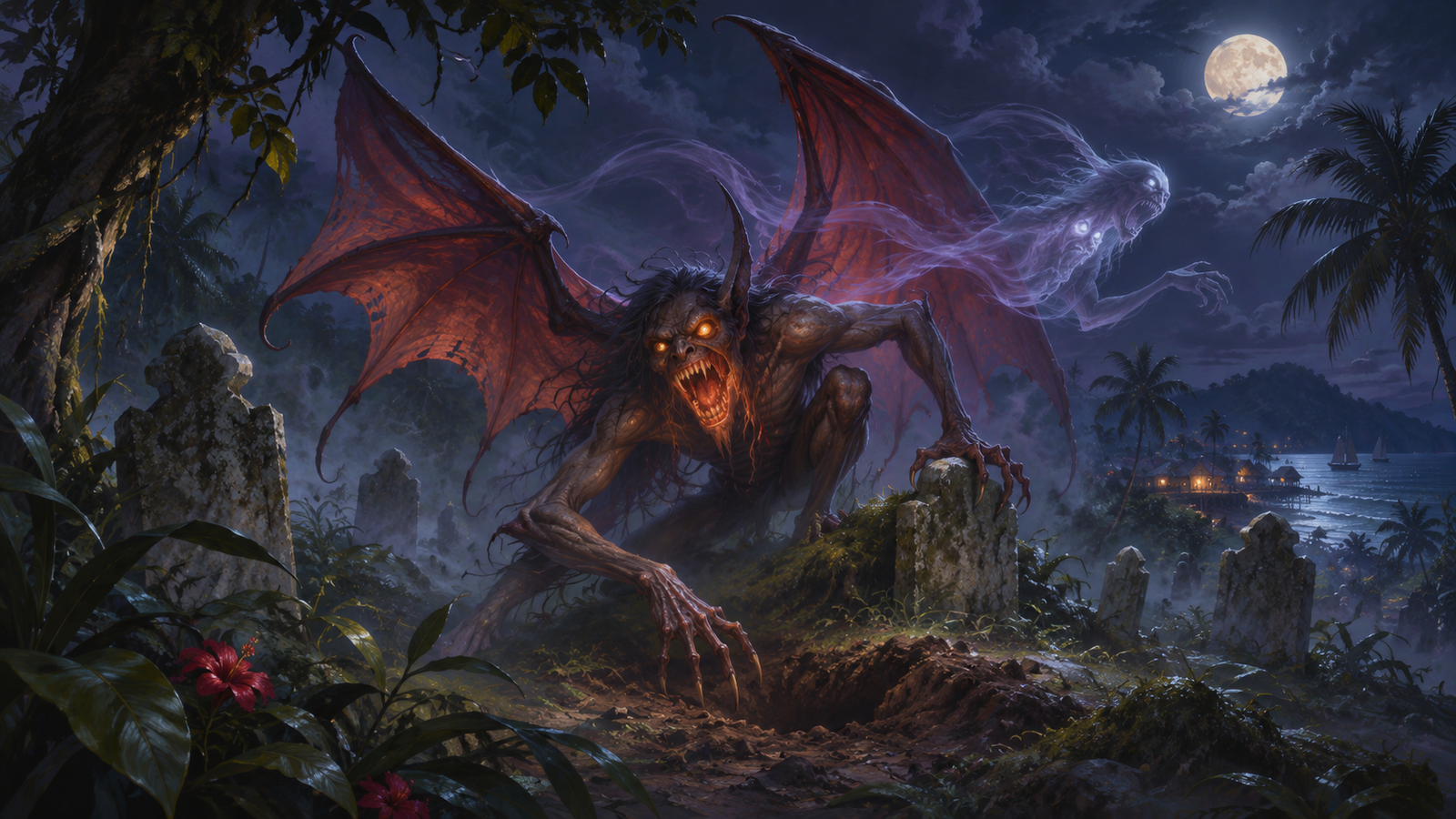
On the third night after the burial, the family hears wings above the rafters. The grave lies untouched, but something is eating the offerings inside the house. Far beyond the village, hidden among the grass, a gaunt creature lies perfectly still. Its eyes never close while its spirit hunts.
Berbalangs are carrion-hunting nocturnal terrors of the southern island seas. Their bodies are slight, their limbs long and clawed, and the spirits they send forth can pass where a physical creature cannot. A berbalang usually attacks a lonely watcher or plunders an unguarded tomb rather than challenge a whole settlement. Villagers may know only the faint moan that grows quieter as the thing draws close. It is not a harmless ghost, nor is it wise to assume that every corpse-eating creature is a revenant: the berbalang’s nature depends on the manifestation encountered.
At a Glance
| Creature | Berbalang — a corpse-hunter whose roaming spirit leaves its body behind |
|---|---|
| Disposition | Secretive, predatory and reluctant to expose its physical body |
| Appearance | Gaunt, bright-eyed, clawed, often winged; the projection may seem nearly weightless |
| Haunts | Hidden scrubland, island grave roads, abandoned gardens and isolated burial houses |
| First signs | An oddly fading moan, food disturbed in a sealed room, a watcher seeing the same eyes in two places |
| Principal danger | Paralysing attacks or a spirit projection while the vulnerable body hides elsewhere |
| Counterplay | Trace the spirit to its sleeping body, protect a grave, and force the creature to defend itself physically |
Berbalang Statistics
Berbalang — D&D 2024
Medium Aberration, Neutral Evil · CR 3 (700 XP; PB +2) · Original conversion
AC 15 (tough hide); Initiative +3 (13); HP 67 (9d8+27); Speed 30 ft., Fly 40 ft.
| STR | DEX | CON | INT | WIS | CHA |
|---|---|---|---|---|---|
| 13 (+1) | 16 (+3) | 16 (+3) | 14 (+2) | 14 (+2) | 12 (+1) |
Saving Throws Dex +5, Int +4; Skills Perception +4, Stealth +5, Arcana +4; Senses Darkvision 60 ft., Passive Perception 14; Languages Common and one language learned from the dead; Damage Resistances Psychic.
Traits
Grave-Reader. The berbalang has Advantage on Intelligence checks made to recognise funerary customs, burial rites and the identities of the dead from grave goods.
Actions
Multiattack. The berbalang makes two Claw attacks. While projected, it cannot use this action.
Claw. Melee Attack Roll +5, reach 5 ft., one target. Hit: 8 (1d10+3) Slashing damage. Once on its turn, it can deal an extra 5 (1d10) Psychic damage to a creature it hits with this attack.
Psychic Touch (Projected Form Only). Melee Attack Roll +5, reach 5 ft., one creature. Hit: 13 (3d6+3) Psychic damage. The target makes a DC 13 Wisdom Saving Throw or has the Frightened condition until the end of its next turn.
Bonus Actions
Leave the Body (1/Day). The berbalang sends out one spectral projection in an unoccupied space within 5 ft. for up to 10 minutes. Its physical body has the Unconscious condition until the projection ends. The projection has the berbalang’s AC, Initiative, HP and saving throws, can Fly 40 ft. (hover), and can move through creatures and objects as Difficult Terrain (taking 5 (1d10) Force damage if it ends its turn inside a solid object). It cannot travel more than 300 ft. from its body, and uses Psychic Touch instead of Claw. The body and projection are one creature with a single shared pool of Hit Points and one action, Bonus Action and Reaction per round. Damage to either reduces that pool; damage to the body also ends the projection immediately. The berbalang may end the projection as a Bonus Action; when it ends, it returns to its body with its remaining HP. If its body dies, the projection dies too. This is not a second combatant.
Original adaptation using D&D 2024 conventions; a distinct aberration, not the published Pathfinder undead creature or a reproduction of a proprietary D&D stat block.
Berbalang — D&D 2014
Medium aberration, neutral evil · Challenge 3 (700 XP) · Original conversion
Armor Class 15 (natural armor); Hit Points 67 (9d8+27); Speed 30 ft., fly 40 ft.
| STR | DEX | CON | INT | WIS | CHA |
|---|---|---|---|---|---|
| 13 (+1) | 16 (+3) | 16 (+3) | 14 (+2) | 14 (+2) | 12 (+1) |
Saving Throws Dexterity +5, Intelligence +4; Skills Arcana +4, Perception +4, Stealth +5; Damage Resistance psychic; Senses darkvision 60 ft., passive Perception 14; Languages Common and one other language from its observations of funerals.
Traits
Grave-Reader. The berbalang has advantage on Intelligence checks to identify the dead from graves, funerary objects and burial rites.
Actions
Multiattack. The berbalang makes two claw attacks in its body; it cannot make this multiattack while projected.
Claw. Melee Weapon Attack: +5 to hit, reach 5 ft., one target. Hit: 8 (1d10+3) slashing damage; on one hit each turn it can deal 5 (1d10) additional psychic damage.
Psychic Touch (Projected Form Only). Melee Spell Attack: +5 to hit, reach 5 ft., one creature. Hit: 13 (3d6+3) psychic damage. The target must succeed on a DC 13 Wisdom saving throw or be frightened until the end of its next turn.
Bonus Actions
Leave the Body (1/Day). The berbalang projects one spectral shape in an unoccupied space within 5 ft. for up to 10 minutes. Its body is unconscious for the duration. The projection has its own appearance, can fly 40 ft. (hover), and can move through creatures and objects as difficult terrain, suffering 5 (1d10) force damage at the end of a turn inside a solid object. The projection cannot move more than 300 ft. from its body. Both forms share the same AC 15, current hit points, saves, turn and actions: they are not two separate combatants. Damage to either applies to the same hit-point total; damage to the body immediately recalls the projection. The berbalang can recall it as a bonus action. It dies if its physical body dies.
Original D&D 2014-compatible conversion, not the proprietary official Berbalang entry. Creature type and abilities are independent of Pathfinder’s published undead creature.
Berbalang — Pathfinder 1e
CE Medium Undead · CR 6 (XP 2,400) · Pathfinder RPG Bestiary 3
Init +4; Senses Darkvision 60 ft., Perception +14; AC 20, touch 15, flat-footed 15 (+4 Dex, +1 Dodge, +5 natural); HP 68 (8d8+32); Fort +6, Ref +6, Will +9; Defensive Abilities Projection; DR 10/good or silver; Immune Undead traits.
Speed 40 ft., Fly 60 ft. (good); Melee Bite +9 (1d6+3 plus paralysis), 2 Claws +9 (1d6+3 plus paralysis); Space/Reach 5 ft./5 ft.; Special Attacks Paralysis 1d4+1 rounds (DC 18).
| STR | DEX | CON | INT | WIS | CHA |
|---|---|---|---|---|---|
| 17 (+3) | 19 (+4) | — | 13 (+1) | 16 (+3) | 18 (+4) |
BAB +6; CMB +9; CMD 26; Feats Defensive Combat Training, Dodge, Flyby Attack, Mobility; Skills Bluff +10, Escape Artist +10, Fly +17, Knowledge (local) +5, Knowledge (religion) +6, Perception +14, Stealth +15; Languages Common; Environment any land; Organisation solitary or pack (2–8); Treasure standard.
Spell-Like Abilities
CL 9th; concentration +13. At will: Bleed, Ghost Sound (DC 14). 3/Day each: Alter Self, Charm Person (DC 15).
Special Ability
Projection (Su; 1/Day). As a Full-Round Action the berbalang divides its current HP between an unconscious physical body and a separate spirit. The spirit gains the Incorporeal subtype and travels no more than 1 mile from the body. Its spirit-form AC is 19, touch 19, flat-footed 14 (+4 Dex, +4 deflection, +1 dodge); it makes one Incorporeal Touch +10 for 1d4 Constitution damage instead of its normal natural attacks. The physical body benefits from Displacement but is helpless. Damage to that body instantly recalls the projection. The spirit can also return as a Standard Action, or returns when reduced to 0 HP. On return, add the remaining HP of both forms. Killing the physical body destroys the spirit as well. These two portions are distinct HP pools while projected, unlike the original fifth-edition conversions.
Published Pathfinder mechanics: Pathfinder Bestiary 3 — Berbalang, OGL 1.0a. The spirit’s flat-footed AC here follows the official reference document (14).
Berbalang — D&D 3.5e
CE Medium Undead · CR 6 · Original 3.5e conversion
Hit Dice 8d12 (52 hp); Initiative +4; Speed 40 ft., Fly 60 ft. (good); AC 20 (+4 Dex, +1 dodge, +5 natural), touch 15, flat-footed 15; Base Attack/Grapple +4/+7; Fort +2, Ref +6, Will +9; Space/Reach 5 ft./5 ft.; DR 10/good or silver; Immunities Undead traits.
| STR | DEX | CON | INT | WIS | CHA |
|---|---|---|---|---|---|
| 17 (+3) | 19 (+4) | — | 13 (+1) | 16 (+3) | 18 (+4) |
Attack Claw +7 melee (1d6+3 plus paralysis); Full Attack Bite +7 melee (1d6+3 plus paralysis) and 2 Claws +7 melee (1d6+3 plus paralysis). Feats Dodge, Flyby Attack, Improved Initiative; Skills Bluff +11, Hide +15, Listen +14, Move Silently +15, Spot +14; Languages Common; Organisation solitary or pack; Treasure standard.
Special Abilities
Paralysis (Su). A living creature damaged by the berbalang’s bite or claw must succeed on a DC 18 Fortitude save or be paralyzed for 1d4+1 rounds. The DC is Charisma-based.
Projection (Su; 1/Day). A Full-Round Action divides the berbalang’s current HP (round down for the body, giving the remainder to the spirit) into a helpless physical body and an Incorporeal projection. The projected form has AC 19, touch 19, flat-footed 14 and a single Incorporeal Touch +8 (1d4 Constitution damage) instead of its bite and claws. It cannot stray more than 1 mile. The physical body has the miss chance of Displacement while the spirit is absent, but is helpless. Any damage to the physical body immediately recalls the projection; damage to the spirit reduces only the spirit’s own pool until the two are reunited. The projection returns when reduced to 0 HP or on a Standard Action by the berbalang; reunification adds both remaining HP totals. Destruction of the body destroys the projection. This is an original 3.5e conversion, not a published 3.5e Berbalang.
Original D&D 3.5e build using undead and incorporeal conventions of the 3.5e SRD, under OGL 1.0a.
What Is Happening Right Now?
At a burial village on an island in the southern seas, a fishing crew has returned to find that the funeral lamp still burns but the grave offerings have vanished. A mat-weaver reports seeing slit-pupilled eyes through the shutters; the watchman insists the intruder could not have passed the locked gate. The village healer has ringed the newest graves with citrus and asks the travellers to guard a funeral until dawn. Beyond the fields lies a patch of grass flattened by a sleeping weight. The berbalang’s physical body hides there, leaving its projection free to hunt the house.
Where Berbalangs Are Found
They dwell among the islands of the Sulu Sea, especially near settlements whose graveyards can be reached without crossing a crowded harbour or defended gate. A hidden garden, a ruined watch shelter or a hollow among thick grasses is a safer resting place than a visible crypt. Ships may carry fearful accounts between the islands, but a creature does not follow a ship across an ocean merely because its sailors repeat the story.
Behaviour and Motives
A berbalang seeks food and secrets without accepting the danger of open combat. It studies a grave keeper’s hours, learns which house is unoccupied, and sends its projection when the lamps go out. If it discovers that its resting body is threatened, hunger yields to immediate self-preservation. Some use illusions or stolen voices to persuade villagers that another household committed the grave thefts.
If Violence Starts
Make the hiding place matter. The hunters can fight the wandering projection, but may be safer tracing the creature to its exposed body. A berbalang that is compelled to fight physically uses flight and cover, not a heroic stand. Tomb guardians, shifting torchlight and frightened villagers can complicate the scene without granting the creature unseen combat abilities. Preserve the distinction between a projected spirit and an independent summoned ally.
Clues, Defences and Rewards
The first clue is the fading sound of the moan: what seems distant grows quiet as the hunter approaches. The second is the absence of footprints beside a violated burial. The third is a warm hollow in grass where the body has remained hidden long enough to crush its own bedding. Local stories prescribe citrus at graves and protective charms; these may inform investigation or a prepared ward, but do not inflict automatic damage unless the chosen rules explicitly assign an effect.
Reconstructing the thefts may reveal a stolen funerary jewel, a carved bead or a ledger of tribute, rather than a chest of coins. The physical body carries any valuables; the spirit projection drops none when dispersed.
Adventure Hooks
The Funeral That Cannot End
The dead cannot be laid to rest while their offerings are repeatedly stolen. The household insists on keeping vigil all night; its chief witness is the very person who has seen the berbalang’s eyes at the window. A party that guards only the grave may miss the attack on the living.
Two Lamps on the Shore
A pair of night watchmen accuse each other of moving a beacon. Both tell the truth. One light belongs to the tower; the other is the reflection in the eyes of a creature poised to enter a fisher’s house.
The Body in the Grass
A wounded traveller collapses near a deserted field, pursued by a winged spirit. He thinks he has escaped into safety, but the body producing the apparition lies concealed only a few paces away.
Related Creatures and Places
Corpse-eating traditions are not interchangeable. The Manananggal has its own divided body, while the Jiang-shi draws breath from the living rather than sending a projection to hunt. Return to the Undead Bestiary or explore the wider Asian Mythology Bestiary.
Historical Context and Sources
Accounts associated with Cagayan Sulu, now Mapun, are repeated in later writings; one influential English-language report was published in 1896. Its descriptions cannot be assumed to document every community’s beliefs or the lives of the people who lived on the island. This creature is a fantasy rendering of the motif of a grave-feeder whose wandering spirit leaves its body behind. For the recorded narrative and its limitations, see The Aswang Project’s folklore compendium and the account’s source-history discussion. The fiction here does not claim the nineteenth-century report is contemporary evidence from the world of 1454.
Rules and licensing. The Pathfinder 1e block is from Pathfinder Roleplaying Game Bestiary 3, © 2011 Paizo Publishing, LLC, made available as Open Game Content under OGL 1.0a. The D&D 3.5e conversion is original and uses the open 3.5e system. The D&D 2024 and 2014 versions are original aberrations; they do not reproduce a proprietary Wizards of the Coast Berbalang stat block. Stat mechanics from open sources are designated Open Game Content where required; original setting narrative and site artwork remain separate.
Full Open Game License 1.0a and Section 15 notices
OPEN GAME LICENSE Version 1.0a
The following text is the property of Wizards of the Coast, Inc. and is Copyright 2000 Wizards of the Coast, Inc (“Wizards”). All Rights Reserved.
1. Definitions: (a)”Contributors” means the copyright and/or trademark owners who have contributed Open Game Content; (b)”Derivative Material” means copyrighted material including derivative works and translations (including into other computer languages), potation, modification, correction, addition, extension, upgrade, improvement, compilation, abridgment or other form in which an existing work may be recast, transformed or adapted; (c) “Distribute” means to reproduce, license, rent, lease, sell, broadcast, publicly display, transmit or otherwise distribute; (d)”Open Game Content” means the game mechanic and includes the methods, procedures, processes and routines to the extent such content does not embody the Product Identity and is an enhancement over the prior art and any additional content clearly identified as Open Game Content by the Contributor, and means any work covered by this License, including translations and derivative works under copyright law, but specifically excludes Product Identity. (e) “Product Identity” means product and product line names, logos and identifying marks including trade dress; artifacts; creatures characters; stories, storylines, plots, thematic elements, dialogue, incidents, language, artwork, symbols, designs, depictions, likenesses, formats, poses, concepts, themes and graphic, photographic and other visual or audio representations; names and descriptions of characters, spells, enchantments, personalities, teams, personas, likenesses and special abilities; places, locations, environments, creatures, equipment, magical or supernatural abilities or effects, logos, symbols, or graphic designs; and any other trademark or registered trademark clearly identified as Product identity by the owner of the Product Identity, and which specifically excludes the Open Game Content; (f) “Trademark” means the logos, names, mark, sign, motto, designs that are used by a Contributor to identify itself or its products or the associated products contributed to the Open Game License by the Contributor (g) “Use”, “Used” or “Using” means to use, Distribute, copy, edit, format, modify, translate and otherwise create Derivative Material of Open Game Content. (h) “You” or “Your” means the licensee in terms of this agreement.
2. The License: This License applies to any Open Game Content that contains a notice indicating that the Open Game Content may only be Used under and in terms of this License. You must affix such a notice to any Open Game Content that you Use. No terms may be added to or subtracted from this License except as described by the License itself. No other terms or conditions may be applied to any Open Game Content distributed using this License.
3. Offer and Acceptance: By Using the Open Game Content You indicate Your acceptance of the terms of this License.
4. Grant and Consideration: In consideration for agreeing to use this License, the Contributors grant You a perpetual, worldwide, royalty-free, non-exclusive license with the exact terms of this License to Use, the Open Game Content.
5. Representation of Authority to Contribute: If You are contributing original material as Open Game Content, You represent that Your Contributions are Your original creation and/or You have sufficient rights to grant the rights conveyed by this License.
6. Notice of License Copyright: You must update the COPYRIGHT NOTICE portion of this License to include the exact text of the COPYRIGHT NOTICE of any Open Game Content You are copying, modifying or distributing, and You must add the title, the copyright date, and the copyright holder’s name to the COPYRIGHT NOTICE of any original Open Game Content you Distribute.
7. Use of Product Identity: You agree not to Use any Product Identity, including as an indication as to compatibility, except as expressly licensed in another, independent Agreement with the owner of each element of that Product Identity. You agree not to indicate compatibility or co-adaptability with any Trademark or Registered Trademark in conjunction with a work containing Open Game Content except as expressly licensed in another, independent Agreement with the owner of such Trademark or Registered Trademark. The use of any Product Identity in Open Game Content does not constitute a challenge to the ownership of that Product Identity. The owner of any Product Identity used in Open Game Content shall retain all rights, title and interest in and to that Product Identity.
8. Identification: If you distribute Open Game Content You must clearly indicate which portions of the work that you are distributing are Open Game Content.
9. Updating the License: Wizards or its designated Agents may publish updated versions of this License. You may use any authorized version of this License to copy, modify and distribute any Open Game Content originally distributed under any version of this License.
10. Copy of this License: You MUST include a copy of this License with every copy of the Open Game Content You Distribute.
11. Use of Contributor Credits: You may not market or advertise the Open Game Content using the name of any Contributor unless You have written permission from the Contributor to do so.
12. Inability to Comply: If it is impossible for You to comply with any of the terms of this License with respect to some or all of the Open Game Content due to statute, judicial order, or governmental regulation then You may not Use any Open Game Material so affected.
13. Termination: This License will terminate automatically if You fail to comply with all terms herein and fail to cure such breach within 30 days of becoming aware of the breach. All sublicenses shall survive the termination of this License.
14. Reformation: If any provision of this License is held to be unenforceable, such provision shall be reformed only to the extent necessary to make it enforceable.
15. COPYRIGHT NOTICE
Open Game License v 1.0a Copyright 2000, Wizards of the Coast, Inc.
System Reference Document Copyright 2000–2003, Wizards of the Coast, Inc.; Authors Jonathan Tweet, Monte Cook, Skip Williams, Rich Baker, Andy Collins, David Noonan, Rich Redman, Bruce R. Cordell, John D. Rateliff, Thomas Reid and James Wyatt, based on original material by E. Gary Gygax and Dave Arneson.
Pathfinder Roleplaying Game Bestiary 3 © 2011, Paizo Publishing, LLC; Authors Jesse Benner, Jason Bulmahn, Adam Daigle, James Jacobs, Michael Kenway, Rob McCreary, Patrick Renie, Chris Sims, F. Wesley Schneider, James L. Sutter, and Russ Taylor, based on material by Jonathan Tweet, Monte Cook, and Skip Williams.
Keep this reference growing
If this page helped with your reading or game, you can support its upkeep or explore the curated books.
Explore the Bookshop — epics, classics and stories behind imagined worlds.