
 Buy me a coffee
Orthrus, the Two-Headed Hound of Geryon
The Two-Headed Hound of the Red Herd
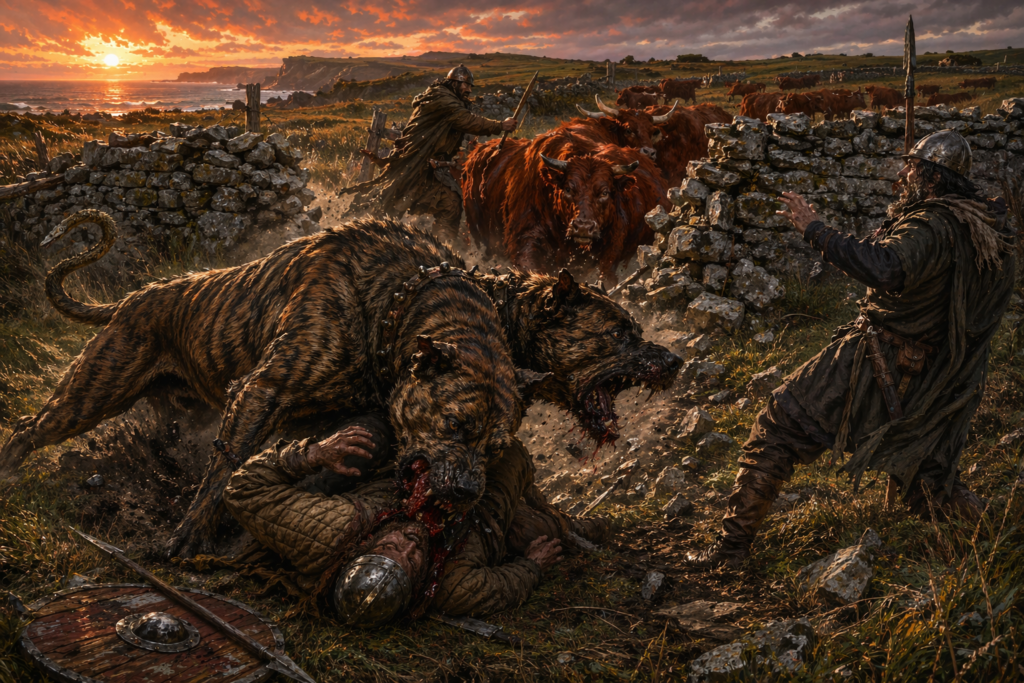
Orthrus is the watchdog of monstrous possession: the beast set over stolen cattle, forbidden pasture, and wealth defended by force alone. He is not merely a two-headed dog, nor a generic magical hound to be scattered through a bestiary as a reusable type. He is the named guardian of Geryon’s red herd, bound to Erytheia and to the open grazing lands where his master’s wealth stands beneath sun, wind, and blood-red evening light. Where the herd is kept, Orthrus is the first answer to trespass.
He belongs to an older, harsher order of danger than wandering predators and dungeon beasts. Orthrus does not lurk. He is stationed. He has a master, a charge, and a place. He exists to make approach costly. He is not just another fight before the master. He is the living boundary around the thing the adventure is truly about: the herd, the theft, the prize, the act of taking back what a monster-lord claims as his own.
Orthrus should feel like a real hound magnified into something ancient and terrible, not a decorative chimera. His terror lies in certainty. He knows what belongs within his master’s enclosure and what does not. Once he marks intruders as thieves, raiders, or interlopers, he answers with the full violence of a guardian whose purpose is absolute.
Overview
Orthrus is a colossal two-headed hound of monstrous lineage, bred or begotten for vigilance, pursuit, and slaughter in the defense of his master’s wealth. In the old stories he guards the red cattle of Geryon at the edge of the western sea, and that role remains central to his identity. He is not simply associated with cattle by flavour. He is defined by the guarding of them.
That makes Orthrus especially strong in adventures of theft, recovery, raiding, heroic labour, giant lords, and contested pasture. He is the beast that turns “take the herd” from a practical task into a feat worth remembering. Once Orthrus is present, it is clear at once that this is no common stockyard or shepherd’s field. Something of great value is being defended here, and defended by more than walls or herdsmen.
Unlike Cerberus, whose place is below, Orthrus belongs to the outer world: open pasture, salt wind, low stone enclosures, and the guarded approaches to Geryon’s herd. He is not the terror of the dead gate. He is the terror that comes running across open ground when you touch what belongs to his master.
Appearance
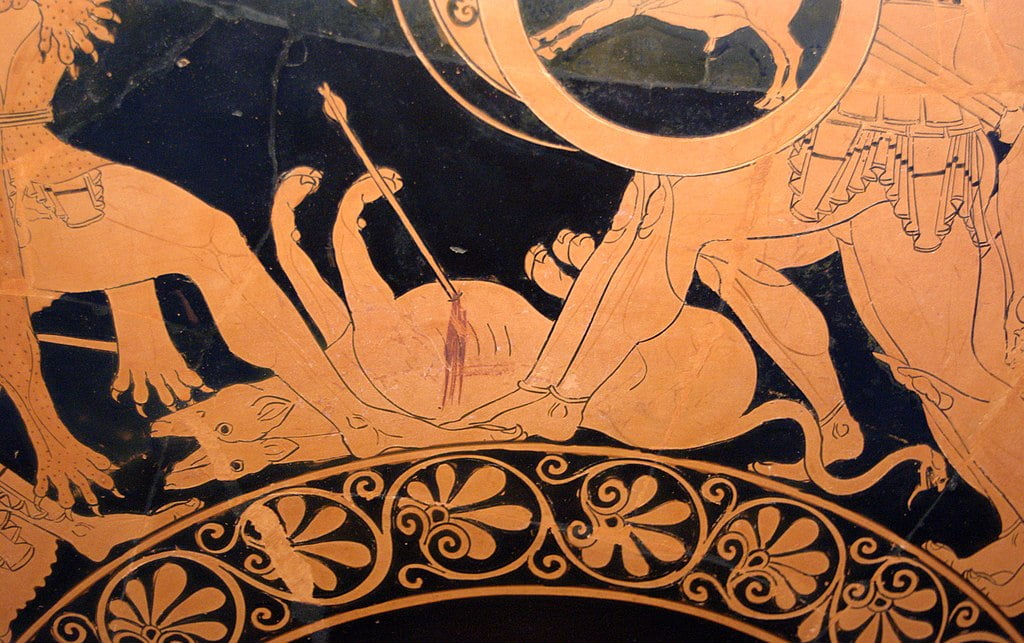
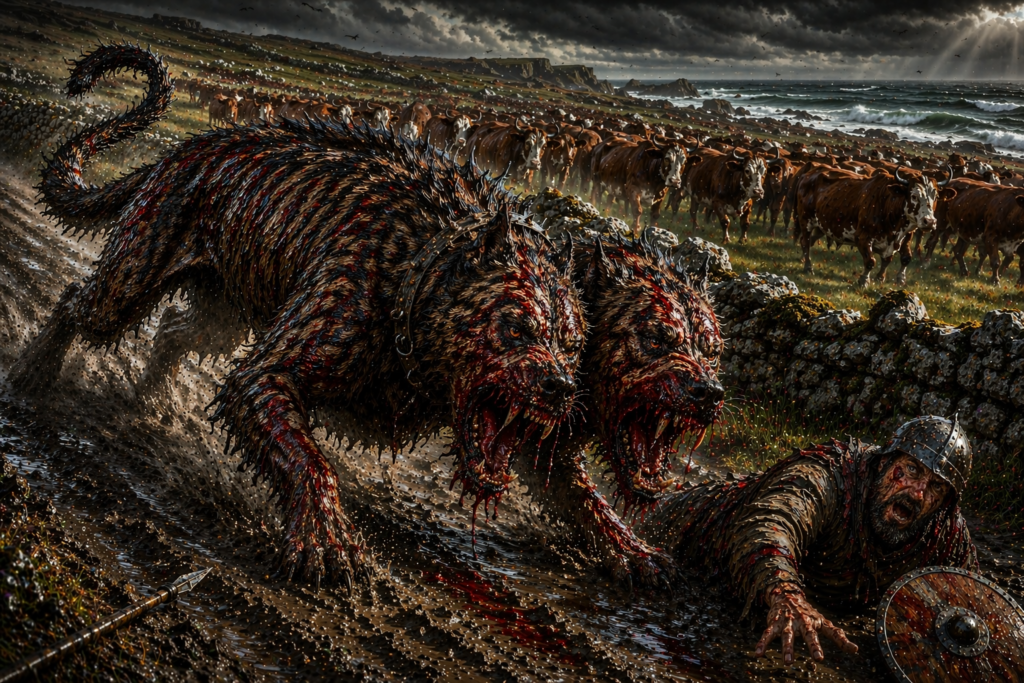
Orthrus resembles an enormous war-hound or mastiff bred past all natural proportion into something older and more brutal. His chest is deep, his shoulders massive, and his forequarters heavy with the kind of muscle meant for sudden charges and crushing impacts. He is not sleek like a coursing hound. He is built to close, seize, drag down, and hold.
From a single broad body rise two thick necks, each ending in a great predatory head. The heads should not feel symmetrical in a neat heraldic way. One may be more scarred, broader in the jaw, and quicker to snarl; the other leaner, sharper-eyed, and more watchful. Together they create the sense not of a novelty, but of doubled function. Orthrus can watch and scent at once, seize one target while tracking another, or remain fixed on the herd even while rending an intruder.
His coat should feel sun-beaten, coarse, and real: dusty red, brindled brown, ash-black, or tawny with dark markings, depending on the version you wish to emphasize. Blood, burs, salt, dry mud, and old scars suit him well. He should not look polished, infernal, or overly magical. Orthrus is strongest visually when he feels like a true hound of the outer grazing lands, only made vast and terrible.
Some traditions connect him to a more serpentine monstrous bloodline, and details such as a serpent tail may be used if desired, but this should remain secondary. The essential image is the two-headed guardian hound.
Habitat
Orthrus keeps to Erytheia, the island pasture where Geryon’s red cattle are guarded at the far western edge of the world. He belongs to the grazing lands, cattle enclosures, and open approaches around the herd itself. He is not a beast of kennel, forest, or mountain. He is the guardian of a specific place, set over a specific charge, and most terrible when an intruder comes within sight or scent of the red herd.
He is most at home among low walls, rough pasture tracks, wind-bent grass, salt air, and the hard ground trodden flat by cattle. The land around him should feel exposed rather than hidden. Orthrus is not diminished by open space. It is there that he is strongest, for nothing stands between his charge, his nose, and his speed.
Behaviour
Orthrus is vigilant, disciplined, and direct. He does not waste energy on show. He watches, scents, gauges movement, and attacks with ruthless commitment once trespass is confirmed. That gives him a different feel from a merely savage beast. He is not a frenzy with teeth. He is a working guardian doing exactly what he was made or set there to do.
His two heads shape everything about the way he behaves. One often remains attentive even when the other feeds or sleeps. When patrolling, one may stay low to ground-scent while the other scans the horizon. In a confrontation, one head may fasten onto the nearest target while the other tracks fleeing figures, mounts, or handlers moving toward the herd. This makes Orthrus feel tactically intelligent without requiring human-like thought.
He is especially dangerous around boundaries. Gates, low stone walls, cattle lanes, narrow breaks in enclosure fencing, and the open approaches to the herd all become killing ground under his watch. Orthrus is most himself when driving intruders away from a centre of value or cutting them off before they can seize or scatter the cattle.
Temperament
Orthrus is not mad, rabid, or theatrically bloodthirsty. He is grimly certain. That is worse. He knows the herd, the enclosure, the scent of handlers, and the tolerated rhythms of the place. Anything outside that order is a threat.
He should therefore be played with hard clarity. He is not curious about strangers. He is not likely to be distracted by tricks that would fool a lesser dog. He is a creature whose entire being is bent toward possession, defence, and pursuit. Once blood is drawn, he becomes relentless, but even then his violence should feel purposeful rather than chaotic.
Toward his master and any true attendants of the herd, Orthrus may show disciplined obedience. Toward everyone else, he is suspicion given muscle and teeth.
Orthrus 5.5 (unique)
Orthos 5E Statblock
Orthrus Pathfinder
Orthos
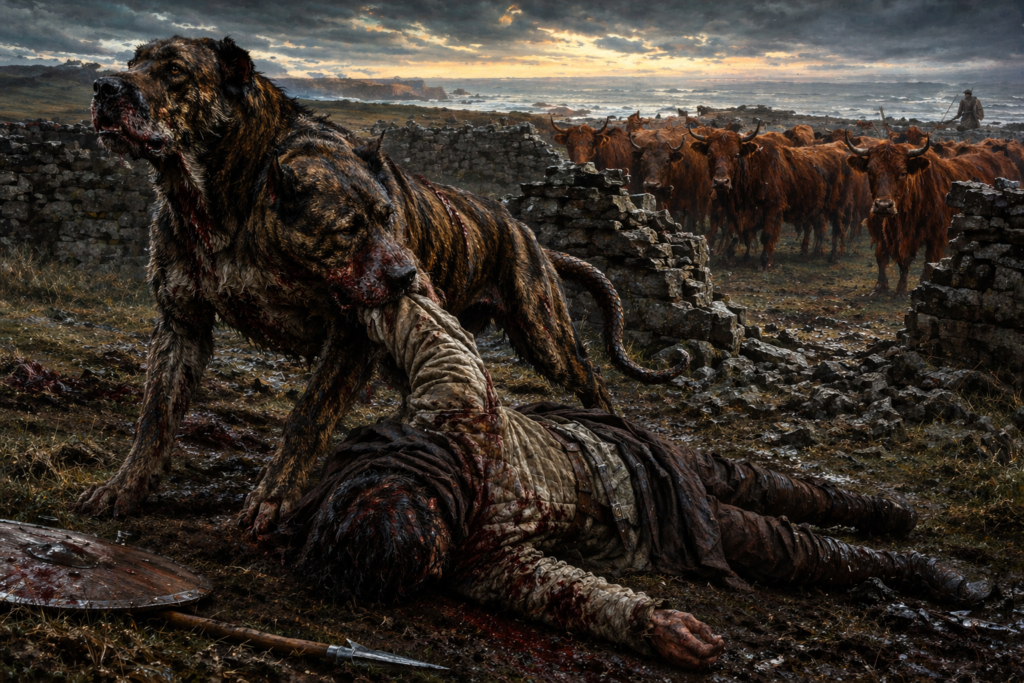
In this instance we’re going with the classic three-headed version with the two-headed canine Orthos (also known as Orthrus).
Medium monstrosity, unaligned
Armor Class 14 (natural armor)
Hit Points 30 (4d8+12)
Speed 40 ft.
| STR | DEX | CON | INT | WIS | CHA |
| 18 (+4) | 15 (+2) | 17 (+3) | 4 (–3) | 13 (+1) | 10 (+0) |
Saving Throws Dex +4, Con +5; Proficiency +2
Skills Perception +5, Stealth +4, Survival +3
Senses passive Perception 20
Languages —
Challenge 3 (700 XP)
Two Heads. Orthos has advantage on Wisdom (Perception) checks and on saving throws against being blinded, charmed, deafened, frightened, stunned, or knocked unconscious.
ACTIONS
Multiattack. Orthos attacks twice with its bite and once with its snake-tail.
Bite. Melee Weapon Attack: +6 to hit, reach 5 ft., one target. Hit: 7 (1d6+4) piercing damage plus 4 (1d8) poison damage. If the target is a creature, it must succeed on a DC 14 Strength saving throw or be knocked prone.
Snake-Tail. Melee Weapon Attack: +6 to hit, reach 5 ft., one target. Hit: 6 (1d4+4) piercing damage plus 4 (1d8) poison damage.
Orthrus
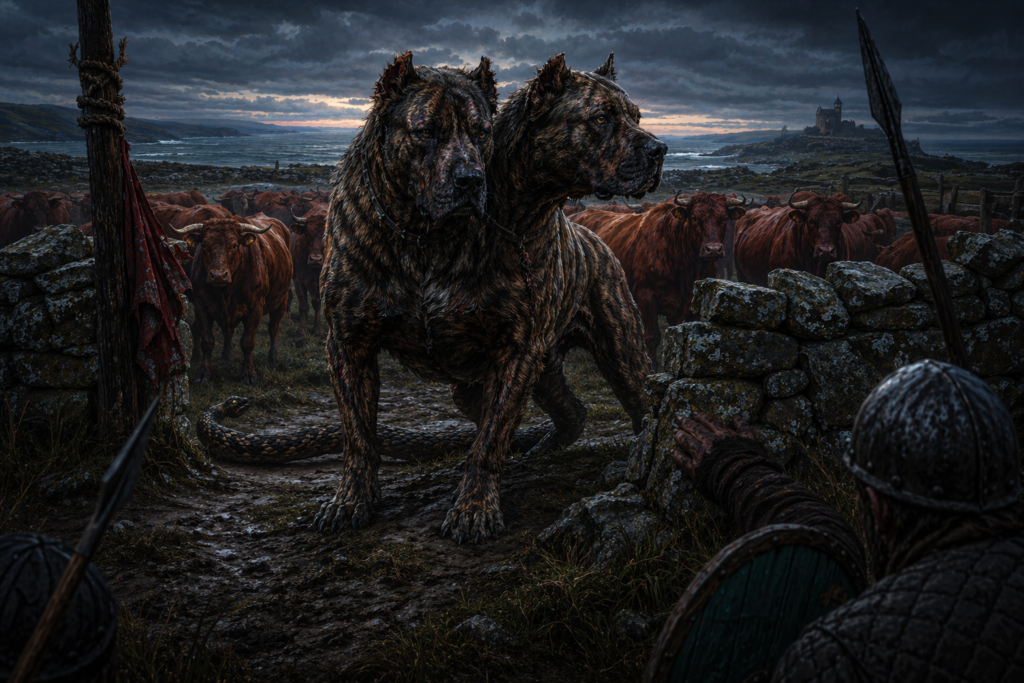
Orthrus possesses a body that resembles a two-headed hound or wolf with a draconic head sprouting from its tail. His fur is faintly reddish, and both of his mouths bristle with oversized teeth.
[This content was created for the Pathfinder rules by Paizo Publishing LLC and is part of the Pathfinder RPG product line.]
| Orthrus CR 7 |
| XP 3,200 CE Large magical beast Init +5; Senses Darkvision 60 ft., Low-Light Vision, Scent; Perception +10 |
| DEFENSE |
| AC 19, touch 10, flat-footed 18 (+1 Dexterity,+9 natural, -1 size) hp 85 (9d10+36) Fort +9, Ref +7, Will +6 |
| OFFENSE |
| Speed 30 ft., Fly 50 ft. (poor) Melee bite +12 (2d6+6), bite +12 (2d6+6) Space 10 ft.; Reach 5 ft. Special Attacks breath weapon (usable every 1d4 rounds), trip, rend (2 bites, 2d6+6), placement of its heads grants it all-around sight. |
| STATISTICS |
| Strength 19, Dexterity 12, Constitution 17, Intelligence 4, Wisdom 13, Charisma 10 Base Atk +9; CMB +14; CMD 25 (29 vs. trip) Feats Power Attack, Improved Initiative, Iron Will, Skill Focus (Perception), Toughness Skills Survival +2, Perception +10, Stealth +4 (+8 in scrubland or brush); Racial Modifiers +2 Perception, +4 Stealth in scrubland or brush Languages Draconic |
| SPECIAL ABILITIES |
| Breath Weapon (Su) A Orthrus’s breath weapon depends on the color of its dragon head, as summarized on the table below. Regardless of its type, a chimera’s breath weapon is usable once every 1d4 rounds, deals 6d8 points of damage, and allows a DC 17 Reflex save for half damage. The save DC is Constitution-based.To determine a Orthrus’s head color and breath weapon randomly, roll 1d10 and consult the table below: |
| ECOLOGY |
| Environment temperate hills Organization solitary, pair, pride (3-6), or flight (7-12) (plus Geryon and Eurytion) Treasure standard |
| d10 | Head Color | Breath Weapon |
| 1-2 | Black | 40-foot line of acid |
| 3-4 | Blue | 40-foot line of lightning |
| 5-6 | Green | 20-foot cone of acid |
| 7-8 | Red | 20-foot cone of fire |
| 9-10 | White | 20-foot cone of cold |
Orthrus
Large Monstrosity, Neutral Evil
Armor Class 18 (natural armor)
Hit Points 231 (22d10 + 110)
Speed 50 ft.
| STR | DEX | CON | INT | WIS | CHA |
|---|---|---|---|---|---|
| 24 (+7) | 16 (+3) | 21 (+5) | 8 (-1) | 17 (+3) | 14 (+2) |
Saving Throws Str +12, Dex +8, Con +10, Wis +8
Skills Athletics +12, Perception +13, Survival +8
Damage Resistances bludgeoning, piercing, and slashing from nonmagical attacks
Condition Immunities frightened
Senses darkvision 120 ft., passive Perception 23
Languages understands Giant and Common but can’t speak
Challenge 13 (10,000 XP)
Proficiency Bonus +5
Traits
Two Heads. Orthrus has advantage on Wisdom (Perception) checks and on saving throws against being blinded, charmed, deafened, frightened, stunned, or knocked unconscious.
Keen Hearing and Smell. Orthrus has advantage on Wisdom (Perception) checks that rely on hearing or smell.
Guardian of the Red Herd. Orthrus can’t be surprised while guarding Geryon, the red cattle, or a place, creature, or treasure specifically entrusted to his watch. In addition, Orthrus has advantage on attack rolls against any creature he sees attempting to drive off, injure, scatter, mount, or steal beasts or goods under his protection.
Monstrous Lineage. Orthrus has advantage on saving throws against spells and other magical effects.
Relentless Pursuit. Opportunity attacks against Orthrus are made with disadvantage while he moves toward a creature that has damaged Geryon, disturbed the herd, or taken something under Orthrus’s protection since the end of Orthrus’s last turn.
Actions
Multiattack. Orthrus makes three attacks: two with his Bite and one with his Maul or Tail.
Bite. Melee Weapon Attack: +12 to hit, reach 5 ft., one target. Hit: 18 (2d10 + 7) piercing damage. If the target is Large or smaller, it must succeed on a DC 19 Strength saving throw or fall prone.
Maul. Melee Weapon Attack: +12 to hit, reach 5 ft., one prone creature. Hit: 25 (4d8 + 7) slashing damage.
Tail. Melee Weapon Attack: +12 to hit, reach 10 ft., one target. Hit: 10 (1d6 + 7) piercing damage, and the target must succeed on a DC 16 Constitution saving throw or take 10 (3d6) poison damage.
Crushing Charge. If Orthrus moves at least 20 feet straight toward a creature and then hits it with a Bite on the same turn, the target takes an extra 13 (3d8) piercing damage and must succeed on a DC 19 Strength saving throw or be knocked prone. Orthrus can then make one Maul attack against that target as a bonus action.
Reactions
Guardian Intercept. When a creature Orthrus can see moves within 20 feet of Geryon, the herd, or anything under Orthrus’s protection, Orthrus can move up to half his speed and make one Bite attack against that creature.
Serpent Strike. When a creature Orthrus can see ends its turn within 5 feet of Orthrus, Orthrus can make one Tail attack against that creature.
Legendary Actions
Orthrus can take 2 legendary actions, choosing from the options below. Only one legendary action option can be used at a time and only at the end of another creature’s turn. Orthrus regains spent legendary actions at the start of his turn.
Watch Both Ways. Orthrus makes a Wisdom (Perception) check.
Shift the Line. Orthrus moves up to half his speed without provoking opportunity attacks.
Snap. Orthrus makes one Tail attack, or makes one Bite attack against a prone creature.
Hunting and Appetite
Orthrus feeds on slain trespassers, herd-killing predators, and beasts culled from Geryon’s stock. He knows the scent, movement, and temper of the red cattle intimately, and can tell at once the difference between a tolerated presence and a thief. Even at rest he sleeps lightly, one head wakeful while the other feeds, dozes, or gnaws old bones in the dust.
Folklore and Supernatural Nature
Orthrus is the first danger of Erytheia, the hound that must be passed before Geryon himself can be faced. Herdsmen say one head scents theft while the other keeps watch for trespass. Some speak of the serpent-tail lashing behind him as he runs the pasture, but whatever lesser details are added in the telling, one truth remains unchanged: Orthrus is Geryon’s appointed guardian, set over the red herd with absolute purpose.
Local Impact
Where Orthrus keeps watch, pasture tracks lie empty, breaches in walls are abandoned, and even hardened raiders think twice before pressing closer. Dead thieves are found torn in the grass or dragged from the edges of the enclosure. Men lower their voices when speaking of the hound that runs before the master.
Treasure
Orthrus wears no treasure, but the pasture margins, broken stone, and feeding ground near his watch often hold the remains of failed raiders and thieves. A party that defeats him and searches the ground thoroughly may recover 1,400 sp, 900 gp, 2 bloodstones (50 gp each), a gold torque worth 250 gp, a silver-inlaid spear worth 125 gp, and a potion of healing. Greater wealth lies beyond him, in Geryon’s keeping.
Using Orthrus in a Campaign
Orthrus is strongest when the encounter is about more than simply killing him. The party may need to draw him away from the herd, hold him long enough to free the cattle, reach Geryon before the hound can pin them in the open, or survive his charge without losing mounts, hirelings, or the prize itself. He should feel like the living lock on a larger objective.
Why Orthrus Works
Orthrus works because his role is immediately clear and dramatically exact. He is not merely a two-headed hound, but the guardian of stolen wealth made flesh. The moment he appears, the players know they have reached the true edge of danger.