
Fenghuang, Sovereign Bird of Auspicious Rule
Fenghuang, Sovereign Bird of Auspicious Rule
The Fenghuang does not come to save kingdoms from monsters; it comes to decide whether the kingdom has become the monster.
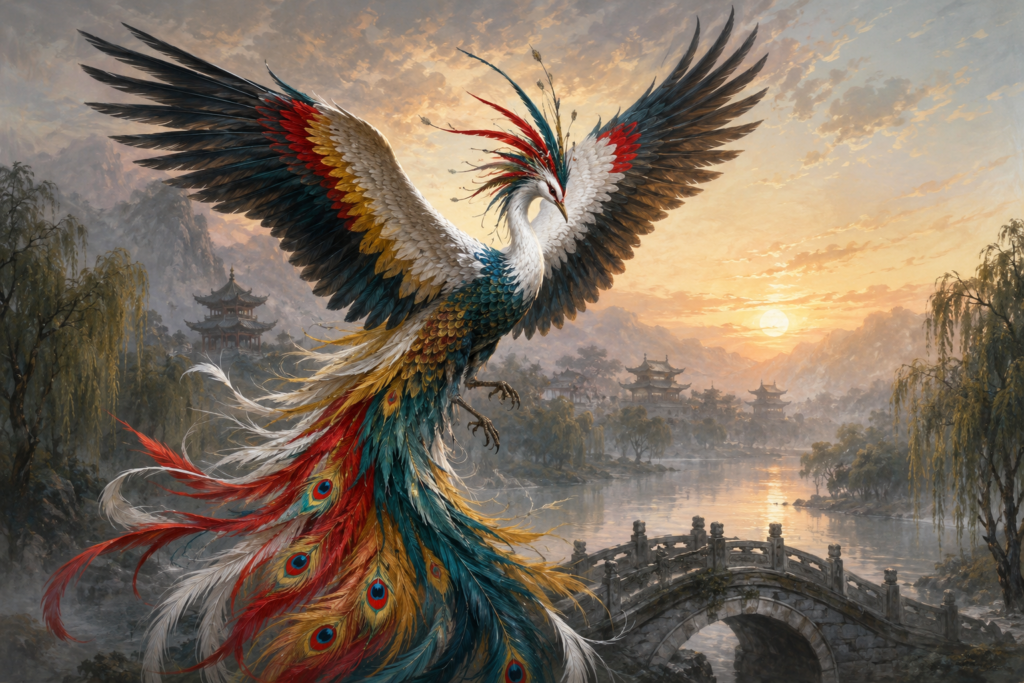
A radiant imperial bird whose arrival means a realm is being judged by harmony itself.
Overview
The Fenghuang is a celestial bird of sovereign virtue, auspicious rule, harmony, and moral order. Outsiders often call it a phoenix, but that comparison is imperfect. The Fenghuang is not chiefly a firebird of death and rebirth. It is an omen-bird, a sacred witness, and a living sign that ruler, people, ancestors, law, season, and land either stand in balance or have begun to rot beneath ceremony.
A Fenghuang rarely enters mortal affairs. When it does, ordinary birds alter their behaviour first. Palace sparrows fall silent. Cranes bow their heads toward the capital. Musicians hear a note none of them played. Court banners stir in still air. In villages, old women who have never seen the palace wake knowing that a great sign has entered the world.
Its presence is not automatically comforting. The Fenghuang may bless a rightful ruler, shame a tyrant, expose a false heir, halt a needless war, reveal unlawful taxation, or condemn a “peace” kept by hunger and fear. It does not honour obedience for its own sake. It honours order that protects the living, remembers the dead, restrains power, and keeps oath with the land.
In a campaign, the Fenghuang is best used as a mythic celestial, imperial omen, guardian of rightful succession, or sacred judge of public legitimacy. It should feel beautiful, terrifying, and politically dangerous.
Appearance
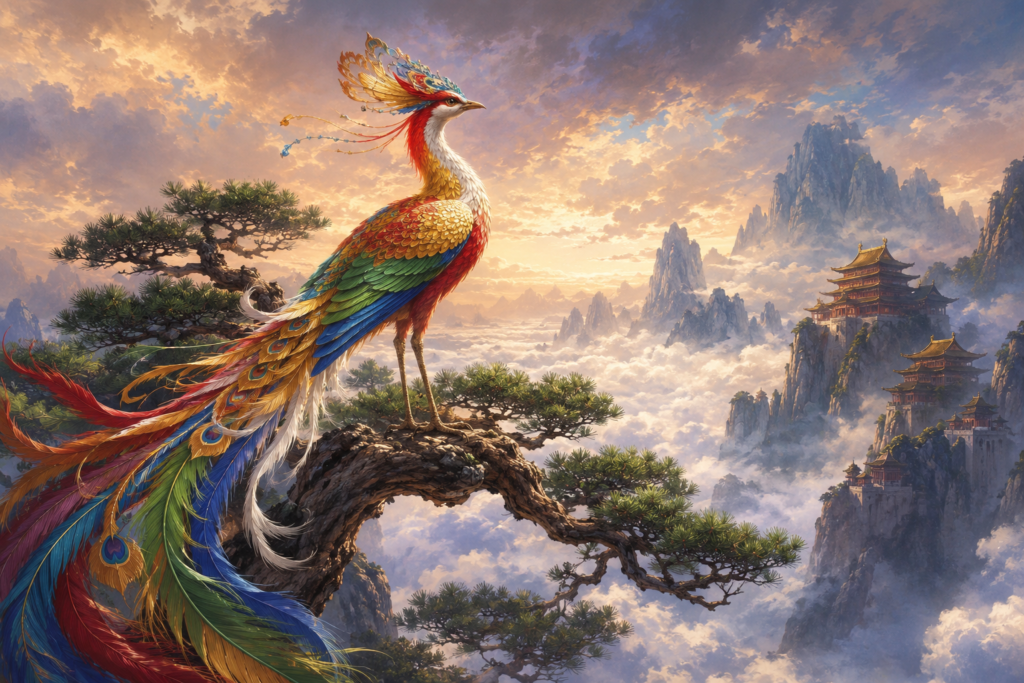
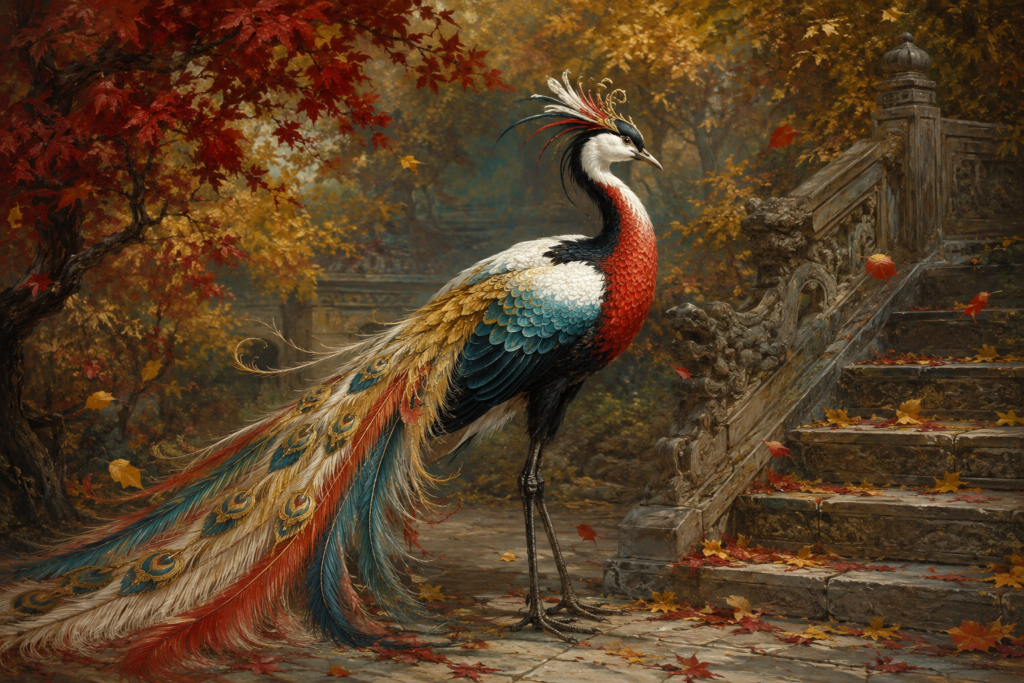
A Fenghuang is a vast, radiant bird with the bearing of a monarch and the movement of a court dancer. Its body seems composed from the noblest features of many birds: a proud crested head, crane-like legs, pheasant brilliance, peacock-like tail feathers, swallow-swift wings, and the ceremonial stillness of an ancient temple statue suddenly given life.
Its plumage carries five sacred colours: black, white, red, yellow, and blue-green. In ordinary light these are feathers. In sacred places they seem to become script, music, lacquer, jade, cloud, silk, seal-ink, and dawn.
Its tail is long enough to trail through the air like a procession banner. When the Fenghuang turns, its feathers leave brief afterimages of ancestral halls, clean rivers, full granaries, repaired roads, quiet graves, and cities at peace.
Its voice is not a cry. It is a chord. Those who hear it often weep before they understand why.
When angered, the Fenghuang does not become ugly. Its beauty becomes accusatory. Blood on its feathers looks like red ink on an imperial decree. Its shadow falls like judgement.
Habitat
The Fenghuang has no ordinary lair. It appears where the moral order of a realm is under strain:
- imperial courts during succession crises;
- sacred mountains and southern peaks;
- ancestral temples before war;
- palace gardens where rulers make private vows;
- battlefields where lawful defence has become conquest;
- famine provinces abandoned by their lords;
- wedding courts where dynastic marriage may heal or doom a realm;
- hidden valleys where birds gather before a new age begins.
It may rest in a tree never cut by human hands, on the roofbeam of a just ruler’s hall, or on a stone where no blood has been spilled. It avoids places poisoned by treachery, cruelty, and ritual hypocrisy unless it has come to judge them.
Ecology
The Fenghuang is not an animal in the ordinary sense. It does not hunt, nest, or breed like a mortal bird.
It is drawn to places where oath, music, season, ancestry, and rule remain in balance. It may accept rice, millet, spring water, incense, silk, bells, jade, or written petitions, but these are gestures rather than food. A corrupt court can bury it in treasure and receive only silence. A poor village that protects the weak may earn a single falling feather.
Ordinary birds revere it instinctively. Cranes lower their heads. Swallows circle in formal patterns. Roosters stop crowing before it speaks. Carrion birds become uneasy, for the Fenghuang reminds the dead that they once had names.
Behaviour
A Fenghuang is patient, ceremonial, and difficult to deceive. It does not usually accuse directly. Instead, it reveals contradiction.
A ruler who claims benevolence hears starving peasants beneath court music. A general who claims honour sees broken oaths written across his armour. A priest who claims purity watches incense smoke bend away from him. A noble who claims lawful inheritance finds no bird willing to perch within his estate.
The Fenghuang values harmony, but not submission. It may stop a war. It may also demand that a tyrant be removed. It may protect a dynasty. It may also prove that the dynasty has lost the right to rule.
It rarely speaks casually. When it does speak, every sentence sounds old enough to belong in a chronicle.
Mechanics Tabs
The rules below are mechanics compatible for different game editions.
Fenghuang 5.5e / 2024
Fenghuang Pathfinder 1e / 3.5e
Fenghuang 3.0e
Fenghuang 5.5e / 2024-Compatible Version
Large Celestial, Lawful Good
Armor Class 20
Hit Points 256
Speed 40 ft., fly 120 ft.
| STR | DEX | CON | INT | WIS | CHA |
|---|---|---|---|---|---|
| 22 (+6) | 24 (+7) | 21 (+5) | 20 (+5) | 24 (+7) | 26 (+8) |
Saving Throws Dex +13, Wis +13, Cha +14
Skills Insight +13, Perception +13, Persuasion +14, Religion +11
Damage Resistances radiant; bludgeoning, piercing, and slashing from nonmagical attacks
Damage Immunities fire, poison
Condition Immunities charmed, frightened, poisoned
Senses truesight 120 ft., passive Perception 23
Languages Celestial, Draconic, Primordial; telepathy 120 ft.
Challenge 17
Proficiency Bonus +6
Traits
Auspicious Presence. When a creature starts its turn within 60 feet of the Fenghuang and intends to make an attack before the start of its next turn, it must make a DC 22 Wisdom saving throw. On a failed save, the creature cannot make attacks until the start of its next turn unless it or an ally has taken damage from the Fenghuang since the end of the creature’s last turn. Creatures defending themselves, protecting innocents, or fighting a clearly monstrous threat have advantage on this saving throw.
Innate Spellcasting. The Fenghuang’s spellcasting ability is Charisma, spell save DC 22. It can innately cast the following spells, requiring no material components:
At will: detect evil and good, detect magic, thaumaturgy
3/day each: calm emotions, dispel magic, lesser restoration, zone of truth
1/day each: commune, greater restoration, hallow
Judge of False Rule. The Fenghuang has advantage on ability checks and saving throws against creatures that hold authority through fraud, oathbreaking, magical domination, or unlawful slaughter. Such creatures have disadvantage on Charisma checks made against the Fenghuang.
Magic Resistance. The Fenghuang has advantage on saving throws against spells and other magical effects.
Sacred Plumage. Whenever a creature within 10 feet of the Fenghuang hits it with a melee attack, the attacker takes 10 radiant damage unless it succeeds on a DC 22 Constitution saving throw.
Voice of Harmonious Command. The Fenghuang’s speech cannot be magically silenced. Creatures that understand any language understand the meaning of its words, though not necessarily their full implications.
Actions
Multiattack. The Fenghuang makes three attacks: one with its Beak and two with its Talons.
Beak. Melee Weapon Attack: +13 to hit, reach 10 ft., one target. Hit: 20 piercing damage plus 14 radiant damage.
Talons. Melee Weapon Attack: +13 to hit, reach 10 ft., one target. Hit: 17 slashing damage plus 10 radiant damage.
Radiant Wingbeat. Each creature of the Fenghuang’s choice within 30 feet must make a DC 22 Dexterity saving throw, taking 45 radiant damage on a failed save, or half as much damage on a successful one. A creature that fails the save is also pushed up to 20 feet away and knocked prone.
Imperial Rebuke. One creature the Fenghuang can see within 120 feet must make a DC 22 Charisma saving throw. On a failed save, the target takes 54 psychic damage and cannot issue commands, use reactions, or cause another creature to make an attack until the end of its next turn. On a successful save, the target takes half damage and suffers no additional effect.
Song of Peaceful Dominion — Recharge 5–6. The Fenghuang sings a chord of celestial authority. Each creature of its choice within 120 feet must make a DC 22 Wisdom saving throw. On a failed save, a creature is charmed by the Fenghuang for 1 minute. While charmed in this way, the creature is incapacitated and its speed is 0 as it experiences a vision of the harm its violence has caused or prevented. The effect ends early for a creature if it takes damage. A creature that succeeds on the saving throw is immune to this Fenghuang’s Song of Peaceful Dominion for 24 hours.
Bonus Actions
Crown of Five Colours. The Fenghuang chooses one creature it can see within 60 feet. Until the start of the Fenghuang’s next turn, that creature gains a +2 bonus to AC and saving throws, and it cannot be frightened.
Reactions
Feather of Reprieve. When a creature the Fenghuang can see within 60 feet would drop to 0 hit points, the Fenghuang causes the creature to drop to 1 hit point instead. The protected creature is surrounded by a brief halo of five-coloured light. The Fenghuang can use this reaction three times per day.
Legendary Actions
The Fenghuang can take 3 legendary actions, choosing from the options below.
Move. The Fenghuang moves up to half its speed without provoking opportunity attacks.
Revealing Gaze. One creature the Fenghuang can see within 60 feet must succeed on a DC 22 Charisma saving throw or be unable to benefit from invisibility, disguise, false identity, or magical concealment until the end of its next turn.
Talons. The Fenghuang makes one Talons attack.
Mandate Broken — Costs 2 Actions. One creature within 60 feet that commands allies must succeed on a DC 22 Wisdom saving throw or each creature currently following its orders may immediately move up to half its speed without provoking opportunity attacks and is no longer compelled by fear, charm, or mundane command to continue fighting.
Notes
Use Auspicious Presence when the Fenghuang is actively opposing unjust violence, coercion, or illegitimate command. In a straightforward fight against demons, plague undead, raiders, or attackers who have already rejected its warning, the DM can ignore the attack hesitation clause to keep combat moving.
The Fenghuang should not punish all violence equally. It opposes violence that breaks sacred order: massacre, treachery, unlawful command, forced obedience, false judgement, and killing protected persons.
Fenghuang Pathfinder 1e / 3.5e-Compatible Version
CR 17
XP 102,400
LG Large outsider
Init +11; Senses darkvision 60 ft., low-light vision, true seeing; Perception +31
Defense
AC 34, touch 17, flat-footed 26; +7 Dex, +1 dodge, +17 natural, –1 size
hp 287
Fort +17, Ref +20, Will +21
Defensive Abilities sacred plumage; DR 10/evil; Immune fire, poison; Resist electricity 10, sonic 10; SR 28
Offense
Speed 40 ft., fly 120 ft.
Melee bite +31, 2 talons +31
Space 10 ft.; Reach 10 ft.
Special Attacks auspicious presence, imperial rebuke, radiant wingbeat, song of peaceful dominion
Spell-Like Abilities CL 17th; concentration +25; save DCs are Charisma-based.
Constant: true seeing
At will: detect magic, detect evil, detect chaos
3/day: calm emotions, dispel magic, lesser restoration, zone of truth
1/day: commune, greater restoration, hallow
Statistics
Str 26, Dex 25, Con 24, Int 21, Wis 25, Cha 27
Base Atk +20; CMB +29; CMD 47
Feats Alertness, Combat Reflexes, Dodge, Flyby Attack, Improved Initiative, Iron Will, Mobility, Power Attack, Skill Focus (Sense Motive), Weapon Focus (talon)
Skills Diplomacy +31, Fly +28, Knowledge (history) +28, Knowledge (nobility) +28, Knowledge (planes) +28, Knowledge (religion) +28, Perception +31, Sense Motive +36, Spellcraft +28
Languages Celestial, Draconic, courtly mortal tongues; telepathy 120 ft.
Special Abilities
Auspicious Presence (Su). Creatures within 60 feet that attempt to make an attack must succeed at a DC 28 Will save or lose the attack action. Creatures fighting in clear self-defence, defending innocents, or resisting a clearly monstrous threat gain a +4 bonus on this save. This is a mind-affecting compulsion effect. The save DC is Charisma-based.
Imperial Rebuke (Su). As a standard action, the Fenghuang targets one creature within 120 feet. The target must succeed at a DC 28 Will save or take 15d6 points of nonlethal damage and be unable to command allies, use fear effects, or activate compulsion effects for 1 round. A creature that rules through fraud, oathbreaking, magical domination, or mass slaughter takes lethal damage instead. The save DC is Charisma-based.
Radiant Wingbeat (Su). As a standard action once every 1d4 rounds, the Fenghuang beats its wings, dealing 12d6 points of sacred damage to chosen enemies within 30 feet and knocking them prone. A DC 27 Reflex save halves the damage and negates the prone effect. Sacred damage from this ability is supernatural energy and is not fire damage. The save DC is Constitution-based.
Sacred Plumage (Su). A creature that strikes the Fenghuang with a natural weapon or non-reach melee weapon takes 2d6 points of sacred damage. Evil creatures take 4d6 points instead.
Song of Peaceful Dominion (Su). Three times per day, the Fenghuang may sing as a full-round action. Creatures of its choice within 120 feet must succeed at a DC 28 Will save or become fascinated and unable to take hostile actions for 1 minute. Affected creatures receive a new save if attacked. This is a sonic, mind-affecting effect. The save DC is Charisma-based.
True Seeing (Su). A Fenghuang continuously benefits from true seeing. This is already included in its spell-like abilities and senses.
Ecology
Environment sacred mountains, imperial courts, celestial gardens
Organization solitary
Treasure none, or sacred remains
Notes
For stricter 3.5e tables, treat “sacred damage” as divine supernatural damage. It is not fire damage and does not represent ordinary light or flame.
Fenghuang 3.0e
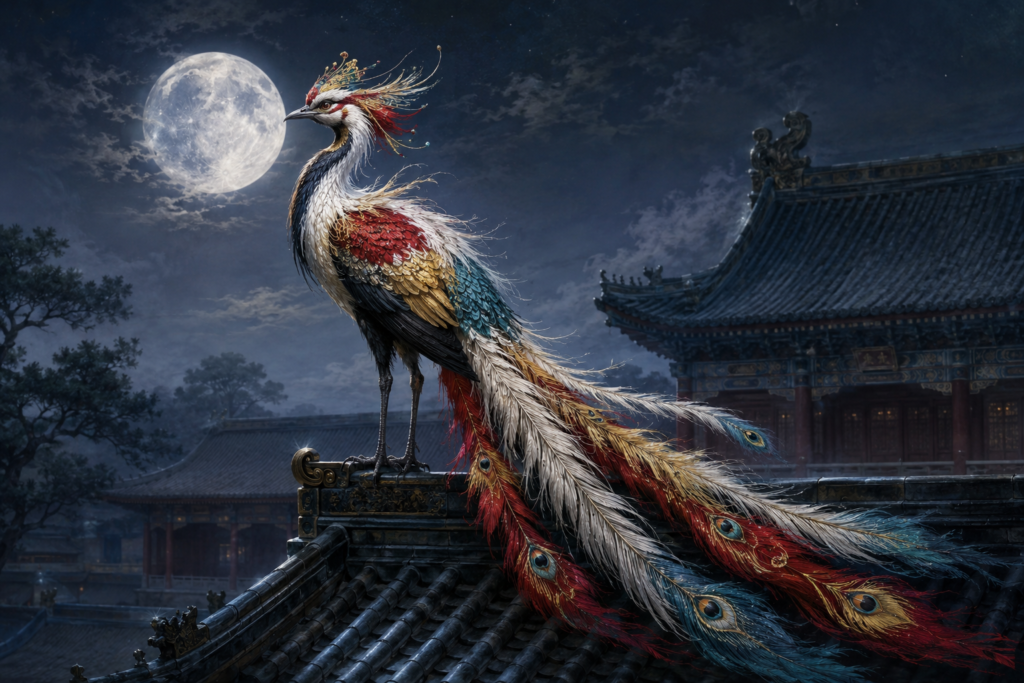
This immense bird of prey is over 100 feet long from the top of its multicolored crown to the tip of its finned, fishlike tail. Its wings span nearly 200 feet. It is covered in feathers of red, blue, green, orange, and yellow, while black and white stripes run the length of its body.
Originally Posted by Shade of the En World forums.
On this Thread
Also known as the oriental phoenix, the feng huang is among the greatest of avian creatures. Fully aware of its beauty and power, the feng huang is self-centered and arrogant.
Although rarely encountered on the Material Plane, feng huang generally make their elaborate nests of spun gold and silver high atop massive ornamental trees in remote areas of other planes. Feng huang are not bothered by extreme temperatures or weather, so they can reside in nearly any environment.
Feng huang are herbivorous, feeding mostly on flowers and bamboo, and prefer to drink sweet beverages, such as fruit juices or honey-filled waters. They covet treasure, particularly gems.
Feng huang are extremely rare. A female feng huang lays only one egg each year, and each such egg has only 1% chance of hatching.
Much larger than the standard phoenix, a feng huang’s bill and neck are shorter in proportion to its body.
A feng huang can speak with any creature with a language, thanks to its tongue ability, and with any avian creature (even those without languages).
| Feng Huang | |
| Gargantuan magical beast (Extraplanar) | |
| Hit Dice | 22d10+132 (253 hp) |
| Initiative | +6 |
| Speed | 30 ft. (6 squares), Fly 120 ft. (average) |
| Armor Class | 26 (-4 size, +2 Dexterity, +13 natural, +5 deflection), touch 13, flat-footed 24 |
| Base Attack/Grapple | +22/+46 |
| Attack | Claw +30 melee (3d6+12/19-20) or bite +30 melee (4d6+12) |
| Full Attack | 2 claws +30 melee (3d6+12/19-20) and bite +25 melee (4d6+12) |
| Space/Reach | 20 ft./15 ft. |
| Special Attacks | Animate fire, breath weapon, flame storm, spell-like abilities, spit flame |
| Special Qualities | Control temperature, remove disease, Darkvision 60 ft., defensive aura, damage reduction 15/epic and cold iron, Low-Light Vision, melt weapons, rebirth, Spell Resistance 37, telepathy 60 ft., tongues |
| Saves | Fort +19, Ref +15, Will +14 |
| Abilities | Strength 34, Dexterity 14, Constitution 23, Intelligence 18, Wisdom 17, Charisma 21 |
| Skills | Concentration +31, Diplomacy +9, Knowledge (Arcana) +29, Knowledge (the planes) +29, Sense Motive +30, Spellcraft +33, Spot +28, Survival +3 (+7 on other planes) |
| Feats | Epic Will, Flyby Attack, Hover, Improved Critical (claw), Improved Initiative, Quicken Spell-Like Ability (invisibility), Snatch, Wingover |
| Environment | Any extraplanar |
| Organization | Solitary |
| Challenge Rating | 26 |
| Treasure | Double standard |
| Alignment | Always chaotic neutral |
| Advancement | – |
| Level Adjustment | – |
COMBAT
A feng huang prefers to avoid combat, but fights aggressively if provoked. It prefers to rely on its spell-like and supernatural abilities rather than resorting to melee combat.
Animate Fire (Su): As a standard action, a feng huang can transform a normal fire into an equivalently-sized fire elemental under its control. After 10 minutes, the elemental reverts to a normal fire.
Breath Weapon (Su): Once per round, 50-foot line, damage 3d10 fire, Reflex DC 27 half. The save DC is Constitution-based.
Control Flames (Su): As a standard action, a feng huang can pyrokinetically control the intensity or movements of one fire source. This functions exactly like the control flames psionic power, treating the feng huang as a 20th-level manifester for determining the power’s effects.
Control Temperature (Su): As a swift action, a feng huang can raise or lower the temperature by 10 degrees in a 100-foot-radius centered on itself. Subsequent uses of this ability stack, so it could, for example, raise the temperature by a total of 20 degrees after two rounds.
remove disease (Su): With the touch of its wings, a feng huang can remove any disease instantly, even those of a magical nature or requiring a caster level check (such as mummy rot).
Defensive Aura (Su): A feng huang has a +5 deflection bonus to Armor Class. This ability is always in effect.
Flame Storm (Su): Twice per day, a feng huang can unleash a deadly cloud of flame in a 20-foot-high, 15-foot-radius spread. Each creature in the area takes 40d6 points of fire damage (Reflex DC 27 half). The save DC is Constitution-based.
Melt Weapons (Ex): Any metal weapon that strikes a feng huang must succeed on a DC 27 Fortitude save or melt away into slag. The save DC is Constitution-based.
Rebirth (Su): When a feng huang is reduced to 0 hp, it does not die. Instead, its body disappears in a flash of (harmless) flame and smoke, replaced by a jade-like egg. The egg hatches into a feng huang in 3d10 days, which then magically grows to maturity in one day.
Spell-Like Abilities: At will–dispel magic, invisibility, plane shift;
3/day–fire seeds (DC 21), fire shield, heat metal (DC 17), produce flame, pyrotechnics (DC 17);
1/day–incendiary cloud (DC 23), wall of fire.
Caster level 20th. The save DCs are Charisma-based.
After 10 rounds of ritual and preparation– dismissal (DC 20), Dispel Evil (DC 19). Caster level 40th. The save DCs are Charisma-based.
The following abilities are always active on the feng huang, as the spells (casterlevel 20th); detect evil, Detect Magic, protection from evil. They can be dispelled, but the feng huang can reactivate them as a free action.
Spit Flame (Su): As a standard action, a feng huang can spit two balls of fire to a range of x feet. This requires a ranged touch attack, and deals 2d10 points of fire damage on a successful hit.
tongues (Su): A feng huang can speak with any creature that has a language, as though using a tongues spell (caster level 20th). This ability is always active. It can also speak normally with any avians.
Originally appeared in Test of the Samurai (1989).
Combat Tactics
The Fenghuang does not fight like a hunting beast. It uses violence only when warning, revelation, and command have failed.
In battle, it first tries to break false authority. It silences commanders, exposes concealed identities, interrupts magical domination, and protects creatures being used as tools by tyrants, oathbreakers, or corrupt priests. Its strongest actions should target the figure whose command is holding the injustice together, not simply the nearest enemy.
The Fenghuang should not punish all violence equally. It opposes massacre, treachery, unlawful command, forced obedience, false judgement, and the killing of protected persons. Against demons, plague undead, oathbreakers, and corrupt celestials, it becomes far more direct.
Use its mobility to keep it above the battlefield, forcing enemies to confront its presence rather than simply surrounding it. It should feel like a celestial witness that can also kill.
Treasure and Sacred Remains
A Fenghuang does not keep coins, gems, or hoarded treasure. Its value lies in the sacred materials it may willingly leave behind. These remains lose most of their power if taken by violence.
Willingly Given Fenghuang Feather: 25,000 gp
A true feather given freely by the Fenghuang is a major sacred relic. It may serve as a focus for magic of truth, restoration, protection, rightful succession, or freedom from magical domination. In political campaigns, it may be worth far more than its listed price because it can prove that a ruler, heir, court, marriage, or treaty has received celestial notice.
Fallen Fenghuang Down: 2,500 gp per usable plume
Small feathers shed naturally during the creature’s appearance may be worked into court regalia, truth-seals, oath banners, holy vestments, or protective charms. These plumes retain only a fraction of the Fenghuang’s authority but are still prized by temples, imperial households, and celestial artisans.
Five-Coloured Tail Plume: 50,000 gp
An intact tail plume is exceptionally rare and should never appear as ordinary loot. It may be used as the central component in a major magic item tied to legitimacy, public truth, celestial command, or the breaking of false authority.
Blood of a Slain Fenghuang: no lawful market value
Blood taken from a murdered Fenghuang is not treasure in any respectable market. It may interest fiends, corrupt alchemists, tyrants, or curse-workers, but selling or using it should carry legal, sacred, and supernatural consequences. A vial might fetch 10,000–20,000 gp from the wrong buyer, but possession alone may be treated as proof of sacrilege.
Body of a Slain Fenghuang: priceless, cursed, and politically catastrophic
A dead Fenghuang should not be treated as a harvestable monster corpse. Its remains are evidence, omen, relic, and accusation. Any attempt to butcher, sell, or display the body should attract celestial attention, court panic, temple intervention, and rival claimants.
Adventure Hooks
The Silent Coronation
A prince is crowned, but every bird in the capital falls silent. Three days later, a Fenghuang appears above the palace and refuses to land. The court claims this is a blessing. The old servants know it is a warning.
The War That Lost Its Music
Two armies meet at dawn. Every drum splits. Every horn cracks. A Fenghuang circles above the battlefield, and no soldier can remember why the war began. The generals remember perfectly, and that is the problem.
The Empress’s Feather
A single feather appears in the private chamber of an empress, queen, or royal consort. It burns anyone who lies while holding it. By morning, half the court wants it destroyed.
Source, Historical, and Mythic Context
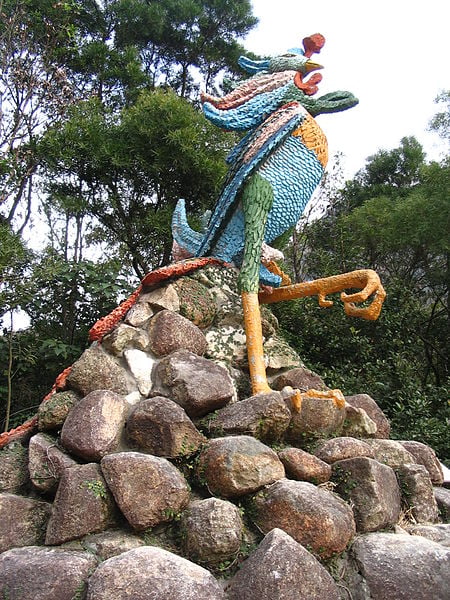
The Fenghuang is a mythic bird from Chinese tradition, often translated into English as the “Chinese phoenix.” That translation is useful for recognition, but incomplete. The Fenghuang is not primarily the fire-born, death-and-rebirth phoenix of Mediterranean tradition. It is more strongly associated with auspicious rule, virtue, harmony, peace, prosperity, and the moral condition of rulership.
Britannica describes the Fenghuang as an immortal bird whose rare appearance foretells harmony at the ascent of a new emperor. Britannica also notes that the name combines older male and female aspects, feng and huang, giving the creature a strong association with yin-yang harmony. The source further records the Fenghuang as appearing as early as Shang dynasty oracle-bone inscriptions.
The bird also carries strong art-historical and imperial associations. The Metropolitan Museum of Art describes the Fenghuang as the noblest of feathered creatures and notes that it is said to appear only in times of peace and prosperity. This explains why the creature appears so often in courtly and imperial art.
Later traditions connect the Fenghuang with moral virtues such as benevolence, righteousness, ritual propriety, wisdom, and sincerity. For fantasy campaigns, this makes the creature more useful as a sacred omen of legitimate order than as a simple fire monster. Its appearance can ask whether law, ceremony, rulership, and public harmony are genuine, or whether they have become beautiful disguises for coercion.
At the table, the Fenghuang works best when its appearance creates a crisis of legitimacy. It may bless a ruler, condemn a court, expose a false heir, silence an unjust war, or reveal that a realm’s public peace has been built on fear. It is not merely a beautiful bird. It is a sign that power itself has been called to account.
Keep this reference growing
If this page helped with your reading or game, you can support its upkeep or explore the curated books.
Explore the Bookshop — epics, classics and stories behind imagined worlds.