
Mares of Diomedes — Man-Eating Horses of Thrace

Mares of Diomedes at a Glance
| Identity | Four man-eating mares of Diomedes, king of the Bistones |
|---|---|
| Names | Podargos, Lampon, Xanthos and Dinus, as named by Hyginus |
| Nature | Four unusually savage horses, not a generic species of fiends |
| Range | Thrace and the Balkans, ancient royal stables, grazing grounds and old roads |
| Disposition | Violent and conditioned to human flesh, but not beyond capture or restraint |
| Associations | Heracles, Diomedes, Abderus, Ares |
The horses are still chained when the first traveller disappears. A second returns at dawn without his hand. In the old royal stables four huge mares stand behind iron gates, watching the stable hand who carries the keys.
What Is Happening Right Now?
A horse trader has reopened a ruined stable in Thrace and sold a single mare to a military captain as a fearless mount. The mare has killed its groom. While the captain argues over compensation, three others escape towards the road used by caravans and farmers.
A stable hand has seen the feeding pit beneath the mangers and can identify the broken iron halters. The animals are not wandering demons: they have been trained to expect human flesh. The party can secure the roads, recover the halters, rescue survivors and decide what justice their owner deserves.
The Four Named Mares
Ancient testimony records four names. Their individual coat markings and mannerisms below are practical campaign distinctions rather than assertions about the ancient texts.
- Podargos is the quickest, pale around the fetlocks and first to test a weak gate.
- Lampon is dark and broad-chested, fighting the others over prey.
- Xanthos is golden-maned and more watchful, recognising familiar handlers.
- Dinus is heavy-jawed and grey, reluctant to leave a cornered victim.
They hunt by speed and by cutting off escape. They can learn to fear an iron gate or a drawn-up line of spearmen. Feeding captives to them only preserves the terror that made their names notorious.
Appearance, Hunting and Habitat
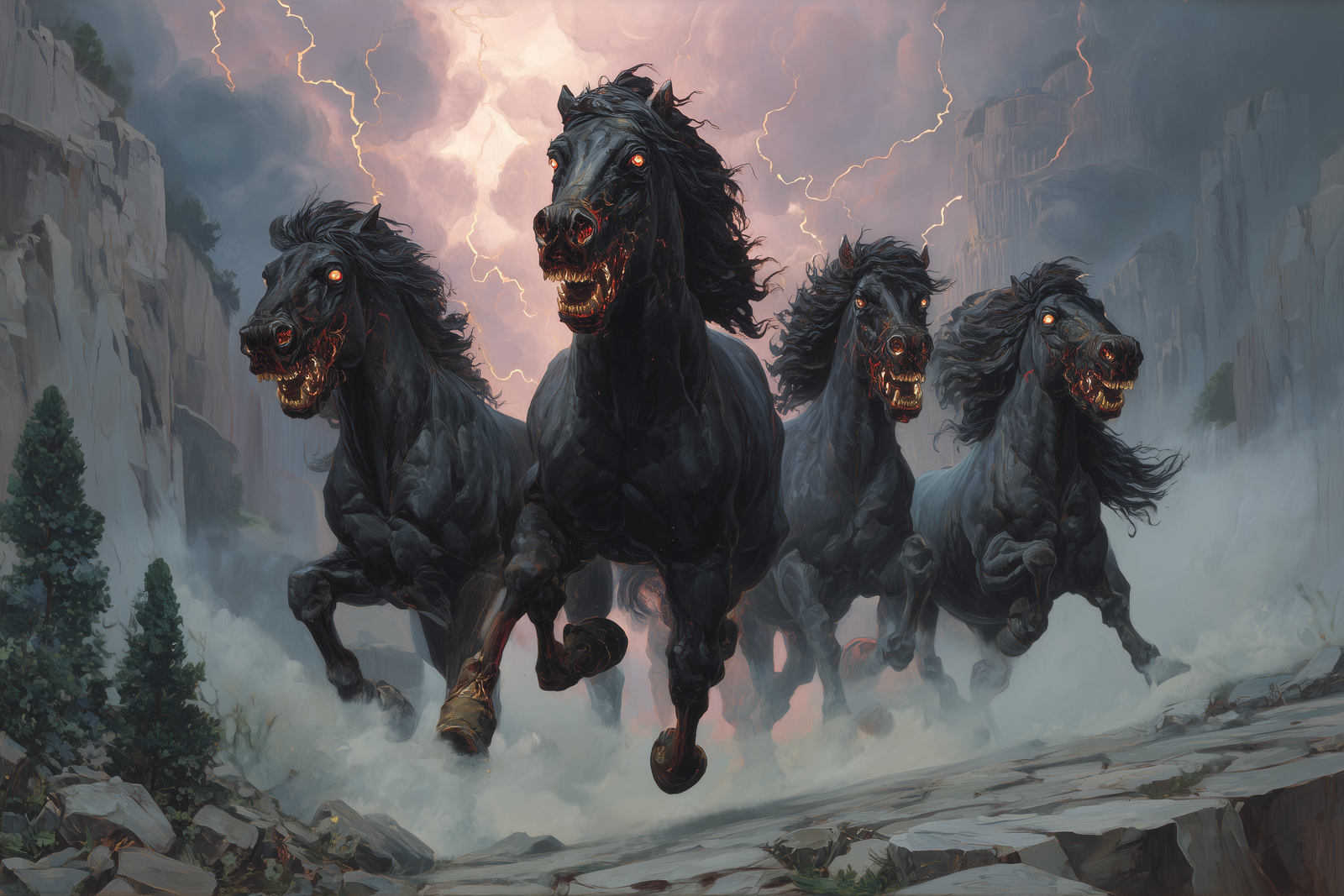
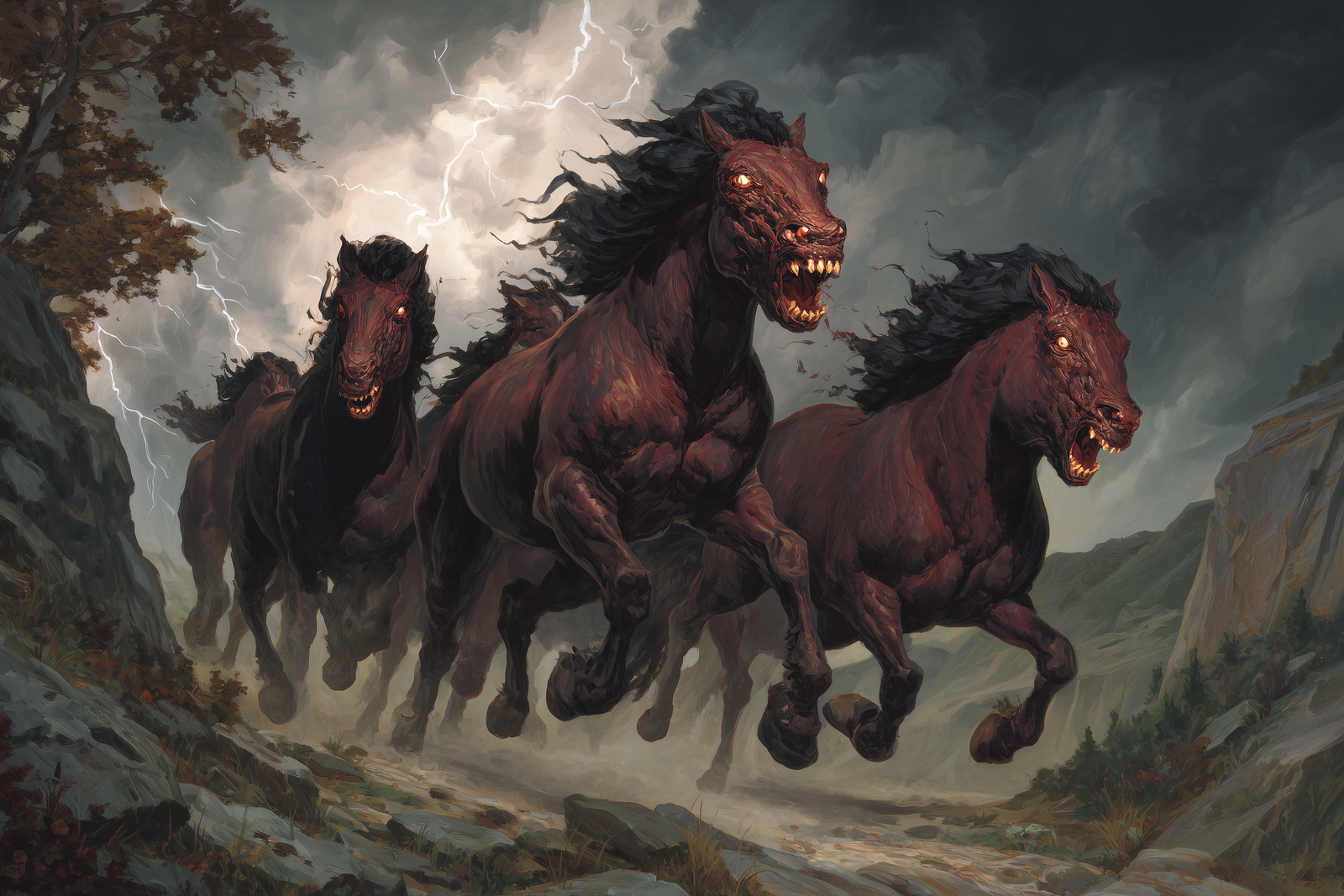
The mares are heavy-bodied, unnaturally swift horses with strong jaws and worn iron halters. Their teeth are a more reliable warning than imagined flames. The old legends mention chains, bronze feeding troughs and a terrible appetite, not a necessary demonic origin or magical fire.
A deserted manger bears blood stains, hoof gouges and scraps of clothing. The mares avoid grazing when they expect easier prey on a road. They can smell a familiar handler and learn a route through fences and ravines, but the same animal will bite that handler if hungry or cornered.
Mares of Diomedes — Creature Statistics
Mares of Diomedes — D&D 2024
Mare of Diomedes
Large Monstrosity, typically Neutral Evil
Armor Class 16 (natural armor)
Hit Points 136 (16d10 + 48)
Speed 60 ft.
Initiative +5 (15)
| STR | DEX | CON | INT | WIS | CHA |
|---|---|---|---|---|---|
| 22 (+6) | 14 (+2) | 16 (+3) | 6 (−2) | 12 (+1) | 8 (−1) |
Saving Throws Str +9, Con +6
Skills Perception +7, Survival +4
Senses darkvision 60 ft., passive Perception 17
Languages understands Common but cannot speak
Challenge 8 (3,900 XP; PB +3)
Traits
Keen Smell. The mare has advantage on Wisdom (Perception) checks relying on smell.
Bloodied Charge. If the mare moves at least 20 feet straight towards a target and hits it with its Hooves on that turn, the attack deals an extra 10 (3d6) bludgeoning damage. A Large or smaller target must succeed on a DC 17 Strength saving throw or fall prone.
Predator of the Fallen. Once on each of the mare’s turns, its Bite deals 7 (2d6) extra piercing damage to a prone target.
Actions
Multiattack. The mare makes one Hooves attack and one Bite attack.
Hooves. Melee Attack Roll: +9, reach 5 ft. Hit: 17 (2d10 + 6) Bludgeoning damage.
Bite. Melee Attack Roll: +9, reach 5 ft. Hit: 15 (2d8 + 6) Piercing damage.
Terrifying Whinny (Recharge 5–6). Creatures of the mare’s choice within 30 feet that can hear it must succeed on a DC 15 Wisdom saving throw or be frightened until the end of their next turn.
Reactions
Violent Breakaway. When the mare escapes a grapple, it moves up to 15 feet without provoking an opportunity attack from the creature that grappled it.
Mares of Diomedes — D&D 2014
Mare of Diomedes
Large monstrosity, usually Neutral Evil
Armor Class 16 (natural armor)
Hit Points 136 (16d10 + 48)
Speed 60 ft.
| STR | DEX | CON | INT | WIS | CHA |
|---|---|---|---|---|---|
| 22 (+6) | 14 (+2) | 16 (+3) | 6 (−2) | 12 (+1) | 8 (−1) |
Saving Throws Str +9, Con +6
Skills Perception +7, Survival +4
Senses darkvision 60 ft., passive Perception 17
Languages understands Common but cannot speak
Challenge 8 (3,900 XP)
Traits
Keen Smell. The mare has advantage on Wisdom (Perception) checks relying on smell.
Bloodied Charge. If the mare moves at least 20 feet straight towards a target and hits it with its Hooves on that turn, the attack deals an extra 10 (3d6) bludgeoning damage. A Large or smaller target must succeed on a DC 17 Strength saving throw or fall prone.
Predator of the Fallen. Once on each of the mare’s turns, its Bite deals 7 (2d6) extra piercing damage to a prone target.
Actions
Multiattack. The mare makes one Hooves attack and one Bite attack.
Hooves. Melee Weapon Attack: +9 to hit, reach 5 ft., one target. Hit: 17 (2d10 + 6) bludgeoning damage.
Bite. Melee Weapon Attack: +9 to hit, reach 5 ft., one target. Hit: 15 (2d8 + 6) piercing damage.
Terrifying Whinny (Recharge 5–6). Creatures of the mare’s choice within 30 feet that can hear it must succeed on a DC 15 Wisdom saving throw or be frightened until the end of their next turn.
Reactions
Violent Breakaway. When the mare escapes a grapple, it moves up to 15 feet without provoking an opportunity attack from the creature that grappled it.
Mares of Diomedes — Pathfinder 1e
MARE OF DIOMEDES CR 8
XP 4,800
NE Large magical beast
Init +6; Senses darkvision 60 ft., low-light vision, scent; Perception +16
Defense
AC 22, touch 11, flat-footed 20 (−1 size, +2 Dex, +11 natural)
hp 114 (12d10+48)
Fort +12, Ref +10, Will +7
Offense
Speed 60 ft.
Melee bite +18 (2d6+7), 2 hooves +18 (1d8+7)
Space 10 ft.; Reach 5 ft.
Special Attacks bloodied charge, trample (2d8+10, DC 23), terrifying whinny (DC 15)
Statistics
Str 24, Dex 14, Con 18, Int 5, Wis 12, Cha 8
Base Atk +12; CMB +20; CMD 32
Feats Endurance, Improved Initiative, Iron Will, Power Attack, Run, Skill Focus (Perception)
Skills Perception +16, Survival +7
Languages understands Common but cannot speak
Ecology
Environment Thracian grasslands, royal stables and coastal roads
Organization solitary or four mares (4)
Treasure incidental
Special Abilities
Bloodied Charge (Ex). If the mare charges at least 20 feet and hits with a hoof, it deals 2d6 extra bludgeoning damage and can immediately attempt to trip the target without provoking an attack of opportunity. A failed attempt cannot trip the mare.
Trample (Ex). The mare can trample Medium or smaller creatures, dealing 2d8+10 bludgeoning damage (Reflex DC 23 half). This save DC is Strength-based.
Terrifying Whinny (Su). Once every 1d4 rounds, the mare may whinny as a standard action. Creatures within 30 feet that can hear it must make a DC 15 Will save or be shaken for 1d4 rounds. A successful save grants immunity to this mare’s whinny for 24 hours. The DC is Charisma-based.
Mares of Diomedes — D&D 3.5e
Mare of Diomedes
Large Magical Beast; Usually Neutral Evil
Hit Dice: 12d10+48 (114 hp)
Initiative: +6
Speed: 60 ft. (12 squares)
Armor Class: 22 (−1 size, +2 Dex, +11 natural), touch 11, flat-footed 20
Base Attack/Grapple: +12/+23
Attack: Hoof +18 melee (1d8+7)
Full Attack: 2 hooves +18 melee (1d8+7) and bite +16 melee (2d6+3)
Space/Reach: 10 ft./5 ft.
Special Attacks: bloodied charge, trample, terrifying whinny
Special Qualities: darkvision 60 ft., low-light vision, scent
Saves: Fort +12, Ref +10, Will +7
Abilities: Str 24, Dex 14, Con 18, Int 5, Wis 12, Cha 8
Skills: Listen +8, Spot +8, Survival +2
Feats: Endurance, Improved Initiative, Iron Will, Multiattack, Power Attack, Run
Environment: Temperate plains and ruins of Thrace
Organization: solitary or four mares (4)
Challenge Rating: 8
Treasure: incidental
Advancement: 13–18 HD (Large); 19–24 HD (Huge)
Combat
The mare charges to knock prey down, then bites. It prefers open ground but may corner a victim against a stable wall. A closed iron gate or narrow bridge can deny its charge.
Special Abilities
Bloodied Charge (Ex): If the mare charges at least 20 feet and hits with a hoof, the attack deals 2d6 extra bludgeoning damage and the mare may trip the target as a free action without provoking an attack of opportunity. A failed attempt cannot trip it.
Trample (Ex): The mare can trample Medium or smaller foes (2d8+10 bludgeoning, Reflex DC 23 half); Strength-based save DC.
Terrifying Whinny (Su): Once every 1d4 rounds as a standard action, the mare can force creatures within 30 feet that hear it to make a DC 15 Will save or be shaken for 1d4 rounds. A successful save grants 24 hours of immunity to that mare’s whinny. The DC is Charisma-based.
If Violence Starts
First attack. A mare charges the least protected victim and knocks them down. Another may block the route to safety. They work together through experience and habit, not a magical shared mind.
In a stable. Stone walls and heavy gates can keep the creatures separated and deny a straight charge. Their jaws remain dangerous if the handlers come too close.
On the road. A defended bridge, steep bank, deep watercourse or overturned cart stops their run. A party that knows the ground may divert the mares rather than fight all four at once.
Capture. Each mare can be controlled with a properly secured halter and careful handling. This does not make it safe as a riding horse. The legend makes plain what happens when their hunger is treated as entertainment.
Encounters
The Abandoned Manger
The groom lies wounded beneath a fodder cart. Three sets of hoofprints lead towards the road, but the fourth mare never left the stable and now waits behind an open loft door.
A Mare at Market
The captain proudly displays his new horse before a walled market. When the rope breaks, the guards shut the gates and trap hundreds of people inside with the animal. The characters must lure it into an empty enclosure or prevent a stampede.
The Fourth Horse
Three mares have been recaptured; the fourth is hunting refugees at a narrow riverside ravine. The party must reach the high ground ahead of it without being forced over the edge by its charge.
Adventure Hooks
- The King’s Last Bit. A trader offers an inscribed bronze bit said to calm the mares. The bit is genuine, but the leather that holds it is rotten.
- Blood on the Causeway. Four horses cross the flooded road. The mounted patrol following them does not know that the mares have doubled back to hunt the riders.
- The Tomb of Abderus. A family tending Abderus’ grave asks for the return of a stolen halter. The thief has sold it to a horse breeder hoping to revive the ancient bloodline.
Mythology: The Eighth Labour
Diomedes, son of Ares, ruled the Bistones of Thrace. His mares were fed human flesh and chained by their iron halters at bronze mangers. Heracles was ordered to take the four animals to Eurystheus.
In the version attributed to Apollodorus, Heracles overpowered the grooms and drove off the horses. When Diomedes and his men pursued, he left the mares in the care of Abderus, who was killed by them. Heracles buried his companion and founded Abdera beside the grave.
Another version says Heracles fed Diomedes to his own mares, making the creatures easier to restrain. These are competing tellings, not necessarily two consecutive events. Some later accounts have the horses dedicated to Hera, while others have them released and killed by wild animals.

Related Creatures, Places and Powers
Heracles — the hero of the eighth labour · Ares — Diomedes’ divine father · Hera — associated with a later fate of the mares · Greece and the Balkans · Hellenic Bestiary · Magical Beasts.
Sources and Licensing
The myth and its variations are recorded in University of Georgia: Labour VIII, Mares of Diomedes, Theoi, Diomedes of Thrace and the Oxford Classical Dictionary.
The four creature stat blocks are original campaign adaptations of the myth; the mares’ physical markings are campaign distinctions, not claims about ancient sources. The unrelated proprietary Horse Horror formerly mixed into this entry is not represented as one of the four mares. The three existing fantasy illustrations and historical Gustave Moreau painting are retained.
Keep this reference growing
If this page helped with your reading or game, you can support its upkeep or explore the curated books.
Explore the Bookshop — epics, classics and stories behind imagined worlds.