
Baba Yaga’s Three Riders — Heralds of Dawn, Sun and Night
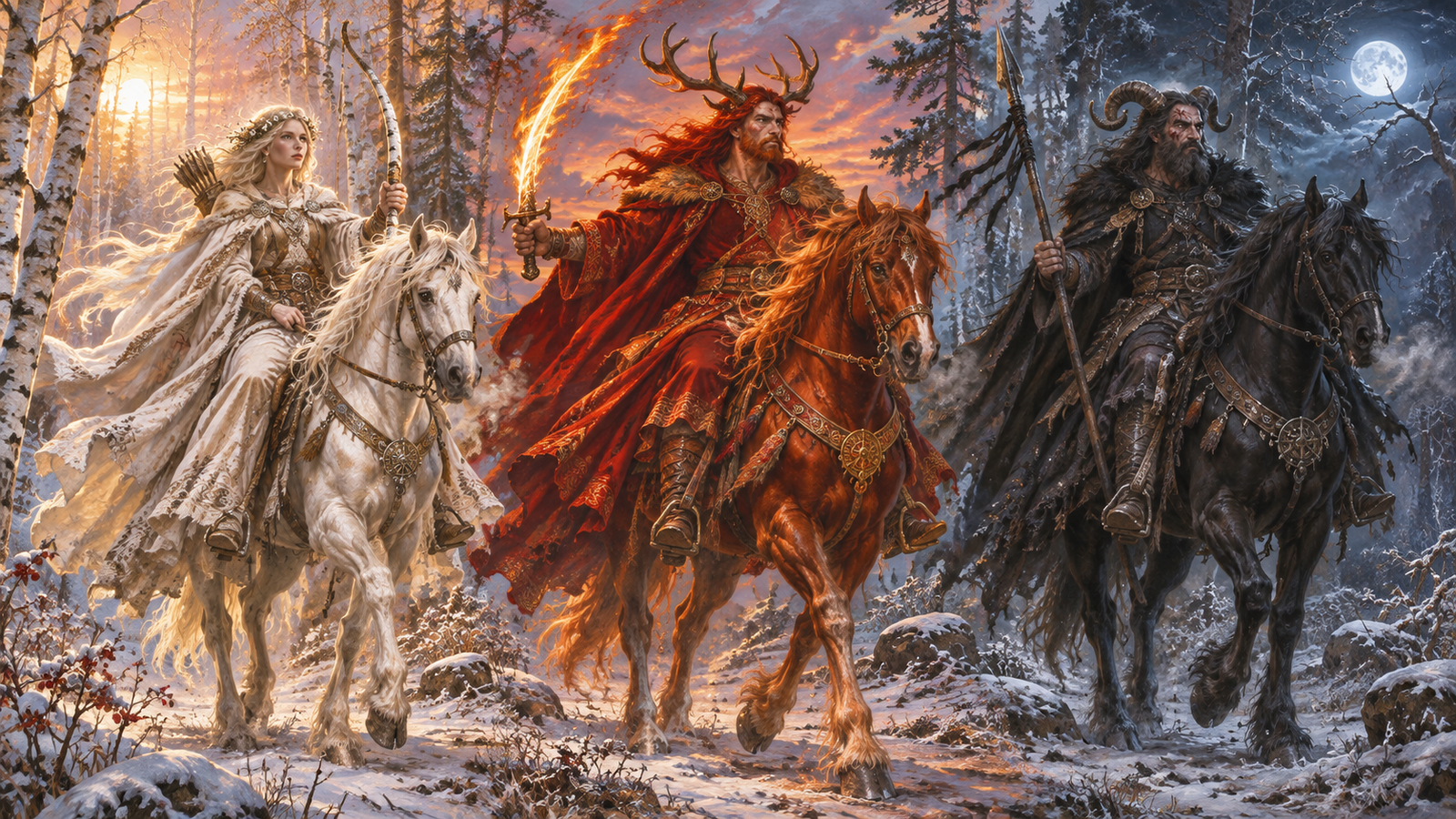
The snow-covered road is empty when three sets of hoofprints appear. White dawn has scarcely broken before a pale horse passes the watching village. By afternoon, a red-gold stallion carries a rider whose judgment burns like the midday sun. After sunset, a black warhorse comes alone through the forest, and even the wolves fall silent.
At a Glance
| Allegiance | Baba Yaga, Queen of Witches |
|---|---|
| White Rider | Bright Morning — the hours after sunrise; a white horse and the judgment of dawn |
| Red Rider | Red Sun — the afternoon; a red-gold stallion and the judgment of day |
| Black Rider | Dark Midnight — sunset until sunrise; a black warhorse and the judgment of night |
| Nature | Three commissioned Fey heralds, chosen and empowered for one century at a time |
| Signs | Unnatural hoofprints, a silence among beasts, and a stranger offering a boon or dreadful sentence |
Meet the Three Riders
- The White Rider — Bright Morning. She rides at dawn with her birch longbow, weighing old promises before the day begins.
- The Red Rider — Red Sun. An antlered, red-haired man carries the burning judgment of the afternoon on a red-gold stallion.
- The Black Rider — Dark Midnight. A ram-horned, bearded herald with a battered spear rides the night road after sunset.
The Riders are more than messengers. Before a return of the Queen of Witches, three mounted Fey appear upon the winter roads of the eastern kingdoms, judging princess and charcoal burner with the same cold attention. Some bring good fortune, others inflict curses that cling long after their hoofbeats fade. A household may make offerings, but none can buy a favourable judgment: the standards are those of Baba Yaga alone.
The Three Riders change with each century—Baba Yaga chooses beings every 100 years to serve as her heralds, and she imbues them with potent magic, transforming them into fey creatures with many magical powers. She selects the Riders seemingly at random, from among dozens of different worlds. Some past Riders found themselves granted this position without ever seeking it, and Baba Yaga rarely presents the opportunity to those who too eagerly reach for it. Others became Baba Yaga’s heralds as part of deals they made with her—deals that would give them something they truly desire in return for serving her for a century.
Upon choosing her Riders, Baba Yaga gives each of them a special magical weapon, robes that protect it and allow it to mask its forms, and the ability to call special supernatural mounts. Though every centennial anniversary is greeted by the arrival of new Riders, their titles remain unchanged. The White Rider, called “My Bright Morning” by Baba Yaga, is seen only in the hours after sunrise, riding a sleek, white destrier. The Red Rider, or “My Red Sun,” sits upon a reddish-gold stallion; the citizens encounter this creature in the daylight hours after noon. The third is the Black Rider, mounted upon a fierce black warhorse. She calls this Rider, seen only in the hours between sunset and sunrise, “My Dark Midnight.”
The first sign of a Rider may be no more than an unfamiliar horse at the ford or a row of hoofprints where the snow has not been disturbed. Those who meet a herald must answer for their deeds. A Rider may accept a plea, refuse an offering, grant protection for a day or mark an oathbreaker with misfortune. The same supernatural gifts serve each of the three, but the weapon, appearance, mount and judgment belong to the individual herald.
When the Three Riders Pass
The riders are not a single mounted host. Their separate patrols divide the turning day: the White Rider appears in the pale morning, the Red Rider follows beneath the afternoon sun, and the Black Rider searches the roads when night falls. Each may question a different witness to the same broken oath. Characters who understand the change of watch can deliver testimony to the next herald before judgment is complete.
The Mill Bridge Judgment
Three villages dispute the old right to cross a winter bridge. At dawn the White Rider asks who kept the bridge standing; in the afternoon the Red Rider tests the claim of the lord who demands a toll; and at midnight the Black Rider summons the oathbreaker to answer for the theft of the bridge’s founding charter. The party must gather witnesses, locate the missing charter and decide whether to plead for mercy or demand the strict letter of Baba Yaga’s bargain.
Shared Gifts of the Three Riders — Pathfinder 1e
Conjure Mount (Su)
As a standard action, one of Baba Yaga’s Riders can summon a special mount. This effect allows the Rider to use the spell phantom steed at will at caster level 13th. The Rider has full control of the appearance of the mount, and Ride is always a class skill for her.
Rider’s Robes (Su)
The Riders wear robes that provide an armor bonus, but don’t take an armor check penalty or have a maximum Dexterity bonus. In addition, the robes allow the Rider to use disguise self as a supernatural ability at caster level 13th. If the Rider is slain, the robes melt away like ice thrown into fire.
Rider’s Weapon (Su)
A Rider cannot be disarmed of the supernatural weapon bestowed by Baba Yaga. When the Rider is slain, the weapon melts away.
Weal or Woe (Su)
A Rider can bring harm or fortune to those judged. As a standard action, a Rider can bestow a curse (–2 penalty on attack rolls, saves, ability checks, and skill checks until the curse is removed) or a boon (+2 bonus on attack rolls, saves, ability checks, and skill checks for 24 hours). A targeted creature can resist the curse with a successful Will save. The save DC is Charisma-based.
Section 15: Copyright Notice
Pathfinder Campaign Setting: Irrisen, Land of Eternal Winter © 2013 Paizo Publishing, LLC; Author: Mike Shel.
Keep this reference growing
If this page helped with your reading or game, you can support its upkeep or explore the curated books.
Explore the Bookshop — epics, classics and stories behind imagined worlds.