
Razorwire Golem — The Shredder of Forgotten Battlefields
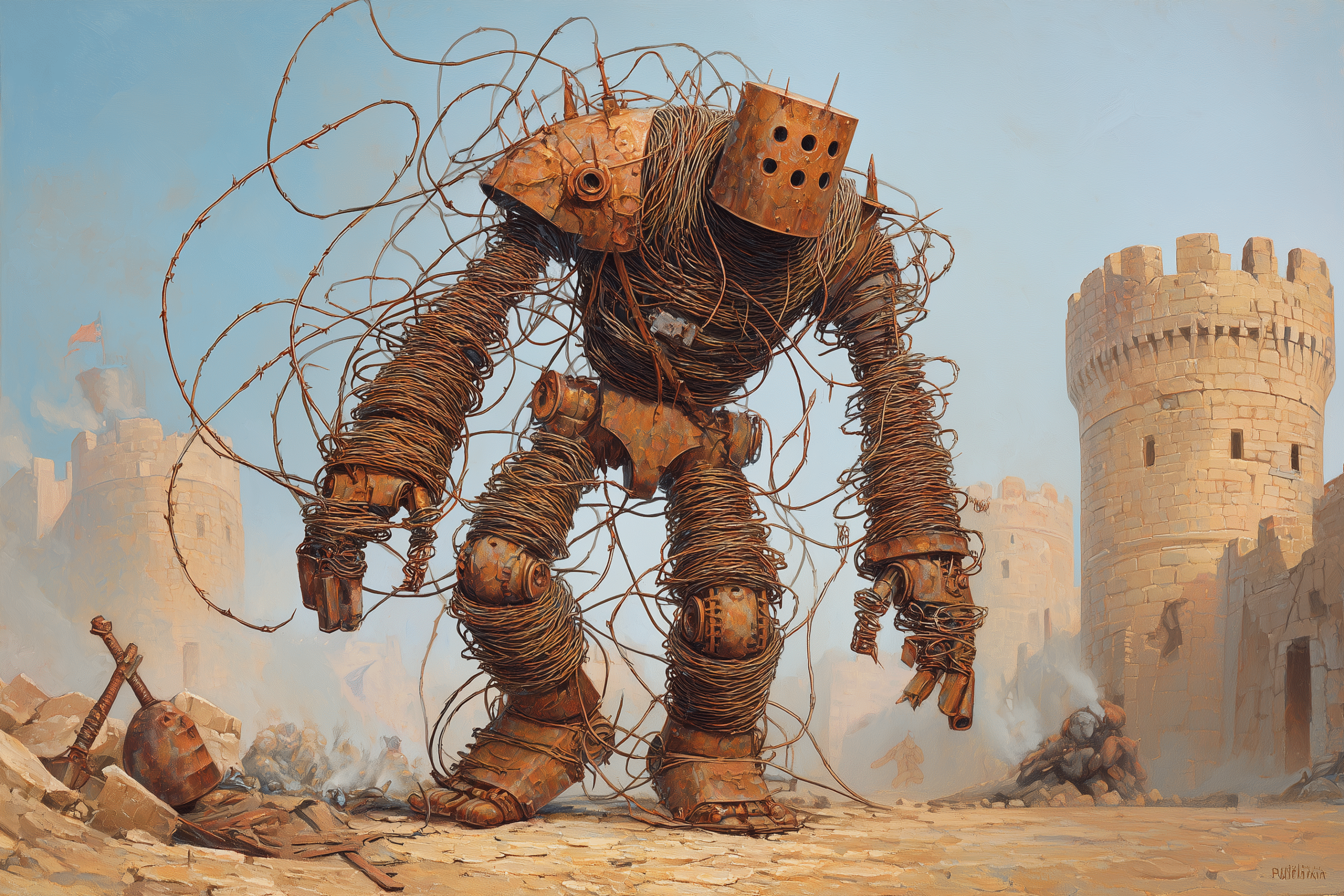
The bodies were gone by morning, but their helmets were still hanging from the wire. The old soldiers’ road is blocked by a twisted mass of metal. No forge glows nearby, and the wire moves although no hand touches it. Then the tangle pulls itself into the rough shape of a man.
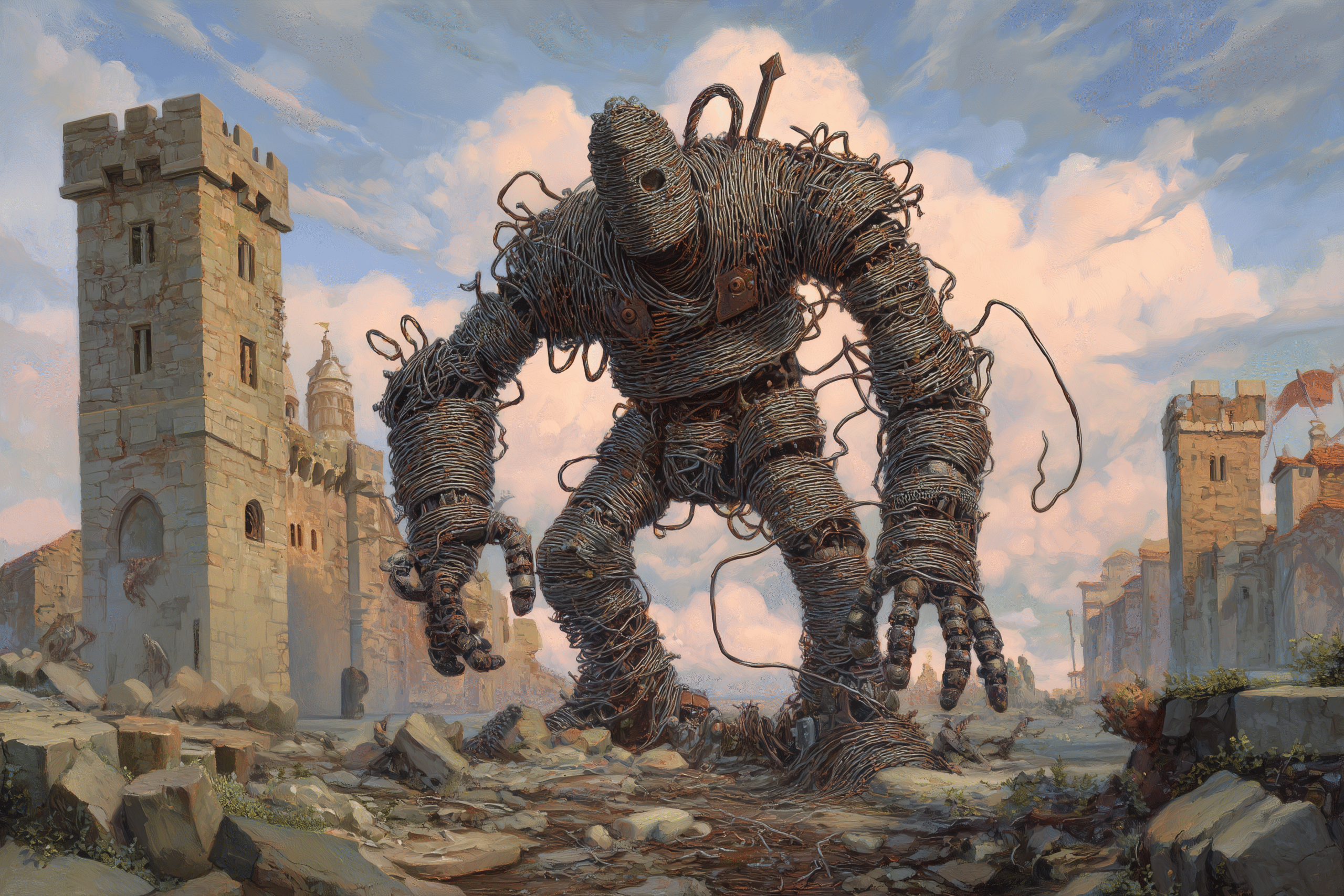
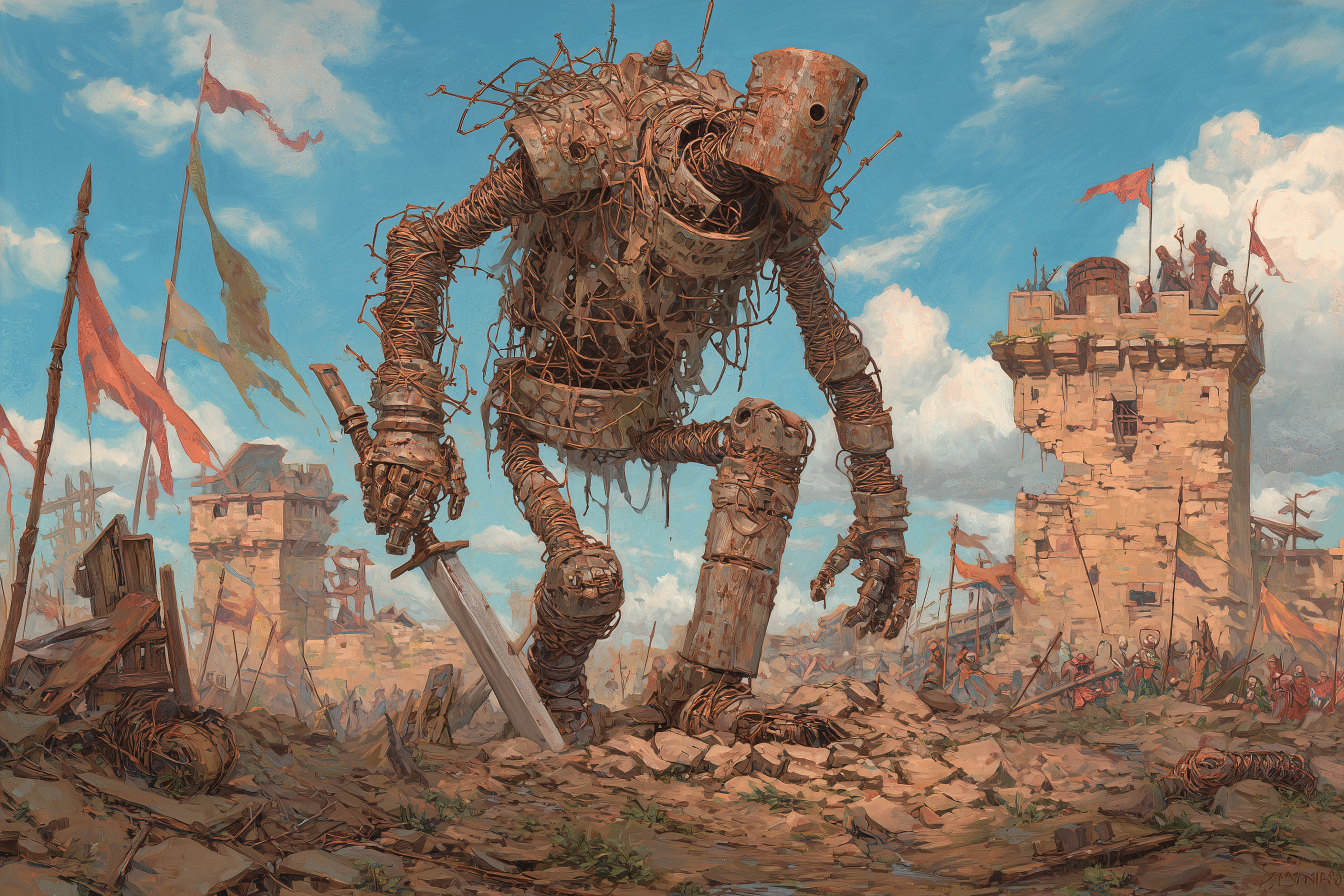
The razorwire golem is a weapon from the oldest abyssal wars. Its limbs are woven from metallic filaments so thin they catch clothing and skin before an enemy sees them; rust-flecked hooks draw tight around a hollow chest, and a bundle of wire deep inside contracts like a beating heart. It has the shape of a soldier, but no living flesh beneath the coils.
Why the Wire Still Moves
Long before this generation’s wars, construct armies followed their demonic masters into battle. Razorwire golems were made to deny a road or gate, seize those who fled, and cut down anyone trying to reach the commander’s position. The forges that produced them are long lost. Those left behind may continue obeying orders from masters who have been dead for an age.
The material is not ordinary farm fencing or the modern wire of a factory. It is a magically drawn mithral-alloyed steel filament, hooked and serrated by the occult practices of ancient abyssal smiths. On a deserted battlefield it resembles twisted wreckage, the wreck of a siege engine or an old barrier of iron thorns. The enchantment lets it contract into a compact coil or extend its limbs across an impossible reach.
What Is Happening Right Now?
A ruined fortress has reopened the road between two villages, and merchants have begun using the pass again. Then pack animals refuse to cross the broken outer gate. A wagon has been found emptied, its canvas sliced into long strips, while three guards lie trapped among the fallen beams. A surveyor insists an iron obstruction must be cleared before the winter convoy arrives.
Deep in the fortress, someone has taken a maker’s seal from an old military chest. The golem recognises that seal as an instruction to guard the gate—and interprets every approaching traveller as an enemy. A local smith believes its wires can be disabled with rust, but the fortress commander wants the thing captured and turned against his rivals. The characters can find the seal, cut a path to the missing guards, or choose whether a weapon this dangerous should ever be commanded again.
Habits and Warning Signs
The golem waits as a tight coil, almost invisible amid iron scrap. A footfall through its territory is felt before it is seen. Hooks snap outward to seize a moving target, then draw the victim into a knot of grinding wire. It does not shout a challenge or bargain. Where its ancient order permits, it may ignore still travellers who never step across the forbidden threshold.
A golem’s apparent cruelty comes from the purpose of its making, not from anger. Its hollow frame is strong against blunt blows, yet rust can break the enchantment’s grip on the filaments. Those who know its maker’s marks may have a chance to interrupt the old order without fighting through a storm of steel.
Razorwire Golem Stat Blocks
Use the rules for one edition. The published Green Ronin 3.5e creature is CR 11. The fifth-edition version here is CR 6; Pathfinder and 2024 variants are original conversions, not published official stat blocks.
Razorwire Golem — D&D 2024
Large Construct, Unaligned · CR 6 (2,300 XP, PB +3). Original 2024-Compatible Conversion
Initiative +2 (12).
AC 17 (steel coils); HP 123 (13d10 + 52); Speed 30 ft., Climb 20 ft.
| STR | DEX | CON | INT | WIS | CHA |
|---|---|---|---|---|---|
| 19 (+4) | 14 (+2) | 18 (+4) | 3 (−4) | 10 (+0) | 3 (−4) |
Saving Throws Con +7, Wis +3. Resistances bludgeoning, piercing and slashing from nonmagical attacks. Immunities poison and psychic damage; blinded, charmed, deafened, exhaustion, frightened, paralyzed and poisoned conditions. Senses darkvision 60 ft., tremorsense 30 ft., passive Perception 10. Languages understands its maker’s languages, cannot speak.
Traits
Coiled Ambush. When curled motionless, it looks like scrap metal (DC 17 Intelligence (Investigation) to recognise it). Magic Resistance. Advantage on saving throws against magic. Constructed Nature. It needs no air, food, water or sleep.
Razor Terrain. As it moves on solid ground, it can leave a 10-foot-wide trail of barbed wire up to 30 feet long per turn. That trail lasts one minute and is difficult terrain to other creatures. A creature moving through it for the first time on a turn takes 5 (1d10) slashing damage. Cutting away a 10-foot square safely takes 10 minutes, or 1 minute with a successful DC 15 Dexterity check using suitable tools.
Actions
Multiattack. Two Razor Lash attacks; if both hit one creature, it must succeed on a DC 15 Strength saving throw or be grappled (escape DC 15). The golem can grapple only one creature this way.
Razor Lash. Melee attack +7 to hit, reach 20 ft., one creature. Hit: 13 (2d8 + 4) slashing damage. DC 15 Constitution saving throw or the creature takes 5 (1d10) slashing damage at the start of its next turn; magical healing or a successful DC 10 Wisdom (Medicine) check stops the bleeding.
Wire Whirl (Recharge 5–6). Creatures of the golem’s choice within 15 ft. make DC 15 Dexterity saving throws. On failure, a target takes 21 (6d6) slashing damage and is restrained until the end of its next turn; on success, it takes half damage and isn’t restrained.
Reel and Rend (1/Day). A grappled target makes a DC 16 Constitution saving throw, taking 27 (6d8) slashing damage on a failure or half on a success; success also ends the grapple.
Reaction
Lash Reflex. When an enemy ends its turn within 10 feet, the golem makes a Razor Lash attack against it.
Original D&D 2024 campaign conversion, not a 2024 Monster Manual or SRD 5.2.1 stat block. The 2024 version deliberately retains the site’s CR 6 play balance rather than copying the source CR 11.
Razorwire Golem — D&D 2014
Large Construct, Unaligned · CR 6 (2,300 XP). Original D&D 2014-Compatible Conversion
AC 17 (steel coils); HP 123 (13d10 + 52); Speed 30 ft., Climb 20 ft.
| STR | DEX | CON | INT | WIS | CHA |
|---|---|---|---|---|---|
| 19 (+4) | 14 (+2) | 18 (+4) | 3 (−4) | 10 (+0) | 3 (−4) |
Saving Throws Con +7, Wis +3. Resistances bludgeoning, piercing and slashing from nonmagical attacks. Immunities poison and psychic damage; blinded, charmed, deafened, exhaustion, frightened, paralyzed and poisoned conditions. Senses darkvision 60 ft., tremorsense 30 ft., passive Perception 10. Languages understands its maker’s languages, cannot speak.
Traits
Coiled Ambush. When curled motionless, it looks like scrap metal (DC 17 Intelligence (Investigation) to recognise it). Magic Resistance. Advantage on saving throws against magic. Constructed Nature. It needs no air, food, water or sleep.
Razor Terrain. As it moves on solid ground, it can leave a 10-foot-wide trail of barbed wire up to 30 feet long per turn. That trail lasts one minute and is difficult terrain to other creatures. A creature moving through it for the first time on a turn takes 5 (1d10) slashing damage. Cutting away a 10-foot square safely takes 10 minutes, or 1 minute with a successful DC 15 Dexterity check using suitable tools.
Actions
Multiattack. Two Razor Lash attacks; if both hit one creature, it must succeed on a DC 15 Strength saving throw or be grappled (escape DC 15). The golem can grapple only one creature this way.
Razor Lash. Melee attack +7 to hit, reach 20 ft., one creature. Hit: 13 (2d8 + 4) slashing damage. DC 15 Constitution saving throw or the creature takes 5 (1d10) slashing damage at the start of its next turn; magical healing or a successful DC 10 Wisdom (Medicine) check stops the bleeding.
Wire Whirl (Recharge 5–6). Creatures of the golem’s choice within 15 ft. make DC 15 Dexterity saving throws. On failure, a target takes 21 (6d6) slashing damage and is restrained until the end of its next turn; on success, it takes half damage and isn’t restrained.
Reel and Rend (1/Day). A grappled target makes a DC 16 Constitution saving throw, taking 27 (6d8) slashing damage on a failure or half on a success; success also ends the grapple.
Reaction
Lash Reflex. When an enemy ends its turn within 10 feet, the golem makes a Razor Lash attack against it.
Updated from this site’s pre-existing D&D 5e statistics. The old Razor Lash average of 12 for 2d8 + 3 was inconsistent with Strength 19; this version uses +4 for 13 damage. This is not a published official 2014 creature.
Razorwire Golem — Pathfinder 1e
Large Construct (Extraplanar), Chaotic Evil · CR 11 (XP 12,800). Original Pathfinder 1e Conversion
Initiative +4; Senses blindsight 60 ft., Perception +2.
Defence
AC 28, touch 13, flat-footed 24 (−1 size, +4 Dex, +15 natural); HP 107 (14d10 + 30); Fort +4, Ref +8, Will +6; DR 10/adamantine; immune to bludgeoning, construct traits and most magic; vulnerable to rust.
Offence
Speed 30 ft., Climb 30 ft.; cannot run; Melee 4 rakes +17 (2d6 + 4 plus grab and trip); Space/Reach 10 ft./15 ft.; Special Attacks Grab, Constrict (2d6 + 4), Rush, Trip.
| STR | DEX | CON | INT | WIS | CHA |
|---|---|---|---|---|---|
| 19 (+4) | 19 (+4) | — | — | 15 (+2) | 4 (−3) |
BAB +14; CMB +19 (+23 for maintaining a grapple); CMD 33; Environment Abyss or battlefields; Organisation solitary or gang (2–4); Treasure none.
Special Abilities
Grab (Ex). A rake against a Medium or smaller creature allows an immediate grapple attempt; a successful grapple deals constrict damage. Constrict (Ex). A successful grapple check deals 2d6 + 4 slashing damage. Rush (Ex). Once per minute the golem moves 60 ft. over ground or climbs 40 ft. as a move action. Trip (Ex). A rake hit permits a trip attempt as a free action without an attack of opportunity or counter-trip.
Immunity to Magic (Ex). Ignores spells permitting spell resistance except: magical fire (including heat metal) hastens it for 1 round; cold slows it for 1 round; make whole and fabricate temporarily compress its body, losing extended reach and Grab for 1d3 rounds. Rust Vulnerability. Rust monsters and rusting grasp affect it normally. Climber. +8 racial bonus on Climb checks; can take 10 while threatened.
Construction
The lost Abyssal method uses 400 pounds of mithral-alloyed steel wire, an occult heart bound in barbed cords and advanced planar magic. Suggested Craft (metalworking) DC 19; CL 16th; Craft Construct, blade barrier, geas/quest, haste and limited wish. Proposed price 88,500 gp; adjust the costs to Pathfinder crafting rules. These are campaign guidelines, not a published Paizo ritual.
Original Pathfinder 1e conversion of Green Ronin’s 3.5e Razorwire Golem. Pathfinder constructs have full BAB, giving the four +17 rake attacks shown here rather than the source’s +13. Not an official Paizo creature.
Razorwire Golem — D&D 3.5e
Large Construct (Extraplanar), Chaotic Evil · CR 11 · Published Third-Party D&D 3.5e
Hit Dice 14d10 + 30 (107 HP); Initiative +4; Speed 30 ft., Climb 30 ft.; AC 28 (−1 size, +4 Dex, +15 natural), touch 13, flat-footed 24.
Base Attack/Grapple +10/+18; Attack Rake +13 melee (2d6 + 4); Full Attack 4 rakes +13 melee (2d6 + 4); Space/Reach 10 ft./15 ft.
| STR | DEX | CON | INT | WIS | CHA |
|---|---|---|---|---|---|
| 19 (+4) | 19 (+4) | — | — | 15 (+2) | 4 (−3) |
Special Attacks Improved Grab, Constrict (2d6 + 4), Rush, Trip; Special Qualities Blindsight 60 ft., construct traits, DR 10/adamantine, immunity to bludgeoning and magic, vulnerability to rust; Saves Fort +4, Ref +8, Will +6; Environment the Abyss; Organisation solitary or gang (2–4); Treasure none; Alignment always chaotic evil; Advancement 15–21 HD Large, 22–42 HD Huge.
Combat
Improved Grab (Ex). A rake hit against a Medium or smaller creature grants a grapple attempt. Constrict (Ex). Successful grappling deals automatic rake damage (2d6 + 4). Rush (Ex). Once per minute it can move 60 ft. on foot or climb 40 ft. as a move action; it cannot run. Trip (Ex). A rake hit permits a free trip attempt without a separate touch attack; failed trips cannot be retaliated against.
Blindsight (Ex). Detects vibrations within 60 ft. Immunity to Bludgeoning (Ex). Blunt weapons and falls deal no damage. Immunity to Magic (Ex). Immune to spells, spell-like abilities and supernatural effects except that fire (including heat metal) hastens it for 1 round, cold slows it for 1 round, and make whole or fabricate compacts it to a five-foot space, suppressing extended reach and Improved Grab for 1d3 rounds.
Vulnerability to Rust (Ex). Rust monsters and rusting grasp work normally. Climb +8 racial bonus, take 10 even when threatened.
Construction
The ancient recipe uses 400 pounds of mithral-alloyed steel (1,500 gp), woven around a preserved ghaele head bound with wire as the golem’s planar heart. Craft (metalworking or weaponsmithing) DC 19; CL 16th; Craft Construct, blade barrier, geas/quest, haste, limited wish, polymorph any object; Price 88,500 gp, Cost 45,750 gp + 3,480 XP. The secret of creating the heart has been lost.
Published third-party source: Green Ronin, The Book of Fiends (2004), a 3.5e-compatible bestiary. Attribution to authors Chris Pramas, Erik Mona and Aaron Loeb. This is not an official Wizards of the Coast Monster Manual monster.
Running the Razorwire Golem
Build the encounter around movement and a choice of approaches. The golem can retreat into a ball of tangled metal, seize intruders from farther away than its body suggests, or stretch across an otherwise narrow gate. Show its wire moving before anyone enters reach. Let characters find the snapped buckle, half-cut rope or shallow furrows in the stone that reveal where the wires will pass.
Fighting it in a featureless chamber wastes its strengths. Use a broken battlement, a wagon jammed in a gateway, a collapsed bridge or a floor of loose scrap. In the 2014 and 2024 versions, its Razor Terrain punishes careless movement; in the stronger Pathfinder and 3.5e versions, grabs, constriction and its longer reach make rescuing an ally especially dangerous. A smith with rusting magic, an artificer who recognises the heart, or a scout who finds the maker’s seal may have more influence on the outcome than a straightforward assault.
Adventure Encounters
The Narrow Road
A convoy of grain is trapped outside a ruined fort. The only intact gate is packed with what seems to be discarded metal, and a missing scout’s glove is still hooked above the entry. A soldier offers to lead a charge and burn the blockage, but setting it alight may hasten the creature in the older rules. The characters must choose between a risky frontal rescue, a rope descent over the wall or finding the seal that still directs the guardian. Every delay brings the grain convoy closer to the winter storm.
The Unfinished Siege
Two rival captains claim a sealed armoury beneath an abandoned battlefield. Each has found half of a rusted command tablet, and neither knows that the fragments together wake a razorwire golem bound to guard the vault. Whoever unites the halves gains an uncertain ally; whoever breaks them may release it from the last of its restrictions. The party can mediate, steal the fragments, explore the armoured entrance or seal the vault for good.
Steel That Remembers
A travelling smith is offered an impossibly fine coil of metal taken from a battlefield cairn. The wire begins to twitch each evening, drawing other scrap into the shape of a man. An emissary from an Abyssal patron promises wealth for the completed weapon, while a group of refugees claims its core was stolen from an ancient sanctuary. The party must discover whether the original binding can be undone before the creature reaches the smith’s forge and completes its body.
After the Wire Falls
A defeated golem can leave a tangled coil of enchanted steel, a maker’s seal and the remnants of its mysterious heart. A smith may salvage the metal, but an unbroken command rune could cause the fragments to gather again. The safest reward may be knowledge of how the lost forge worked—or proof that the technique should remain lost.
Related Monsters, Craft and Magic
See the golem collection, Iron Golem, Clockwork Golem, adamantine, heat metal, rusting grasp and blindsight.
Sources: The Book of Fiends, Green Ronin Publishing (2004), third-party 3.5e-compatible source for the published Razorwire Golem; other editions, adventures and setting material are campaign adaptations. The creature’s original planar history is retained; the ruined-fortress situations are original encounters.
Keep this reference growing
If this page helped with your reading or game, you can support its upkeep or explore the curated books.
Explore the Bookshop — epics, classics and stories behind imagined worlds.