
20,000 Leagues Under the Sea (1954 film)

A mysterious sea monster leads three travellers into the extraordinary underwater world of Captain Nemo.
Richard Fleischer’s 20,000 Leagues Under the Sea transforms Jules Verne’s maritime adventure into a lavish spectacle of discovery, captivity and moral conflict. The Nautilus is both a wonder of engineering and an instrument of its captain’s vengeance.
At a Glance
| Film | 20,000 Leagues Under the Sea (1954) |
|---|---|
| Director | Richard Fleischer |
| Producer | Walt Disney |
| Screenplay | Earl Felton, adapting Jules Verne |
| Principal cast | Kirk Douglas, James Mason, Paul Lukas, Peter Lorre |
| Music | Paul J. Smith |
| Running time | 127 minutes |
| Genre | Science fiction; maritime adventure |
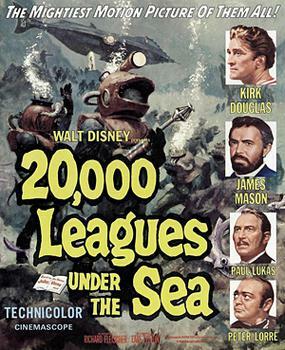
Why This Film Matters
The film makes its submarine a setting in its own right: a self-contained world with an observation salon, extraordinary machinery and a community governed by the captain’s wishes. The freedom to explore the oceans comes at the cost of freedom to leave the vessel. That contradiction gives the adventure much of its dramatic tension.
The Story — Without Major Spoilers
Reports of ships destroyed by an unidentified creature prompt an expedition. Professor Pierre Aronnax, his assistant Conseil and the harpooner Ned Land are thrown into the sea and discover that the supposed monster is a submarine. Captain Nemo takes them aboard the Nautilus, where they witness wonders beneath the waves and learn that their host has little intention of releasing them.
As the voyage continues, the travellers confront dangerous marine life and the consequences of Nemo’s campaign against the surface world. The conflict ultimately concerns the captain’s secret base and the fate of his invention, rather than ending with the celebrated squid encounter.
Characters and Performances
Captain Nemo (James Mason) combines scientific accomplishment, compassion and consuming bitterness. Mason’s restrained performance gives the captain’s code both authority and menace. Ned Land (Kirk Douglas) provides the practical counterweight to Nemo’s idealism, insisting on his freedom. Professor Pierre Aronnax (Paul Lukas) is fascinated by the scientific discoveries but increasingly troubled by their cost. Conseil (Peter Lorre) is the professor’s loyal assistant, not an independent scientist. His dry humour and affection for Ned help sustain the group’s uneasy friendship.
The World on Screen
Harper Goff’s distinctive submarine design combines riveted metal, an aggressive silhouette, a raised wheelhouse and elaborate observation windows. Its interiors combine the appearance of nineteenth-century craftsmanship with speculative technology. The sea offers coral reefs, submerged landscapes, wrecks and enormous animals, but the most important power in this world is the knowledge that allows Nemo to cross it.
Behind the Camera
The production was an ambitious CinemaScope live-action feature for Disney. Underwater photography, elaborate sets and mechanical effects give the voyage a tangible sense of place. The squid confrontation was redesigned as a storm-lashed encounter after an earlier version filmed on calmer water exposed too much of the machinery operating the creature. The film won Academy Awards for special effects and colour art direction/set decoration, and received a nomination for editing.
Adaptation and Critical Assessment
The film retains Verne’s central tension between exploration and freedom while reshaping Nemo’s history and the voyage’s conclusion. The submarine’s distinctive appearance and the film’s treatment of its power source are cinematic interpretations, not specifications for the literary vessel. Mason’s Nemo should likewise be distinguished from the Prince Dakkar revealed in The Mysterious Island.
What works: the contrasting personalities aboard the Nautilus, tactile production design, underwater exploration and the dramatic squid encounter. What works less well: the leisurely pacing of some episodes and the simplified account of the political and personal forces behind Nemo’s actions. The film is most rewarding when its marvels and moral questions are considered together.
Related Films and Stories
Jules Verne · 20,000 Leagues Under the Sea (1916) · Mysterious Island (1961). The two screen versions and the later film are separate adaptations, not a single continuous screen history.
Explore the Setting
Meet the literary-inspired Captain Nemo — Prince Dakkar. The Giant Squid is a bestiary counterpart for encounters in deep water, rather than a literal representation of the film’s mechanical creature. The Giant Nautilus is an intelligent planar animal and has no connection to the construction of Nemo’s submarine.
Ideas for the Table
The monster that is a machine. Several ships vanish along a trading route, but the evidence points to engineering rather than supernatural predation. Rival witnesses disagree on who is responsible.
Guests who cannot leave. A secretive inventor rescues an adventuring company and offers access to valuable discoveries, on condition that nobody reveals the workshop’s location. The characters must negotiate the terms of their freedom.
The threatened vessel. An enormous marine creature becomes entangled with a submersible. Saving the crew may require navigation, repairs, careful observation and a means of separating the animal from the vessel rather than a simple fight.
Sources and Credits
- American Film Institute Catalog — cast, story and production.
- Disney D23 film reference — running time, credits and awards.
- Walt Disney Archives: When Squids Attack! — mechanical creature effects.
- Walt Disney Archives anniversary retrospective — production design and historical context.
- Jules Verne’s original novel — literary comparison.
Original promotional poster and film designs belong to their respective rights holders. The painted illustration, review and tabletop ideas are independent interpretations.
Return to Science Fiction Films · Fantasy Films and Television.
Keep this reference growing
If this page helped with your reading or game, you can support its upkeep or explore the curated books.
Explore the Bookshop — epics, classics and stories behind imagined worlds.