
Death Worm
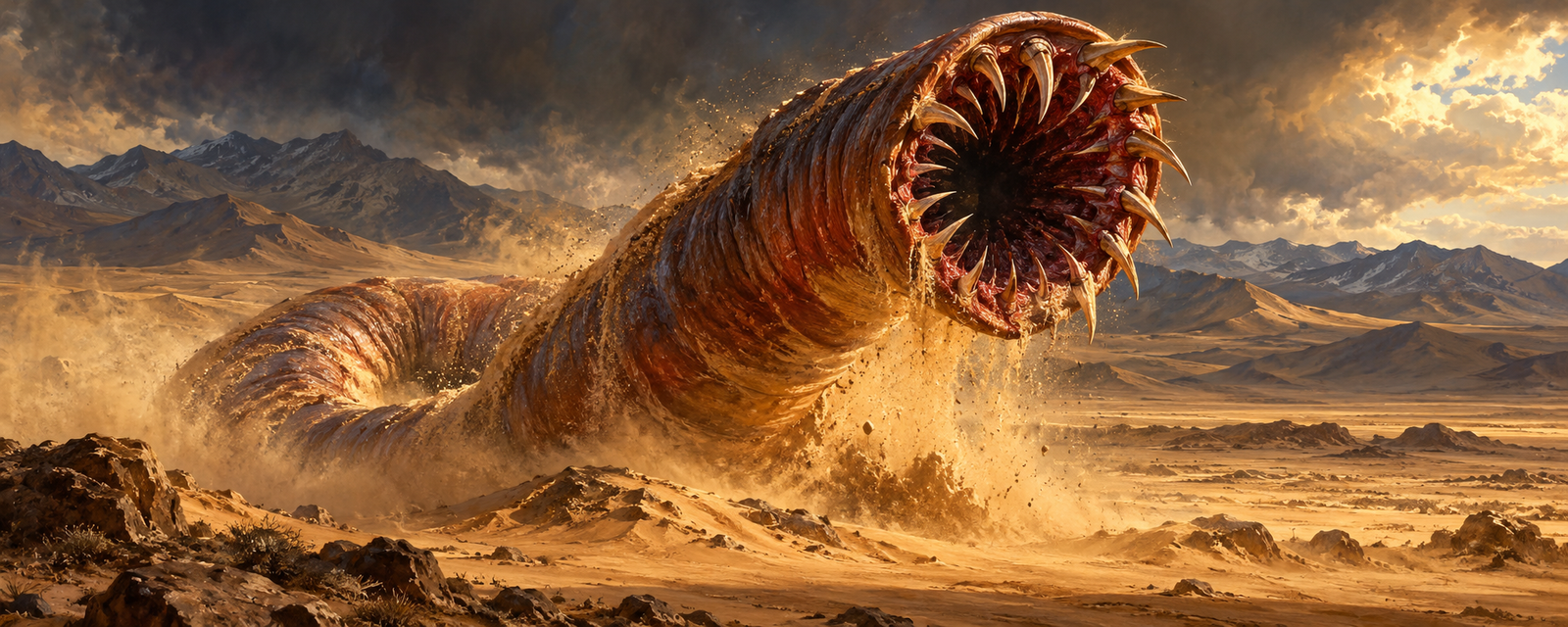
Across the Gobi, travellers tell of the olgoi-khorkhoi: a deadly worm that lies beneath the sand and strikes without warning. Some accounts describe a short, red, sausage-shaped creature whose touch is fatal; others tell of a much larger burrowing predator armed with venom, corrosive blood and electrical attacks. The folklore and the game statistics below are related interpretations, not evidence of a real animal or interchangeable creatures.
At a Glance
Identity: Mongolian death worm (olgoi-khorkhoi), a Gobi Desert cryptid; the larger Pathfinder death worm is a fantasy bestiary interpretation.
Habitat: Arid dunes, gravel plains and rocky desert margins.
Campaign range: Gobi Desert; populations elsewhere are unconfirmed.
Temperament: Reclusive ambush predator; dangerous when disturbed.
Combat role: Burrowing ambusher, with poisonous contact and ranged elemental attacks in the published game versions.
Rules currently available: D&D 5e (2014-era third-party interpretation), CR 2; Pathfinder 1e, CR 6. These are distinct rules treatments.
Rules sources: The fifth-edition version comes from EN World’s Epic Monsters; the Pathfinder CR 6 creature appears in Pathfinder Bestiary 2. Their sizes, abilities and challenge ratings differ. Neither stat block should be described as an official 2024 D&D or D&D 3.5e version.
Behaviour and Warning Signs
A death worm spends most of its time out of sight. For a game encounter, let the party notice a low ridge of moving sand, an abrupt tremor underfoot, or a camel refusing to cross a patch of open ground before the attack. The creature is not a scheming villain: it reacts to nearby movement and disturbance, strikes exposed prey, and withdraws underground if the prey proves too dangerous. Reports of a dislike of yellow objects or the goyo plant belong to the folklore and need not function as automatic game-rule weaknesses.
If Violence Starts
The worm favours an isolated target at the edge of a caravan rather than charging a defended formation. In the fifth-edition version, its toxic blood punishes nearby melee attackers and its lightning breath threatens clustered opponents; in Pathfinder, venomous skin and corrosive blood make grappling and metal-bladed attacks risky. Show these dangers through what happens to equipment, animals and the ground, then give the party room to change tactics. A wounded worm can burrow away rather than fight to the death; pursuing it into unstable sand should be a deliberate choice, not a compulsory second battle.
Encounter — The Vanished Camel
At a Gobi watering stop, a caravan’s last camel has vanished. Its lead rope disappears into a fresh furrow in the sand; a cracked water jar lies nearby. The caravan master will pay for the animal or its cargo, but refuses to risk another beast. The party can follow the furrow from firmer gravel, probe the ground with poles, or use a decoy to draw the worm into open terrain. A rescue is possible if they recover the trapped animal before the worm drags it deeper; if they arrive too late, the saddle packs remain recoverable from the disturbed sand. The worm may retreat after taking serious injury, leaving a dangerous but navigable burrow. No single failed tracking check should erase the encounter: frightened camels, collapsing sand and scattered cargo all point towards the same hunting ground.
Rules by Edition
Four distinct rules treatments follow: original unofficial 2024, 2014 and D&D 3.5e adaptations, plus the Pathfinder 1e published creature. The EN World CR 2 version is linked separately, not presented as our 2014 adaptation. Each version has its own challenge rating; do not combine their attacks or statistics.
Death Worm — 5.5e / 2024
Medium Monstrosity, Unaligned
AC 14 (natural armour); HP 68 (8d8 + 32); Speed 20 ft., Burrow 20 ft.
STR 16 (+3), DEX 14 (+2), CON 18 (+4), INT 2 (−4), WIS 12 (+1), CHA 5 (−3)
Saving Throws Con +6; Skills Perception +3, Stealth +4
Resistances Acid; Immunities Poison damage, Poisoned condition
Senses Tremorsense 60 ft., Darkvision 60 ft., Passive Perception 13
Languages None; CR 3 (700 XP; PB +2)
Sand Ambusher. While buried in sand or loose soil, the worm has Advantage on Dexterity (Stealth) checks. It can sense vibrations through the ground with Tremorsense but cannot sense creatures that are not in contact with that surface.
Corrosive Blood. Once per turn, when a creature within 5 feet damages the worm with a melee attack, that attacker takes 3 (1d6) Acid damage.
Actions — Bite. Melee Attack Roll: +5, reach 5 ft., one target. Hit: 10 (2d6 + 3) Piercing damage plus 7 (2d6) Poison damage.
Actions — Venom Spray (Recharge 5–6). Dexterity Saving Throw: DC 14, each creature in a 15-foot Cone. Failure: 21 (6d6) Poison damage. Success: Half damage. A creature with Total Cover from the worm is unaffected.
Encounter note: The listed CR is provisional homebrew design, not an independently playtested rating. The worm attacks from cover, sprays a group if possible, and withdraws when badly wounded.
Death Worm — 5e / 2014
Medium monstrosity, unaligned
Armor Class 14 (natural armor); Hit Points 68 (8d8 + 32); Speed 20 ft., burrow 20 ft.
STR 16 (+3), DEX 14 (+2), CON 18 (+4), INT 2 (−4), WIS 12 (+1), CHA 5 (−3)
Saving Throws Con +6; Skills Perception +3, Stealth +4; Damage Resistance acid; Damage Immunity poison; Condition Immunity poisoned; Senses darkvision 60 ft., tremorsense 60 ft., passive Perception 13; Languages —; Challenge 3 (700 XP; provisional).
Sand Ambusher. The worm has advantage on Dexterity (Stealth) checks while hidden beneath loose sand. Tremorsense detects vibrations through the ground, not airborne creatures.
Corrosive Blood. Once per turn when a creature within 5 feet hits the worm with a melee attack, that creature takes 3 (1d6) acid damage.
Actions — Bite. Melee Weapon Attack: +5 to hit, reach 5 ft., one target. Hit: 10 (2d6 + 3) piercing damage plus 7 (2d6) poison damage.
Actions — Venom Spray (Recharge 5–6). The worm sprays venom in a 15-foot cone. Each creature in the cone makes a DC 14 Dexterity saving throw, taking 21 (6d6) poison damage on a failed save, or half as much on a success. Total cover prevents exposure.
Original unofficial 2014-format adaptation, not the separate EN World CR 2 creature. Challenge rating is a design estimate.
Death Worm — Pathfinder 1e
XP 1,200
N Large magical beast
Init +5; Senses darkvision 60 ft., low-light vision, tremorsense 60 ft.; Perception +13
Defense
AC 17, touch 10, flat-footed 16 (+1 Dex, +7 natural, −1 size)
hp 57 (6d10+24, including Toughness)
Fort +8, Ref +6, Will +3
Offense
Speed 20 ft., burrow 20 ft.
Melee bite +9 (2d6+6 plus poison)
Space 10 ft.; Reach 5 ft.
Special Attacks poison, venom spray
Statistics
Str 18, Dex 13, Con 16, Int 2, Wis 12, Cha 5
Base Atk +6; CMB +11; CMD 22
Feats Improved Initiative, Skill Focus (Perception), Toughness
Skills Perception +13, Stealth −3 (+5 in sand); Racial Modifiers +8 Stealth in sand
Ecology and Special Abilities
Environment warm deserts; Organization solitary; Treasure none.
Poison (Ex). Bite—injury; save Fort DC 16; frequency 1/round for 2 rounds; effect 1d4 Con damage; cure 1 save. DC Constitution-based.
Venom Spray (Ex). As a standard action once every 1d4 rounds, the worm sprays a 30-foot line of corrosive fluid, dealing 4d6 acid damage (Reflex DC 16 half). DC Constitution-based.
Sand Hunter (Ex). The worm has a +8 racial bonus on Stealth checks in loose sand, included above.
This is an original unofficial Pathfinder 1e adaptation, not Paizo’s CR 6 death worm. For the published creature, use the Pathfinder Bestiary 2 reference. CR is provisional.
Death Worm — D&D 3.5e
Large Magical Beast
Hit Dice 6d10+18 (51 hp); Initiative +5; Speed 20 ft. (4 squares), burrow 20 ft.; AC 17 (−1 size, +1 Dex, +7 natural), touch 10, flat-footed 16
Base Attack/Grapple +6/+14; Attack bite +9 melee (2d6+6 plus poison); Full Attack bite +9 melee (2d6+6 plus poison); Space/Reach 10 ft./5 ft.
Special Attacks poison, venom spray; Special Qualities darkvision 60 ft., low-light vision, tremorsense 60 ft.
Saves Fort +8, Ref +6, Will +3; Abilities Str 18, Dex 13, Con 16, Int 2, Wis 12, Cha 5
Skills Hide −3 (+5 in sand), Listen +6, Spot +6; Feats Alertness, Improved Initiative, Track
Environment warm deserts; Organization solitary; Challenge Rating 4 (provisional); Treasure none; Alignment always neutral; Advancement 7–9 HD (Large)
Poison (Ex). Injury, Fortitude DC 16, initial and secondary damage 1d4 Constitution. The save DC is Constitution-based.
Venom Spray (Ex). Once every 1d4 rounds, the worm spits caustic venom in a 30-foot line. Creatures in the line take 4d6 acid damage (Reflex DC 16 half). The save DC is Constitution-based.
Buried Hunter (Ex). A death worm receives a +8 racial bonus on Hide checks in sand or loose desert soil; the bonus is included in the situational skill value above. The worm may burrow beneath sand but does not leave a usable tunnel.
Conversion note: This is an original 3.5e creature, not a transcription of Paizo’s Pathfinder death worm. The provisional CR should be adjusted after encounter testing.
2014 D&D and Pathfinder 1e — Published References
The EN World fifth-edition Mongolian death worm is a third-party CR 2 creature, not the original CR 3 adaptation above. The Pathfinder Bestiary 2 death worm is a different, Large CR 6 creature with venomous skin, corrosive blood, an acid line and an electrical attack. Use each publisher’s linked rules for its edition; do not merge their statistics.
Video Field Notes
Selected viewing: Three useful treatments of the Mongolian death worm legend. These are background for GMs, not evidence that the creature exists.
Ben G Thomas — The Mongolian Death Worm
Folklore, claimed abilities and the evidence behind the stories. Watch on YouTube.
Animal Planet — The Mongolian Death Worm
An expedition-style treatment of the legend. Watch on YouTube.
PBS Monstrum — Death Worms: Fact or Fiction? A useful wider history of monstrous-worm traditions and Roy Chapman Andrews’s account. Watch at PBS.
Sources and Link Guide
In the campaign: Gobi Desert — the worm’s established setting; World Bestiary — other creatures and regional encounters.
Folklore research: Atlas Obscura — Inside the Decades-Long Hunt for the Mongolian Death Worm (reporting with folklore specialist commentary); PBS Monstrum (history and changing versions of the legend). Roy Chapman Andrews recorded second-hand reports in On the Trail of Ancient Man (1926), without claiming to have found the creature.
Rules provenance: Paizo’s Pathfinder Bestiary 2 death worm (CR 6) and Mike Myler’s EN World 5e creature (CR 2) are separate published designs. The four edition panels above are original, unofficial SpiralWorlds adaptations; their challenge ratings remain provisional.
Explore the Desert Bestiary
Explore the Gobi Desert campaign region, then browse other desert predators such as the Cerastes and Seps. These creatures have distinct traditions and are not variants of the Mongolian death worm.
Keep this reference growing
If this page helped with your reading or game, you can support its upkeep or explore the curated books.
Explore the Bookshop — epics, classics and stories behind imagined worlds.