
Ulm — Guilds, Cloth and the Danube

Ulm’s wealth is measured in cloth, but its independence rests on the oaths of those who make and sell it. Between the Blau channels and the Danube, a trader may find guild inspectors, boatmen, councillors and former soldiers who remember the cost of the recent wars. No single lord owns the city; its citizens intend to keep it that way.
At a Glance
- Status: Free Imperial City on the Danube, governed by its own civic institutions under Imperial privileges.
- Government: mayor and council, with a Great Council of forty established by the 1397 Great Civic Oath; the guilds hold thirty of its seats.
- Position: where the Blau meets the Danube, with trade routes toward the Upper Rhine and through Upper Swabia, including Ravensburg’s merchant network, to Lake Constance, the Alps and northern Italy.
- Livelihoods: production and inspection of fustian (Barchent) cloth, merchants’ warehouses, tanning, fishing, river carriage, food markets and workshops.
- Neighbours: smaller Imperial towns, the divided Württemberg county and other Swabian territorial lords; the recently embattled Imperial City of Esslingen is a fellow city whose political fortunes still matter here.
- Recent wound: Ulm’s commander Walter Ehinger died with other city captains at Mutzenreis in 1449, during the war against Ulrich V of Württemberg and his allies.
What Is Happening Right Now?
The Quality Seal Is Under Challenge
Ulm’s fine fustian reaches merchants in Italian and northern markets because its makers guard their reputation. Municipal cloth inspectors scrutinise the weave and finish before bales may bear the city’s stamp. A consignor whose cloth has been rejected faces a ruined journey; a guild officer who accepts a bribe could injure every honest weaver in the city. An arriving trader is not only negotiating a price but deciding whose seal can be trusted.
The Defeat at Mutzenreis Still Has a Cost
Ulm was among the Imperial cities that supported Esslingen against the territorial princes. On 3 November 1449, the allies were defeated on the Plienshalde; Walter Ehinger of Ulm and Hermann Bopfinger of Nördlingen were among the captains killed. The peace of 1454 between Esslingen and Württemberg matters beyond Esslingen’s walls. Merchants argue over compensation for losses sustained while convoys were diverted or escorts were raised. The dead will not return merely because the principals have signed their settlement.
A Civic Oath Is Also a Political Bargain
Under the Great Civic Oath of 1397, Ulm’s organised trades exercise considerable influence over its government. Patrician families retain wealth and connections, yet a wealthy house cannot simply instruct the guild representatives to overlook a debt or breach of standards. The city’s system offers a visitor several possible patrons—and several officials who may lawfully refuse the same request.
Places That Matter
The Rathaus — Commerce and Judgment
First built as a trading house and enlarged around 1370, the building by the market has accommodated council business since the late fourteenth century and has been called the Rathaus since 1419. Merchants climb its steps with cloth samples, account books and disputed weights; witnesses wait in the passages for their names to be called. A trader who cannot prove a bale’s origin may find that a fine costs more than a journey across the Alps.
The Blau Channels — Fishers and Tanners
In the low streets near the river, the Blau divides into channels before joining the Danube. Fishing boats, vats, wooden walkways, mills and wet hides share the space. The tanners’ trade smells, the water rises after rain, and a boatman may know which cellar steps are submerged. Missing hides or stolen cargo can be traced through buyers and carriers; flooding can spoil legitimate work without the intervention of a spirit.
The Great Stone Works — A City Building within Its Walls
In 1377 the people of Ulm began the great stone building within their walls. It has become the undertaking of generations: wagons deliver blocks, masons balance on scaffolds and guild representatives argue over wages and supplies. No passer-by can mistake it for finished work. An unpaid contractor may seek the council’s help; a badly set stone can threaten the men beneath it.
The Danube Quays and Western Roads
Goods arrive by road from the west and north, then pass toward the Danube and southern markets. River transport saves labour when the water and weather permit it; loaded wagons still need passable banks, bridges, guarded doors and reliable buyers. A watchman who controls a quay may delay bales as effectively as a noble controlling a pass.
Geislingen, Albeck and the City Lands
Ulm governs far more than its streets. Its extensive Imperial-city territory includes Geislingen, Albeck and Leipheim and numerous villages, fields, mills and woodlands. Rural tenants bring rents and produce to a council based in the city, while its bailiffs must deal with local customs and neighbouring jurisdictions. Control of grain, timber and roads explains why the city can defend its markets but also why distant villages may resent a tax imposed by merchants who rarely visit.
Guilds, Outsiders and Older Rights
The business of Ulm is carried by dyers, weavers, inspectors, boatmen, tanners, provisioners, clerks and guards, none of whom necessarily shares the priorities of a patrician merchant. The Great Council gives guild representatives political leverage, but that does not make all craftsmen one faction or settle the price of their work. A poor journeyman may depend on an influential master even while both are formally subject to the same city law.
Merchants and craftworkers from other peoples follow the roads south and west, bringing goods whose value the city knows well. A foreign guild’s mark might guarantee a metal fitting, a navigational instrument or a bolt of cloth. Ulm’s officers can arbitrate a sale inside the walls, but the debt may be owed to a community far beyond the council’s jurisdiction. Trusted interpreters and agents can be worth as much as the cargo they represent.
Along the Blau, the complaints heard most often concern mills, spoiled dye, stolen hides and flooded cellars. A tannery worker knows which stretch of bank turns treacherous after rain; a boatman knows who can open a sluice without permission. There are older stories about things beneath deep water, but the quarrels that reach the council usually have names, witnesses and a price.
Travel, Trade and Law
For cloth, ask who has inspected the bolt and whether the city stamp is genuine. For river travel, ask the boatmen where shallows or damaged banks have changed since the last voyage. For a council petition, gather witnesses, account books and names of the guilds or houses most affected before expecting a hearing. A wealthy stranger can purchase hospitality, but not unquestioned obedience from the council.
The False Stamp: a merchant arrives with three bales of cloth bearing Ulm’s mark. The official inspector refuses two, alleging false seals. The trader insists a guild master approved them and has receipts to prove it. A porter who moved the bales overnight will testify only if his brother’s apprenticeship is protected. Characters can inspect the weave, interview the carrier, recover the original register and arrange a lawful sale or return before the convoy leaves for Italy.
The Captain’s Account: an account of funds raised to support Esslingen during the war has gone missing. A relative of a soldier killed alongside Walter Ehinger demands to know why the promised compensation has not been paid. The guild treasurer blames a vanished courier; a council officer has an earlier copy that lists different sums. The party can investigate the discrepancy, secure testimony or negotiate restitution, but exposing the missing money may reopen a bitter dispute between families who fought on the same side.
The River Gate: damaged quay steps force a grain barge to unload at a private landing. The boatman’s claim of necessity is genuine; the merchant’s storage fee is not. A flooded cellar contains the evidence, and whoever retrieves it must decide whether to support the boatmen, the warehouse owner or the poorer households waiting for grain.
Historical Foundations and Further Journeys
The City of Ulm’s history records the 1376 siege, the 1377 building campaign and the 1397 council settlement. Its economic history documents Ulm’s cloth trade and the municipal quality inspection that supported it. The Ulm city archive preserves the Great Civic Oath; the Rathaus account dates its civic use and its earlier market function; the Blau quarter history records its fishing and tanning livelihoods. The Esslingen city archive’s Mutzenreis account records the deaths of Walter Ehinger and Hermann Bopfinger in 1449 and the losses imposed on the alliance.
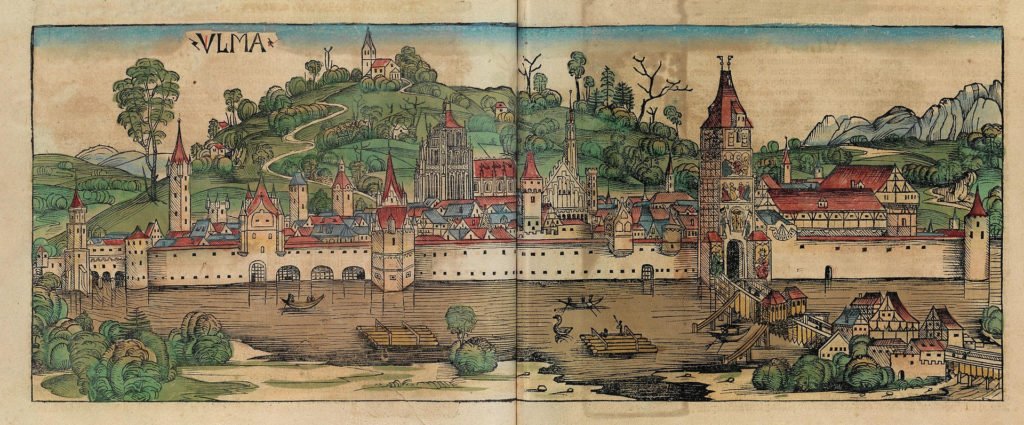
The panorama below comes from the 1493 Nuremberg Chronicle. Its towers and riverbanks belong to a later artist’s view of Ulm; the city’s workshops, quay traffic and unfinished great building are the landmarks that matter to travellers at the present time. Westward the roads lead to Esslingen and Württemberg; farther south the Swabian Alb marks the upland approaches.
Ulm present blossoming is mostly due to the export of high-quality textiles. The city is situated at the crossroads of important trade routes extending to Italy.
Keep this reference growing
If this page helped with your reading or game, you can support its upkeep or explore the curated books.
Explore the Bookshop — epics, classics and stories behind imagined worlds.