
Delos — The Silent Island of Apollo and Artemis
At a Glance
| Place | Delos, a small rocky island among the Cyclades, near Mykonos and Rheneia |
|---|---|
| Present condition | Ruined and largely uninhabited island with ancient streets, sanctuaries and harbours |
| Divine patrons | Apollo, Artemis and their mother Leto |
| Ancient landmarks | Sanctuary of Apollo, Sacred Lake, Terrace of the Lions, Kynthos, theatre quarter, harbour and ancient houses |
| Access | By hired vessel from neighbouring islands; landing depends on winds and the captain |
| Adventuring character | Expedition to a deserted holy island, broken inscriptions, forgotten offerings, dangerous coast and ancient divine guardians |
The boatman refuses to remain after sundown. Before his passengers he lays a scrap of parchment: a sketch copied from an old inscription, a drawing of a lion, and a warning that anyone carrying stolen silver must be left on the shore. On the deserted island, the ruins seem to face inward toward a place the mariners will not name. The travellers have only a few hours to find what they came for—or convince the captain to return.
Delos was once both a great sanctuary and a bustling international trading port. Those thriving markets and residential streets belong to its ancient past. In the later medieval world, weathered walls, broken statues and abandoned precincts lie exposed to wind and sea. A visiting scholar may trace lines of an inscription through the dust while an island captain worries about the rising waves. The old gods are another matter: a ruined city need not be an empty sacred place.
What Is Happening Right Now?
The ancient town has been abandoned for centuries. There is no permanent civic market, active ancient senate or ordinary chain of temples dispensing divine services. Most arrivals are sailors taking shelter, pilgrims, travellers, scavengers, scholars and people with private reasons to visit the ruins. The bare rocks and the memory of Apollo’s sanctuary make it as valuable to dreamers as to thieves.
In 1445, the Italian antiquarian Cyriacus of Ancona visited Delos and recorded inscriptions and ancient remains. One name he copied has since vanished from the exposed stone, and Marios believes the missing line identifies the buried dedication the Keeper seeks. Cyriacus carried the record away, but the boatmen of Mykonos and those who tend the old offerings have their own memories of what was taken from the holy ground.
Places to Explore
The Ancient Harbour
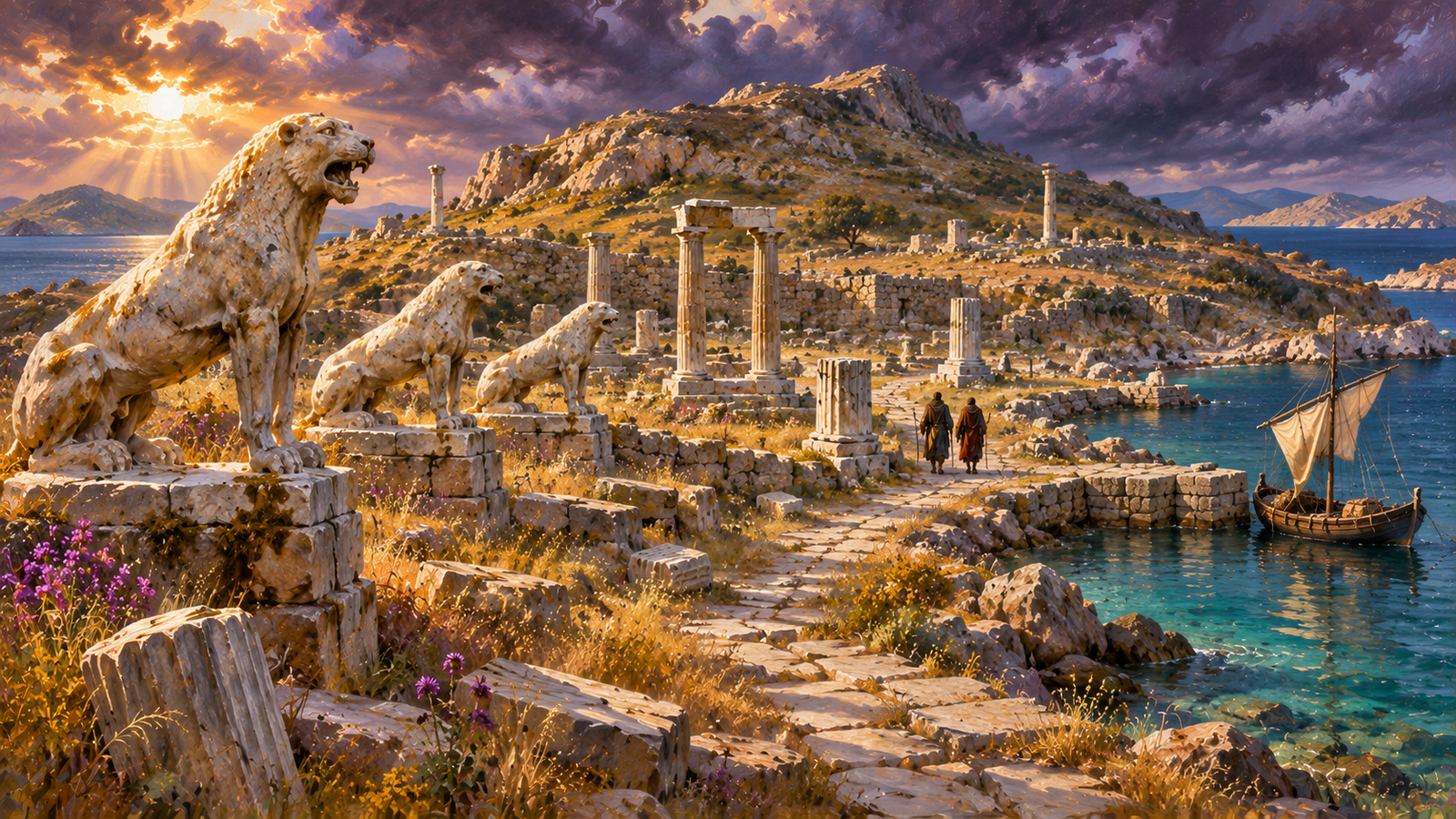
The remains of quays and sea walls testify to the old free port, when ships from across the Mediterranean brought merchants, travellers, goods and gods. Today, only occasional boats land beside the deserted quays when the winds allow; the harbour’s customs officials and merchants have vanished. The first difficulty is getting ashore, and the second is arranging to leave.
The Sanctuary of Apollo
The sacred centre gathers ruined buildings, foundations, offerings and inscriptions devoted to Apollo. A stranger may find an ancient votive, the trace of a procession or an inscription whose final line has been deliberately removed. Even an unenchanted stone can matter to people who believe their families possess an old promise to the god.
The Sacred Lake and the Terrace of the Lions
The lakeside is bound to Leto’s arrival and the births of Apollo and Artemis. Weathered lions stand watch over the sacred landscape. At dusk a cracked lion turns its head toward a stranger approaching the terrace. The Keeper of the Lions, an old guardian bound to the sanctuary, has awakened because a carved dedication was taken from its base.
The Keeper remembers the ancient island and the names of people whose gifts once stood beneath the lions. It cannot protect every empty street, and it does not want to kill explorers for curiosity. It asks that the stolen fragment be brought home and warns the party that the wrong inscription, already copied by a scholar, points to a second missing offering. Marios the stone-cutter knows where the fragment is hidden; his fear of the collector who paid him is greater than his fear of the god’s messenger.
The Theatre Quarter and Empty Houses
Homes, courtyards, shops and the theatre belong to Delos’s flourishing past. Collapsed walls leave insecure stairways, pits, cisterns and hiding places. A gang using an ancient house as a temporary storehouse could be responsible for distant torchlight, and a hostile spirit could use that trespass to draw attention to a buried offence.
Mount Kynthos
Climb the rocky heights for a commanding view of the island, its harbours and the surrounding Aegean. Weather changes quickly, and an exposed ridge can be hazardous to visitors unused to climbing. Ancient shrines and lookout places offer a choice between searching for a lost mark and making camp before the wind becomes violent.
Preparing the Crossing
There are no inns, healers, stables or shops on the uninhabited island. On nearby Mykonos, Helena hires out her small sailing boat with a crew and insists on a clear agreement for the return passage. Her cousin Niko keeps a simple lodging near the harbour where travellers can buy meals, fill waterskins, store bulky gear and hire an interpreter. Neither will promise a crossing in dangerous wind. A party seeking a longer stay must bring its own provisions and be prepared to sleep under shelter made from stones and canvas without damaging sacred ruins.
People and Rival Interests
Cyriacus of Ancona. A real antiquarian traveller who visited Delos in 1445. His notes and sketches can lead the characters to an inscription and a centuries-old secret. The visit itself is historical; any further intrigue involving his papers is part of the adventure.
Helena, the boat-owner, knows the safest landings and will not risk her crew for threats or titles; she is wary of treasure-seekers who make promises they cannot keep. Marios, an itinerant stone-cutter, sold a carved dedication to a collector and regrets the bargain because the Keeper follows him in his dreams. The Keeper of the Lions guards the sacred terrace and wants the dedication restored. Its memory reaches far into the island’s ancient age, but its concern is the fate of a particular place and offering, not the rule of a living city.
What the Old Gods Still Want
Apollo still casts a clear light on the broken inscriptions of his old sanctuary. One line appears at sunrise and fades when a thief approaches it. Artemis watches the wild edges of the island; a hunter who kills a nesting bird beneath her shrine finds every arrow turning aside until restitution is made. Leto remains remembered as the mother protected by the island in her hour of need. The gods are not providing services to visitors: their attention falls on particular acts of care, theft and desecration.
The Keeper’s stone lion has already turned towards Marios, and the missing fragment has awakened old inscriptions near Apollo’s sanctuary. Those who return it may hear the guardian recite a passage no mortal scholar has read in centuries. A thief who conceals it will see the lions watching from every broken doorway until the object is surrendered. The gods’ favour does not make the sea safe, but it can reveal which ancient promises still hold.
Dangers, Supplies and Travel
Bring drinking water, food, shade, rope, suitable footwear and a trustworthy pilot. Most services must be arranged on a neighbouring inhabited island. Hazards include broken masonry, heat, sudden winds, insecure wells and hostile sailors; if the gods are offended, supernatural consequences can make the expedition far more dangerous. A departing captain may determine whether visitors escape an approaching storm at all.
Travel onward requires another sea crossing. A cargo captain from a nearby island may reach Athens only after stopping elsewhere. Delos is not linked to the mainland by a permanent road or a guaranteed ferry schedule.
Three Adventure Openings
- The missing line. A patron owns a copied inscription dated to Cyriacus’s visit, but the last words were cut away. A local guide insists the missing line names an offering his family pledged to protect. The characters can sell the inscription, restore its meaning or use it to settle an old wrong.
- The lion’s eyes. A sailor sees one stone lion facing a different direction on two visits. Thieves have used its plinth to mark a smuggling cache, while a guardian spirit demands the offerings be returned before anyone escapes.
- A landing after dark. The boat is forced ashore by a storm. A stranger offers shelter in a house that should have been uninhabited for a thousand years. Everyone inside claims to be waiting for a festival that ended centuries ago.
When the Party Returns
Return the carved dedication and the Keeper allows Helena’s passengers to cross the terrace in peace. Marios helps decipher the next inscription and may become a companion on a later expedition; Niko saves the travellers a dry room in Mykonos before another voyage. If the fragment is sold, the lion watches the collector’s ship until it reaches harbour, and Marios refuses to approach Delos again without trusted protection. The island remains abandoned, but it remembers those who came ashore.
Deeper History
Delos grew into a major sanctuary in ancient Greece and later an international free port, celebrated for the cults of Apollo and Artemis. War, destruction and changing trade led to long decline; the ruins came to attract scholars and travellers in the fifteenth century. The ancient harbour quarter, houses, sanctuary, theatre and lion statues are genuine features of the island, although an accessible ruin today is not necessarily exposed and intact to the same degree in every earlier century.
Sources and Connections
Greek Ministry of Culture — Archaeological Site of Delos; UNESCO — Delos; French School at Athens — History of the Delos excavations (including Cyriacus’s 1445 visit).
Return to Greece and the Balkans, explore the Hellenic gods or continue to Crete.
Keep this reference growing
If this page helped with your reading or game, you can support its upkeep or explore the curated books.
Explore the Bookshop — epics, classics and stories behind imagined worlds.