
Hildesheim: Power, Piety, and Conflict at the Heart of a Fractured Realm
Hildesheim: Power, Piety, and Conflict at the Heart of a Fractured Realm
Hemmed in by ambitious dukes and bound by sacred law, the Bishopric of Hildesheim endures as a fractured temple-state where ritual authority holds the land together—and threatens to tear it apart.

A fragmented temple-state within the Holy Roman Empire, Hildesheim sustains its authority through sacred law and ritual legitimacy, holding together a scattered territory amid stronger and encroaching secular powers.
- Location:
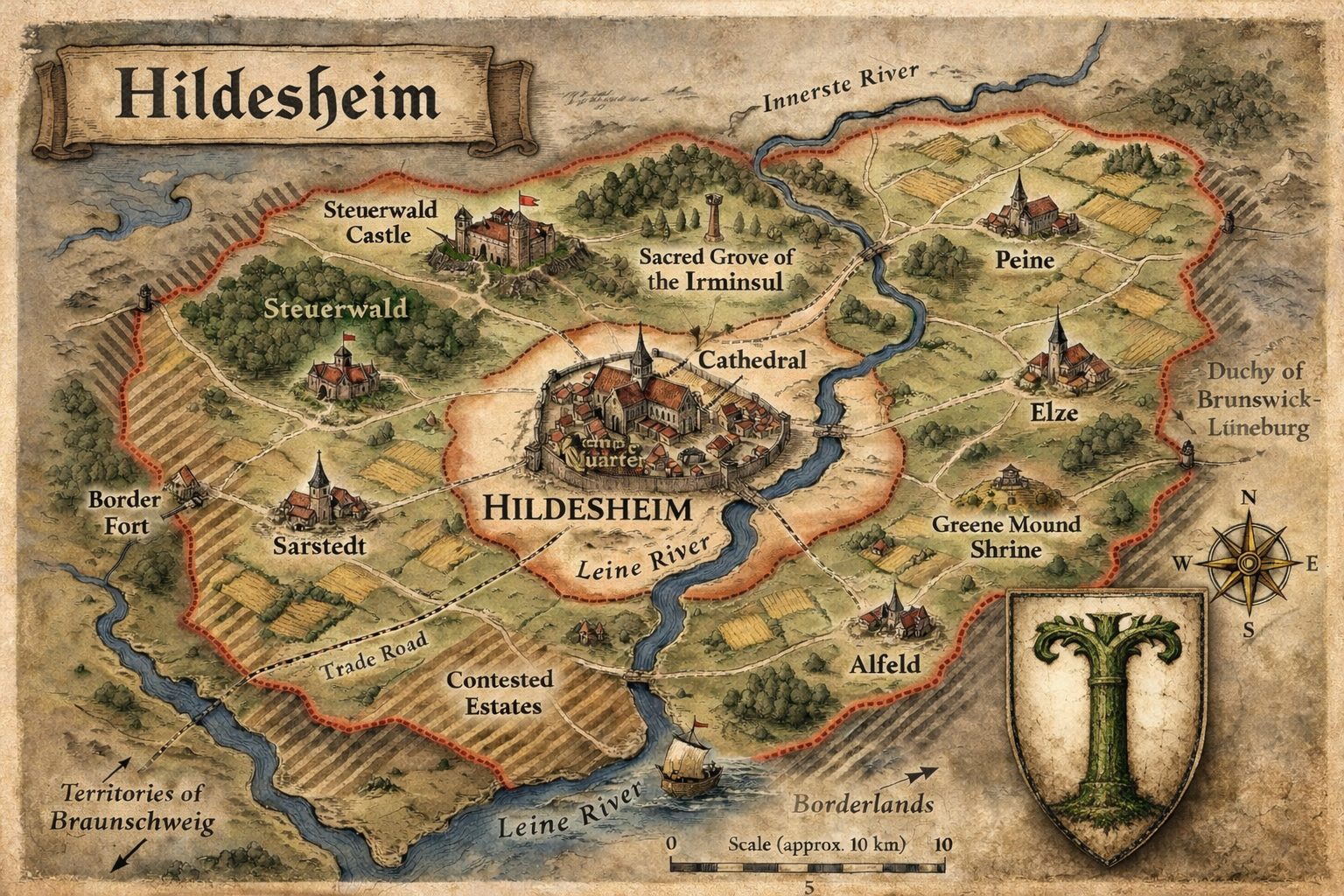
North-central Germany in Lower Saxony, between the Leine and Innerste rivers. The territory is non-contiguous, broken into enclaves surrounded by the lands of Brunswick-Lüneburg and other secular lordships. - Capital:
Hildesheim - Other Settlements:
Peine, Steuerwald (fortified administrative center), Elze, and numerous villages tied to temple estates - Other Names (historical):
Hochstift Hildesheim - Description:
A patchwork of fertile farmland, river valleys, and fortified religious centers. Hildesheim dominates as a dense urban core of stone buildings, temple complexes, and defensive walls. Beyond the city, authority thins—isolated estates, scattered settlements, and contested routes define the wider landscape. - Real-World Inspirations:
Late medieval ecclesiastical principalities of the Holy Roman Empire, adapted through a structured Saxon-Germanic religious framework.
Society & Culture
- Culture & Daily Life:
Urban life centers on temple institutions, guild activity, and regulated markets. Craft production and trade shape the city, while rural communities follow agricultural cycles tied to obligation, land, and ritual observance. - Class Structure:
High Priest-Lord and temple council → Priesthood → Urban elites (guild leaders, merchants) → Free citizens → Rural populations - Social Tensions:
Persistent tension between centralized temple authority and local traditions; friction between urban autonomy and rural obligation; and constant pressure from neighboring secular powers. - Moral & Philosophical Outlook:
Order is derived from alignment with divine forces and the proper observance of sacred law. Authority is justified through ritual legitimacy, but in practice must be continually negotiated and reinforced.
Belief System
- Religious Identity:
A structured Saxon-Germanic temple system in which divine order governs rulership, law, and land. - Pantheon / Powers:
- Wodan — authority, rulership, knowledge
- Donar — law, protection, oaths
- Saxnot — identity, land, lineage
- Religious Structure:
A centralized temple hierarchy led by the High Priest-Lord and supported by a council of senior priests. Beyond the city, local shrines and rural practitioners retain influence, often independent in practice. - Sacred Geography:
Sacred groves, river crossings, burial mounds, and long-established ritual sites form a parallel network of authority. These places carry enduring legitimacy, particularly in rural regions. - Ritual System:
Oath-binding ceremonies, seasonal rites tied to agricultural cycles, and offerings at sacred sites define religious life. Public rituals reinforce authority, while local practice preserves older traditions. - Religion and Authority:
Political legitimacy depends on recognition of divine favor. The High Priest-Lord governs through sacred law, but authority weakens where ritual control is absent or contested.
State Structure
- Government:
Temple-state governed by a High Priest-Lord, supported by a temple council - Power Hierarchy:
High Priest-Lord → Temple council → Priesthood → Urban councils → Rural leaders - Military:
Limited forces composed of retainers, levies, and hired troops. Defense relies on fortified positions and strategic holdings rather than sustained campaigns.
Economy & Infrastructure
- Agriculture dominates temple-held rural lands
- Trade routes pass through Hildesheim, supporting markets and guild production
- Craft industries operate within the city
- Roads are functional but inconsistent; rivers assist transport
- Wealth is concentrated in temple institutions and urban elites
Technology Level
Late medieval: fortified stone construction, steel arms and armor, administrative literacy, and established legal systems.
Historical Pressure
- Encroachment from Brunswick-Lüneburg and neighboring powers
- Growing autonomy and influence of urban guilds
- Tension between centralized temple authority and local sacred traditions
- Fragmented territory limiting direct control
Snapshot

Hildesheim stands as a structured and devout temple-state, its authority centered in a fortified city defined by ritual, administration, and trade. Its temples and institutions project stability, reinforcing the rule of the High Priest-Lord.
Beyond the city, that authority becomes uneven. The territory is fragmented, and control depends on recognition rather than force. Sacred sites outside the urban core retain influence independent of the temple hierarchy, and local traditions persist alongside formal structures.
Urban elites increasingly shape governance through economic strength, while rural communities remain tied to land, obligation, and older practices. The balance between these forces is delicate and constantly shifting.
Hildesheim endures through legitimacy, ritual, and negotiation—but its authority is continually tested by distance, division, and the ambitions of its neighbors.
Authority in Hildesheim rests on ritual legitimacy and legal recognition, both of which are increasingly contested. Power belongs to those who can assert sacred law, secure acknowledgment, and enforce claims across a fragmented and uneven territory.
Power Triangle
High Priest-Lord & Temple Council
- Goal: Preserve authority through sacred legitimacy
- Resource: Ritual law, temple network, administrative control
- Weakness: Limited military strength; dependence on recognition over force
Ducal Houses of Brunswick-Lüneburg
- Goal: Expand into and absorb Hildesheim’s lands
- Resource: Military strength, territorial cohesion, noble alliances
- Weakness: Internal rivalries and competing obligations
Urban Guild Powers of Hildesheim
- Goal: Increase autonomy and economic dominance
- Resource: Wealth, trade networks, civic organization
- Weakness: Reliance on stability and external protection
Gameplay Identity
A region defined by legal conflict, ritual authority, and political maneuvering, where control is achieved through influence, negotiation, and recognition rather than open warfare.
Player Activity Loop
- Act as envoys, negotiators, or legal agents between factions
- Escort sacred objects, charters, or high-value goods
- Investigate disputes over land, relics, or ritual rights
- Enforce or undermine sacred authority
- Explore contested estates and sacred sites
Current State
- Sustained territorial pressure from neighboring powers
- Rising influence of urban guilds within the capital
- Fragmented and uneven territorial control
- Sacred legitimacy increasingly challenged
Operational Map
- Hildesheim (Temple City):
Secure; center of ritual authority and governance - Steuerwald Stronghold:
Strategic defensive site anchoring regional control - Peine & Outlying Estates:
Contested zones with shifting influence - Sacred Sites (groves, mounds, shrines):
Variable control; often beyond direct temple authority
Control Overview
- Secure: Hildesheim and immediate surroundings
- Contested: Trade routes, estates, and border regions
- Unstable: Remote lands and independent sacred sites
Environment & Travel
- Rolling farmland and river valleys dominate the landscape
- Travel between major locations typically takes one to three days
- Roads are usable but inconsistent in safety and quality
- Hazards include banditry, faction interference, and territorial disputes
People & Creatures
- Clergy, merchants, administrators, and rural populations form the majority
- Threats arise from bandits, rival retainers, and faction-aligned forces
- Sacred locations are associated with guarded or unexplained presences
Culture in Motion
- Seasonal rituals tied to agricultural cycles
- Public oath ceremonies reinforcing authority
- Legal gatherings where disputes are resolved through sacred law
Encounter Tables
d12 Low Level (1–5)
d12 Mid Level (6–10)
d12 High Level (11+)
d12 Low Level (1–5)
- A land dispute escalates as both sides arrive with armed retainers
- A courier carrying sealed documents is pursued along a contested road
- A village refuses dues, citing an older charter
- A relic disappears from a shrine, drawing suspicion
- A merchant caravan is halted by an unauthorized toll
- A minor official seeks escort to deliver a ruling
- A boundary marker is moved overnight
- A rural estate declares independence from temple authority
- A sacred grove attracts unwanted attention
- A patrol challenges the party’s right to travel
- A trader is accused of smuggling restricted goods
- A legal hearing collapses into violence
d12 Mid Level (6–10)
- A fortified estate refuses to recognize temple authority
- A major trade agreement collapses under pressure
- A relic tied to legitimacy becomes politically contested
- A rival faction seizes control of a key route
- A town council openly challenges temple rule
- A legal case threatens to shift territorial control
- A high-ranking official is accused of corruption
- A stronghold becomes the focus of a tense standoff
- A sacred site begins to affect those nearby
- A tax convoy disappears without trace
- A noble house seeks external backing for its claim
- A border dispute escalates into armed conflict
d12 High Level (11+)
- A coordinated effort seeks to dismantle temple authority
- A major territory is seized by a rival power
- A relic capable of legitimizing rule is uncovered
- A coalition challenges the High Priest-Lord
- A city-wide conflict erupts between factions
- Sacred authority is publicly defied
- A strategic fortress falls, shifting regional control
- A legal ruling reshapes the political landscape
- A widespread uprising disrupts governance
- A powerful influence begins shaping leadership decisions
- External powers intervene directly
- The future of the bishopric is decided in open conflict
Key Settlement — Hildesheim
- Role: Ritual and administrative center
- Population: Several thousand inhabitants
- Ruler: High Priest-Lord
Notable Features
- Central temple complex forming the heart of authority
- Fortified walls and controlled access points
- Market districts shaped by guild influence
Current Issues
- Tension between temple authority and guild power
- External pressure from neighboring territories
- Internal disputes over legitimacy and governance
Quest Hooks
- Secure or intercept sacred documents or relics
- Investigate corruption within temple or guild leadership
- Resolve disputes threatening civic stability
Threats
- Political fragmentation
- External encroachment
- Erosion of ritual authority
Unique Element
Authority is determined by recognition of sacred legitimacy rather than force.
Why It Matters
Hildesheim is the point where ritual authority, political power, and economic influence converge, making it the center of regional tension and conflict.
GM Quick Summary
- Fragmented temple-state governed by sacred law and legitimacy
- Core conflict: ritual authority versus military power
- Players act as agents, negotiators, and intermediaries
- Danger arises from instability, dispute, and contested recognition
- Ideal for intrigue-driven and diplomacy-focused campaigns
Keep this reference growing
If this page helped with your reading or game, you can support its upkeep or explore the curated books.
Explore the Bookshop — epics, classics and stories behind imagined worlds.