
Duchy of Bar — René of Anjou and the Two Jurisdictions
Duchy of Bar (Vassal of Holy Roman Empire)
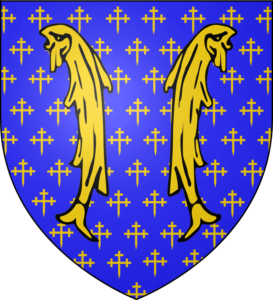
The Duchy of Bar is a small territory situated in the north-eastern part of France. Bordered by the Duchy of Lorraine and the County of Champagne, the Duchy of Bar is known for its rugged terrain and diverse population.
- Coat of Arms: The historic livery of Bar bears two golden barbels on a blue shield. Its distinctive fishes are echoed on ducal badges and merchants’ seals; heraldic variations must be distinguished from a modern flag.
- Status: Duchy with two distinct feudal jurisdictions: the Barrois mouvant, where lands west of the Meuse owe homage to the French Crown, and the Barrois non-mouvant, which remains within the Empire.
- General Alignment: Lawful Neutral.
- Capital City: Bar-le-Duc.
- Other Settlements: Stenay, Commercy, Void-Vacon.
- Common Languages: French, Lorraine Franconian.
- Religion(s): Local household, civic, rural, court and ancestral traditions.
- Demographics: The population of Bar consists mainly of French and Lorraine Franconian-speaking people. The majority of the population are farmers and peasants.
- Government: Feudal Monarchy.
- Legislature: The ruler of Bar governs with the help of an advisory council composed of lords and nobles.
- Population: The estimated population of Bar in 1453 is around 100,000.
- Places of interest: Bar-le-Duc’s castle and civic temples, the sacred archives in Mihiel, and the fortified town of Stenay.
- Current Ruler: René I of Anjou, Duke of Bar.
- Other Notable Residents: René of Anjou’s son John II, Duke of Lorraine, commands a neighbouring ducal court. Agents of their family pass between Bar-le-Duc and Nancy, carrying separate seals for the two principalities.
- Notable places: The castle and market of Bar-le-Duc, the sacred houses of Mihiel, the fortifications of Stenay, and the Meuse crossings that divide feudal obligations.
The Duchy of Bar is primarily a hilly region, with forests covering much of the area. The Meuse River runs through the Duchy, providing a major waterway for trade and transportation. The people of Bar are known for their resilience and independent spirit, with many small villages and towns scattered throughout the territory.
One of the most unique features of the Duchy of Bar is the presence of the elusive “Bar Beast.” According to local folklore, this creature roams the forests and hills of Bar, attacking travelers who venture too close to its lair. Some say the Bar Beast is a giant wolf, while others claim it is a mutated bear. Regardless of its true nature, the Bar Beast is a source of fear and fascination for the people of Bar.
In addition to the Bar Beast, the Duchy of Bar is also home to a number of other mythical creatures, including fairies, sprites, and goblins. These creatures are said to live in the forests and hills, and are known for their mischievous behavior.
What Is Happening Right Now? René’s stewards must answer two different obligations: in the Barrois mouvant a royal French warrant carries one kind of authority, while east of the Meuse the imperial lordship obeys different oaths. At Nancy, René’s son John II governs Lorraine; the family alliance is strong, but its courts cannot simply merge tax ledgers and noble privileges. A caravan charged twice at a river crossing must choose where to demand justice.
Despite its small size, the Duchy of Bar is an important strategic location, due to its proximity to the Duchy of Lorraine and the County of Champagne. As a result, the Duchy has often been the site of battles and skirmishes throughout its history.
Overall, the Duchy of Bar is a rugged and independent territory, filled with natural beauty and mysterious creatures.
Keep this reference growing
If this page helped with your reading or game, you can support its upkeep or explore the curated books.
Explore the Bookshop — epics, classics and stories behind imagined worlds.