
SpiralWorlds · European Campaign Region
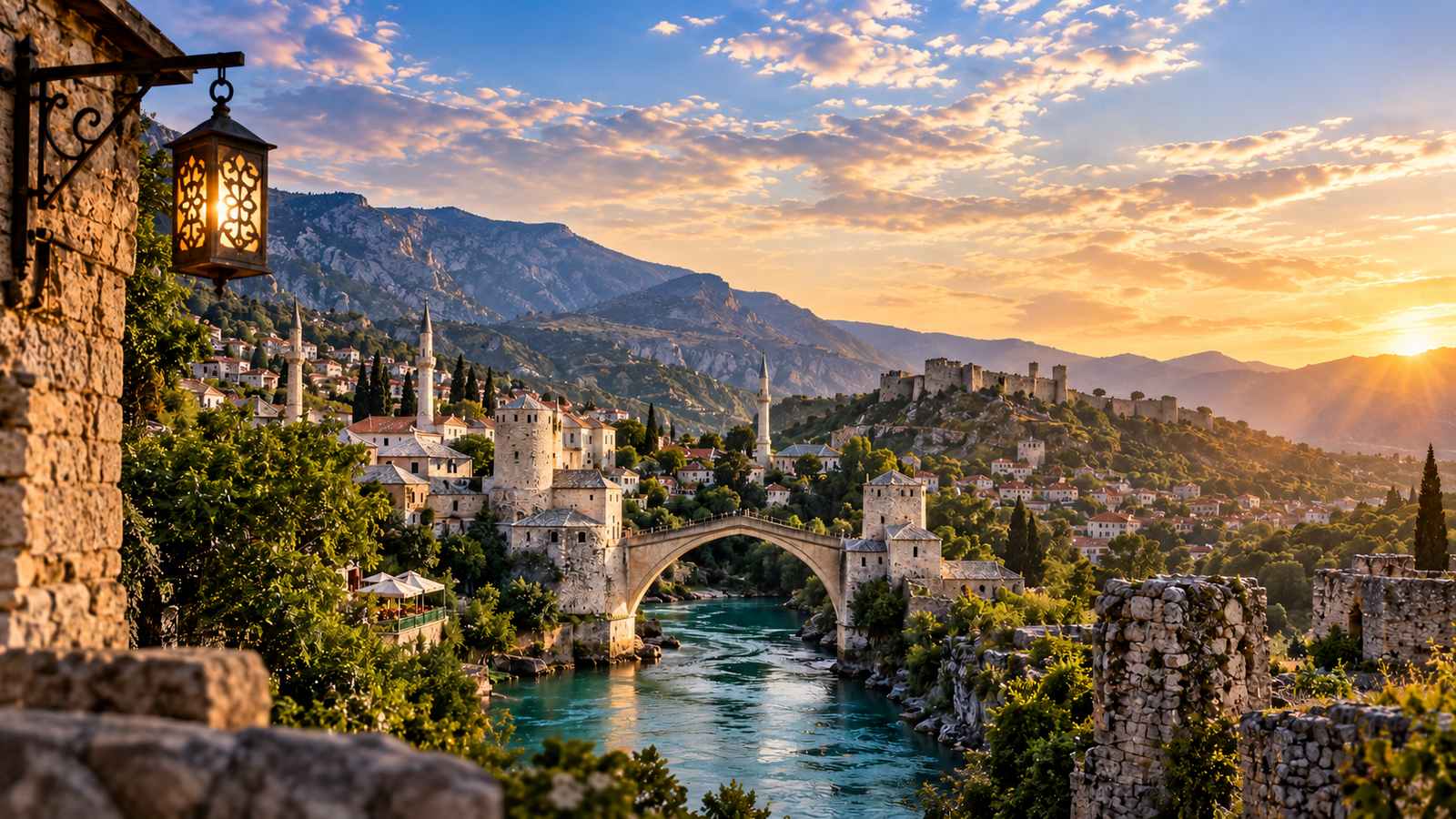
Kingdom of Bosnia — Mountain Kingdom of Silver, Fortresses and Rival Lords
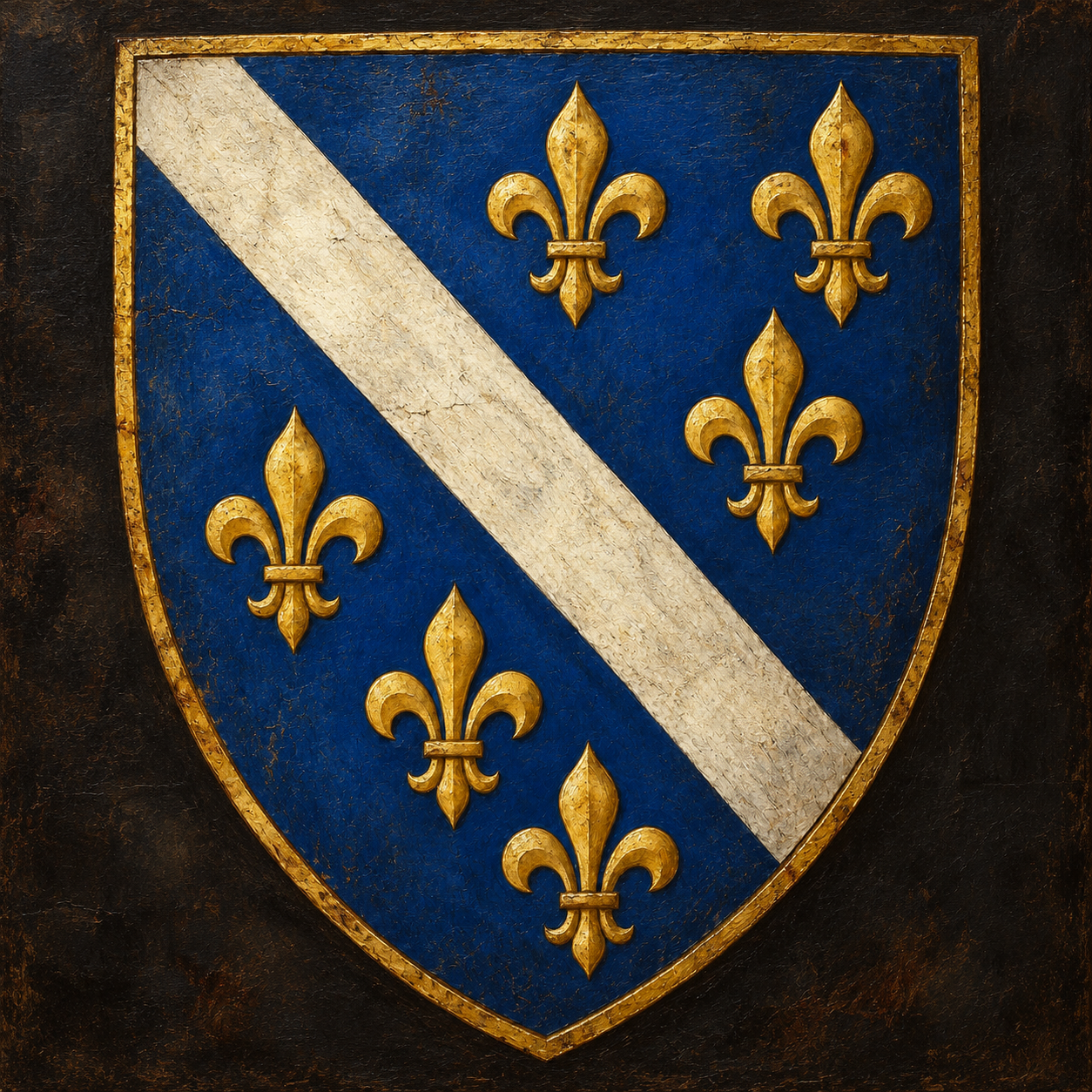
- Status
- Independent kingdom with powerful regional magnates and overlapping political obligations.
- Current ruler
- King Stjepan Tomaš of the Kotromanić dynasty.
- Royal centres
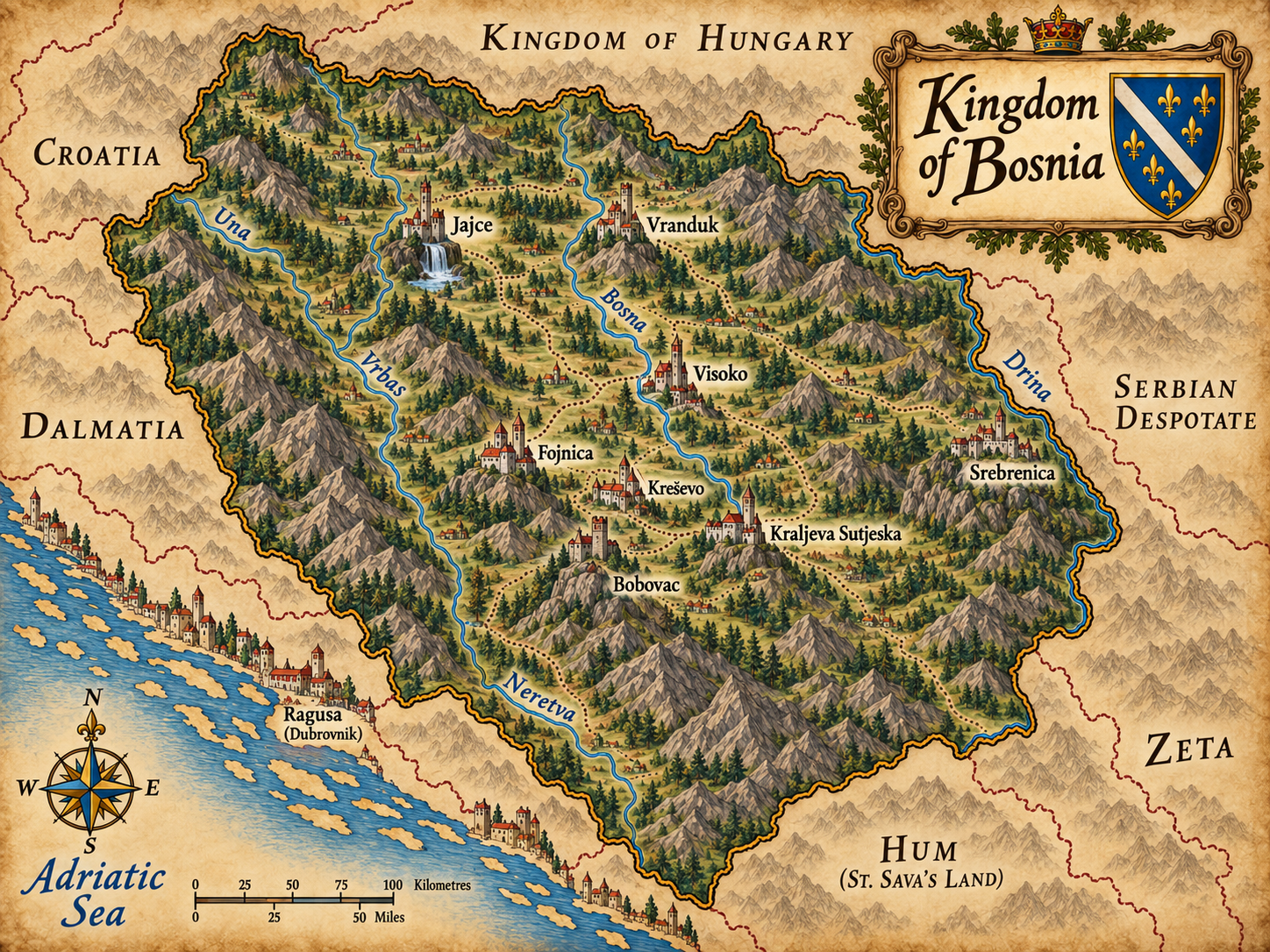
- Bobovac and Kraljeva Sutjeska, with Jajce an increasingly important royal fortress and residence.
- Government
- Feudal monarchy operating through the crown, noble households, castellans, local communities and negotiated obligations.
- Character
- Mountain fortresses, mining wealth, caravan trade, fragmented jurisdiction and dangerous frontiers.
- Languages
- Bosnian and neighbouring South Slavic vernaculars dominate ordinary speech; court, merchant and diplomatic business can require additional regional or learned languages. There is no universal Common.
- Major resources
- Silver and other mined metals, woodland products, livestock, craft production and control of inland trade routes.
- Campaign use
- Political missions, caravan travel, mine expeditions, fortress intrigue, frontier warfare, espionage and wilderness adventure.
Bosnia rises in steep ridges, wooded valleys and defensible river country where castles command roads and silver pays for politics. Royal authority reaches far, but it does not reach everywhere with equal strength. Powerful nobles maintain their own households, fortresses and alliances, merchant caravans follow guarded routes between mining towns and the Adriatic trade, and an argument that is settled lawfully in one valley may become a blood feud in the next.
Adventurers come here because Bosnia rewards people who can cross dangerous country, negotiate between rival authorities and solve problems that armed retainers cannot. A missing silver convoy can threaten royal finances. A disputed mine can bring nobles, merchants and dwarven specialists to the edge of violence. A mountain fortress may need rescuing before anyone agrees whose banner it should fly.
The kingdom is not a wilderness with a crown placed over it. It contains royal courts, mining centres, merchant communities, fortified towns and old political institutions. What makes Bosnia dangerous is that all of them exist inside a landscape where distance, lordship and difficult terrain give local power unusual weight.
What Is Happening Right Now?
Bosnia is living through an uneasy interval in which several conflicts have paused without being solved. King Stjepan Tomaš is trying to hold the kingdom together while powerful nobles retain the wealth, fortresses and armed households needed to resist royal pressure.
Stjepan Vukčić Kosača, one of the greatest magnates in the region and the father of Queen Katarina, has just concluded peace with the Republic of Ragusa after years of warfare around Konavle. The agreement has stopped open conflict, but merchants, dispossessed clients, soldiers and rival noble households still remember who profited and who suffered.
Farther east, the political map has become even more dangerous. The hobgoblin Ninefold Dominion now occupies Constantinople while the Ottoman state remains an entirely separate power with its own rulers, armies and Balkan ambitions. Bosnia must therefore watch more than one expanding eastern power while also managing its relationship with Hungary, neighbouring Balkan states and its own magnates.
The result is a kingdom where rumours of war affect the price of horses, powder, iron, salt and grain long before an army appears. Fortresses are inspected. Messengers ride under guard. Merchants quietly ask who controls the next pass. Noble households hire outsiders precisely because trusted local agents are often entangled in the rivalries they are supposed to investigate.
Why Adventurers Come to Bosnia
Silver and the Mines
Bosnia’s mineral wealth supports courts, markets, merchants and armed households. Mine owners need guards, engineers, assayers, monster hunters and negotiators whenever a shaft collapses, a claim is disputed or something beneath the mountain begins killing workers.
Castles That Control the Road
Fortresses matter because the country funnels movement through valleys, passes, bridges and river crossings. A single castellan can delay an army, close a trade road or strand travellers between rival jurisdictions.
Courts That Need Outsiders
Royal and noble households often need agents who do not already belong to a local faction. Escorts, investigations, discreet negotiations and retrieval missions are common ways for adventurers to become involved in Bosnian politics.
Old Country Beneath New Fortifications
Mines, wooded ravines and fortified hills repeatedly expose older ruins, sealed chambers, abandoned workings and supernatural claims that pre-date the people currently taxing the road above them.
Places Adventurers Can Actually Go
Bobovac — The Royal Fortress
Bobovac stands among the strongest symbols of royal authority. Its steep position, fortifications and connection with the crown make it a place for guarded audiences, treasury business, sensitive prisoners and decisions that the king does not want exposed to an open market town.
Use it for: royal intrigue, fortress defence, treasury theft, secret audiences, disputed heraldry and attempts to gain access to the king.
Kraljeva Sutjeska — The Royal Court
The court complex in the Sutjeska valley provides a more administrative and residential face of royal power. Officials, scribes, petitioners, envoys, retainers and suppliers make it easier to approach than an isolated fortress, but also harder to keep secrets.
Use it for: petitions, diplomacy, court rivalries, intelligence gathering, legal disputes and royal employment.
Jajce — Fortress-City of the Western Roads
Jajce is a major fortified royal centre commanding routes through western Bosnia. Its walls, approaches and growing political importance make it a natural gathering point for soldiers, messengers, noble households and travellers moving between the interior and western frontiers.
Use it for: military preparations, sieges, escort work, border intelligence, noble assemblies and journeys deeper into western Bosnia.
Visoko — Market, Memory and Royal Country
Visoko lies in one of the historic hearts of Bosnian political life and remains valuable as a market and meeting place. Merchants, local nobles, craftsmen and travellers make it easier to find information here than in the more secluded royal strongholds.
Use it for: buying supplies, finding guides, meeting brokers, tracing ownership, hearing political rumours and hiring caravan protection.
Fojnica — Mining Town and Caravan Market
Fojnica belongs to the network of mining communities that turns mountains into royal and mercantile wealth. Ore, tools, charcoal, pack animals and skilled labour move through its markets alongside merchants linked to the Adriatic trade.
Use it for: mine expeditions, missing workers, stolen silver, merchant disputes, specialist craftsmen and journeys into the surrounding mountains.
Kreševo — Metal, Craft and Mountain Roads
Kreševo is another important mining community where extraction and craft work draw together miners, smiths, merchants and transport crews. Dwarven craftsmen and mining families are more likely to be encountered in places like this than in royal ceremonial life.
Use it for: specialist metalwork, mining expertise, underground hazards, labour disputes and commissions involving rare ores.
Srebrenica — Silver on a Dangerous Frontier
Srebrenica is one of the great silver-mining centres of the region and a prize repeatedly contested by neighbouring powers. Ragusan merchants maintain long commercial connections with its mines and market. Characters entering its orbit should expect wealth, spies, competing claims and sudden changes in political authority.
Use it for: silver caravans, espionage, disputed mining rights, ransom, smuggling, border politics and merchant protection.
Vranduk — The Fortress Above the Bosna
Vranduk controls movement through a narrow section of the Bosna valley and demonstrates why Bosnian castles matter. A relatively small garrison in the right position can watch travellers, defend a crossing and make an invading force pay dearly for every mile.
Use it for: checkpoint encounters, military messengers, prisoners, ambushes, river travel and a last defensible position during pursuit.
People Who Matter
King Stjepan Tomaš
The king is attempting to preserve and strengthen royal authority in a realm where the greatest nobles possess resources that cannot simply be commanded away. He needs revenue, loyal castellans, reliable information and allies who can act without immediately exposing royal involvement.
What he wants: a kingdom strong enough to survive both internal rivalry and foreign pressure.
Queen Katarina Kosača
Katarina links the royal house directly to the powerful Kosača family. She is therefore more than a ceremonial figure: her family relationships connect two centres of power whose interests can overlap without ever becoming identical.
What she can offer: access, mediation and a route between households that may refuse to approach one another directly.
Stjepan Tomašević
The king’s adult son and heir represents the future of the dynasty and therefore attracts attention from every group thinking beyond the present dispute. Foreign envoys and Bosnian nobles alike have reason to consider what sort of ruler he may become.
Why adventurers notice him: anyone close to the heir becomes interesting to people planning for the next reign.
Stjepan Vukčić Kosača
One of the most powerful magnates in the region, Kosača rules extensive lands and pursues interests that can coincide with or resist those of the Bosnian crown. His daughter’s marriage to the king creates kinship, not obedience.
What he wants: to preserve his own territorial, commercial and dynastic power against enemies inside and outside Bosnia.
Vladislav Vukčić Kosača
Vladislav has already fought against his father and has only recently been reconciled with him. Any household containing that recent history is fertile ground for envoys, rivals and outsiders who believe the settlement may not hold.
What makes him dangerous: family loyalty and political interest have already proved capable of pointing in opposite directions.
Radivoj Ostojić
The king’s brother once stood as a rival claimant to the Bosnian throne before reconciling with Tomaš. He is a living reminder that succession, foreign support and dynastic legitimacy are not abstract subjects in Bosnia.
Why he matters: former rivals do not stop knowing the people who once supported them.
Factions and Competing Interests
| Power | What It Wants | What It Can Offer Adventurers | What It May Demand |
|---|---|---|---|
| Royal Household | Reliable revenue, defensible roads, loyal castles and stronger royal authority. | Legal protection, introductions, military escorts, court access and lucrative commissions. | Secrecy, service, intelligence and action against people too politically dangerous for an open royal accusation. |
| Kosača Affinity | Preservation of its lands, trade, fortresses and independence of action. | Safe passage through allied territories, armed support, coastal contacts and access to powerful patrons. | Loyalty to the household’s interests even when those interests diverge from the crown. |
| Castle Lords and Noble Houses | Local advantage, inherited rights and control of roads, rents and armed followers. | Local knowledge, guides, soldiers, lodging and jurisdictional protection. | Recognition of local authority and participation in feuds that outsiders may barely understand. |
| Mining and Merchant Interests | Open roads, predictable tolls, labour, security and profitable access to metal. | Credit, transport, appraisers, buyers, information and specialist equipment. | Convoy protection, debt collection, recovery of stolen goods and silence about questionable arrangements. |
| Ragusan Merchants | Protected trade routes, functioning colonies and dependable commercial agreements. | Money-changing, coastal connections, imported goods, shipping contacts and news from beyond Bosnia. | Recovery of cargo, enforcement of contracts and protection from nobles who regard merchant wealth as an opportunity. |
| Foreign Agents | Information about roads, castles, noble loyalties, mines and military preparations. | Foreign coin, intelligence, introductions and escape routes. | Espionage, sabotage, maps and promises whose consequences may only become clear later. |
For wider organised power across the setting, see Guilds, Factions & Organisations. Bosnia is a kingdom, not itself a faction: the useful factions are the households, merchant networks, military interests and political clients acting inside and across it.
Magic You Can See in Everyday Bosnia
Magic exists beside ordinary mining, transport, warfare and administration rather than replacing them. Most travellers notice small practical uses before spectacular spellcasting.
Mine Magic
Experienced miners use charms, divinations and inherited practices to read stone, trace air, recognise unstable workings and judge whether an unfamiliar seam is worth following. None of this makes deep mining safe.
Warded Wealth
Important strongrooms, account chests, silver stores and noble archives may carry magical seals or tamper wards. The richest households assume that ordinary locks alone are not sufficient protection.
Road Charms
Carters, shepherds and travellers carry protective tokens against storms, wolves, malicious spirits and bad crossings. Some work. Some are tradition. Distinguishing the two can matter.
Court Practitioners
Rulers and great nobles may retain astrologers, healers, diviners, alchemists, learned magicians and specialists capable of investigating curses, unusual deaths or objects brought from old ruins.
Dwarven Craft
Dispersed dwarven miners, smiths and stoneworkers can be found around important mining districts. They are communities and families within Bosnia, not a hidden replacement state beneath it.
Old Places
A mine tunnel or hill fort can cut into something far older than the present kingdom. Ancient boundaries, sealed chambers, spirits and forgotten works remain excellent reasons for mundane labour to become an adventure.
See the SpiralWorlds Magic library for spells, magical traditions and supernatural effects used elsewhere in the setting.
What Adventurers Can Obtain
| Need | Best Places | What Is Realistically Available |
|---|---|---|
| Lodging and food | Market towns, fortified settlements and established caravan stops | Inns, household lodging, stables, fodder, preserved food and local guides. |
| Weapons and armour repair | Jajce, Visoko, mining towns and noble centres | Ordinary repairs are common; exceptional work requires a recognised master or specialist commission. |
| Mining equipment | Fojnica, Kreševo and other mining districts | Picks, hammers, rope, timbering tools, lamps, carts, pack animals and specialist labour. |
| Precious metal and appraisal | Mining markets and merchant centres | Assayers, merchants, money-changers and buyers accustomed to bullion and metal values. |
| Guides and escorts | Any serious market or noble seat | Local guides, armed retainers, caravan guards and muleteers; loyalty matters more than the advertised price. |
| Imported goods | Merchant communities linked to Ragusa | Salt, cloth, selected luxury goods, written correspondence and access to wider Adriatic commercial networks. |
| Magical services | Royal and noble households, wealthy mining centres and specialist practitioners | Healing, appraisal, divination, protective work and commissions when a suitable practitioner can be found. |
| Political introductions | Kraljeva Sutjeska, Bobovac, Jajce and major noble courts | Possible through patrons, merchants, household officials and existing obligations; rarely available simply for cash. |
The wider SpiralWorlds settlement rules explain how markets, authority, knowledge, magical services and local pressure should be handled in individual towns and cities.
Travel Through Bosnia
Bosnia should feel larger in play than it looks on a map. Mountain terrain, narrow valleys, rivers, seasonal weather and local tolls make the quality of a route more important than straight-line distance.
| Travel Problem | What It Means at the Table |
|---|---|
| Mountain passes | A blocked pass may require a long detour rather than a simple delay. |
| River crossings | Bridges, ferries and shallow crossings become strategic assets and natural places for tolls, ambushes and inspections. |
| Winter and heavy rain | Mud, snow, swollen rivers and damaged tracks can isolate communities that are politically close on paper. |
| Pack transport | Mules, horses and experienced drivers are essential to merchants moving metal, salt, cloth and supplies through difficult country. |
| Local authority | A royal letter may impress one castellan and irritate the next if he believes the crown is trespassing upon his rights. |
| War rumours | Merchants can abandon a route before an army arrives, making food, fodder and transport suddenly expensive. |
Law, Lordship and Getting Into Trouble
There is no single uniform experience of law across Bosnia. The king possesses real authority, but noble lords, castellans, local courts, merchant privileges and inherited custom all shape what happens after a dispute.
Adventurers who cause trouble should therefore ask a practical question before asking whether an act is “legal”: whose land are we standing on, and who has the power to enforce a judgement here?
Minor disorder: compensation, a fine, confiscation, expulsion or a demand for a local guarantor.
Violence: detention by household retainers, pressure for blood-price or restitution, or transfer to a lord’s court.
Attacking officials: treated as an attack upon the authority that appointed or protects them.
Interfering with mines: potentially a political offence because mineral revenue supports powerful private and royal interests.
Espionage: especially dangerous around fortresses, bridges, powder stores, mining districts and foreign embassies.
Having the right patron: can transform an arrest into a negotiation, but normally creates a debt to that patron.
Running Bosnia at the Table
Authority: Real but divided.
Roads: Difficult and strategically important.
Markets: Strongest around mines, royal centres and merchant routes.
Knowledge: Local, household-based and commercially valuable.
Magic: Established but unevenly available.
Danger: Political tension and terrain can turn an ordinary journey into an adventure before monsters appear.
The most useful Bosnia adventures combine two pressures. A mine collapse becomes more interesting when two nobles dispute ownership of the seam. A monster in a pass matters more when closing the road will bankrupt a merchant faction. A stolen letter becomes dangerous when both the crown and a foreign agent need it recovered first.
Dangers and Encounters
Armed Toll Collectors
The toll may be genuine, invented or technically lawful under a privilege nobody in the party can read.
Mine Collapse
Workers are trapped beyond a broken gallery, but the noises coming back through the stone are not all human.
Noble Retainers
Two armed households meet on a narrow road and neither captain is willing to be the one who backs aside.
Caravan Ambush
Bandits may be ordinary thieves, unpaid soldiers or men quietly protected by someone who benefits from closing the road.
Abandoned Working
A mine thought exhausted has been reopened after strange silver-bearing stone appears in a collapsed lower gallery.
Foreign Scouts
Travellers asking too many questions about bridge widths, castle stores and mountain roads claim to be merchants.
Rumours and Adventure Hooks
- The King’s Silver Never Arrived. A guarded shipment from a mining district vanished between two fortresses. Both castellans insist it crossed their territory safely.
- The Peace Has a Missing Page. A copy of correspondence connected with the recent Ragusan settlement has been stolen. Several people will pay to recover it, and at least one wants it destroyed.
- Something Is Under Bobovac. A royal mason repairing old stonework finds a sealed stair descending beneath a part of the fortress nobody expected to contain foundations.
- The Mine Breathes at Night. Workers in a mountain settlement refuse to enter a profitable shaft after lamps begin extinguishing in sequence from the deepest gallery outward.
- The Wrong Banner. A remote fortress has changed its displayed colours after receiving contradictory instructions from the king and a powerful local lord.
- The Dominion Wants a Map. A foreign buyer offers an absurd price for accurate surveys of several Bosnian passes and asks that the work look like an innocent merchant itinerary.
- The Dwarven Claim. Dwarven miners produce an old metal charter claiming rights beneath land recently granted to a human noble family. Both documents may be genuine.
- Silver That Should Not Exist. An assayer identifies ore from a supposedly exhausted district. The merchant carrying it refuses to reveal where it was found and is murdered before dawn.
The Kingdom Behind the Adventures
A Crown Among Powerful Lords
Medieval Bosnia developed a strong monarchy without eliminating the political weight of its great noble families. Royal power depended upon land, fortresses, revenue, dynastic legitimacy and the ability to secure cooperation from magnates whose own resources could rival those of lesser rulers elsewhere.
This structure explains the kingdom’s play identity. Bosnia is neither a fully centralised state nor a collection of unrelated petty territories. The crown matters everywhere, but the route by which royal authority becomes practical power varies from region to region.
The Kotromanić Kingdom
Under Stjepan II and especially Tvrtko I, Bosnia expanded and became one of the major political powers of the western Balkans. Mining, trade and urban growth strengthened the kingdom while the Kotromanić dynasty accumulated important royal territories around the Bosna valley and central mining districts.
After Tvrtko I’s death, the power of leading noble houses increased and succession became more vulnerable to internal and foreign intervention. Bosnia remained a kingdom with substantial resources, but no ruler could ignore the magnates, Hungary, Serbia or the growing Ottoman presence around its frontiers.
Stjepan Tomaš
Tomaš became king in 1443. Early in his reign he fought both external enemies and powerful Bosnian nobles. His eventual reconciliation with Stjepan Vukčić Kosača was reinforced when he married Kosača’s daughter Katarina in 1446.
The marriage did not dissolve the political distinction between royal and Kosača interests. It created one more route for negotiation inside a political world where family alliance, territorial ambition and foreign diplomacy continually overlap.
Mining and Trade
Bosnia’s economic strength is inseparable from mining. Silver became one of its most important exports, while merchant networks brought salt, cloth and other goods inland. Ragusan merchants established communities in several Bosnian commercial and mining centres, helping connect inland production with Adriatic and wider European markets.
That commerce gives the kingdom a natural adventuring economy. Silver has to be extracted, weighed, guarded, transported, taxed and sold. Every one of those stages creates people worth robbing, protecting, bribing or investigating.
The Eastern Crisis
Historically, Bosnia faced increasing Ottoman pressure during Tomaš’s reign. SpiralWorlds preserves that independent Ottoman power but changes the wider Balkan balance after the conquest of Constantinople.
In the campaign world, the Ninefold Dominion commands the successful siege and occupies Constantinople for its own hobgoblin imperial programme. The Ottoman state survives separately. Bosnia therefore confronts a Balkan political system made more unstable, not simpler, by the fall of the imperial city.
Historical and SpiralWorlds Context
The Kingdom of Bosnia is built upon the real geography, dynastic politics, mining economy and documented political relationships of the late-medieval Bosnian state. Bobovac, Kraljeva Sutjeska, Jajce, Visoko, Fojnica, Kreševo, Srebrenica and Vranduk are historical places rather than invented fantasy settlements.
The campaign adds living magic, nonhuman peoples, monsters and the consequences of the wider SpiralWorlds chronology without replacing Bosnia’s historical political identity. Dwarves working within mining and craft networks are a setting addition; they do not replace the historically human population, merchants or noble houses.
The greatest deliberate geopolitical divergence is the fate of Constantinople. Historically, the Ottoman state conquered the city in 1453. In SpiralWorlds, the hobgoblin Ninefold Dominion commands the successful siege and occupies the city, while the Ottoman state remains a separate regional power.
For the wider period, see The Age of Severed Crowns and Greece and the Balkans.
Sources and Licensing
Historical material on this page is synthesised from modern reference works and scholarship concerning the medieval Bosnian kingdom, its rulers, royal centres, noble houses, mining economy and relations with neighbouring states.
Historical sources used for this rebuild
- Hrvatska enciklopedija — Stjepan Tomaš
- Hrvatska enciklopedija — Kotromanići
- Hrvatska enciklopedija — Stjepan Vukčić Kosača
- Hrvatska enciklopedija — Radivoj Ostojić
- Hrvatska enciklopedija — Kraljeva Sutjeska
- Hrvatska enciklopedija — Bosnia and Herzegovina, medieval history
- Museum of the Bosnian Kingdom — Calendar of Medieval Bosnia
- Museum of the Bosnian Kingdom — Katarina, Bosnian Queen
- Visit Kakanj — Royal Court in Kraljeva Sutjeska
Original Material
The reader-first campaign presentation, current adventure pressures, magic integration, encounters, rumours, adventure hooks, service guidance, travel guidance and system-neutral play material on this page are original SpiralWorlds material.
No Open Game Content rules text is reproduced on this page. The Open Game License is therefore not required merely because the location is intended for fantasy roleplaying campaigns. Linked rules pages retain their own appropriate licences and source notices.
Kingdom of Bosnia — SpiralWorlds campaign material. Copyright © 2026 SpiralWorlds.