
Aegae — Royal Necropolis of Macedon
At a Glance
| Region | Macedonia, inland northern Greece |
|---|---|
| Ancient role | First royal capital of Macedon and burial place of its royal dynasty |
| Present condition | Abandoned city beneath fields and hills, with a largely concealed necropolis |
| Nearby settlement | Palatitzia and the surrounding agricultural communities |
| Landmarks | Palace foundations, ancient theatre, burial mounds and ruined sanctuaries |
| Royal associations | Philip II, Alexander the Great and the Temenid dynasty |
| Principal dangers | Unstable chambers, contested relics, grave guardians and rival excavators |
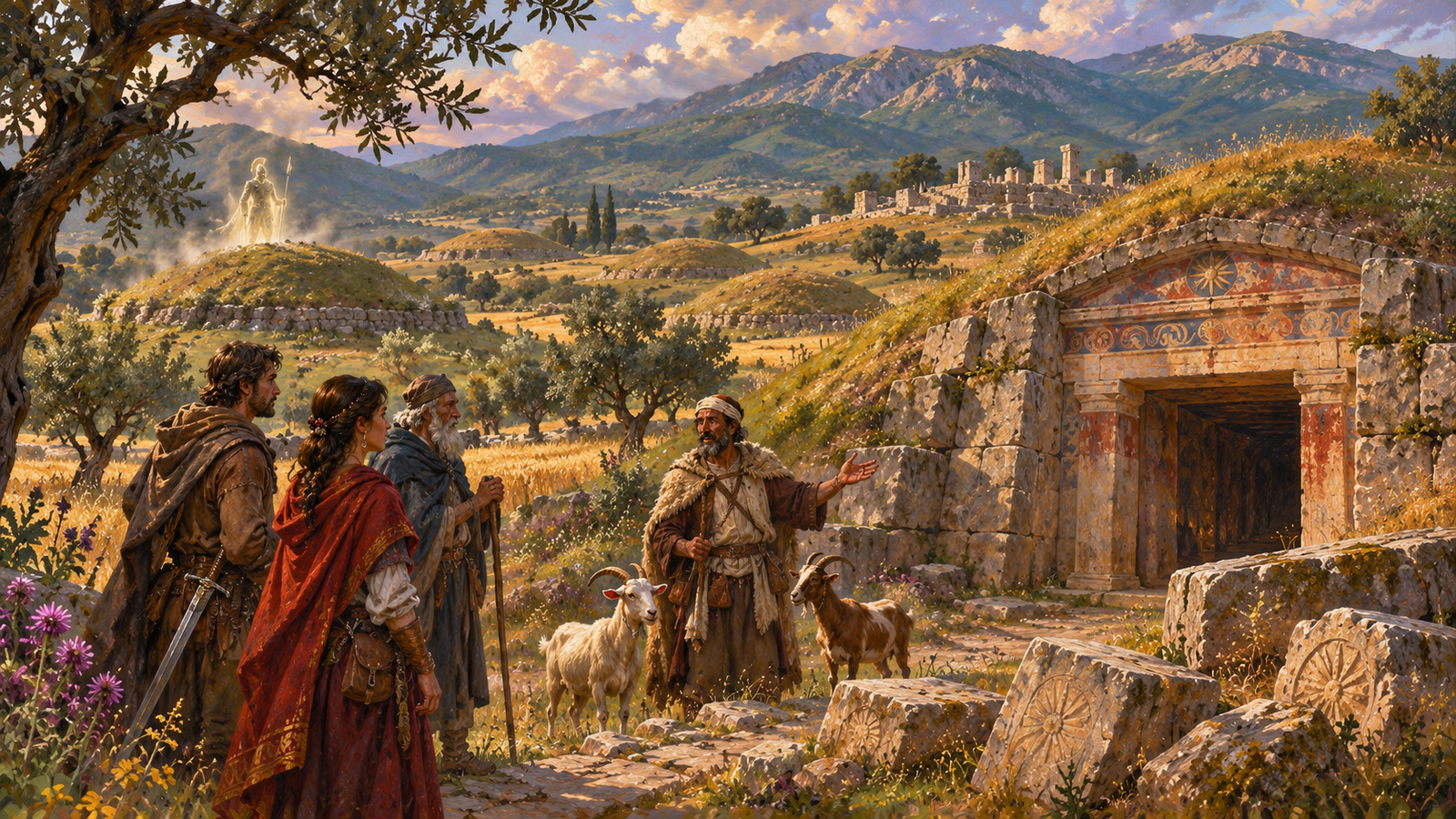
Nikos the shepherd has found a painted stone protruding from a rain-scoured mound. Before he can carry it home, a nobleman’s agent offers more silver than his family has earned all year. Then a woman from Palatitzia tells him that the stone marks a royal grave and must stay where the dead can find it. At dusk, footsteps cross the field without a living traveller in sight.
What Is Happening Right Now?
Aegae is no longer a functioning city. Fields, tracks and scattered settlements occupy the landscape where Macedonian kings once held court. Ancient masonry breaks through the soil in places, but the full scale of the buried city is not understood.
The royal cemetery is even less visible. Hundreds of tumuli spread across the wider area, some obvious as low mounds, others nearly lost beneath cultivation and scrub. Local stories warn against disturbing certain hills after sunset.
Ottoman authorities govern the roads beyond the deserted royal grounds, where villagers farm the slopes beneath the Pierian mountains. A shepherd named Nikos has found a painted stone exposed by rain. A noble collector offers silver to buy it, while Myrto, whose family tends a nearby burial mound, says the stone belongs to the dead. In the night, an armed stranger tries to remove the fragment and finds a line of bare footprints leading away from his camp, although no living person has approached it.
The First Capital of Macedon
Aegae was the oldest royal centre of the Macedonian kingdom. Its kings ruled from here before the political capital shifted to Pella. Even after that move, Aegae remained sacred to the dynasty.
The city held royal ceremonies, sanctuaries and the ancestral burials of the Temenid house. Philip II was assassinated in the theatre here in 336 BCE during the wedding celebrations of his daughter Cleopatra. His son, Alexander the Great, was then proclaimed king.
That memory never fully leaves the site. Aegae is not merely an abandoned settlement. It is a royal landscape in which political legitimacy, death and ancestral cult were deliberately bound together.
The Palace
The ancient palace once dominated the city. Its courts, halls, mosaics and ceremonial spaces were built to project royal authority on a scale greater than an ordinary Greek civic building.
Today much of the complex survives only as buried or broken foundations. Fallen stone has been reused over centuries, while soil and vegetation cover rooms that once received ambassadors, generals and members of the royal household.
Subterranean service passages and storage spaces remain more intact than the exposed upper architecture. Some are accessible through collapsed wells or animal burrows. Others open only after heavy rain washes soil away.
The Royal Necropolis
The cemetery around Aegae contains hundreds of burial mounds dating across many centuries. The most important royal tombs are monumental chambers built beneath the earth and concealed by tumuli.
Several remain untouched after long centuries. Their painted interiors, weapons, armour, vessels and royal grave goods have never been exposed to daylight since burial.
Not every tomb contains treasure. Some contain only bones and ritual objects. Others preserve curses, ancestral guardians or funerary magic designed to keep the dead king inside as much as to keep thieves out.
Philip’s Tomb
One of the greatest sealed tombs belongs to Philip II. Its exact location is not known to ordinary travellers, and the mound above gives little away.
The burial chamber holds royal weapons, armour, ceremonial vessels and objects tied to the Argead line. More dangerous than the treasure is the claim of legitimacy attached to it. A ruler who produced convincing relics of Philip could use them politically far beyond Macedonia.
The tomb is therefore protected by more than stone. Oaths sworn by the royal household still cling to the chamber. Intruders who enter for greed alone hear the sound of marching feet and commands in a language they may not understand.
The Theatre
The theatre is one of the most charged places at Aegae because it was the scene of Philip II’s assassination. Time has broken its seating and stage structures, but the shape of the space remains legible.
At certain hours, voices spoken on the old performance ground carry unnaturally well. On the anniversary of Philip’s death, witnesses report hearing applause before dawn even when no one else is present.
Nearby Lives and the Road to Aegae
Palatitzia — Houses Beneath the Old Palaces
On the cultivated ground northeast of the ancient city lies Palatitzia, a settlement remembered for its proximity to the old palaces. Its people make a living from fields, vineyards, animals and work on the nearby routes rather than from the tombs. The ruined Macedonian royal precinct is not their town, yet the ancient stones turn up in field boundaries, wells and building repairs. A traveller who wishes to understand the place must first win the trust of its living households.
Myrto’s Threshing Court
Myrto gives travellers a meal of barley, cheese and beans at her family’s threshing court. She can spare a covered place among stored straw for a small party, but only when her relatives are not bringing in the harvest. A large armed company will be turned away. She fears that her grandson will be blamed for the stone found by Nikos and wants it carried back to its proper place before an angry stranger arrives.
Andreas’s Workshop and the River Road
Andreas, a mason and cartwright, can repair a wheel, fit a pack saddle or identify stone quarried from the older foundations. He knows why a section of an ancient retaining wall has begun to sag after rain. Daphne, a healer, tends injuries and sick animals and keeps clean water and simple herbs; she will help a stranger who pays in grain or labour. Sotiris, a muleteer, guides caravans north to Veroia and towards crossings of the Aliakmon, though he will not lead a heavy cart into unstable hill tracks. None of them sells magical relics. Their value lies in what they know and whom they trust.
The Shield-Bearer Who Has No Name
The exposed stone bears a fragment of a royal inscription. On the next night, the Shield-Bearer—a spectral attendant bound to an unnamed grave—walks from the burial mound seeking the stone that once marked his lord’s oath. He carries a broken bronze spear, but does not attack those who speak respectfully. When shown the fragment he asks for the name of the person who first buried it. Nikos knows a damaged epitaph near the theatre; Andreas can fit the stone into its missing place. Restore the dedication and the shade takes his watch beside the mound again. Sell it, and he follows its new owner until the inscription is returned.
A royal claimant can still make use of the fragment, even when its supposed genealogy is false. Myrto will defend her grandson from any stranger using the discovery to threaten him; the collector’s promised reward may be enough to tempt a hungry family. It is the choices of the living, not the number of tomb chambers opened, that decide how dangerous Aegae becomes.
Travel and Access
- Do not expect a living city: Aegae is a dispersed archaeological landscape rather than a walled medieval settlement.
- Ask locally before digging: Fields, mounds and ruins may belong to nearby communities or landholders.
- Watch the weather: Rain destabilises buried chambers and can expose openings without warning.
- Beware false tombs: Treasure-seekers have created pits and tunnels that are more dangerous than the ancient structures.
- Take no grave object lightly: Royal burial goods carry political and supernatural consequences.
Dangers and Adventure Hooks
- A shepherd discovers a painted stone doorway after part of a mound collapses.
- A noble patron wants proof that one tomb belongs to an ancestor of his own dynasty.
- Grave robbers open the wrong chamber and release a royal guardian into the countryside.
- A golden object offered for sale bears the personal symbols of Philip II.
- A scholar claims one burial contains correspondence from Alexander written before the Asian campaign.
- A rival expedition follows the party and intends to let them trigger every trap first.
- The theatre begins repeating fragments of the murder that occurred there in 336 BCE.
- Someone is secretly moving bones between tombs to manufacture a false royal genealogy.
Buried Oaths and Royal Claims
The royal tombs lie among working fields, low hills and broken foundations. A person who seeks one hidden chamber must ask who owns the ground, whose animals graze there and which families already know that its stones have been disturbed. The easiest way to start a blood feud is to arrive promising wealth and protection to people whose names the visitor has not learned.
Gold is only one reason to unseal a tomb. A shield bearing an old emblem can strengthen a claim to royal ancestry, an inscription may destroy it, and an oath once sworn over the dead may still bind a descendant or guardian. The shield-bearer of Aegae does not value treasure. He values the name and promise entrusted to his care.
Historical Foundations
- UNESCO World Heritage Centre — Archaeological Site of Aigai
- Hellenic Ministry of Culture — Aigai and Palatitzia
The palace, theatre, royal necropolis and Macedonian dynastic associations are well attested. The names and oaths of the ancient royal dead remain potent beneath the burial mounds.
Explore Beyond Aegae
The royal cemetery belongs to Macedon’s ancient age, but the wider region remains a place of living rulers and roads. Follow Greece and the Balkans to find present-day settlements, Mount Olympus for the northern sacred mountain, or Athens for another city built over an illustrious past. See Alexander the Great for the royal dynasty and the Timeline for the older historical ages.
Keep this reference growing
If this page helped with your reading or game, you can support its upkeep or explore the curated books.
Explore the Bookshop — epics, classics and stories behind imagined worlds.