
Slime Mold — The Walking Fungus Garden
At a Glance
| Creature | Slime Mold — the walking fungus garden |
|---|---|
| Nature | Mindless, unaligned; feeds on organic decay through a living mantle of fungi |
| Size | Large; often twelve feet long and more than six hundred pounds |
| Where found | Deep forests, moss-choked ruins, damp caverns and rotten storehouses |
| Warning signs | Toadstools spreading against the wind, moving leaf-litter and victims whose skin darkens a day after contact |
| Greatest danger | Engulfment and delayed fungal rot, especially from touching its body |
| Common company | Solitary or infestations of two to five |
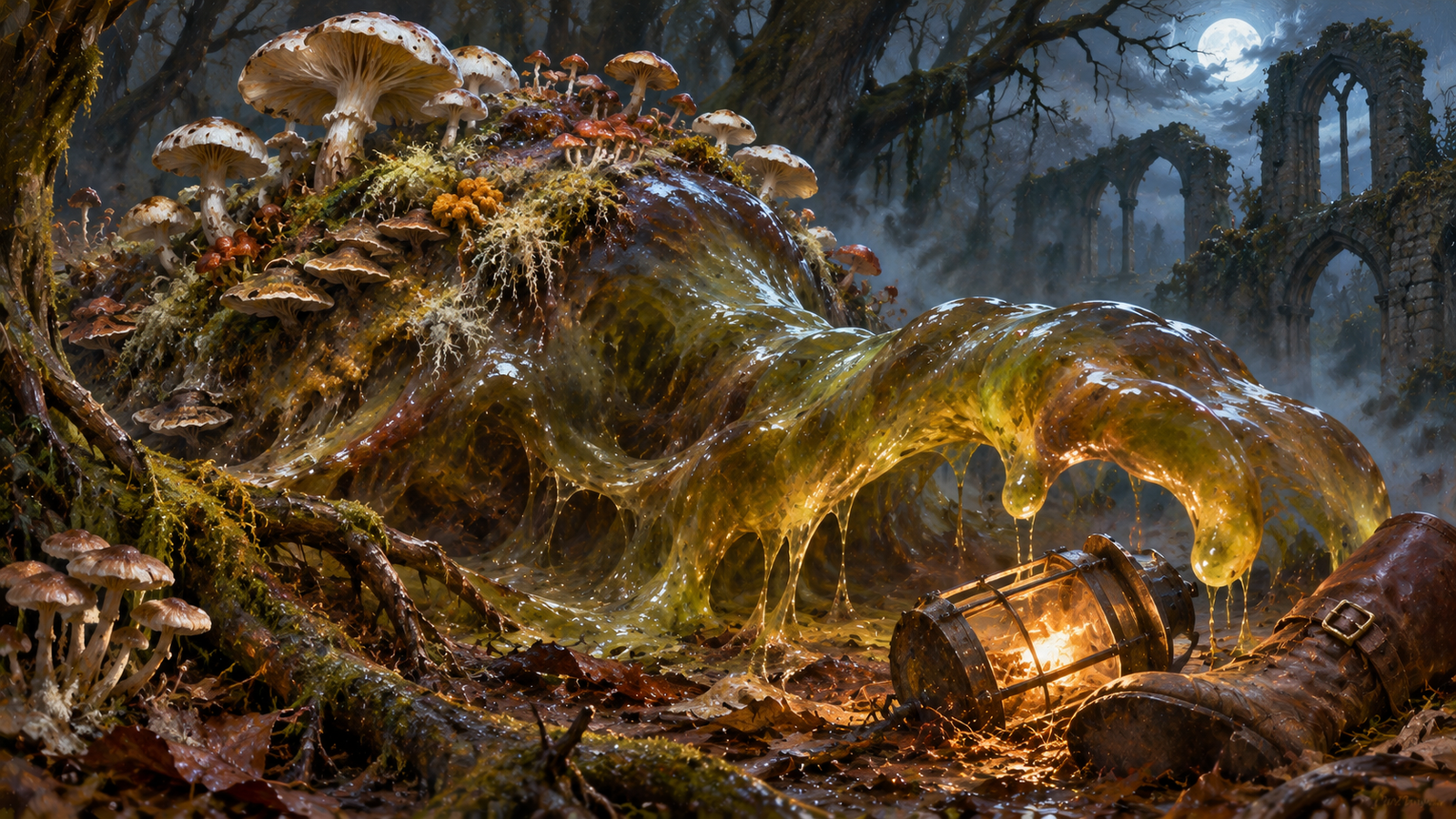
The circle of mushrooms moves while the woods are still. At the centre of the ruined clearing, an amber mass lifts itself from the leaf mould. Toadstools grow across its shoulders, roots hang from its flanks and thick arms of slime flow around an abandoned lantern. The woodsman who struck it yesterday has begun to lose strength in both hands.
The Fungus That Walks
A slime mold moves beneath a living garden of toadstools. Its flesh is translucent yellow-brown jelly threaded with dark veins, but its upper surface is cloaked by moss, mildew and mushrooms. When it lies still, a traveller may take the creature for a fallen stump crowned with fungi. Then a pseudopod lifts the leaves and the whole mound rolls forward.
The creature itself cannot readily digest meat. Its fungal companions break down the dead and dying, turning victims into the rot upon which the ooze feeds. The mushrooms receive food and a mobile shelter; the ooze gains camouflage and a weapon more dreadful than its weight. The fungus carries a sickness that does not reveal itself until the following day.
Signs in the Forest
Boots lie beside a hollow tree, but the missing forester’s knife remains clean. Mushrooms have appeared where he camped, and the leaf mould smells sharp and sweet. Those who handled the strange fungus yesterday now complain of weakness and fever. One has patches of blackened skin.
How It Hunts
The ooze waits in the damp shade of deep woodland, among fallen branches or against the stones of an overgrown abbey. It does not chase for miles. It rolls forward when prey approaches, strikes with a heavy limb of slime and drags smaller creatures beneath its fungal canopy. A gloveless hand can become infected merely by punching its body.
Fire does not immediately destroy it; its living fungus shelters a body resistant to heat. The creature does not shoot spores across a chamber or split instantly when struck by a sword. Fungal rot develops after contact, and the patient may have gone home before the first symptoms appear.
New Growth
As the creature crosses a bed of rot, small living beads break from its body. These tiny scraps may settle among mushrooms and feed for months before gathering into a new hunting ooze. The young move slowly; the party that clears a single adult may return to find the monastery woodpile crawling with a fresh infestation.
Game Statistics
Slime Mold
Large Ooze, Unaligned — original D&D 2024 conversion
AC 8; Initiative −1 (9); HP 42 (4d10 + 20); Speed 20 ft.
| STR | DEX | CON | INT | WIS | CHA |
|---|---|---|---|---|---|
| 16 (+3) | 8 (−1) | 20 (+5) | 1 (−5) | 1 (−5) | 1 (−5) |
Saving Throws Con +7
Resistances Fire
Immunities Charmed, Deafened, Exhaustion, Frightened, Prone
Senses Blindsight 60 ft., Passive Perception 5; Languages None
CR 2 (450 XP; PB +2)
Traits
Fungal Camouflage. While the ooze remains motionless amid mushrooms, dead leaves or rotting wood, a creature must succeed on a DC 14 Wisdom (Perception) check to recognise the living mass.
Ooze Body. The mold can move through an opening one inch wide without extra movement. Its fungal growths extend above the slime so that it resembles an ordinary bed of mushrooms.
Actions
Slam. Melee Attack Roll: +5 to hit, reach 10 ft., one creature. Hit: 10 (2d6 + 3) Bludgeoning damage. The target must make a DC 15 Constitution saving throw. On failure it contracts Fungal Rot.
Engulf. The ooze moves up to 20 ft. through spaces occupied by Medium or smaller creatures. Each target makes a DC 15 Dexterity saving throw. On failure the target takes 10 (2d6 + 3) Bludgeoning damage, is Grappled (escape DC 13) and is Restrained until it escapes. It also makes the saving throw against Fungal Rot.
Fungal Rot
Disease. Infection manifests after 24 hours. Each infected creature gains the Poisoned condition and has its Hit Point maximum reduced by 5 (1d10). At the end of each Long Rest, it repeats a DC 15 Constitution saving throw. On success the infection ends and its Hit Point maximum returns to normal; on failure its maximum decreases by another 5 (1d10). In this conversion, an effect that ends the Poisoned condition, such as Lesser Restoration, also ends the infection.
Slime Mold
Large ooze, unaligned — original D&D 2014 conversion
Armor Class 8; Hit Points 31 (3d10 + 15); Speed 20 ft.
| STR | DEX | CON | INT | WIS | CHA |
|---|---|---|---|---|---|
| 16 (+3) | 8 (−1) | 20 (+5) | 1 (−5) | 1 (−5) | 1 (−5) |
Damage Resistances fire; Condition Immunities blinded, charmed, deafened, exhaustion, frightened, prone
Senses blindsight 60 ft. (blind beyond this range), passive Perception 5; Languages —; Challenge 1 (200 XP) — original conversion
Traits
False Appearance. When the ooze lies motionless among fungi, it is almost indistinguishable from a mass of mushrooms, lichen and decay. A DC 14 Wisdom (Perception) check reveals it.
Amorphous. The ooze moves through gaps at least one inch wide without squeezing.
Actions
Slam. Melee Weapon Attack: +5 to hit, reach 10 ft., one target. Hit: 6 (1d6 + 3) bludgeoning damage, and the target makes a DC 15 Constitution saving throw or contracts fungal rot.
Engulf. The slime mold moves up to 20 ft., passing through the spaces of Medium or smaller creatures. Each creature makes a DC 15 Dexterity saving throw or takes 6 (1d6 + 3) bludgeoning damage, becomes grappled (escape DC 13) and restrained, and must also save against fungal rot.
Fungal Rot
After one day, an infected victim is poisoned and its Hit Point maximum decreases by 5 (1d10). At the end of each long rest it repeats the DC 15 Constitution saving throw: success ends the disease and restores the reduced maximum; failure reduces the maximum by another 5 (1d10). Lesser restoration ends the infection. This delayed disease translates the Pathfinder Strength and Constitution injury; it does not use ability damage in this edition.
Slime Mold — CR 2
XP 600; N Large ooze; Init −1; Senses Perception −5
DEFENSE
AC 8, touch 8, flat-footed 8 (−1 Dex, −1 size); hp 28 (3d8 + 15)
Fort +6, Ref +0, Will −4
Immune ooze traits; Resist fire 10
OFFENSE
Speed 20 ft.; Space 10 ft.; Reach 10 ft.
Melee slam +4 (1d6 + 4 plus disease)
Special Attacks engulf (DC 14, 1d6 + 4 bludgeoning plus disease)
STATISTICS
Str 16, Dex 8, Con 21, Int —, Wis 1, Cha 1
Base Atk +2; CMB +6; CMD 15 (can’t be tripped); SQ freeze; Feats — (mindless)
ECOLOGY
Environment temperate forests; Organization single or infestation (2–5); Treasure none
SPECIAL ABILITIES
Fungal Rot (Ex). Contact disease delivered by the slam or engulf; Fortitude DC 16; onset 1 day; frequency 1/day; effect 1d2 Strength damage, 1 Constitution damage and fatigue; cure one successful save. A creature that hits the mold with an unarmed or natural attack is also exposed. The save DC is Constitution-based.
Freeze (Ex). While motionless among fungal beds, the creature resembles an ordinary carpet of mushrooms and mildew.
Engulf (Ex). The mold rolls over prey as a standard action, dealing 1d6+4 bludgeoning damage and exposing it to fungal rot; a DC 14 Reflex save avoids it.
Slime Mold — CR 2
N Large Ooze — original D&D 3.5e conversion
Hit Dice 3d10+15 (31 hp); Initiative −1; Speed 20 ft. (4 squares)
Armor Class 8 (−1 Dex, −1 size), touch 8, flat-footed 8
Base Attack/Grapple +2/+9; Attack slam +4 melee (1d6+4 plus fungal rot); Full Attack slam +4 melee; Space/Reach 10 ft./10 ft.
Special Attacks engulf (Reflex DC 14; 1d6+4 damage plus disease), fungal rot; Special Qualities freeze, ooze traits, fire resistance 10
Saves Fort +6, Ref +0, Will −4; Abilities Str 16, Dex 8, Con 21, Int —, Wis 1, Cha 1
Skills/Feats — (mindless); Environment temperate forests; Organization solitary or infestation (2–5); Treasure none; Alignment always neutral
COMBAT
Fungal Rot (Ex). Contact disease from slam, engulf, or striking the ooze with an unarmed or natural attack. Fortitude DC 16; onset 1 day; frequency 1/day; inflicts 1d2 Strength damage, 1 Constitution damage and fatigue on each failed save; one successful save cures the disease. Disease-curing magic may also cure it.
Engulf (Ex). The ooze can move over a Medium or smaller creature as a standard action, forcing DC 14 Reflex save or dealing 1d6+4 damage and exposing the victim to fungal rot.
Freeze (Ex). Its living fungal garden makes it nearly indistinguishable from rotting vegetation while motionless.
Ooze Traits. No Intelligence score and no ordinary feats or skills; it is blind but senses nearby prey, and is immune to poison, sleep, critical hits and mind-affecting effects.
What Is Happening Right Now?
The Monks’ Mushroom Supper
The monastery’s cellar is full of plump mushrooms, and a cook has disappeared among the baskets. Fresh caps grow in the footprint left by the missing man. The brothers insist they need the harvest to feed the pilgrims arriving tomorrow; the creature is already crawling towards the kitchen stairs.
The Rot Beneath the Ford
A carrier collapses with blackened skin after making camp beside a damp forest road. His boots were found standing beside a harmless-looking ring of toadstools. The miller has just sent his children to gather more mushrooms from the same place. The first symptoms will not appear until the following day.
Rules Sources and Related Oozes
Published Pathfinder 1e: Mold, Slime, from Pathfinder Roleplaying Game Bestiary 2 (©2010, Paizo Publishing, LLC). This version is CR 2 with fungal rot (Fort DC 16; onset 1 day). The other three panels are original edition conversions and are not official published Slime Mold stat blocks.
Related: Garden Ooze · Green Slime · Brown Mold · Yellow Mold · Ooze Bestiary.
Section 15: Copyright Notice – Bestiary 2
Pathfinder Roleplaying Game Bestiary 2, © 2010, Paizo Publishing, LLC; Authors Wolfgang Baur, Jason Bulmahn, Adam Daigle, Graeme Davis, Crystal Frasier, Joshua J. Frost, Tim Hitchcock, Brandon Hodge, James Jacobs, Steve Kenson, Hal MacLean, Martin Mason, Rob McCreary, Erik Mona, Jason Nelson, Patrick Renie, Sean K Reynolds, F. Wesley Schneider, Owen K.C. Stephens, James L. Sutter, Russ Taylor, and Greg A. Vaughan, based on material by Jonathan Tweet, Monte Cook, and Skip Williams.
Keep this reference growing
If this page helped with your reading or game, you can support its upkeep or explore the curated books.
Explore the Bookshop — epics, classics and stories behind imagined worlds.