
 Buy me a coffee
Mirror Image, “Shifting Doubles”
Mirror Image 5e: Uses, Tactics, and Full Spell Guide
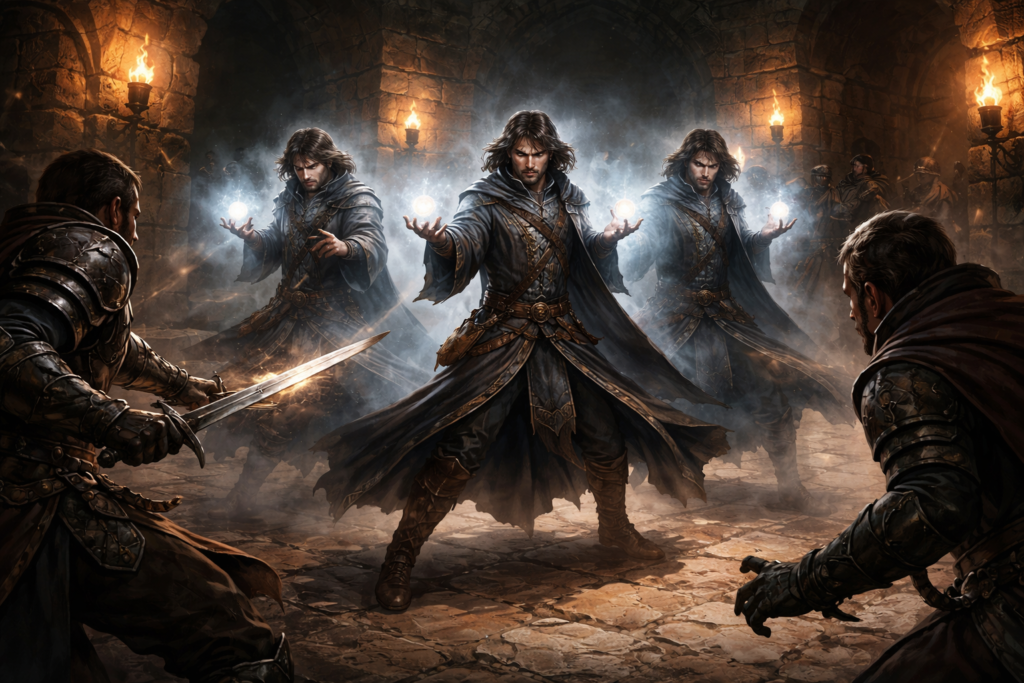
When steel is already in motion and escape is no longer certain, the illusionist survives not by standing firm, but by becoming many and forcing every strike to gamble against deception.
Mirror Image 5.5
Mirror Image 3.5
Mirror Image
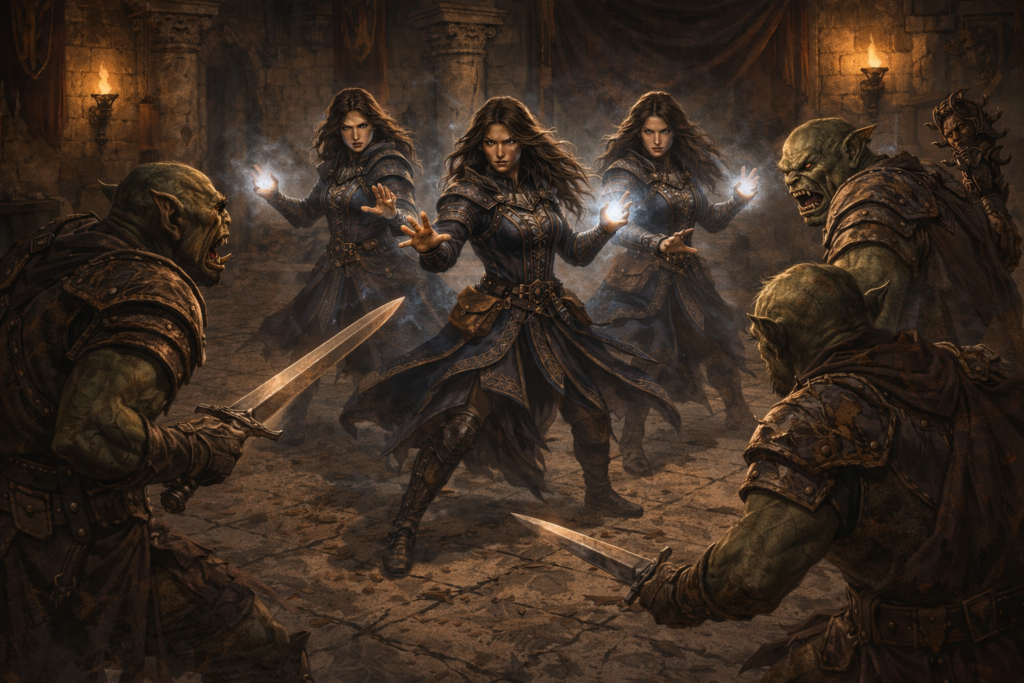
One body becomes several, and in that flickering uncertainty, the enemy’s surest blows are spent on lies.
Alternative Name: Shifting Doubles
2nd-Level Illusion
Casting Time: 1 action
Range: Self
Components: V, S
Duration: 1 minute
Available To: Sorcerer, Wizard
Effect: Three illusory duplicates of yourself appear in your space. Until the spell ends, the duplicates move with you and mimic your actions, shifting position so it is impossible to track the real you by sight alone.
Each time a creature targets you with an attack roll during the spell’s duration, roll a d20 to determine whether the attack instead targets one of your duplicates:
- With three duplicates, a roll of 6 or higher causes the attack to target a duplicate
- With two duplicates, a roll of 8 or higher causes the attack to target a duplicate
- With one duplicate, a roll of 11 or higher causes the attack to target a duplicate
A duplicate has an Armor Class equal to 10 + your Dexterity modifier. If an attack hits a duplicate, the duplicate is destroyed.
A duplicate can be destroyed only by an attack that hits it. It ignores all other damage and effects. The spell ends when all duplicates are destroyed.
A creature is unaffected by this spell if it can’t see, if it relies on senses other than sight such as blindsight, or if it can perceive illusions as false, as with truesight.
Overview
Mirror Image is one of the finest defensive illusion spells because it protects the caster without hardening them, hiding them, or placing a barrier between them and danger. Instead, it attacks certainty itself. It makes the caster difficult to identify at the exact moment identification matters most: when an enemy commits to the blow.
That gives the spell a distinctive kind of power. An attack does not fail because armor turns it aside. It fails because the attacker chose wrongly. A blade cuts through an image. An arrow finds a body that is not there. A lunging foe realizes too late that their confidence was spent on a false target. The spell does not reduce threat. It wastes it.
This is why Mirror Image remains so valuable. It protects without concentration, functions immediately, and turns hostile attention into confusion. Used well, it does not merely keep the caster alive. It makes them exasperating to kill.
Why Mirror Image Matters
Other illusion spells alter how creatures understand the world around them. Mirror Image alters how creatures understand the caster themselves.
That places it in a clean and important role within the illusion family:
- Minor Illusion, Silent Image, Minor Image, and Major Image shape false realities in the environment
- Mirror Image shapes false certainty around the self
That distinction matters because Mirror Image is not about scene control, spectacle, or misdirection at a distance. It is about surviving pressure in immediate proximity. It functions inside the attack roll, inside the melee exchange, inside the heartbeat where a foe believes they finally have the caster cornered.
It is one of the strongest low-to-mid-level defensive spells precisely because it turns targeting into doubt.
Best Uses
Opening Defense
Mirror Image is strongest when cast before the enemy has begun landing hits. With all three duplicates active, the spell gives the caster the widest margin of safety during the most dangerous opening moments of a fight.
Multi-Attacker Pressure
The spell shines when several enemies are trying to bring down one vulnerable target. Each attacker must contend with the duplicates separately, and that quickly turns aggression into waste.
Against Heavy Hits
When facing enemies that strike hard, even a single redirected attack can matter enormously. Mirror Image is at its best when every avoided hit feels important.
Protecting Concentration
Because the spell itself requires no concentration, it is excellent for protecting concentration on other magic. If fewer attacks strike the real caster, the spells that truly shape the encounter are much easier to maintain.
Close Quarters Survival
Mirror Image is superb when the caster cannot easily keep distance. In corridors, crypts, shrines, towers, and crowded chambers, it creates breathing room through uncertainty rather than retreat.
Practical Tactics
Cast Early
Do not wait until the duplicates would only absorb the last desperate strike. The spell is most effective when it begins the fight at full strength and forces enemies to work through all three false selves.
Let Enemies Commit
Mirror Image gains value when enemies are made to spend attacks against it. Do not waste that advantage by stepping recklessly into unnecessary danger. Let the spell drain hostile momentum while you choose the next move.
Combine with Positioning
The duplicates do not replace good movement. They make good movement better. Use cover, chokepoints, elevation, and shifting angles so enemies face both uncertainty and inconvenience.
Layer Defenses
Mirror Image becomes especially frustrating when paired with other protective tools. If attacks are already missing, and the attacks that do connect often strike a duplicate, the caster becomes markedly harder to bring down.
Recognize Decline
The spell is front-loaded. Once duplicates begin to disappear, the protection falls off quickly. Treat the last remaining image as a warning that the spell has nearly done its work.
Limits of the Spell
Mirror Image does not increase Armor Class, reduce damage, or defend against everything. It only interferes with attack rolls from creatures that rely on sight.
That means it does nothing against:
- area effects
- attackers that cannot see
- senses such as blindsight
- creatures that can reliably perceive illusions as false
It is also temporary and fragile by design. Each successful hit against a duplicate strips away part of the spell’s protection. Mirror Image is powerful not because it lasts forever, but because it turns the opening and middle of a fight into a targeting problem for the enemy.
DM Notes
Mirror Image is at its best when described as a living confusion rather than a stack of abstract charges. The duplicates should feel like convincing, shifting versions of the caster, not static copies standing in neat formation.
Describe the spell dynamically:
- a sword passes through the wrong body and the image tears apart into nothing
- a duplicate turns with the same motion as the caster a fraction too late
- an attacker curses as a clean strike destroys only a false self
- the real caster remains just difficult enough to fix in the eye
Creatures should also respond according to temperament and perception. A blind beast ignores the spell entirely. A disciplined warrior may continue striking without panic. A frightened looter or enraged cultist may become visibly frustrated as certainty fails them.
Mirror Image is more satisfying when it feels like pressure and irritation building inside the scene, not merely a die result interrupting damage.
Good Combinations
Blur: Combining distorted visibility with false targets makes the caster extraordinarily difficult to strike cleanly.
Shield: If an attack bypasses the duplicates, Shield can still turn a real hit into a miss.
Misty Step: After enemies waste attacks on duplicates, instant repositioning can make the whole exchange feel hopeless for them.
Major Image: A caster who is hard to identify inside a battlefield already reshaped by illusion becomes even more difficult to answer.
Disguise Self: Outside combat, layered visual deception can create bizarre uncertainty about who is real and who was ever present at all.
Concentration spells: Mirror Image is excellent protection for any effect the caster truly needs to maintain.
Adventure and Story Uses
Mirror Image is one of the best spells for showing what illusion magic means in personal combat. It turns the caster into a moving uncertainty: not invisible, not armored, but impossible to pin down with confidence.
A duelist in a noble court splits into several identical forms beneath chandeliers and banners.
A mage in a tomb passage advances untouched while enemies carve apart shadows.
A fugitive sorcerer slips through armed pursuers who cannot keep their eyes on the true body.
A ritualist in a shrine survives the desperate rush to stop them because every attacker reaches for the wrong self first.
That is why the spell feels memorable. It is not simply protection. It is humiliation through misperception.
Mirror Image
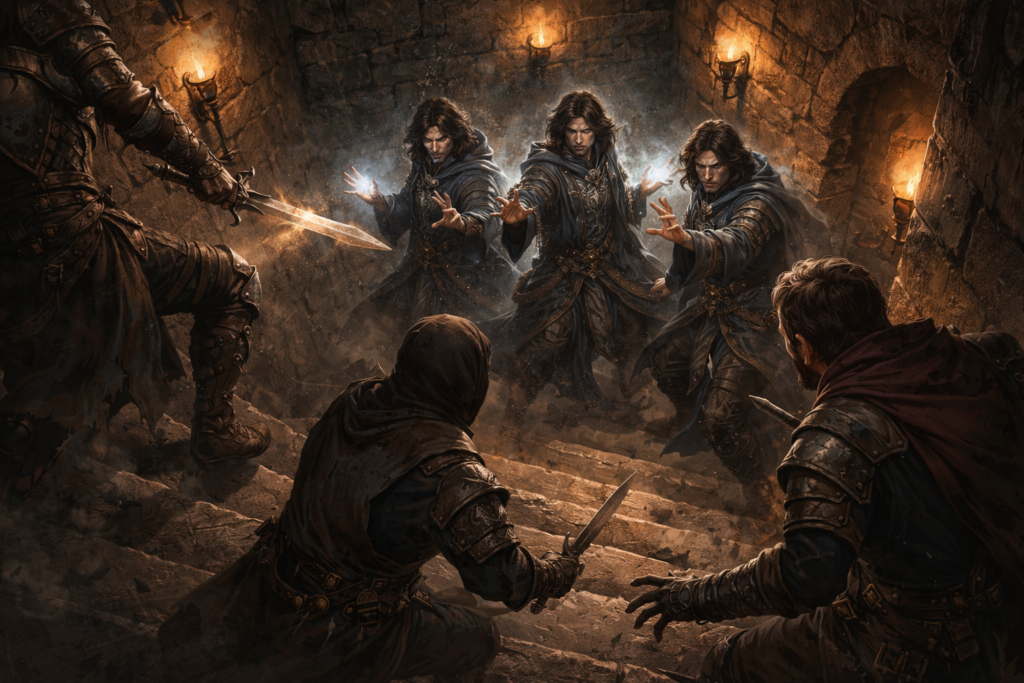
Several illusory duplicates of you pop into being, making it difficult for enemies to know which target to attack. The figments stay near you and disappear when struck.
This material is Open Game Content, and is licensed for public use under the terms of the Open Game License v1.0a.
Illusion (Figment)
Level Bard 2, Sorcerer/Wizard 2
Components V, S
Casting Time 1 standard action
Range Personal; see text
Target You
Duration 1 min./level (D)
Mirror image creates 1d4 images plus one image per three caster levels (maximum eight images total). These figments separate from you and remain in a cluster, each within 5 feet of at least one other figment or you. You can move into and through a mirror image. When you and the mirror image separate, observers can’t use vision or hearing to tell which one is you and which the image. The figments may also move through each other. The figments mimic your actions, pretending to cast spells when you cast a spell, drink potions when you drink a potion, levitate when you levitate, and so on.
Enemies attempting to attack you or cast spells at you must select from among indistinguishable targets. Generally, roll randomly to see whether the selected target is real or a figment. Any successful attack against an image destroys it. An image’s AC is 10 + your size modifier + your Dexterity modifier. Figments seem to react normally to area spells (such as looking like they’re burned or dead after being hit by a fireball).
While moving, you can merge with and split off from figments so that enemies who have learned which image is real are again confounded.
An attacker must be able to see the images to be fooled. If you are invisible or an attacker shuts his or her eyes, the spell has no effect. (Being unable to see carries the same penalties as being blinded.)