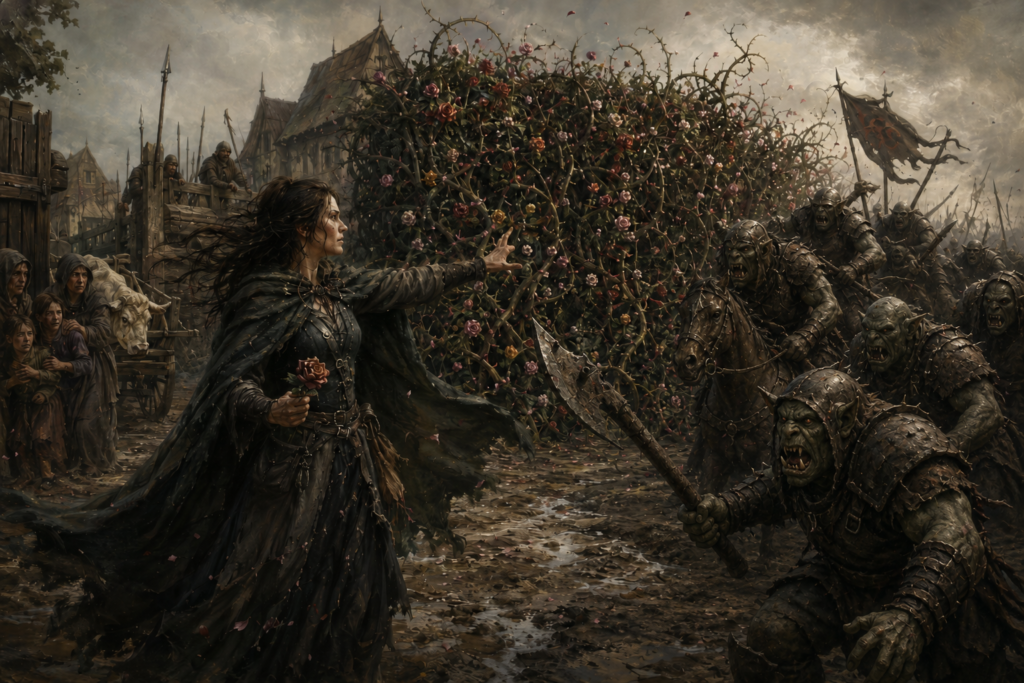
Wall of Roses Spell — Magical Thorn Hedge
An enormous hedge of thorned roses rises from the earth, beautiful enough to invite the eye and cruel enough to hold back an army.

Wall of Roses creates a vast barrier of living, thorned rose bushes. It is not a simple damage spell. Its power lies in control, fortification, delay, and denial. A witch or druid can use it to seal a road, protect a sacred grove, close a breach, divide a battlefield, or hold raiders outside a settlement long enough for defenders to act.
The wall is fragrant, flowering, and unmistakably alive. Its stems are thick, interlocked, and armed with magically responsive thorns. Creatures that try to push through are cut, snagged, slowed, and dragged back by vines that move when disturbed.
Because the wall lasts for days, it changes more than a single fight. Roads close. Cavalry routes vanish. Refugees are redirected. Merchants lose time. Patrols must find another way. Used well, the spell becomes a temporary border written in roses and blood.
Effect
You conjure a massive wall of living rose bushes within range. The wall rises to a height of 10 feet and may curve, bend, enclose spaces, follow roads, block gates, or form irregular defensive lines.
The spell cannot be used to create the wall directly inside a creature’s space. When the wall forms, it bends around creatures already in its area, leaving them outside the wall’s area in positions chosen by the caster. It does not appear around an army and kill it instantly.
The roses are dense enough to stop normal land movement. A creature can force a way through, but doing so is slow and painful. Nonmagical fire does not burn the hedge, though magical fire and sustained cutting can destroy sections.
The material component is a single living rose blossom.
Wall of Roses, 5.5e / 2024
Wall of Roses Pathfinder 1e / 3.5e
Wall of Roses 3.0e
Wall of Roses, 5.5e / 2024
6th-level Conjuration
Casting Time: 1 Minute
Range: 120 feet
Components: V, S, M; a living rose blossom
Duration: 7 days
Available To: Druid, Witch
Saving Throw: None on creation
Alternative Spell Name: Thorn-Bloom Rampart
You create a wall of living rose bushes on solid ground within range. The wall is up to 10 feet high, 5 feet thick, and 300 feet long. You may shape it as one continuous barrier or as connected sections, provided the entire wall remains within range when you cast the spell.
The wall cannot be created in a creature’s space. If its area would include a creature, the hedge bends around that creature, leaving it in the nearest unoccupied space outside the wall’s area, chosen by you.
The wall blocks normal movement and heavily obscures sight through it. Its space is difficult terrain. A creature that enters the wall for the first time on a turn, starts its turn inside it, or forces its way through a 5-foot thickness of the hedge takes 22 (4d10) piercing damage from the animated thorns.
A creature can force its way through 5 feet of the hedge by spending an action and at least 15 feet of movement.
A 5-foot section of the wall has AC 15, 30 hit points, resistance to nonmagical bludgeoning and piercing damage, immunity to poison and psychic damage, immunity to nonmagical fire, and vulnerability to magical fire damage. Destroying a section opens a 5-foot gap.
When the spell ends, the wall withers into dead rose canes, fallen petals, and dry thorns.
At Higher Levels. When you cast this spell using a spell slot of 7th level or higher, the wall’s maximum length increases by 100 feet for each slot level above 6th.
Wall of Roses Pathfinder 1e / 3.5e
School: Conjuration creation
Level: Druid 6, Witch 6
Components: V, S, M
Casting Time: 1 round
Range: 20 yards/level
Effect: Thorned rose wall covering up to 100 square yards/level
Duration: 7 days + 1 day/level
Saving Throw: None
Spell Resistance: Yes
Material Component: A single living rose blossom
This spell calls into being an enormous wall of thorny rose bushes. The wall rises to a height of 10 feet and may be shaped to follow terrain, roads, walls, field boundaries, settlement edges, or other continuous lines within the spell’s area.
The wall cannot be used to appear directly on creatures in order to harm them. When the spell is cast, the roses snake around pedestrians, soldiers, mounts, and other creatures already in the area, leaving them outside the barrier or in small pockets rather than crushing or impaling them.
The wall blocks normal land movement. A creature attempting to force, crawl, cut, or hack its way through the roses takes 2d10 + 1 point per caster level points of piercing damage. A creature takes this damage once for each attempt to pass through the wall. It takes 1d3 + 1 rounds to force a path through the wall unless a suitable gap has already been opened.
The rose wall is unaffected by nonmagical burning. Magical fire, sustained chopping, siege tools, or similar force can damage or destroy sections of it.
Wall of Roses 3.0e

This spell calls into being an enormous wall of thorny rose bushes.
Liber Mysterium
The Netbook of Witches and WarlocksBy Timothy S. Brannan and The Netbook of Witches and Warlocks Team
Conjuration Creation
Level: Witch 6, Druid 6
Components: V S M
Casting Time: 1 round
Range: 20 yards / level
Target, Effect, Area: 100-sq. yards/level
Duration: 7 days + 1 day / level
Saving Throw: None
Spell Resistance: Yes
A high level caster could effectively encircle a small city with such a wall, should she choose. The wall rises to a height of only ten feet, but is extremely effective in keeping land based creatures out. The roses are unaffected by non-magical burning.
Any creature trying to force or hack it’s way through the roses will take 2d10 +1 per caster level points of damage to do so, as the vines tend to swing when disturbed and it is impossible to protect oneself against them.
It takes 1d3+1 rounds to wade your way through the wall. Note that the wall will snake it’s way around pedestrians when forming, so you can not simply cast this spell onto an opposing army, slaying them all in one fell swoop.
The material component of this spell is a single live rose blossom.
Why This Spell Is Dangerous in the World
Wall of Roses is dangerous because it lasts long enough to become a military and political fact. It can close a road, seal a gate, defend a village, split an army’s line of advance, or turn open ground into a controlled approach.
A ruler fears it because it can isolate districts, protect rebels, block supply carts, or delay troops for days. A village may bless the witch who raises it against raiders, then curse her if the same wall keeps grain, healers, or messengers outside.
The spell is strongest when it changes choices. It does not murder everyone in its area when cast. It creates a barrier, and the danger begins when someone must cross it.
Best Uses
Defending a settlement: Seal breaches, reinforce weak approaches, protect refugees, or buy time while gates and walls are repaired.
Blocking roads and passes: Close a bridge approach, forest road, ravine path, ford, or cavalry route.
Protecting sacred places: Guard druid groves, witch shrines, hidden tombs, faerie borders, and forbidden gardens.
Creating siege pressure: Force enemies toward one gate, keep cavalry at distance, or protect a camp from sudden assault.
Dividing a battlefield: Separate infantry from cavalry, isolate reinforcements, or block a retreat route.
Tactics
Cast Wall of Roses before battle whenever possible. Its duration makes it better as preparation than as a last-second defence.
The strongest use is not always a complete enclosure. A partial wall that leaves one obvious gap may be more valuable, because it lets the caster decide where enemies are likely to go.
Do not treat the spell as only a damage effect. The damage punishes crossing, but the real value is forcing enemies to spend time, tools, movement, magic, or blood to reach the other side.
DM Notes
The wall should be a serious obstacle, not an unbeatable prison. Ordinary travellers, carts, horses, pack animals, and most infantry cannot casually cross it. Trained soldiers can cut gaps, but they need time, tools, and protection while they work.
Flying creatures, burrowing creatures, teleportation, climbing routes, magical fire, siege axes, and prepared engineering remain valid counters.
If the spell is used around a settlement, think beyond the battle map. Who is trapped outside? Which fields, wells, roads, graves, shrines, or livestock pens are cut off? Who benefits from the delay? Who suffers from it?
Good Combinations
- Plant Growth: Turns the surrounding ground into a broader defensive landscape.
- Spike Growth: Punishes enemies who try to move around the hedge rather than cut through it.
- Entangle: Holds creatures near the wall while defenders attack from safety.
- Wall of Stone: Creates a layered defence of hard fortification and living obstruction.
- Pass without Trace: Lets the caster’s allies move around the defended area while enemies struggle to find safe approaches.
Using This Spell in Your Game
Use Wall of Roses when nature magic should feel territorial, graceful, and ruthless. It is ideal for witches protecting hidden villages, druids resisting road-builders, faerie courts closing mortal borders, nobles sealing plague districts, or defenders buying a few crucial days.
The spell works best in adventures about approach, siege, evacuation, pursuit, border crossing, or blocked travel. It gives the party a visible problem they can cut through, burn with magic, climb around, fly over, tunnel beneath, negotiate past, or exploit.
Spellcasting Culture and Worldbuilding Hooks
Among witches, Wall of Roses is often treated as a boundary spell. A red rose wall may mark blood debt, protection, forbidden love, or vengeance. A white rose wall may mark mourning, sanctuary, or a protected household. Black roses may suggest curse-work, death gardens, or darker pacts.
Among druids, the spell is more territorial than symbolic. It declares that the land itself refuses trespass.
A city that survives behind such a wall may later plant roses along its true fortifications. A noble house may adopt the thorned rose as a heraldic device. A village once sealed off by a witch may remember the smell of roses as a sign of both salvation and fear.
Adventure and Worldbuilding Hooks
The Seven-Day Siege: A witch seals a town against raiders, but the wall also traps grain carts, healers, and messengers outside. The party must decide whether to defend the barrier, open a controlled passage, or bargain with its caster.
The Road That Flowered Overnight: A major trade road disappears beneath a wall of roses. Merchants blame druids, druids blame a noble surveyor, and someone is using the delay to move contraband through the hills.
The Garden Around the Prison: A condemned prisoner is held inside a rose wall that cannot be burned by ordinary fire. The wall protects the captive as much as it confines them, and several factions want it breached for different reasons.
Source and Literary Context
Wall of Roses is adapted from Liber Mysterium: The Netbook of Witches and Warlocks, by Timothy S. Brannan and The Netbook of Witches and Warlocks Team. The original spell presents the rose wall as a large-scale witch and druid barrier: beautiful, thorned, resistant to ordinary fire, and capable of enclosing or defending a substantial area.
The spell also draws strength from the older symbolic life of the rose. Roses are not only flowers of beauty and love; they are also thorned plants, carrying pain, secrecy, blood, protection, and warning in the same image. In classical tradition, the rose is associated with Aphrodite and the powers of desire, beauty, generation, and loss. That double meaning suits the spell perfectly: the wall is lovely enough to seem ceremonial, but cruel enough to become a weapon.
The hedge is equally important. In historical landscape use, hedges were not decorative borders alone. They marked ownership, enclosed fields, controlled grazing, blocked movement, protected boundaries, and changed who could pass through a place. A magical hedge therefore has immediate social and political meaning. It does not merely obstruct a battlefield; it declares that a road, shrine, settlement, garden, or border has been placed under living authority.
In folklore and fantasy tradition, hedges also work as threshold spaces: the line between cultivated land and wild growth, household and road, mortal settlement and the hidden world beyond. That makes Wall of Roses especially fitting for witches, druids, faerie courts, sacred groves, forbidden gardens, and besieged communities. The spell is strongest when it feels like a boundary with meaning, not just a mass of thorns.
For a reference copy of Liber Mysterium: The Netbook of Witches and Warlocks, see PlanetADnD: Liber Mysterium PDF. For botanical background on roses, see Encyclopaedia Britannica: Rose. For the classical association of the rose with Aphrodite, see Theoi: Aphrodite’s Attributes and Sacred Plants. For historical context on hedgerows as field boundaries, see Encyclopaedia Britannica: Hedgerow, and for enclosure as the use of hedge or fence to restrict common access, see Encyclopaedia Britannica: Enclosure.
Buy me a coffee