
Spell, Produce Flame, “Hand of the Living Ember”
Produce Flame, “Hand of the Living Ember”
A living flame blossoms in your hand, bright enough to guide your path and dangerous enough to answer violence.
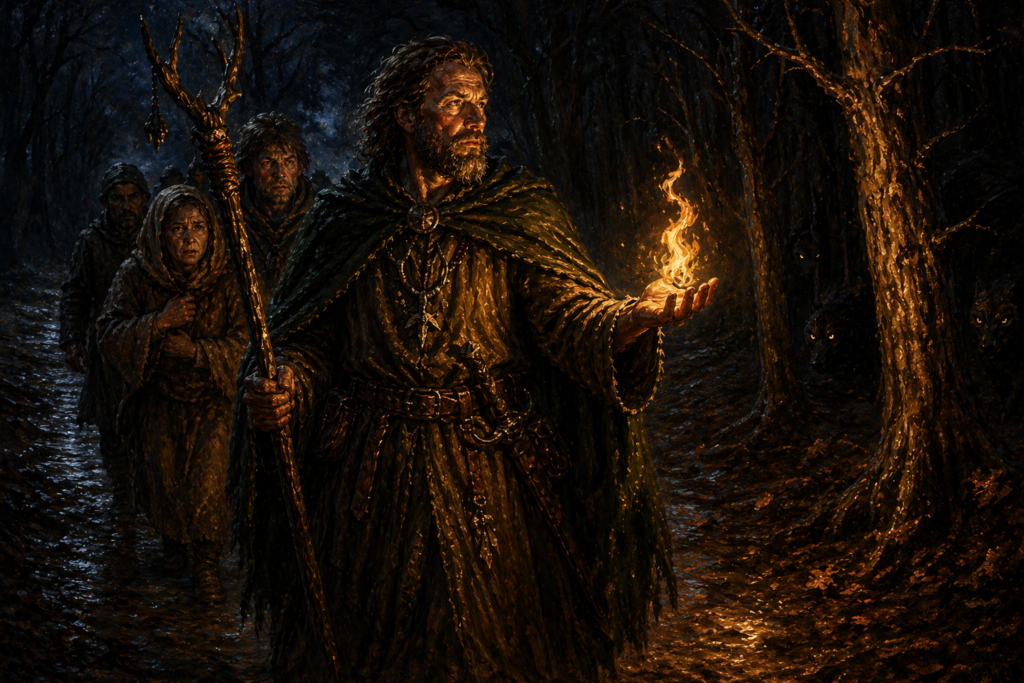
Some fire spells are made for war. Others begin as a necessary light in the dark: a palm held open, a spark made obedient, a flame that burns only where the caster wills it to burn. Produce Flame belongs to that older and quieter tradition of magic, where survival, warning, and violence all share the same small ember.
Overview
Produce Flame is one of the simplest and most useful fire spells available to a nature caster. It places a harmless magical flame in the caster’s open hand, giving them both a source of light and a ready weapon.
Unlike larger fire spells, Produce Flame is controlled, portable, and personal. It does not fill a battlefield with flame or consume everything nearby. Instead, it gives the caster a steady ember that can be carried like a torch, pressed into an enemy at close range, or hurled across a battlefield as a burning missile.
For druids, fire-priests, wilderness guardians, and elemental spellcasters, this spell is as much a tool as an attack. It lights paths, signals companions, frightens beasts, burns away threats, and reminds witnesses that even a small flame can become a weapon in the right hand.
Effect
A flame appears in your open hand. The flame gives off light, but it does not harm you or your equipment.
While the spell lasts, you can use the flame as a source of illumination and as a magical fire attack. Depending on the rules version used at your table, you may either strike with the flame directly or hurl it at a target. Each attack spends part of the spell’s remaining duration in older versions of the spell.
The spell does not function underwater.
Produce Flame 5.5e / 2024
Produce Flame Pathfinder / 3.5e
Produce Flame 3.0
Produce Flame 5.5e / 2024
1st-Level Evocation
Casting Time: 1 action
Range: Self
Components: V, S
Duration: 10 minutes
Available To: Druid
Alternative Spell Name: Hand of the Living Ember
A flame appears in your open hand for the duration. The flame sheds Bright Light in a 20-foot radius and Dim Light for an additional 20 feet. The flame does not harm you or your equipment.
When you cast the spell, and again as a Magic action on a later turn while the spell lasts, you can hurl the flame at one creature or object within 120 feet of you. Make a ranged spell attack. On a hit, the target takes 1d8 Fire damage, and the spell ends.
Alternatively, you may keep the flame in your hand for illumination without attacking.
The spell ends early if you dismiss it, cast it again, or if the flame is submerged in water.
At Higher Levels
When you cast this spell using a spell slot of 2nd level or higher, the fire damage increases by 1d8 for each slot level above 1st.
5.5e Design Notes
This version keeps Produce Flame simple and readable for modern play. It works as a light source first and a modest fire attack second. Ending the spell after an attack makes it clean at the table and prevents it from competing too strongly with repeated cantrip attacks.
For a slightly stronger version, you could allow the caster to hurl the flame multiple times during the duration, but that makes the spell closer to a sustained attack spell. The cleaner version above is better for balance and page clarity.
Produce Flame Pathfinder / 3.5e
School: Evocation [Fire]
Level: Druid 1, Fire 2
Components: V, S
Casting Time: 1 standard action
Range: 0 ft.
Effect: Flame in your palm
Duration: 1 minute/level, dismissible
Saving Throw: None
Spell Resistance: Yes
Flames as bright as a torch appear in your open hand. The flames do not harm you or your equipment.
In addition to providing illumination, the flames can be used to touch enemies or hurled at distant targets. You may strike an opponent with a melee touch attack, dealing fire damage equal to 1d6 + 1 point per caster level, to a maximum of 1d6 + 5.
Alternatively, you may hurl the flames up to 120 feet as a thrown weapon. When doing so, you make a ranged touch attack with no range penalty and deal the same damage as with the melee attack.
Immediately after you hurl the flames, a new flame appears in your hand. Each attack you make reduces the spell’s remaining duration by 1 minute. If an attack reduces the remaining duration to 0 minutes or less, the spell ends after that attack resolves.
This spell does not function underwater.
Pathfinder / 3.5e Notes
This version preserves the original spell’s strongest identity: a low-level magical flame that can be carried, used in melee, or thrown repeatedly until its duration is spent.
The spell’s damage is intentionally modest. Its real strength is flexibility. A caster can use it for light, hold it as a threat, make touch attacks against armoured foes, or throw fire at range without suffering range penalties.
Produce Flame
This material is Open Game Content, and is licensed for public use under the terms of the Open Game License v1.0a.
Flames as bright as a torch appear in your open hand. The flames harm neither you nor your equipment.
Evocation [Fire]
Level Druid 1, Fire 2
Components V, S
Casting Time 1 standard action
Range 0 ft.
Effect Flame in your palm
Duration 1 min./level (D)
Saving Throw None
Spell Resistance Yes
In addition to providing illumination, the flames can be hurled or used to touch enemies. You can strike an opponent with a melee touch attack, dealing fire damage equal to 1d6 +1 point per caster level (maximum +5). Alternatively, you can hurl the flames up to 120 feet as a thrown weapon.
When doing so, you attack with a ranged touch attack (with no range penalty) and deal the same damage as with the melee attack. No sooner do you hurl the flames than a new set appears in your hand. Each attack you make reduces the remaining duration by 1 minute. If an attack reduces the remaining duration to 0 minutes or less, the spell ends after the attack resolves.
This spell does not function underwater.
Why This Spell Is Useful in the World
Produce Flame is useful because it turns the caster’s hand into a tool of survival. It replaces a torch, guards a night road, lights a shrine, signals allies, and gives the caster a weapon that cannot easily be disarmed.
In wild country, that matters. A druid crossing a rain-dark forest may have no dry torchwood. A village priest may need a sacred flame during a storm. A scout may need light without carrying oil. A lone traveller may need to show wolves, bandits, or worse things that they are not helpless.
The spell is also socially powerful. An open hand holding harmless fire is not as destructive as a battlefield spell, but it changes the room. In a court, market, shrine, or tavern, Produce Flame is a visible warning: the caster has brought fire under discipline.
Best Uses
Exploration: Use Produce Flame as a magical torch when mundane fire is unavailable, inconvenient, or too easily extinguished.
Low-level combat: The spell gives druids and fire casters a useful attack option, especially when they want fire damage without using a larger spell.
Threat and deterrence: A visible flame can frighten beasts, warn enemies, or make negotiations more tense without immediately escalating to a major spell.
Wilderness survival: The flame can serve as a camp tool, signal light, or emergency source of controlled fire.
Character identity: Produce Flame is excellent for druids, fire devotees, hermits, elemental adepts, and shrine guardians whose magic should feel practical and ancient.
Tactics
Use Produce Flame before entering darkness, ruins, woodland paths, caves, or hostile camps. It allows the caster to begin an encounter with light already in hand.
In older rulesets, the spell rewards careful pacing. Each attack consumes 1 minute of duration, so a caster should decide whether the flame is more valuable as light or as a weapon. Throwing it every round spends the spell quickly; holding it can preserve the spell’s usefulness during exploration.
In 5.5e-style play, the spell works best as a utility spell with an emergency attack attached. It should not replace dedicated damage cantrips or higher-level fire spells, but it gives a prepared caster a strong visual and practical tool.
DM Notes
Produce Flame should feel controlled rather than explosive. The flame is not a fireball waiting in the hand. It is a living ember, bright enough to guide, hot enough to wound, and obedient enough not to burn the caster.
The spell’s visibility matters. In darkness, it reveals the caster’s position. In polite company, it may be treated like drawing a blade. In dry fields, granaries, libraries, stables, or wooden halls, even a controlled magical flame may cause alarm.
The underwater limitation should be preserved. It gives water, weather, and terrain real authority in the world and prevents fire magic from feeling universally convenient.
Good Combinations
- Entangle: Holds enemies in place while the caster burns exposed targets from a safer distance.
- Faerie Fire: Reveals hidden or elusive enemies before the caster hurls flame at them.
- Longstrider: Helps the caster maintain distance while using the flame as a ranged attack.
- Fog Cloud: Lets the caster control visibility, though they must still manage their own line of sight and the flame’s glow.
- Flaming Sphere: Creates layered fire pressure, forcing enemies to respond to both a moving hazard and the caster’s hand-held flame.
Using This Spell in Your Game
Use Produce Flame when you want fire magic to feel old, intimate, and useful. It is not just a combat spell. It belongs in scenes of night travel, sacred rites, forest watches, ruined towers, winter roads, and tense standoffs.
A caster holding Produce Flame should change the atmosphere of a scene. The light catches on wet stone, iron buckles, animal eyes, polished shields, frightened faces, and the underside of branches. It announces power without needing spectacle.
For low-level characters, the spell can become iconic. A druid known for walking through the dark with flame in hand feels immediately distinct from a wizard with a wand or a soldier with a lantern.
Spellcasting Culture and Worldbuilding Hooks
In many druid circles, Produce Flame is taught as a lesson in restraint. The novice is not praised for making fire, but for keeping the fire obedient.
Among fire-priests, the spell may be used to carry ritual flame between shrines. Because the flame does not burn the bearer, it becomes a sign of divine favour, discipline, or sacred office.
In frontier villages, a caster who knows Produce Flame is valuable during winter, siege, plague, and storm. They can relight hearths, burn infected brush, keep watchfires alive, and guide search parties through dangerous ground.
In harsher traditions, the spell is used in trials. A witness may be asked to speak while a harmless flame burns in the judge’s palm, not because the spell detects lies, but because everyone understands what controlled fire implies.
Adventure Hooks
The Hand That Would Not Go Out: A dead druid’s hand still holds a small flame. It will not burn flesh, wood, or cloth, but it refuses to fade until carried back to the grove where the druid first learned the spell.
The Fireless Village: A settlement has lost the ability to kindle mundane flame. Only Produce Flame still works there, and every casting draws something closer from beneath the frozen wells.
The Stolen Ember Rite: A false priest claims authority because he can produce sacred flame in his hand. The local druids insist he stole the rite from a murdered initiate.
The Ford in the Rain: During a flood, villagers can cross a dangerous ford only by following the caster’s magical flame. Something in the water knows the spell cannot function beneath the surface.
The Trial of the Open Palm: To join an ancient fire circle, the characters must carry a produced flame through darkness, rain, temptation, and attack without once using it in anger.
Keep this reference growing
If this page helped with your reading or game, you can support its upkeep or explore the curated books.
Explore the Bookshop — epics, classics and stories behind imagined worlds.