
Illusion • Vigil Voice
Magic Mouth Spell
Triggers, uses, tactics, and ideas for the Games Master.
At a Glance
| Edition | Bard level and essential difference |
|---|---|
| 5.5e / 2024 | Level 2 • ritual • object only • 30-foot trigger • repeat option |
| 5e / 2014 | Level 2 • ritual • honeycomb and jade dust • repeat option |
| Pathfinder 1e | Level 1 • creature or object • trigger range 15 ft./level |
| D&D 3.5e | Level 1 • creature or object • permanent until discharged |
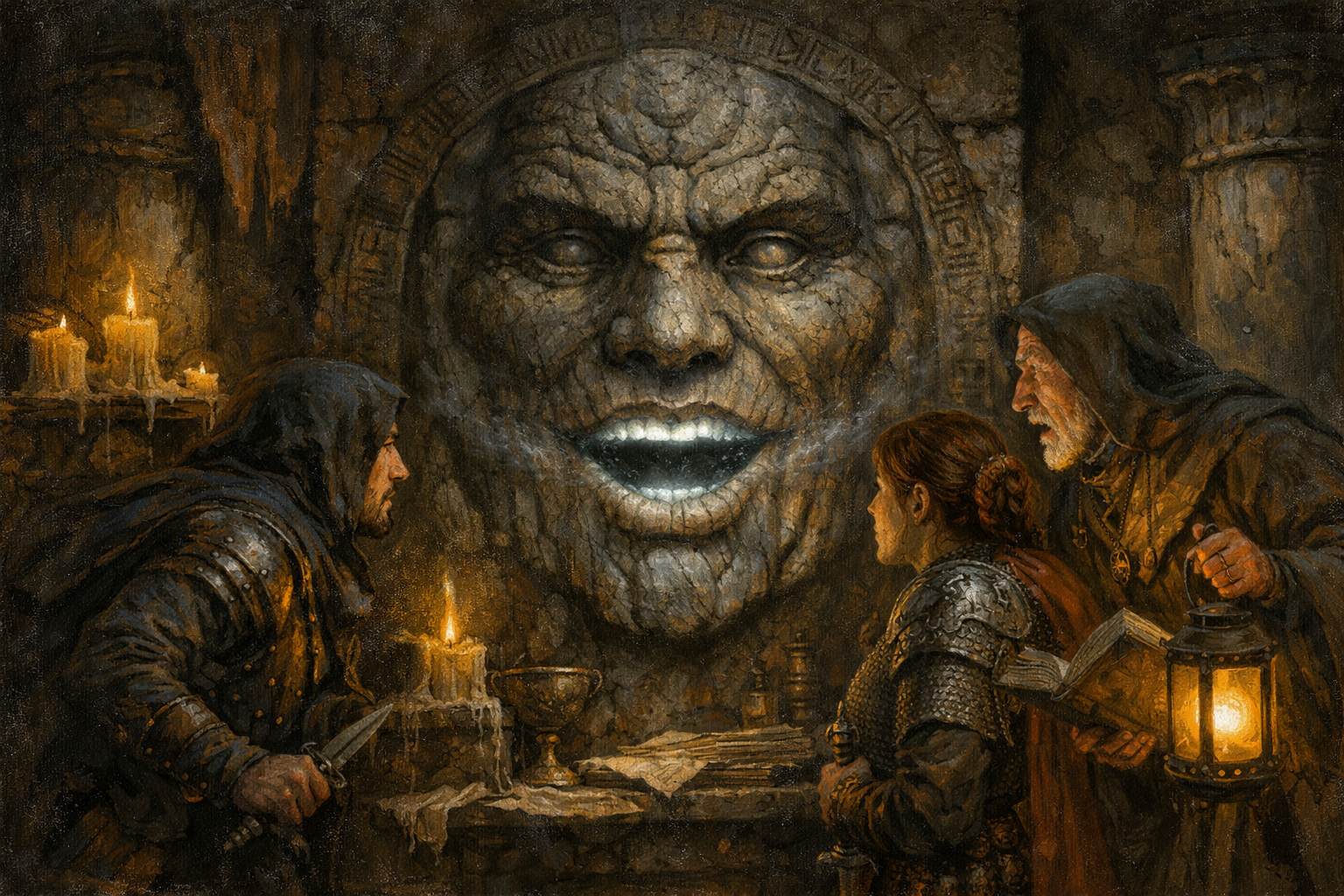
Some spells shatter doors, seal vaults, or scorch the unworthy. Magic Mouth does something quieter and often more unsettling: it leaves intention behind. A threshold can warn, a tomb can accuse, a relic can proclaim, and a silent chamber can suddenly speak with the authority of the dead, the divine, or the prepared.
Magic Mouth stores a spoken message in an object so it is delivered when a chosen condition is met, making it one of the best low-level spells for warnings, rituals, deceptions, haunted atmosphere, and prepared magical defenses.
Spell Rules by Edition
Magic Mouth — 5.5e / 2024
| Spell | Level 2 Illusion |
|---|---|
| Classes | Bard, Wizard |
| Casting Time | 1 minute or Ritual |
| Range | 30 feet |
| Components | V, S, M (jade dust worth at least 10 GP, consumed) |
| Duration | Until dispelled |
| Concentration | No |
Choose an object you can see within range that another creature is not wearing or carrying. Speak a message of no more than 25 words, which may be delivered over as long as 10 minutes, and specify the circumstance that will trigger it.
When triggered, a magical mouth appears on the object and recites the message in your voice at the volume you used when recording it. If the object has a mouth or a feature resembling one, the magical mouth appears there. Decide when casting whether the spell ends after delivering the message or remains to repeat it whenever the trigger occurs.
The trigger may be general or detailed, but it must depend on visible or audible conditions occurring within 30 feet of the object, such as a creature approaching or a silver bell ringing.
Rules source: System Reference Document 5.2.1.
Magic Mouth — 5e / 2014
| Spell | Level 2 Illusion |
|---|---|
| Classes | Bard, Wizard |
| Casting Time | 1 minute; ritual |
| Range | 30 feet |
| Components | V, S, M (a small bit of honeycomb and jade dust worth at least 10 gp, consumed) |
| Duration | Until dispelled |
| Concentration | No |
Choose an object you can see within range that another creature is not wearing or carrying. Speak a message of no more than 25 words, which may be delivered over as long as 10 minutes, and specify the circumstance that will trigger it.
When triggered, a magical mouth appears on the object and recites the message in your voice at the volume you used when recording it. If the object has a mouth or a feature resembling one, the magical mouth appears there. Decide when casting whether the spell ends after delivering the message or remains to repeat it whenever the trigger occurs.
The trigger may be general or detailed, but it must depend on visible or audible conditions occurring within 30 feet of the object, such as a creature approaching or a silver bell ringing.
Rules source: System Reference Document 5.1.
Magic Mouth — Pathfinder 1e
| School | Illusion (glamer) |
|---|---|
| Level | Arcanist 2, Bard 1, Medium 2, Mesmerist 1, Occultist 2, Psychic 2, Red Mantis Assassin 2, Skald 1, Sorcerer 2, Summoner 1, Unchained Summoner 1, Wizard 2 |
| Casting Time | 1 standard action |
| Components | V, S, M (a small bit of honeycomb and jade dust worth 10 gp) |
| Range | Close (25 ft. + 5 ft./2 levels) |
| Target | One creature or object |
| Duration | Permanent until discharged |
| Saving Throw | Will negates (object) |
| Spell Resistance | Yes (object) |
Rules source: Archives of Nethys — Magic Mouth.
Magic Mouth — D&D 3.5e
Illusion (Glamer)
Level Bard 1, Sorcerer/Wizard 2 ,
Components V, S, M
Casting Time 1 standard action
Range Close (25 ft. + 5 ft./2 levels)
Target One creature or object
Duration Permanent until discharged
Saving Throw Will negates (object)
Spell Resistance Yes (object)
The message, which must be twenty-five or fewer words long, can be in any language known by you and can be delivered over a period of 10 minutes. The mouth cannot utter verbal components, use command words, or activate magical effects. It does, however, move according to the words articulated; if it were placed upon a statue, the mouth of the statue would move and appear to speak. Of course, magic mouth can be placed upon a tree, rock, or any other object or creature.
The spell functions when specific conditions are fulfilled according to your command as set in the spell. Commands can be as general or as detailed as desired, although only visual and audible triggers can be used. Triggers react to what appears to be the case. Disguises and illusions can fool them. Normal darkness does not defeat a visual trigger, but magical darkness or invisibility does. Silent movement or magical silence defeats audible triggers. Audible triggers can be keyed to general types of noises or to a specific noise or spoken word. Actions can serve as triggers if they are visible or audible. A magic mouth cannot distinguish alignment, level, Hit Dice, or class except by external garb.
The range limit of a trigger is 15 feet per caster level, so a 6th-level caster can command a magic mouth to respond to triggers as far as 90 feet away. Regardless of range, the mouth can respond only to visible or audible triggers and actions in line of sight or within hearing distance.
Magic mouth can be made permanent with a permanency spell.
Material Component A small bit of honeycomb and jade dust worth 10 gp.
Rules source: D&D 3.5e System Reference Document — Magic Mouth.
What Changed
The modern spell takes 1 minute to cast, supports ritual casting, and can retain its message for repeated use. It targets a visible object that another creature is not wearing or carrying, with triggers restricted to 30 feet. The 2024 material component is jade dust; the 2014 component also includes honeycomb.
Pathfinder and 3.5 make this a level-1 Bard spell with a standard-action casting time. It can affect a creature or object, discharges when its message is delivered, and has a trigger range of 15 feet per caster level. Their rules explicitly explain how disguises, illusions, darkness, invisibility, and silence affect the trigger, and how Permanency can preserve it.
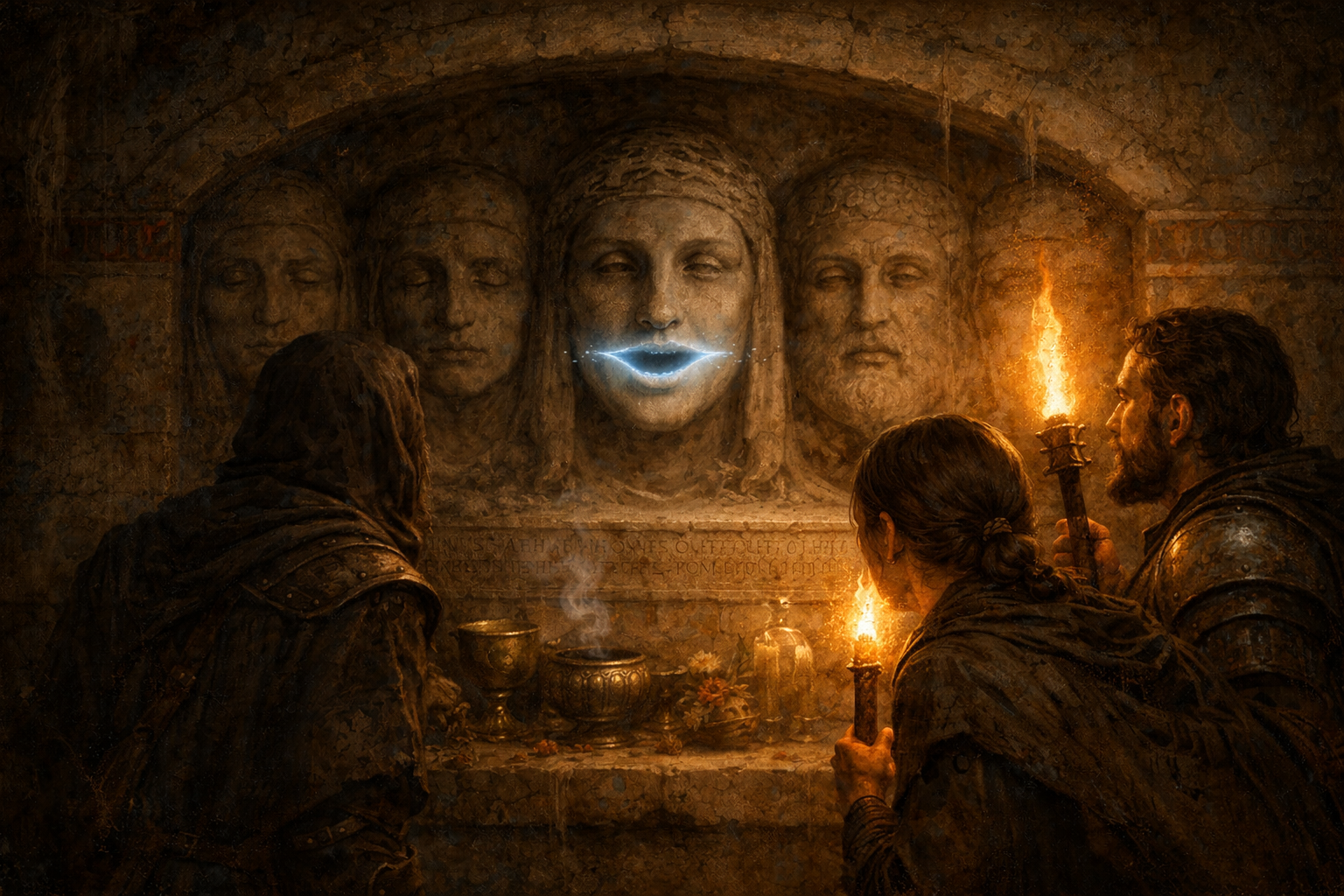
A waiting enchantment hidden in stone, wood, or iron speaks at exactly the wrong moment for whoever has crossed the line.
Overview
Magic Mouth is a spell of preparation rather than force. It does not stop intruders by itself, but it changes how a place behaves when someone enters it. A sealed chamber can announce judgment. A gate can proclaim law. A treasure chest can threaten thieves. A shrine idol can speak only when taboo is broken. A hidden vault can greet the rightful heir and denounce everyone else.
That gives the spell unusual value. Mechanically, it is simple. In play, it is versatile. It can warn, bluff, delay, misdirect, reveal lore, reinforce ritual, or turn an ordinary room into a memorable scene. Few low-level spells do more to make architecture feel inhabited, defended, sacred, or haunted.
Because the spell lasts until dispelled, it also suits worldbuilding exceptionally well. Old ruins, noble tombs, wizard towers, treasure vaults, shrines, archives, and cursed houses all become more vivid when something inside them has been waiting to speak for years.
Uses
Warning wards. Place the spell on gates, doors, reliquaries, coffers, boundary stones, tomb lids, or hidden passages so trespass triggers a clear spoken warning.
Ceremonial voices. Use it in shrines, courts, halls, and tombs where statues, carved faces, masks, and sacred objects deliver ritual phrases, prayers, laws, titles, or condemnations.
False confidence or intimidation. A chest can claim to be cursed. A door can announce that guards are coming. An idol can declare judgment. Even without direct force, the right words at the right moment can change behaviour.
Delayed information. Instructions, passwords, confessions, threats, prophecies, and clues can be left in a place to be heard only under the proper conditions.
Dungeon personality. Magic Mouth is one of the best spells for making a location memorable. Players may forget a locked door. They rarely forget the door that spoke to them.
Tactics
Magic Mouth works best when attached to an object people are likely to notice, touch, open, disturb, or approach. Doors, locks, tombs, lecterns, idols, mirrors, reliquaries, chests, banners, and stone faces are usually stronger choices than random surfaces.
Its strength depends on trigger discipline. The better the trigger, the better the spell. Good triggers are clear, physical, and tied to the location: footsteps crossing a threshold, a chest being opened, a name being spoken, torchlight entering a chamber, someone touching a relic, or a creature approaching within a set distance.
The message itself should be brief and purposeful. With only 25 words, the spell is strongest when it warns, commands, accuses, identifies, threatens, or declares. It loses force when it rambles.
It is also best used in layers. Magic Mouth becomes far more effective when paired with real defenses, social consequences, or emotional pressure. A speaking warning before a trap is more memorable than a trap alone. A false reassurance before danger is crueler than silence. A sacred denunciation before a sealed shrine door can do more than a lock to make intruders hesitate.
Trigger and Message Examples
These are the kinds of uses that make the spell come alive at the table:
Threshold warning:
Trigger: when a creature matching a visible description crosses the doorway.
Message: “Turn back now. This vault is sealed by oath and death.”
Tomb curse declaration:
Trigger: when the sarcophagus lid is touched.
Message: “You have disturbed the king. Leave your breath behind you.”
False bluff on a chest:
Trigger: when the lid is opened.
Message: “Poison released. Pray your gods were listening.”
Temple challenge:
Trigger: when someone speaks above a whisper before the altar.
Message: “Kneel, or be judged as one who enters without reverence.”
Hidden clue:
Trigger: when moonlight falls on the statue’s face.
Message: “Beneath the third stone waits the road below.”
Good Combinations
Alarm: Alarm detects intrusion; Magic Mouth gives it voice. Together they create a warning system that both senses and announces.
Arcane Lock: Arcane Lock bars entry, while Magic Mouth turns attempted entry into a scene of accusation, threat, or ritual challenge.
Hold Portal (Pathfinder/3.5): A magically sealed threshold becomes much more dramatic when it also speaks commands, denunciations, or warnings at the moment of pressure.
Glyph of Warding: Magic Mouth can warn before the punishment lands, or falsely reassure intruders moments before the glyph triggers.
Illusory Script: One conceals meaning in writing; the other delivers meaning aloud under the right condition.
Nystul’s Magic Aura: Useful for making a prepared warded object seem harmless until it suddenly speaks.
Unseen Servant: Combined with speaking objects, this can make a house, crypt, shrine, or laboratory feel disturbingly alive.
DM Notes
Magic Mouth is easy to underestimate because it does not look dramatic on the spell list. In practice, it is one of the most useful spells for atmosphere, environmental storytelling, and prepared magical spaces.
Its best use is not as raw utility, but as a way of giving a place intention. A chamber that speaks feels different from a chamber that merely contains danger. A tomb that accuses the intruders feels older, prouder, and more personal. A shrine that warns in a calm voice can feel holier than one guarded by visible force.
When ruling on the spell, keep triggers grounded in visible or audible conditions within 30 feet of the object in 2024/2014, or within 15 feet per caster level and line of sight or hearing in Pathfinder/3.5. Reward clever, careful phrasing, but do not let the spell become an all-knowing sensor. Its power lies in persistence, timing, and presentation.
For published adventures, this spell is one of the cleanest ways to deliver lore without pausing play. A speaking idol, a warning seal, a funerary mask, or a carved lintel can reveal history, law, taboo, identity, or threat exactly when the players are most ready to listen.
These examples depend on perceptible conditions. Identifying a rightful heir or exempting a caster must use a visible or audible sign agreed with the Games Master; the spell does not read ancestry, thoughts, or hidden identity. The mouth speaks its warning—it does not itself release poison, impose a curse, or activate a separate ward.
Rules Sources and Licensing
This work includes material taken from the System Reference Document 5.1 (“SRD 5.1”) by Wizards of the Coast LLC and available at https://dnd.wizards.com/resources/systems-reference-document. The SRD 5.1 is licensed under the Creative Commons Attribution 4.0 International License available at https://creativecommons.org/licenses/by/4.0/legalcode.
This work includes material from the System Reference Document 5.2.1 (“SRD 5.2.1”) by Wizards of the Coast LLC, available at https://www.dndbeyond.com/srd. The SRD 5.2.1 is licensed under the Creative Commons Attribution 4.0 International License, available at https://creativecommons.org/licenses/by/4.0/legalcode.
The Pathfinder and 3.5 spell mechanics and their tables are Open Game Content under the Open Game License v1.0a. Artwork and original setting prose are excluded from that designation.
Open Game License v1.0a and copyright notices
Permission to copy, modify and distribute the files collectively known as the System Reference Document (“SRD”) is granted solely through the use of the Open Gaming License, Version 1.0a.
This material is being released using the Open Gaming License Version 1.0a and you should read and understand the terms of that license before using this material.
The text of the Open Gaming License itself is not Open Game Content. Instructions on using the License are provided within the License itself.
The following items are designated Product Identity, as defined in Section 1(e) of the Open Game License Version 1.0a, and are subject to the conditions set forth in Section 7 of the OGL, and are not Open Content: Dungeons & Dragons, D&D, Player’s Handbook, Dungeon Master, Monster Manual, d20 System, Wizards of the Coast, d20 (when used as a trademark), Forgotten Realms, Faerûn, proper names (including those used in the names of spells or items), places, Red Wizard of Thay, the City of Union, Heroic Domains of Ysgard, Ever-Changing Chaos of Limbo, Windswept Depths of Pandemonium, Infinite Layers of the Abyss, Tarterian Depths of Carceri, Gray Waste of Hades, Bleak Eternity of Gehenna, Nine Hells of Baator, Infernal Battlefield of Acheron, Clockwork Nirvana of Mechanus, Peaceable Kingdoms of Arcadia, Seven Mounting Heavens of Celestia, Twin Paradises of Bytopia, Blessed Fields of Elysium, Wilderness of the Beastlands, Olympian Glades of Arborea, Concordant Domain of the Outlands, Sigil, Lady of Pain, Book of Exalted Deeds, Book of Vile Darkness, beholder, gauth, carrion crawler, tanar’ri, baatezu, displacer beast, githyanki, githzerai, mind flayer, illithid, umber hulk, yuan-ti.
All of the rest of the SRD is Open Game Content as described in Section 1(d) of the License.
More information on the Open Game License can be found at www.wizards.com/d20.
The terms of the Open Gaming License Version 1.0a are as follows:
OPEN GAME LICENSE Version 1.0a
The following text is the property of Wizards of the Coast, Inc. and is Copyright 2000 Wizards of the Coast, Inc (“Wizards”). All Rights Reserved.
1. Definitions: (a)”Contributors” means the copyright and/or trademark owners who have contributed Open Game Content; (b)”Derivative Material” means copyrighted material including derivative works and translations (including into other computer languages), potation, modification, correction, addition, extension, upgrade, improvement, compilation, abridgment or other form in which an existing work may be recast, transformed or adapted; (c) “Distribute” means to reproduce, license, rent, lease, sell, broadcast, publicly display, transmit or otherwise distribute; (d)”Open Game Content” means the game mechanic and includes the methods, procedures, processes and routines to the extent such content does not embody the Product Identity and is an enhancement over the prior art and any additional content clearly identified as Open Game Content by the Contributor, and means any work covered by this License, including translations and derivative works under copyright law, but specifically excludes Product Identity. (e) “Product Identity” means product and product line names, logos and identifying marks including trade dress; artifacts; creatures characters; stories, storylines, plots, thematic elements, dialogue, incidents, language, artwork, symbols, designs, depictions, likenesses, formats, poses, concepts, themes and graphic, photographic and other visual or audio representations; names and descriptions of characters, spells, enchantments, personalities, teams, personas, likenesses and special abilities; places, locations, environments, creatures, equipment, magical or supernatural abilities or effects, logos, symbols, or graphic designs; and any other trademark or registered trademark clearly identified as Product identity by the owner of the Product Identity, and which specifically excludes the Open Game Content; (f) “Trademark” means the logos, names, mark, sign, motto, designs that are used by a Contributor to identify itself or its products or the associated products contributed to the Open Game License by the Contributor (g) “Use”, “Used” or “Using” means to use, Distribute, copy, edit, format, modify, translate and otherwise create Derivative Material of Open Game Content. (h) “You” or “Your” means the licensee in terms of this agreement.
2. The License: This License applies to any Open Game Content that contains a notice indicating that the Open Game Content may only be Used under and in terms of this License. You must affix such a notice to any Open Game Content that you Use. No terms may be added to or subtracted from this License except as described by the License itself. No other terms or conditions may be applied to any Open Game Content distributed using this License.
3.Offer and Acceptance: By Using the Open Game Content You indicate Your acceptance of the terms of this License.
4. Grant and Consideration: In consideration for agreeing to use this License, the Contributors grant You a perpetual, worldwide, royalty-free, non-exclusive license with the exact terms of this License to Use, the Open Game Content.
5.Representation of Authority to Contribute: If You are contributing original material as Open Game Content, You represent that Your Contributions are Your original creation and/or You have sufficient rights to grant the rights conveyed by this License.
6.Notice of License Copyright: You must update the COPYRIGHT NOTICE portion of this License to include the exact text of the COPYRIGHT NOTICE of any Open Game Content You are copying, modifying or distributing, and You must add the title, the copyright date, and the copyright holder’s name to the COPYRIGHT NOTICE of any original Open Game Content you Distribute.
7. Use of Product Identity: You agree not to Use any Product Identity, including as an indication as to compatibility, except as expressly licensed in another, independent Agreement with the owner of each element of that Product Identity. You agree not to indicate compatibility or co-adaptability with any Trademark or Registered Trademark in conjunction with a work containing Open Game Content except as expressly licensed in another, independent Agreement with the owner of such Trademark or Registered Trademark. The use of any Product Identity in Open Game Content does not constitute a challenge to the ownership of that Product Identity. The owner of any Product Identity used in Open Game Content shall retain all rights, title and interest in and to that Product Identity.
8. Identification: If you distribute Open Game Content You must clearly indicate which portions of the work that you are distributing are Open Game Content.
9. Updating the License: Wizards or its designated Agents may publish updated versions of this License. You may use any authorized version of this License to copy, modify and distribute any Open Game Content originally distributed under any version of this License.
10. Copy of this License: You MUST include a copy of this License with every copy of the Open Game Content You Distribute.
11. Use of Contributor Credits: You may not market or advertise the Open Game Content using the name of any Contributor unless You have written permission from the Contributor to do so.
12. Inability to Comply: If it is impossible for You to comply with any of the terms of this License with respect to some or all of the Open Game Content due to statute, judicial order, or governmental regulation then You may not Use any Open Game Material so affected.
13. Termination: This License will terminate automatically if You fail to comply with all terms herein and fail to cure such breach within 30 days of becoming aware of the breach. All sublicenses shall survive the termination of this License.
14. Reformation: If any provision of this License is held to be unenforceable, such provision shall be reformed only to the extent necessary to make it enforceable.
15. COPYRIGHT NOTICE
Open Game License v 1.0a Copyright 2000, Wizards of the Coast, Inc.
System Reference Document Copyright 2000-2003, Wizards of the Coast, Inc.; Authors Jonathan Tweet, Monte Cook, Skip Williams, Rich Baker, Andy Collins, David Noonan, Rich Redman, Bruce R. Cordell, John D. Rateliff, Thomas Reid, James Wyatt, based on original material by E. Gary Gygax and Dave Arneson.
Pathfinder Roleplaying Game Core Rulebook. © 2009, Paizo Publishing, LLC; Author: Jason Bulmahn, based on material by Jonathan Tweet, Monte Cook, and Skip Williams. END OF LICENSE
Keep this reference growing
If this page helped with your reading or game, you can support its upkeep or explore the curated books.
Explore the Bookshop — epics, classics and stories behind imagined worlds.