
Lahm’s Finger Darts Spell
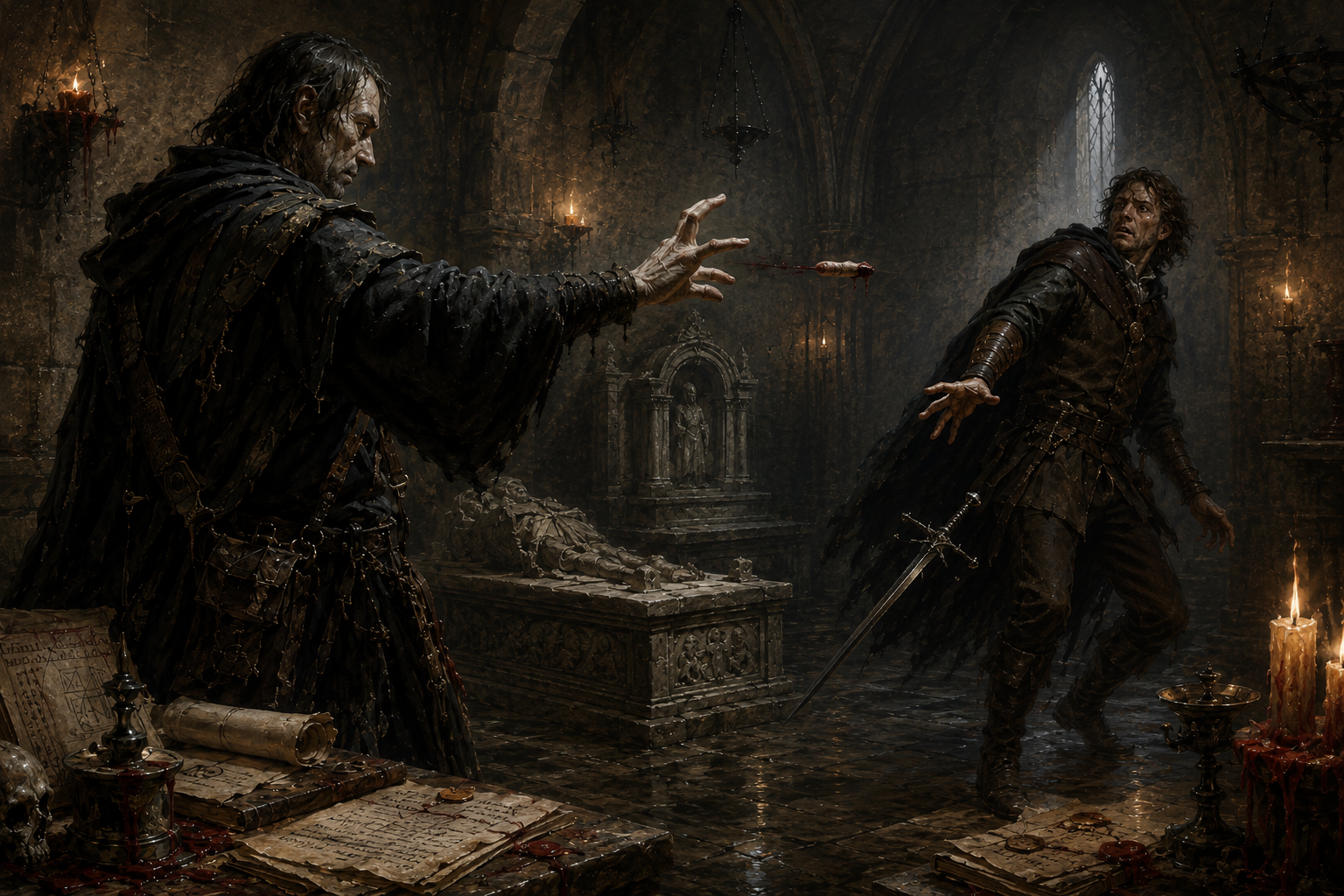
Corrupt magic buys certainty with flesh: each dart is one of the caster’s own fingers, and every dart costs Strength as well as the finger itself.
Lahm’s Finger Darts is a 3.0 Book of Vile Darkness corrupt spell. There is no direct official D&D 5e / 2014, D&D 5.5e / 2024, or Pathfinder 1e version, and the page no longer presents an invented modern condition-based conversion as published rules.
The original spell is much harsher and simpler. A finger tears free as an unerring projectile, deals Dexterity damage, and leaves the caster both physically maimed and weakened by the corruption cost. Higher caster level permits more darts only by sacrificing more fingers.
Quick Rules Reference
- 5.5e / 2024: no direct official Lahm’s Finger Darts spell.
- 5e / 2014: no direct official version.
- Pathfinder 1e: no native core entry.
- D&D 3.5e: the known printed source is 3.0 Book of Vile Darkness; use only as an explicitly labelled legacy import.
- 3.0: Transmutation [Evil], Corrupt 2, medium range, no save, Spell Resistance yes.
- Damage: each dart deals 1d4 Dexterity damage and strikes unerringly under the spell’s stated conditions.
- Scaling: 1 dart initially; 2 at caster level 4, 3 at 7, 4 at 10, maximum 5 at 13+.
- Corruption cost: 1 Strength damage and one lost finger per dart.
- Regrowth: one lost finger regrows for each point of that corruption Strength damage healed.
Rules
Lahm’s Finger Darts by Edition
5.5e / 2024 — No Direct Official Lahm’s Finger Darts
The 2024 rules do not contain this spell. The previous version on this page invented Constitution saves, Crippled and Hampered conditions, Corrupt Exhaustion, modern character-level dart scaling and modern healing interactions. Those mechanics have been removed.
5e / 2014 — No Direct Official Lahm’s Finger Darts
The 2014 rules likewise contain no direct Lahm’s Finger Darts spell. Any modern adaptation of its self-mutilation and ability-damage mechanics is a house rule rather than an official printing.
Pathfinder 1e — No Native Core Entry
Pathfinder 1e has no native core Lahm’s Finger Darts spell. A campaign importing it should identify it as 3.0 corrupt magic and decide explicitly how the corruption cost and ability damage interact with Pathfinder rules.
D&D 3.5e — Legacy 3.0 Import
The known printed source is the 3.0 Book of Vile Darkness. No revised 3.5e printing is presented here as though it were native to that edition.
If used in a 3.5e game, retain the original spell’s core cost and effect unless the table deliberately converts it: unerring finger-darts, Dexterity damage, no saving throw, Spell Resistance, and a Strength/finger corruption cost.
What Changed?
- The fabricated 5.5e/2024 conversion has been removed.
- Modern Crippled, Hampered and Corrupt Exhaustion mechanics are no longer presented as official rules.
- The spell is identified correctly as 3.0 Book of Vile Darkness corrupt magic.
- The original no-save, Spell-Resistance, Dexterity-damage procedure is restored.
- The actual corruption cost—Strength damage plus literal finger loss—is restored.
Legacy 3.0 Lahm’s Finger Darts
Book of Vile Darkness reference.
Transmutation [Evil]
Level: Corrupt 2
Components: V, S, Corrupt
Casting Time: 1 action
Range: Medium (100 ft. + 10 ft./level)
Target: Up to five creatures, no two more than 15 ft. apart
Duration: Instantaneous
Saving Throw: None
Spell Resistance: Yes
Each dart is one of the caster’s fingers and deals 1d4 Dexterity damage. It strikes unerringly even when the target is in melee or has partial cover or concealment, but it cannot damage inanimate objects.
The caster gains another possible dart for every three caster levels beyond 1st: two darts at 4th level, three at 7th, four at 10th and five at 13th or higher. Targets are designated before Spell Resistance or damage is resolved.
Corruption cost: 1 Strength damage and one lost finger per dart. Creatures without fingers cannot cast the spell. A hand with one or no fingers is useless. Lost fingers regrow as the corruption Strength damage is healed, one finger per point healed.
Original Rules Preservation Note
Lahm’s Finger Darts originates in Book of Vile Darkness, page 98, as a corrupt transmutation spell. The Pathfinder / 3.5e-compatible version above preserves the original structure: corrupt component, no saving throw, Spell Resistance, Dexterity damage, one point of Strength damage per dart, one lost finger per dart, scaling up to five darts, and finger regrowth tied to healing the corruption cost.
No direct modern D&D version is presented here. The spell’s actual published identity is the 3.0 corrupt-magic version above; any modern conversion should be clearly labelled as a house rule rather than blended into the source mechanics.
Why Lahm’s Finger Darts Matters
Lahm’s Finger Darts is feared because it leaves evidence on both sides of the spell.
The victim remembers the dart. The caster carries the wound.
A witness may not understand corrupt transmutation, but they will remember the missing finger, the sudden tearing motion, the hiss of flesh crossing the room, and the victim’s hand failing at the worst possible moment. Unlike many spells, this one marks the caster as well as the target.
That makes it valuable in play. It creates investigation clues, social stigma, cult identifiers, villain signatures, healing dilemmas, and long-term consequences.
A murderer who used the spell may later hide one hand in a glove. A cult priest may display a maimed hand as proof of devotion. A court sorcerer may restore the fingers afterward, leaving skin too smooth, too new, and too suspicious. A survivor may recognise the caster not by face, voice, or robe, but by the hand.
How the Spell Feels in the World
People who live by their hands hate this spell.
A swordmaster fears it because it ruins grip and timing. An archer fears it because it steals aim. A thief fears it because it turns delicate work into trembling failure. A scribe fears it because a shaking hand can destroy a lifetime of labour. A musician fears it because the spell attacks art as much as flesh.
That makes Lahm’s Finger Darts more personal than a fire spell. It does not merely injure the body. It threatens vocation, identity, livelihood, honour, and reputation.
In a late medieval campaign world, a maimed hand is not a minor cosmetic issue. It affects work, oath-taking, legal witness, religious gesture, weapon use, guild standing, and marriage prospects. A spell that spends fingers carries more meaning than its immediate combat effect.
Using Lahm’s Finger Darts in Play
Use this spell when you want corrupt magic to feel tempting but costly.
A villain should not cast it casually. The moment should matter. The caster chooses a finger. The finger darkens. The joint strains. The spell completes. Only then does the dart fly.
That order is important. Describe the price before the attack.
The best uses are intimate and specific:
- A cult assassin cripples a witness before she can flee across rooftops.
- A corrupt priest fires one dart at a temple champion before a duel.
- A court sorcerer maims an envoy’s sword hand during negotiations.
- A plague-surgeon sacrifices a finger to stop a fleeing patient from escaping quarantine.
- A desperate player character considers using the spell because no cleaner option remains.
The spell is less interesting when treated as ordinary damage optimisation. It is strongest when the table understands that the caster has made a visible bargain with corruption.
Corrupt Magic and Consequence
This spell should carry consequences outside combat.
A caster who uses it in public may be identified later by missing fingers, strange regrowth, ritual gloves, splints, scars, or hand gestures adapted around injury. A healer who restores the fingers may become complicit, suspicious, or afraid. A magistrate may treat unnatural regrowth as evidence of forbidden practice.
In cults, missing fingers may become signs of rank. One missing finger might mark initiation. Three might mark deep service. A complete hand of unnaturally smooth regrown fingers may mark someone who has sacrificed and been restored many times.
In infernal courts, the spell may be treated as a small contract written in flesh: the caster pays before harm is delivered. Devils may respect the neatness of the transaction. Demons may care only for the pain. Mortal law may care that the wound proves method, means, and intent.
Best Campaign Roles
Villain Signature Spell
This is the strongest use. A villain who tears away a finger to cripple someone is instantly memorable. It tells the party what kind of enemy they face without a speech.
Forbidden Player Temptation
As treasure, this spell should feel dangerous. A scroll or grimoire containing it is not just a reward. It is an invitation to cross a line.
Cult Initiation Rite
The spell can mark cult rank, devotion, or obedience. A novice may be expected to sacrifice one finger. A high priest may display a hand ruined and restored many times.
Legal Evidence
The spell creates unusual forensic clues: missing fingers, regrown fingers, maimed victims, and witnesses who remember the caster’s hand.
Personal Revenge
A survivor may seek revenge because the spell ruined a livelihood rather than because it nearly killed them.
Best Targets in Story Terms
The most interesting targets are not always the strongest enemies.
Use the spell against people whose identity depends on grace, precision, or touch:
- The archer about to loose the warning shot.
- The thief halfway across a rooftop.
- The duelist defending a noble hostage.
- The scribe copying a forbidden confession.
- The surgeon trying to save a poisoned heir.
- The musician whose song is holding back a curse.
- The monk balancing on a bridge chain.
- The spellcaster whose gestures must be exact.
The spell becomes more memorable when the target’s loss of coordination changes the scene.
Encounter Use
For a low-level party, one dart is enough to make the caster frightening. Do not open with maximum output unless the caster is fanatical or desperate.
For a mid-level party, the caster can use two or three darts to create tactical pressure without dominating the whole encounter. A good target is the character about to escape, interrupt a ritual, or make a critical movement-based action.
For a high-level party, the spell works best as part of a larger villain scene. The caster sacrifices fingers while guards, wards, hostages, contracts, or ritual consequences make the choice matter.
The spell is not only a combat action. It is a statement: “I will spend myself to hurt you.”
Good Pairings
- Bestow Curse The dart damages coordination first; the curse makes the injury feel like it has sunk into fate.
- Hold Person The victim’s body is already vulnerable, making the spell feel like precise cruelty rather than random harm.
- Ray of Enfeeblement Strength loss and coordination loss together make a martial enemy feel physically ruined.
- Silence Prevents immediate verbal spellcasting responses and makes the mutilation scene feel more dreadful.
- Fear Effects The visible self-sacrifice gives fear magic a concrete emotional reason to take hold.
- Infernal Contracts A devil may teach this spell as a lesson: all power has a price, and the wise pay with someone else’s future after paying a little of their own flesh first.
Failure, Risk, and Misuse
The obvious risk is physical cost. The subtler risk is recognisability.
A caster who uses Lahm’s Finger Darts becomes easier to identify. Gloves, rings, missing fingers, oddly restored skin, altered handwriting, and changed gestures can all betray the spell’s use.
Repeated use also creates dependency. A caster who solves problems by sacrificing fingers may begin to see the body as currency. That is exactly the kind of moral erosion corrupt magic should create.
Misuse at the table usually comes in three forms:
Too clean: The spell becomes just another efficient debuff. Restore the cost and consequence.
Too silly: The spell becomes cartoon gore. Keep the description controlled, ritualised, and grim.
Too broad: The spell becomes a tool for attacking objects, mechanisms, and obstacles. Keep it creature-focused.
Adventure and Worldbuilding Hooks
The Fingerless Witness
A witness swears she saw the killer cast a forbidden finger-dart spell, but the accused now has all ten fingers. The party must discover whether the fingers regrew through restoration magic, infernal favour, false testimony, or a prepared double.
The Guild of Trembling Hands
A thieves’ guild is being dismantled without mass murder. Its burglars, lockpickers, climbers, and cutpurses are being crippled one by one by a corrupt mage who understands exactly which hands to ruin.
The Saint with New Fingers
A local cult venerates a woman whose fingers regrow after every act of “holy violence.” Her followers call it proof of divine favour. The old temple calls it corruption. The party must decide whether they are looking at a miracle, a fiendish pact, or something stranger.
FAQ
Can Lahm’s Finger Darts damage locks, ropes, traps, or weapons?
No. The spell cannot damage objects. It targets creatures.
Does the caster lose the finger if the target resists the spell?
Yes. The cost is paid when the dart is created, not when the spell succeeds.
Can the spell hit a creature behind a wall?
No. The dart is unerring against a valid target, but it does not ignore total cover or blocked line of effect.
Can a creature without humanoid hands cast it?
Not by default. The creature needs true finger-like digits capable of being lost.
Can a caster fire more darts than she has fingers?
No. Each dart requires one available finger.
Can restored fingers be used again for the spell?
Yes, if the spell’s corrupt cost has been properly healed and the fingers have regrown. That repeated cycle should leave social, magical, or visible consequences if it becomes common.
Should player characters be allowed to learn this spell?
Only if corrupt magic is part of the campaign. The spell should carry physical, moral, social, and possibly legal consequences.
Is this spell evil because of the damage or because of the cost?
Both. It harms the victim through corrupt transmutation, and it requires the caster to treat her own living body as expendable fuel for harm.
Historical, Anatomical, and Mythic Context
Lahm’s Finger Darts belongs to the symbolic world of hands, oaths, craft, punishment, and bodily sacrifice. Fingers are not incidental in a medieval or mythic setting. They write, bless, steal, swear, count coins, draw bowstrings, play instruments, hold weapons, seal contracts, and perform sacred gestures. A spell that spends fingers therefore attacks identity as much as anatomy.
Medieval culture gave the hand a special status as the body’s chief instrument of touch, work, reading, writing, and expression. The Getty’s exhibition material on the hand in medieval manuscripts notes that fingers were treated as exceptionally expressive, while the Huygens Institute project A Show of Hands studies hand images in medieval manuscripts from 900–1550 and their role in learning, memory, and visual culture.
The spell also has a legal and social edge. Medieval law could treat bodily mutilation as a visible punishment, making the damaged body a public sign of crime, shame, authority, or vengeance. Patricia Skinner’s work on disfigurement, authority, and law is useful for this theme, especially the idea that mutilation could mark the body as a legal and political text. For a more accessible discussion of mutilation in medieval Anglo-Scandinavian law, see The Mutilated Body in Medieval Anglo-Scandinavian Law.
That background makes the spell more than a ranged debuff. The caster corrupts the very part of the body associated with touch, craft, oath, command, witness, and skill. She does not merely harm an enemy. She turns her own hand into evidence that flesh has become currency.
Keep this reference growing
If this page helped with your reading or game, you can support its upkeep or explore the curated books.
Explore the Bookshop — epics, classics and stories behind imagined worlds.