
Ghoul Gauntlet Spell
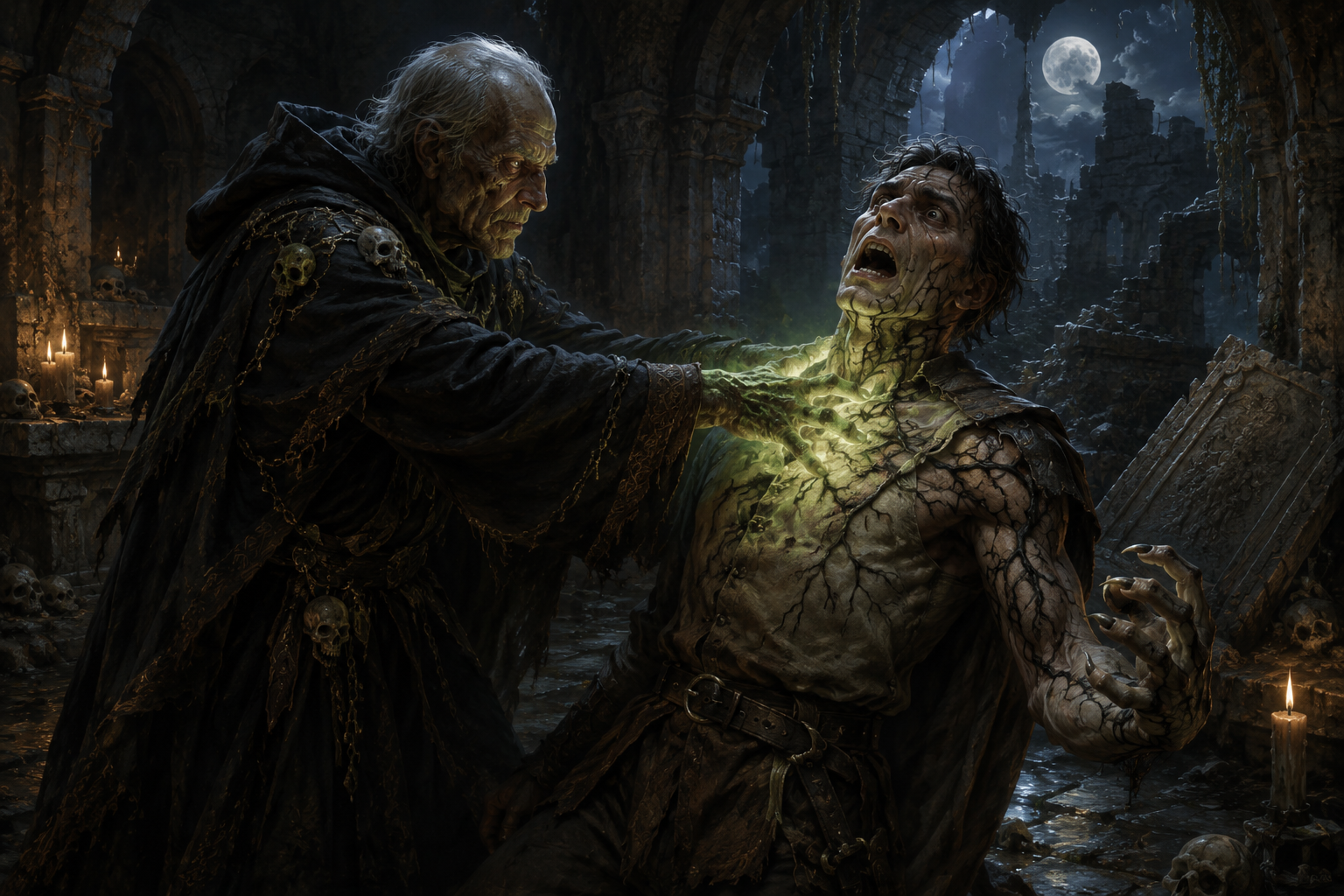
One touch starts a deathly transformation: 3d6 damage every round until the victim is cured, dies, or becomes a ghoul.
Ghoul Gauntlet is a D&D 3.5e necromancy spell from Libris Mortis, later revised in Spell Compendium. There is no direct official D&D 5e / 2014 or D&D 5.5e / 2024 version, and Pathfinder 1e has no native core entry.
The two 3.5e printings are close but not identical. Spell Compendium narrows the target to one living humanoid and raises the caster’s total undead-control allowance to 4 Hit Dice per caster level. Libris Mortis targets one living creature and uses a 2-HD-per-level control limit.
Quick Rules Reference
- 5.5e / 2024: no direct official Ghoul Gauntlet spell.
- 5e / 2014: no direct official Ghoul Gauntlet spell.
- Pathfinder 1e: no native core entry; a 3.5e import should be labelled as such.
- D&D 3.5e: Necromancy [Death, Evil], Sorcerer/Wizard 6, Hunger 5, touch, Fortitude negates, Spell Resistance yes.
- Transformation: 3d6 damage each round; reaching 0 hit points turns the victim into a ghoul.
- Healing: hit-point healing can delay death but does not stop the transformation.
- Removal: restorative or anti-magic effects listed by the printing can end the change before death.
- Created ghoul: remains under the caster’s control, subject to that printing’s undead-control limit.
Rules
Ghoul Gauntlet by Edition
5.5e / 2024 — No Direct Official Ghoul Gauntlet
The 2024 rules do not contain an official Ghoul Gauntlet spell. The former modern version on this page—melee spell attack, Constitution save, necrotic scaling, modern cure list and spellcasting-modifier control cap—was a conversion and has been removed.
5e / 2014 — No Direct Official Ghoul Gauntlet
The 2014 spell list likewise has no direct Ghoul Gauntlet spell. Importing the 3.5e transformation requires an explicit house rule rather than presenting it as published 5e mechanics.
Pathfinder 1e — No Native Core Entry
Pathfinder 1e has no native core Ghoul Gauntlet entry. If a Pathfinder campaign imports the spell, identify which 3.5e printing is being used because the target and undead-control limits differ.
Ghoul Gauntlet — D&D 3.5e
Spell Compendium printing
| School | Necromancy [Death, Evil] |
|---|---|
| Level | Sorcerer 6, Wizard 6, Hunger 5 |
| Components | V, S |
| Casting Time | 1 standard action |
| Range | Touch |
| Target | One living humanoid creature |
| Duration | Instantaneous |
| Saving Throw | Fortitude negates |
| Spell Resistance | Yes |
A failed initial save begins the transformation. The subject takes 3d6 damage each round. When it reaches 0 hit points, it becomes a ghoul.
Hit-point healing can prolong the victim’s life but does not halt the change. The printing lists remove disease, dispel magic, heal, limited wish, miracle, Mordenkainen’s disjunction, remove curse, wish, and greater restoration as ways to negate the gradual transformation after a failed initial save.
The created ghoul remains under your control indefinitely. Your total controlled undead from all sources is limited to 4 HD per caster level; newly created undead remain controlled and you choose which older excess undead are released. Undead commanded through a cleric’s command/rebuke ability do not count against this spell’s stated limit.
Libris Mortis printing
| School | Necromancy [Death, Evil] |
|---|---|
| Level | Sorcerer 6, Wizard 6, Hunger 5 |
| Target | One living creature |
| Save / SR | Fortitude negates / Yes |
The transformation procedure is the same: 3d6 damage per round, with the victim becoming a ghoul at 0 hit points, and ordinary healing only delaying the process.
The important mechanical difference is control capacity: Libris Mortis limits controlled undead from all sources to 2 HD per caster level.
What Changed?
- The invented 5.5e/2024 conversion has been removed.
- Pathfinder 1e is no longer treated as though it had a native printing.
- The two real 3.5e printings are separated.
- Spell Compendium narrows the target to a living humanoid and uses a 4-HD-per-level undead-control cap.
- Libris Mortis targets one living creature and uses a 2-HD-per-level control cap.
- The core countdown remains 3d6 damage per round until cured or reduced to 0 hit points.
Why This Spell Is Dangerous in the World
Ghoul Gauntlet is dangerous because it breaks trust around the dying.
In plague years, famine winters, sieges, and battlefields, people already fear corpses. This spell gives that fear a name. A victim can be alive, speaking, begging, and still be legally and spiritually treated as a future corpse-hazard. It invites panic killings. It creates accusations against healers who fail to stop it. It gives necromancers a way to turn noble hostages, captured soldiers, rivals, and witnesses into obedient dead.
In regions touched by the Red Death, Ghoul Gauntlet is especially feared because it resembles the worst stories of failed death: the body continues, but the person does not. However, the spell is not the Red Death. It is a deliberate magical crime, not a plague symptom.
The spell also creates legal consequences. A ghoul made from a murdered heir, priest, guildmaster, knight, spouse, or envoy is not merely an undead monster. It is evidence. It is desecration. It is a political weapon wearing a known face.
Rules Clarifications and Edge Cases
- Healing buys time. It does not end the transformation.
- Reaching 0 hit points is dangerous. If the victim dies while the spell remains active, the ghoul transformation occurs.
- Death ward should matter. If active before the spell lands, it should block or suppress the death effect. If cast afterward, it may protect against further death magic but should not automatically reverse the transformation unless the edition’s rules support that.
- Remove curse can end it. It must be used before the victim becomes a ghoul.
- Resurrection is possible only after the ghoul is dealt with. The ghoul must usually be destroyed and the soul must be available, subject to the campaign’s normal resurrection limits.
- The ghoul is not the same person. It may retain traces, habits, clothing, voice, or hatred, but the person has died.
- The ghoul does not spread Ghoul Gauntlet. The spell creates a ghoul; it does not make every ghoul a carrier of the spell.
Good Combinations
- Paralysis or Restraint: Keeps the victim or their rescuers from acting quickly enough.
- Silence: Makes emergency spellcasting and coordination harder.
- Wall or Locking Magic: Separates the victim from the party’s healer.
- Existing Undead Servants: Forces the party to fight through bodies while the transformation advances.
Adventure and Worldbuilding Hooks
The Unfinished Transformation
A monastery preserves a victim of Ghoul Gauntlet in a state between life and undeath. The monks have kept him alive with repeated healing, but they cannot break the spell. Now the necromancer who cast it is dead, and the only known cure may lie in his sealed laboratory.
The Ghoul with the Signet Ring
A ghoul wearing a noble signet is found feeding in a charnel ditch. The family insists the heir died honourably in battle. The ghoul’s existence proves otherwise.
The Mercy Trial
A soldier killed his own brother after seeing the first signs of transformation. The court must decide whether it was murder, mercy, cowardice, or battlefield necessity.
Historical and Mythic Context
Ghoul Gauntlet draws on the ancient fear that the dead may not remain safely dead, and that hunger can survive the death of the person. The ghoul is especially associated with graveyards, desolate places, corpse-eating, and the violation of burial. In Arabic folklore, the ghūl belongs to the wider family of dangerous spirits and is often linked with wilderness, graves, and devouring appetite. See Britannica’s entry on the ghoul.
The spell turns that fear into a deliberate act of necromancy. The victim is not merely eaten by a ghoul, but made into one. That makes the horror more intimate than a battlefield curse. It attacks the boundary between patient and corpse, family member and monster, person and remains.
In a late medieval campaign, this matters because burial is not only disposal. Burial is law, memory, inheritance, household honour, sacred duty, and protection of the living. The horror is not only that the corpse walks, but that burial, inheritance, testimony, mourning, and legal recognition are all interrupted by hunger.
A spell that turns a dying person into a flesh-eating undead servant is therefore a crime against the victim, the family, the grave, and the community that must decide what to do before the transformation finishes. In places already scarred by plague, famine, siege, or the Red Death, Ghoul Gauntlet becomes more than a private curse. It becomes public terror, because it makes the sickbed, battlefield, and death chamber feel uncertain until death is safely complete.
Keep this reference growing
If this page helped with your reading or game, you can support its upkeep or explore the curated books.
Explore the Bookshop — epics, classics and stories behind imagined worlds.