
Faerie Fire
Faerie Fire turns concealment into exposure. Cold blue, green or violet radiance clings to creatures and objects, tracing what darkness, distortion or invisibility was meant to hide and giving attackers a clear target.
The spell changes substantially between D&D 5.5e / 2024, Pathfinder 1e and D&D 3.5e. The modern spell is a concentration-based battlefield debuff using a Dexterity saving throw and Advantage. Pathfinder and D&D 3.5e instead use long range, legacy concealment rules and spell resistance.
Quick Rules Reference
D&D 5.5e / 2024
- Level
- 1st-level Evocation
- Classes
- Bard, Druid
- Range
- 60 feet
- Area
- 20-foot Cube
- Save
- Dexterity
- Duration
- Concentration, up to 1 minute
- Main Effect
- Advantage on attacks; suppresses Invisible
Pathfinder 1e
- Level
- Druid 1, Hunter 1, Mesmerist 1
- Range
- Long
- Area
- 5-ft.-radius burst
- Save
- None
- Spell Resistance
- Yes
- Duration
- 1 minute/level (D)
- Main Effect
- –20 Stealth and defeats listed concealment
D&D 3.5e
- Level
- Druid 1
- Range
- Long
- Area
- 5-ft.-radius burst
- Save
- None
- Spell Resistance
- Yes
- Duration
- 1 minute/level (D)
- Main Effect
- Defeats specified forms of concealment
Game Statistics
Faerie Fire — D&D 5.5e / 2024
- Casting Time
- Action
- Range
- 60 feet
- Components
- V
- Duration
- Concentration, up to 1 minute
- Area
- 20-foot Cube
- Saving Throw
- Dexterity
Spell Effect
Choose a 20-foot Cube within 60 feet. Objects in the Cube are outlined in blue, green or violet light. Each creature caught in the Cube makes a Dexterity saving throw; on a failed save, that creature is also outlined.
For the duration, affected objects and creatures shed Dim Light in a 10-foot radius. An affected creature cannot benefit from the Invisible condition. Attack rolls against an affected creature or object have Advantage if the attacker can see the target.
The Cube Is Not a Persistent Zone
The Cube determines what is affected when the spell takes effect. It does not remain behind as an active volume that marks creatures entering the space later. The radiance remains on the creatures and objects that were actually affected.
Objects Do Not Save
The Dexterity saving throw applies to creatures. Objects in the Cube are outlined automatically.
Concentration
The outlines remain only while concentration continues, for up to 1 minute. If the caster loses concentration, every outline created by that casting ends.
Seeing the Target Still Matters
Faerie Fire prevents an affected creature from benefiting from Invisible, but it does not abolish unrelated barriers to sight. The Advantage clause requires the attacker to be able to see the affected creature or object.
Faerie Fire — Pathfinder 1e
- School
- Evocation [light]
- Level
- Druid 1, Hunter 1, Mesmerist 1
- Casting Time
- 1 standard action
- Components
- V, S, DF
- Range
- Long (400 ft. + 40 ft./level)
- Area
- Creatures and objects within a 5-ft.-radius burst
- Duration
- 1 min./level (D)
- Saving Throw
- None
- Spell Resistance
- Yes
Spell Effect
A harmless pale radiance surrounds and outlines the affected creatures and objects. The caster chooses blue, green or violet when the spell is cast.
An outlined creature takes a –20 penalty on Stealth checks. It also loses the concealment normally provided by ordinary darkness, Blur, Displacement, Invisibility and similar effects.
Magical darkness of 2nd level or higher continues to function normally. The glow is too weak to produce any special harmful effect against undead or other creatures merely because powerful light is dangerous to them.
Mythic Faerie Fire
Mythic Faerie Fire dazzles outlined creatures. It also outlines qualifying figment illusions within the burst, revealing them as illusions.
The augmented mythic form can expend additional mythic power to force creatures in the burst to make a Fortitude saving throw or become blinded for 1 round.
Faerie Fire — D&D 3.5e
- School
- Evocation [Light]
- Level
- Druid 1
- Casting Time
- 1 standard action
- Components
- V, S, DF
- Range
- Long (400 ft. + 40 ft./level)
- Area
- Creatures and objects within a 5-ft.-radius burst
- Duration
- 1 min./level (D)
- Saving Throw
- None
- Spell Resistance
- Yes
Spell Effect
A pale blue, green or violet glow surrounds the affected creatures and objects. The light is comparable to candlelight and causes no harm.
An outlined creature cannot claim the concealment it would normally receive from ordinary darkness, Blur, Displacement, Invisibility or similar visual effects.
Magical darkness of 2nd level or higher continues to function normally. The glow is not intense enough to have a special harmful effect on undead or dark-dwelling creatures vulnerable to powerful light.
How Faerie Fire Works
Faerie Fire is revelation magic expressed through visible light. It does not need to destroy the effect concealing a target. Instead, the spell creates a new visible sign that betrays the target’s shape and position.
An invisible creature may still possess whatever spell, supernatural power or condition made it invisible. Faerie Fire simply prevents that invisibility from providing its normal visual defence when the rules of the chosen edition say the outline defeats it.
What Faerie Fire Is For
Expose Invisible Enemies
Faerie Fire is one of the classic answers to Invisibility. It turns an unseen opponent into something the whole group can identify and attack more effectively.
Mark a Dangerous Target
When one creature matters more than everything else in the encounter, keeping it unmistakably visible can be more valuable than inflicting a small amount of immediate damage.
Exploit Enemy Clustering
The modern 20-foot Cube rewards careful placement against groups. Several failed saves can create multiple obvious targets for concentrated attacks.
Defeat Visual Defence
In Pathfinder and 3.5e, the spell directly counters several classic concealment effects rather than using the modern Invisible-condition and Advantage framework.
Support High-Value Attacks
In D&D 5.5e, Advantage is particularly valuable when an ally has a limited, expensive or unusually damaging attack that needs to connect. Faerie Fire can therefore multiply the value of other characters’ offensive resources without dealing damage itself.
Do Not Spend It on Certainty
If an enemy is already plainly visible, easy to hit and unlikely to escape, Faerie Fire may be solving a problem the party does not have. Its strongest targets are enemies whose survival depends upon concealment, invisibility or simply being difficult to strike.
Faerie Fire and Invisibility
Faerie Fire and See Invisibility solve related problems in different ways.
See Invisibility changes what one caster can perceive. Faerie Fire marks a target so that the outline itself becomes visible to others.
| Question | D&D 5.5e / 2024 | Pathfinder 1e | D&D 3.5e |
|---|---|---|---|
| Does Faerie Fire end Invisibility? | No. The affected creature cannot benefit from the Invisible condition while marked. | No. The invisibility effect may remain active, but its normal concealment benefit is defeated by the visible outline. | No. The invisibility effect remains, but the outlined creature loses the concealment normally gained from it. |
| Does everyone benefit? | Attackers who can see the affected target gain Advantage on attack rolls against it. | The visible outline removes the specified concealment benefits for observers able to perceive it. | The visible outline removes the specified concealment benefits for observers able to perceive it. |
| Does the creature save? | Yes. Dexterity. | No saving throw; Spell Resistance applies. | No saving throw; Spell Resistance applies. |
| Is the invisibility dispelled? | No. | No. | No. |
Faerie Fire, Blur and Displacement
In Pathfinder 1e and D&D 3.5e, Faerie Fire explicitly defeats the concealment normally produced by Blur and Displacement.
Do not carry that wording automatically into D&D 5.5e. The modern spell states what its outline does: affected creatures cannot benefit from Invisible, and attack rolls against affected creatures or objects have Advantage when the attacker can see them. Other modern defensive spells use their own wording.
Darkness, Light and Line of Sight
Faerie Fire creates visible radiance, but it is not universal supernatural sight.
- Ordinary darkness: the glow makes a marked subject conspicuous according to the visibility rules of the edition.
- Opaque barriers: Faerie Fire does not allow attackers to see through walls, doors, stone pillars or other solid obstructions.
- D&D 5.5e magical darkness: resolve the darkness effect using its own modern rules. Do not import the legacy “2nd-level magical darkness” clause.
- Pathfinder and 3.5e magical darkness: a magical darkness effect of 2nd level or higher functions normally despite Faerie Fire.
- Light-sensitive creatures: the legacy spell is explicitly too dim to produce a special harmful effect merely because powerful light would harm the creature.
Rules Clarifications
Does the D&D 5.5e Cube remain on the battlefield?
Can Faerie Fire affect allies?
Do objects make a Dexterity save in D&D 5.5e?
Does Faerie Fire dispel Invisibility?
Can a blinded attacker gain modern Faerie Fire’s Advantage?
Does Faerie Fire deal fire or radiant damage?
Does D&D 5.5e Faerie Fire improve when upcast?
Does Pathfinder Faerie Fire really impose –20 Stealth?
Faerie Fire or See Invisibility?
| Spell | Best At | Main Limitation |
|---|---|---|
| Faerie Fire | Marking one or more targets so the party can engage them more effectively. | Uses an area and edition-specific resistance mechanics; modern creatures can succeed on their Dexterity saves. |
| See Invisibility | Allowing one caster to perceive invisible creatures without needing to mark each target first. | Normally helps the caster rather than making the target visibly outlined for the whole group. |
| Glitterdust | A classic Pathfinder / 3.5e area counter to invisible creatures with additional offensive potential. | Primarily a legacy-edition comparison rather than part of modern Faerie Fire’s rules. |
| Dispel Magic | Attempting to end an eligible magical effect itself. | Does not automatically solve every innate, supernatural or non-dispellable source of invisibility. |
Good Uses and Combinations
- See Invisibility: a character able to locate an unseen enemy can help the caster place Faerie Fire where the target actually stands.
- Dispel Magic: use revelation when seeing the target is enough; use dispelling when the underlying magical effect itself needs to end.
- High-impact attacks: in modern play, Advantage is particularly valuable when an ally has a powerful attack that cannot afford to miss.
- Focused attacks: a luminous target provides an obvious tactical signal. Everyone can immediately identify which enemy has been successfully marked.
- Glitterdust: in legacy games, compare the lower-level, longer-lasting Faerie Fire with Glitterdust’s larger burst and ability to blind.
Creatures That Use Faerie Fire
Faerie Fire is particularly associated with fey creatures on SpiralWorlds. These creatures provide ready-made examples of how the spell can appear naturally in encounters rather than only on player-character spell lists.
Daoine Sídhe
The Daoine Sídhe can employ Faerie Fire innately, making revelation magic part of the creature’s normal supernatural repertoire.
Trow
Trow use Faerie Fire alongside charms, illusion and mobility, making the spell a natural tool for exposing opponents during deceptive fey encounters.
Faun
Fauns combine Faerie Fire with music, enchantment and woodland movement, using revelation as part of a broader style of fey battlefield control.
Faerie Queen
The Faerie Queen can invoke Faerie Fire as part of her formidable fey magic, demonstrating how the same low-level spell remains tactically useful even in encounters with immensely powerful beings.
GM Adjudication
Describe Cold Light
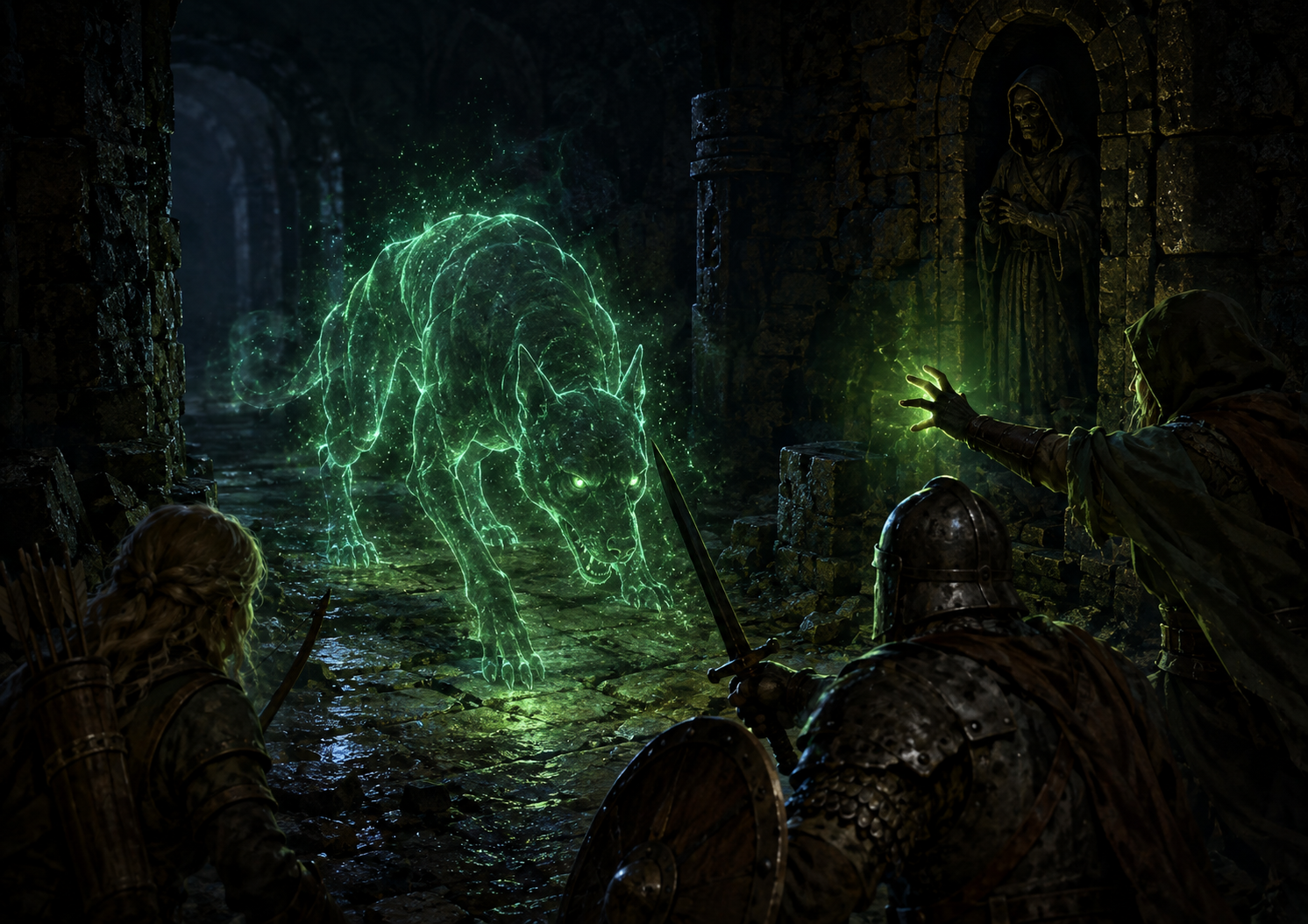
The spell does not need to resemble ordinary flame. Green radiance can gather along the ridge of an invisible hound’s shoulders, trace its paws against wet stone and mark the shape of its teeth when it opens its mouth. A cloaked assassin may be visible only as a luminous hem, hood and hand around an otherwise absent body.
Keep Multiple Targets Readable
When several creatures are affected, the colour is primarily a practical visual cue. The battlefield should become easier to understand rather than a storm of distracting magical particles.
Make Concealment Encounters Fair
Faerie Fire gives low-level characters a meaningful answer to invisibility and visual deception without making those abilities irrelevant. The spell still has to be prepared or known, placed correctly and—in modern play—survive both a saving throw and concentration.
Cold Woodland Light
The name faerie fire has a striking natural counterpart. Foxfire, the eerie bioluminescence produced by certain fungi growing through decaying wood, has also been called fairy fire. The phenomenon creates visible light without anything resembling an ordinary burning flame.
That makes it an unusually good natural-philosophical model for the spell. A scholar does not need to explain Faerie Fire as miniature green flames somehow burning without heat. It can instead be understood as cold luminescence: a hidden property of the natural world amplified, directed and made to cling deliberately to a chosen subject.
In a woodland at night, the connection is easy to understand. Damp timber glows faintly among roots and fallen trees; luminous fungi appear where darkness ought to be complete; travellers interpret the strange light through stories of hidden beings and enchanted places.
Faerie Fire in SpiralWorlds
In the learned magical traditions of late-medieval Earth, Faerie Fire can be taught as an application of natural philosophy rather than simply “fairy magic.” Students compare foxfire, luminous insects, unusual minerals, alchemical light and magical correspondences before learning how spellcraft can bind visible radiance to a moving subject.
Its practical value means the spell is known beyond woodland druids. Scouts, wardens, court magicians and fortress guards all have reasons to understand magic capable of betraying invisible intruders.
Gatehouses and Fortifications
A suspicious traveller can be ordered into an open yard where a caster has a clear view of the surrounding space. If an invisible companion follows close behind, a well-placed Faerie Fire may expose the deception.
Vaults and Treasuries
Objects can also be outlined. In a guarded treasury, brief magical marking can make particular objects conspicuous during an inspection, exchange or inventory.
Monster Hunting
Foresters and hunters value the spell against predators whose defence depends upon invisibility or disappearing into darkness. The hero illustration shows precisely that use: the hound remains physically dangerous, but green light makes its location unmistakable.
Battlefields
A fleeing officer, concealed skirmisher or invisible killer becomes far harder to lose once marked. Even in editions without modern Advantage, denying a target’s normal visual defence can alter an entire engagement.
Courts and Councils
In courts familiar with illusion and invisibility, a suspicious alcove, screen or entrance may be checked before a sensitive meeting begins. Casting Faerie Fire in such a setting is not decorative; it openly declares that unseen observation is considered a credible threat.
Adventure Uses
- An invisible hound stalks a ruined passage until green Faerie Fire suddenly traces its shoulders, jaws and paws.
- A thief reaches a reliquary unseen, but the watch druid floods the chamber with cold green light.
- A court magician exposes an invisible assassin during an audience, leaving the killer marked while guards close the doors.
- A creature in an overgrown ruin cannot be tracked reliably until a luminous outline clings to it whenever it emerges from cover.
- A fugitive intentionally allows Faerie Fire to mark a disguised decoy while escaping by another route.
- A commander marks an enemy standard bearer so archers can follow the target through smoke, darkness and confusion.
- Every object in an apparently empty vault takes on a green outline except one chest, raising the question of why the spell failed to mark it.
Related Spells and References
The concealment spell Faerie Fire most famously undermines. See Invisibility
Personal supernatural sight rather than visible battlefield marking. Glitterdust
A related legacy spell for revealing invisible creatures. Blur
A legacy visual defence explicitly countered by legacy Faerie Fire. Displacement
Another legacy concealment effect defeated by the legacy spell. Dispel Magic
Attempts to terminate an eligible magical effect rather than merely reveal its subject. Druid Spells
Browse the wider SpiralWorlds Druid spell reference. Bard Spells
Browse the wider SpiralWorlds Bard spell reference.
Rules Sources and Licensing
- D&D Beyond — 2024 Basic Rules: Spell Descriptions
- System Reference Document 5.2.1
- Archives of Nethys — Pathfinder 1e Faerie Fire
- D&D 3.5 System Reference Document — Faerie Fire
- University of Chicago Library — Foxfire and Fungi
This work includes material from the System Reference Document 5.2.1 (“SRD 5.2.1”) by Wizards of the Coast LLC.
Source: System Reference Document 5.2.1 . Licensed under the Creative Commons Attribution 4.0 International License .
Pathfinder 1e and D&D 3.5e mechanics are presented in concise reference wording. Consult the linked source material and its applicable licence notices for the underlying open rules material.
Faerie Fire

A pale glow surrounds and outlines the subjects. Outlined subjects shed light as candles.
This material is Open Game Content, and is licensed for public use under the terms of the Open Game License v1.0a.
Evocation [Light]
Level Druid 1
Components V, S, DF
Casting Time 1 standard action
Range Long (400 ft. + 40 ft./level)
Area Creatures and objects within a 5-ft.-radius burst
Duration 1 min./level (D)
Saving Throw None
Spell Resistance Yes
Outlined creatures do not benefit from the concealment normally provided by darkness (though a 2nd-level or higher magical darkness effect functions normally), blur, displacement, invisibility, or similar effects. The light is too dim to have any special effect on undead or dark-dwelling creatures vulnerable to light. The faerie fire can be blue, green, or violet, according to your choice at the time of casting. The faerie fire does not cause any harm to the objects or creatures thus outlined.