
Devil’s Eye Spell — Infernal Sight Through Magical Darkness
Devil’s Eye Spell — Infernal Sight Through Magical Darkness
The caster’s eyes take on a cold infernal gleam, seeing clearly where mortal sight should fail.
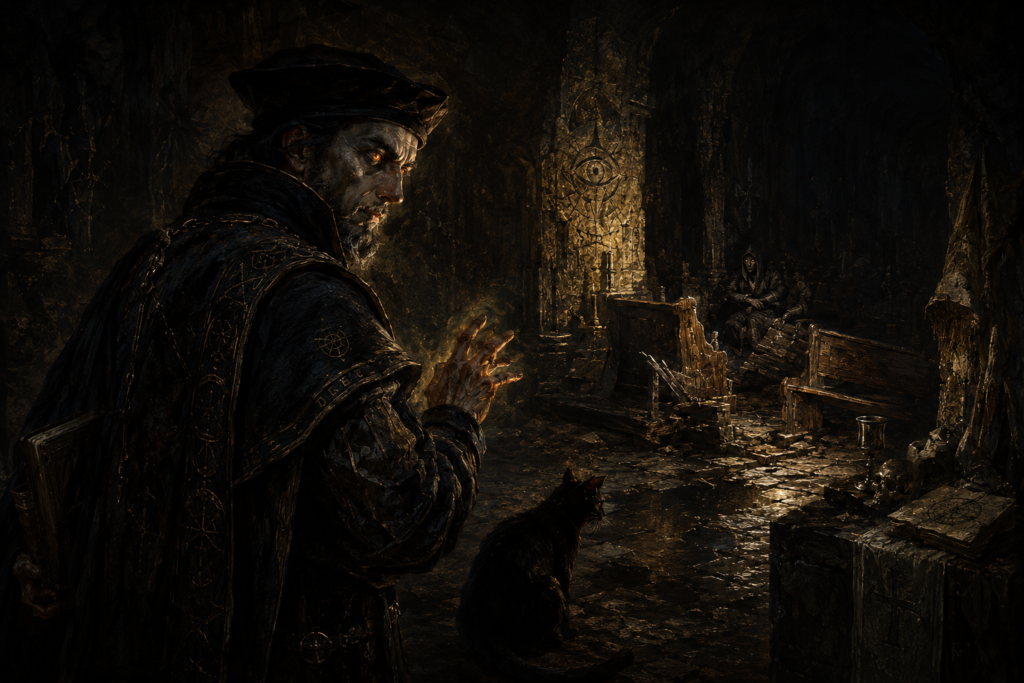
Some spells do not make light. They teach the caster to use darkness better than everyone else.
Devil’s Eye is an infernal divination that lets the caster see through ordinary darkness and magical darkness. It is not true sight, blindsight, or a universal perception spell. Its power is narrower, cleaner, and more sinister: the caster can step into darkness without surrendering control of the battlefield.
For a short time, darkness no longer protects the caster’s enemies. A blackguard can stride through a magically darkened shrine. A diabolist can command murder from a lightless room. A sorcerer can stand inside unnatural shadow and still choose targets with precision.
The spell should feel infernal, not merely practical. It does not banish darkness, sanctify it, or overcome it with holy light. It accepts darkness as useful and gives the caster permission to hunt within it.
That is what makes the spell dangerous. The caster does not need to reveal the hidden battlefield to everyone. They only need to see it themselves.
Effect
For the duration, you can see normally in darkness and magical darkness out to the range given in the rules version below.
This spell does not let you see through solid objects, smoke, fog, dust, heavy rain, invisibility, illusions, or physical cover. It defeats darkness, not every form of concealment.
While the spell is active, your eyes often show a visible sign of infernal alteration: narrowed catlike pupils, ember-red reflections, blackened sclera, or a faint predatory gleam when you turn your head.
Edition Tabs
Devil’s Eye 5.5e / 2024
Devil’s Eye, Pathfinder 1e / 3.5e
Devil’s Eye, 3.0e
Devil’s Eye 5.5e / 2024
2nd-Level Divination
Casting Time: 1 Action
Range: Self
Components: V, S
Duration: 10 Minutes
Available To: Cleric, Sorcerer, Warlock, Wizard
Alternative Spell Name: Infernal Sight
For the duration, you can see normally in darkness, both magical and nonmagical, to a range of 30 feet.
This spell does not grant Truesight, Blindsight, Tremorsense, or the ability to see invisible creatures. It does not let you see through smoke, fog, dust, heavy rain, solid barriers, physical cover, or visual illusions.
Infernal Mark. While the spell lasts, your eyes visibly change. A creature within 10 feet that studies your face can recognise the supernatural alteration with a successful Intelligence (Arcana) or Wisdom (Insight) check against your spell save DC.
Balance Note. Devil’s Eye defeats darkness, including magical darkness, but it does not solve every perception problem.
Devil’s Eye, Pathfinder 1e / 3.5e
Devil’s Eye
Divination [Evil]
Level: Blackguard 2, Cleric 3, Diabolic 2, Sorcerer/Wizard 3
Components: V, S
Casting Time: 1 standard action
Range: Personal
Target: You
Duration: 1 minute/level
Saving Throw: None
Spell Resistance: No
You gain the visual acuity of a devil. For the duration, you can see normally in darkness and magical darkness to a range of 30 feet.
This spell does not let you see invisible creatures, detect secret doors, pierce illusions, see through solid objects, or ignore concealment caused by smoke, mist, fog, dust, sand, heavy rain, or similar physical obstruction.
The spell’s evil descriptor reflects the infernal nature of the perception granted. Repeated use may draw attention from devils, infernal cults, corrupt temples, or enemies trained to recognise diabolic magic.
Devil’s Eye, 3.0e

The caster gains the visual acuity of a devil.
Book of Vile Darkness 3.5
By Monte Cook
Divination [Evil]
Level: Blackguard 2, Cleric 3, Diabolic 2, Sorcerer/Wizard 3
Components: V, S
Casting Time: 1 action
Range: Personal
Target: Caster
Duration: 1 minute/level
He can see not only in darkness, but also in magical darkness, with a range of 30 feet.
Why This Spell Is Dangerous in the World
Devil’s Eye changes who controls darkness.
In most places, darkness slows violence. It hides the hunted, confuses pursuers, protects fugitives, and makes even armed people hesitate. A caster using Devil’s Eye reverses that relationship. Darkness becomes a private advantage rather than a shared danger.
The spell is feared in prisons, crypts, siege tunnels, courts, temples, vaults, and noble houses. A single infernal caster who can see inside magical darkness can direct assassins, identify targets, steal relics, or execute prisoners while everyone else struggles blind.
Its limits matter. Smoke still blinds. Fog still matters. A wall remains a wall. An invisible assassin is still invisible. Devil’s Eye makes darkness useful to the caster; it does not make the caster all-seeing.
Best Uses
Use Devil’s Eye when darkness is part of the encounter rather than background decoration.
It works well in magical darkness, unlit corridors, night raids, underground passages, infernal sanctums, darkened temples, ambush chambers, and battlefields where one side has deliberately removed light.
For player characters, it rewards preparation against enemies who use darkness. For villains, it creates a clear tactical identity: the enemy does not merely hide in the dark; the enemy has built their plan around seeing through it.
Tactics
A caster should use Devil’s Eye before entering a prepared dark zone. Casting it after sight has already been lost is possible, but less efficient.
A blackguard can combine the spell with magical darkness and force enemies into a fight where only one side can see properly. A cleric of an infernal power can direct guards, cultists, or fiendish servants from inside a darkened chamber. A wizard can move through magical shadow without spending actions dispelling it.
Villains should use the spell with purpose. A diabolist might extinguish lamps, release magical darkness, then calmly cross the room while guards panic. A fiend-bound assassin might retreat into darkness not to escape, but to make pursuers step into prepared murder.
DM Notes
At the table, Devil’s Eye should answer one question:
Is darkness the thing blocking sight?
If yes, the caster can see through it within the spell’s range.
If the obstruction is smoke, fog, dust, rain, sand, a curtain, a wall, total cover, invisibility, or illusion, the spell does not solve the problem.
Do not use Devil’s Eye as an excuse to make every villain untouchable. It is strongest when the players can identify what is happening and respond. They might create smoke, flood the room with dust, force the caster into open light, break the darkness effect, mark the caster with flour or blood, use sound and area effects, or retreat beyond the spell’s limited range.
Good Combinations
- Darkness: The obvious pairing. The caster can fight or direct allies inside magical darkness while enemies lose reliable sight.
- Silence: Darkness and silence together create a brutal ambush environment, especially in corridors, shrines, prisons, and execution chambers.
- See Invisibility: Covers a different problem. Devil’s Eye defeats darkness; See Invisibility deals with invisible creatures.
- Summon Monster: A summoned fiendish creature becomes more dangerous when the caster can direct it clearly in darkness.
- Hold Person: The caster can identify a target inside darkness before disabling them.
Using This Spell in Your Game
Devil’s Eye is best treated as a spell of infernal preparation. It should not feel like an ordinary night-vision trick. It is a borrowed way of seeing, and the source of that borrowed sight should leave a mark.
For villains, make the sign readable: catlike pupils, red reflections in the dark, a black gleam across the eyes, or a familiar that watches with the same expression. This gives players a clue instead of reducing the encounter to hidden rules.
For player characters, the spell is useful without being too broad. The 30-foot limit matters. The caster can operate inside darkness nearby, but cannot survey an entire battlefield, ignore other forms of concealment, or replace proper scouting.
Spellcasting Culture and Worldbuilding Hooks
Infernal cults teach Devil’s Eye as a privilege of initiation. A novice is told to kneel in darkness and repeat the oath. A trusted servant is taught to read the oath after the lamps are extinguished.
Black cats, fiendish familiars, and temple animals may become associated with the spell, not because the spell requires them, but because witnesses remember eyes in the dark. In some cities, a black cat watching from a chapel roof is enough to start rumours of diabolic activity.
Respectable temples distrust Devil’s Eye because it does not overcome darkness with light. It accepts darkness, enters it, and turns it into advantage. That distinction is enough to condemn it in the eyes of many priests.
Adventure Hooks
The Witness Who Saw in the Dark: A noble claims she recognised an assassin during a magical blackout at a feast. Everyone else was blind, so her testimony should be impossible. The party must discover whether she cast Devil’s Eye, made a pact to gain it, or is protecting the true killer.
The Vault That Punishes Lamps: A temple vault is protected by wards that extinguish every flame and punish magical light. The obvious solution is Devil’s Eye, but the only person who knows the spell is an infernal prisoner who will teach it in exchange for release, revenge, or a name from the temple records.
The Devil Saw the Map: A war council is attacked after a map room is plunged into magical darkness. Nothing obvious is stolen, but one enemy agent saw troop routes, supply roads, and hidden fortifications clearly enough to begin a devastating campaign. The party must find the spy before the first fortress falls.
Keep this reference growing
If this page helped with your reading or game, you can support its upkeep or explore the curated books.
Explore the Bookshop — epics, classics and stories behind imagined worlds.