
Beget Bogun Spell – Druidic Ritual for Creating a Tiny Nature Servant
Beget Bogun Spell – Druidic Ritual for Creating a Tiny Nature Servant
A druid completes a secret forest rite, awakening a tiny compost-bodied servant bound to the maker by obedience, shared senses, and dangerous living magic.
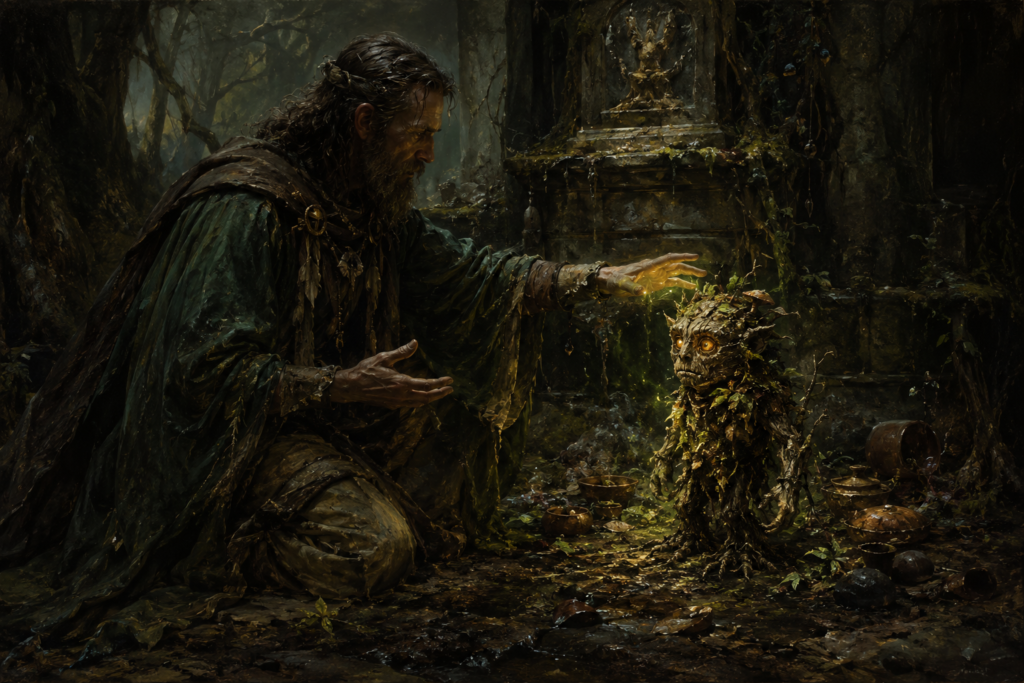
Beget bogun is the final spell in the creation of a bogun: a small nature servant made from living or once-living vegetable matter. It is not a battle spell, a summoning spell, or a quick way to conjure a minion. It is the last breath of magic in a week-long rite of weaving, solitude, and druidic will.
The finished bogun resembles a vaguely humanoid mound of compost, moss, bark, nettles, branches, and root. It is small, self-aware, and wilful enough to make obedience imperfect. Like a homunculus, it is an extension of its creator, sharing the creator’s alignment and maintaining a supernatural bond with the druid who made it. It cannot speak, but it can carry messages, open doors, scout, spy, attack intruders, and perform simple tasks.
The spell’s quiet danger lies in that bond. A bogun is not disposable. It knows its maker, avoids separation, may resist some commands, and harms its creator when destroyed. The druid does not merely create a servant. The druid creates a little piece of their own will, given moss, wings, nettles, and spite.
Quick Rules Reference
- Spell Type: Druidic creation spell.
- Purpose: Final spell in the bogun creation ritual.
- Required Body: A prepared Tiny mannequin made from vegetable matter and a small part of the creator’s body.
- Result: The mannequin awakens as a bogun.
- Duration: Instantaneous; the bogun remains after the spell is cast.
- Use Case: Downtime creation, druidic service, scouting, message-carrying, grove defence, and story complications.
Effect
You touch a prepared Tiny mannequin made from living or once-living vegetable matter and complete the final act of the bogun creation rite. If the body has been properly woven, the grove ritual has been completed, and the required magic is supplied, the mannequin awakens as a bogun.
The spell is the animating spark, not the whole process. It does not create the body, replace the week-long ritual, remove the need for solitude, bypass the creator requirement, or excuse the other final spells required by the rite. It is the last act that infuses living magic into the prepared body.
The finished bogun is permanent until destroyed or until its creator dies. Because the spell’s duration is instantaneous, the bogun is not merely an ongoing spell effect and is not normally ended by dispelling beget bogun.
Mechanics Tabs
The rules below are mechanics compatible for different game editions.
Beget Bogun 5.5e / 2024
Beget Bogun Pathfinder 1e / D&D 3.5e
Beget Bogun 3.0e
Beget Bogun 5.5e / 2024-Compatible Version
Alternative Spell Name: Awaken Grove-Servant
1st-Level Conjuration
Casting Time: 1 action, performed as the final act of a special week-long creation ritual
Range: Touch
Component: V, S, M
Material Component: A prepared Tiny mannequin made from living or once-living vegetable matter, incorporating a small part of the creator’s body such as hair, blood, or nail parings; the mannequin becomes the bogun
Duration: Instantaneous
Available To: Druid
You touch a prepared Tiny mannequin made from moss, bark, roots, nettles, branches, vines, reeds, leaves, compost, and similar vegetable matter. If the mannequin has been prepared through the required creation rite, it awakens as a bogun: a Tiny nature construct magically linked to its creator.
The bogun cannot normally speak, but it understands its creator’s instructions and can perform simple tasks such as carrying a message, opening a door or window, fetching small objects, spying, attacking, or guarding a place. It is self-aware and somewhat wilful, so its obedience is not perfectly mechanical.
Because the result is a permanent servant, this spell should not create a combat-ready creature for only the cost of a 1st-level spell slot. In a 5.5e-compatible game, the spell is best treated as the final magical step in a downtime ritual. The spell slot awakens the bogun; the creation process supplies the real cost, time, risk, and balance.
Suggested 5.5e Creation Framework
- Caster Requirement: The creator must be a druid of significant experience. As a direct conversion from the original rules, 7th level is the clean benchmark.
- Body: The creator must prepare a Tiny mannequin from living or once-living vegetable matter.
- Personal Link: A small part of the creator’s body, such as hair, blood, or nail parings, must be worked into the mannequin.
- Craft Check: If a check is needed, use an appropriate artisan’s tools check for weaving, basketweaving, herbal craft, or druidic crafting. DC 12 matches the original difficulty.
- Ritual Site: The rite must be performed in a forest grove or similarly powerful natural sanctuary.
- Ritual Time: The creator must work for one week, at least 8 hours each day, in solitude.
- Interruption: Interruption by another sentient creature ruins the magical work, though the prepared body and grove may be reused.
- Final Magic: The final day requires magic equivalent to control plants, wood shape, and beget bogun.
- Cost: The original creation has no gold cost because all materials are gathered from the forest. In 5.5e, the DM may still require rare herbs, sacred bark, grove access, seasonal timing, or a story cost.
Creator Link
A bogun is magically linked to its creator. It shares the creator’s alignment and is bound to the maker in a manner similar to a homunculus. It cannot speak, but the bond allows it to convey what it sees and hears to its creator within the bond’s range.
For a 5.5e-compatible game, use a maximum bond range of 500 yards unless the bogun’s dedicated creature entry gives a different range. A bogun does not willingly travel beyond this distance. If forcibly removed, it does everything it can to return to its creator.
Wilful Servant
A bogun is obedient, but not perfectly predictable. On rare occasions, it may refuse a task. If this matters in play, the creator can make a DC 11 Charisma (Persuasion) check, Wisdom (Animal Handling) check, or another appropriate check chosen by the DM. On a success, the bogun cooperates. On a failure, it refuses the task or performs it in a contrary, literal-minded, or troublesome way.
Shared Harm
A bogun is bound to its creator’s life force. If the bogun is destroyed, the creator suffers backlash damage. A direct 5.5e conversion is 11 (2d10) psychic or necrotic damage, ignoring resistance unless the DM decides the bond has a specific damage type. If the creator dies, the bogun collapses into rotting vegetation.
5.5e Notes
- No XP Cost: Modern D&D does not normally use XP costs. Replace the original 25 XP cost with the week-long ritual, solitude requirement, personal body component, and final spell requirements.
- Not a Summon: The bogun is made through downtime and ritual, not called into battle for a short duration.
- Not a Free Familiar: The bogun may resemble a familiar in story terms, but it is not automatically a class familiar unless the DM allows it to function that way.
- Use the Bogun Page: The bogun’s statistics, flight, nettle poison, bond, refusal chance, and death backlash should come from the dedicated bogun creature entry.
- Practical Limit: One active bogun per creator is the cleanest default unless the campaign intentionally supports more.
Beget Bogun Pathfinder 1e / D&D 3.5e-Compatible Version
Conjuration (Creation)
Level: Druid 1
Components: V, S, M, XP
Casting Time: 1 standard action
Range: Touch
Effect: Tiny construct
Duration: Instantaneous
Saving Throw: None
Spell Resistance: No
Beget bogun allows you to infuse living magic into a small mannequin that you have created from vegetable matter. This is the final spell in the process of creating a bogun.
Material Component: The mannequin from which the bogun is created.
XP Cost: 25 XP.
Original-Style Bogun Creation Requirements
Unlike a homunculus, a bogun is created from natural materials available in any forest. There is no gold piece cost for its creation. All materials used become permanent parts of the bogun.
The creator must be at least 7th level and must possess the Craft Wondrous Item feat.
Before any spells are cast, a physical form must be woven from living or once-living vegetable matter to hold the magical energy. A bit of the creator’s own body, such as a few strands of hair or a drop of blood, must also be incorporated into this crude mannequin. The creator may assemble the body personally or hire someone else to do it. Creating the mannequin requires a Craft (basketweaving or weaving) check against DC 12.
Once the body is finished, the creator must animate it through an extended magical ritual that requires one week to complete. The creator must labour for at least 8 hours each day in complete solitude in a forest grove. Any interruption from another sentient creature undoes the magic.
If the creator is personally weaving the creature’s body, that process and the ritual can be performed together. When not actively working on the ritual, the creator must rest and can perform no other activities except eating, sleeping, or talking.
Missing even one day causes the process to fail. The ritual must then be started again, though the previously crafted body and the grove can be reused.
On the final day of the ritual, the creator must personally cast control plants, wood shape, and beget bogun. These spells may come from outside sources, such as scrolls, rather than being prepared by the creator.
Pathfinder / 3.5e Notes
- Final Step Only: Beget bogun completes the creation process; it does not replace the body, grove, week-long ritual, personal component, or other required spells.
- Feat Requirement: The original creation process uses Craft Wondrous Item, not Craft Construct.
- No Gold Cost: The original bogun has no gp creation cost because its materials are natural forest matter.
- Instantaneous Duration: Once created, the bogun is not maintained by spell duration.
- Creature Entry Required: Use the bogun creature entry for statistics, poison, flight, telepathic link, obedience, refusal chance, and death backlash.
- XP Cost: The spell itself has a 25 XP cost in 3.5e. If adapting to a system without XP costs, replace this with ritual risk, rare natural conditions, or a small permanent personal cost.
Beget Bogun 3.0e
Beget bogun allows you to infuse living magic into a small mannequin that you have created from vegetable matter.
(Complete Divine)
Originally posted on D&D tools
Conjuration (Creation)
Level: Druid 1,
Components: V, S, M, XP,
Casting Time: 1 standard action
Range: Touch
Effect: Tiny construct
Duration: Instantaneous
Saving Throw: None
Spell Resistance: No
This is the final spell in the process of creating a bogun.
See the bogun’s description for further details.
Material Component: The mannequin from which the bogun is created.
XP Cost: 25 XP.
Why This Spell Is Dangerous in the World
Beget bogun creates a servant small enough to be ignored and intimate enough to be dangerous. A bogun can slip through an open window, hide in a thatch roof, carry a message through thorn scrub, brush poison nettles against an enemy, open a gate, steal a charm, or report everything it sees and hears back to its creator.
The deeper danger is the bond. A bogun is not a tool that can be lost without consequence. It knows its maker, depends on its maker, resists its maker in small ways, and wounds its maker when destroyed. It is useful because it is an extension of the druid’s will. It is dangerous for exactly the same reason.
Rules Clarifications and Edge Cases
- Can the spell be cast without the mannequin? No. The prepared vegetable-matter body is required.
- Does the spell summon a bogun? No. It awakens a crafted body after an extended creation process.
- Can the bogun be dispelled? The spell’s duration is instantaneous, so the created bogun is not normally ended by dispelling the spell.
- Is the bogun a familiar? It is familiar-like and homunculus-like, but it is not automatically a class familiar unless the rules of the table make it one.
- Can a bogun refuse orders? Yes. A bogun is self-aware and somewhat wilful. Rare refusal or contrary behaviour is part of its identity.
- Can the bogun speak? No. It cannot speak, but it communicates with its creator through the magical link.
- How far can it travel from its creator? The original bond reaches 500 yards. A bogun does not willingly go beyond this range.
- What happens if it is destroyed? The creator suffers backlash damage. In the original rules, destruction of the bogun deals 2d10 damage to its creator.
- What happens if the creator dies? The bogun dies as well, collapsing into rotting vegetation.
- Does the creator have to prepare all final spells personally? The creator must personally cast the required spells on the final day, but the magic can come from outside sources such as scrolls.
Good Combinations
- Control Plants: In the original bogun creation rite, control plants is one of the final spells required to complete the servant. It represents the caster’s authority over living vegetation and helps bind the crude vegetable body into a responsive druidic servant rather than a simple bundle of moss and twigs.
- Wood Shape: Wood shape is the natural partner to beget bogun. It gives form, structure, and intention to the body, helping turn bark, root, branch, and woven plant matter into something capable of holding the animating spell.
- Plant Growth: Plant growth is not required by the original ritual, but it pairs well in campaign play when the druid wants the bogun’s grove, orchard, shrine, or boundary to feel actively protected by living vegetation. It can also explain why a newly created bogun has a dense, overgrown home to guard.
- Entangle: Entangle supports a bogun’s normal role as a small guardian rather than a direct fighter. A druid can use it to slow intruders while the bogun hides, scouts, opens a hidden way, carries a warning, or uses its nettles against an isolated target.
- Speak with Plants: Speak with plants can give the caster useful information before deciding where to create the bogun. The trees, reeds, orchard roots, or shrine ivy may reveal where the servant is most needed and what threat it should be made to watch.
Adventure Hooks
The Window That Opened Itself
A locked house is entered night after night without broken doors or footprints. The culprit is a bogun slipping through shutters and lifting latches for the druid who made it.
The Grove Must Not Be Interrupted
A druid is six days into the bogun rite when soldiers, villagers, hunters, or plague-bearers enter the grove. If the solitude is broken, the magic fails. If the strangers are driven away, they may believe they have been attacked without cause.
The Death of the Little Servant
A bogun is destroyed by someone who thinks it is a harmless nuisance. Miles away, its creator collapses from the backlash. The party must decide whether the killing was self-defence, ignorance, sabotage, or the first move in an attack on the druid.
Historical and Mythic Context
Beget bogun draws its strength from several older ideas: the handmade servant, the spirit-bearing figure, and the dangerous bond between maker and made. The bogun itself is a D&D creature rather than a direct lift from one single named myth, but it clearly belongs to a family of imagined beings made by human or magical craft and then given a strange little life of their own.
The closest comparison is the homunculus, the “little person” of alchemical and magical imagination. In game terms, the bogun is explicitly homunculus-like: it is small, artificial, self-aware, linked to its maker, and dangerous to destroy because the creator shares in its fate. The difference is material and spiritual. The homunculus belongs to the laboratory, vessel, and alchemical body; the bogun belongs to grove, compost, nettle, bark, and druidic solitude.
The bogun also echoes European traditions of woven or shaped plant figures. Harvest customs produced straw figures such as harvest trophies and corn dollies, objects associated with the spirit or presence of the crop and the turning of the agricultural year. A bogun is not simply a corn dolly with statistics, but the resemblance is useful: both are small crafted bodies made from plant matter, treated as vessels for something more than decoration.
There is also a wider mythic pattern here: the created helper who is useful because it is obedient, and frightening because it is never merely a tool. Golems, homunculi, straw figures, household spirits, poppets, and little crafted servants all carry the same pressure. Once a maker gives shape to matter and binds purpose into it, the question changes from “Can it serve?” to “What does it become when the command, bond, or maker fails?”
That is the best way to treat beget bogun in play. The spell is not just a technical creation rule. It is a small myth about making life from the materials of the land and paying for that act with attachment. The druid does not buy a servant. The druid weaves one, hides a fragment of the self inside it, and accepts that the tiny thing of moss and nettles now carries part of the maker’s fate.
Related Internal Page: Bogun: The Tiny Forest Construct
Keep this reference growing
If this page helped with your reading or game, you can support its upkeep or explore the curated books.
Explore the Bookshop — epics, classics and stories behind imagined worlds.