
Enthrall
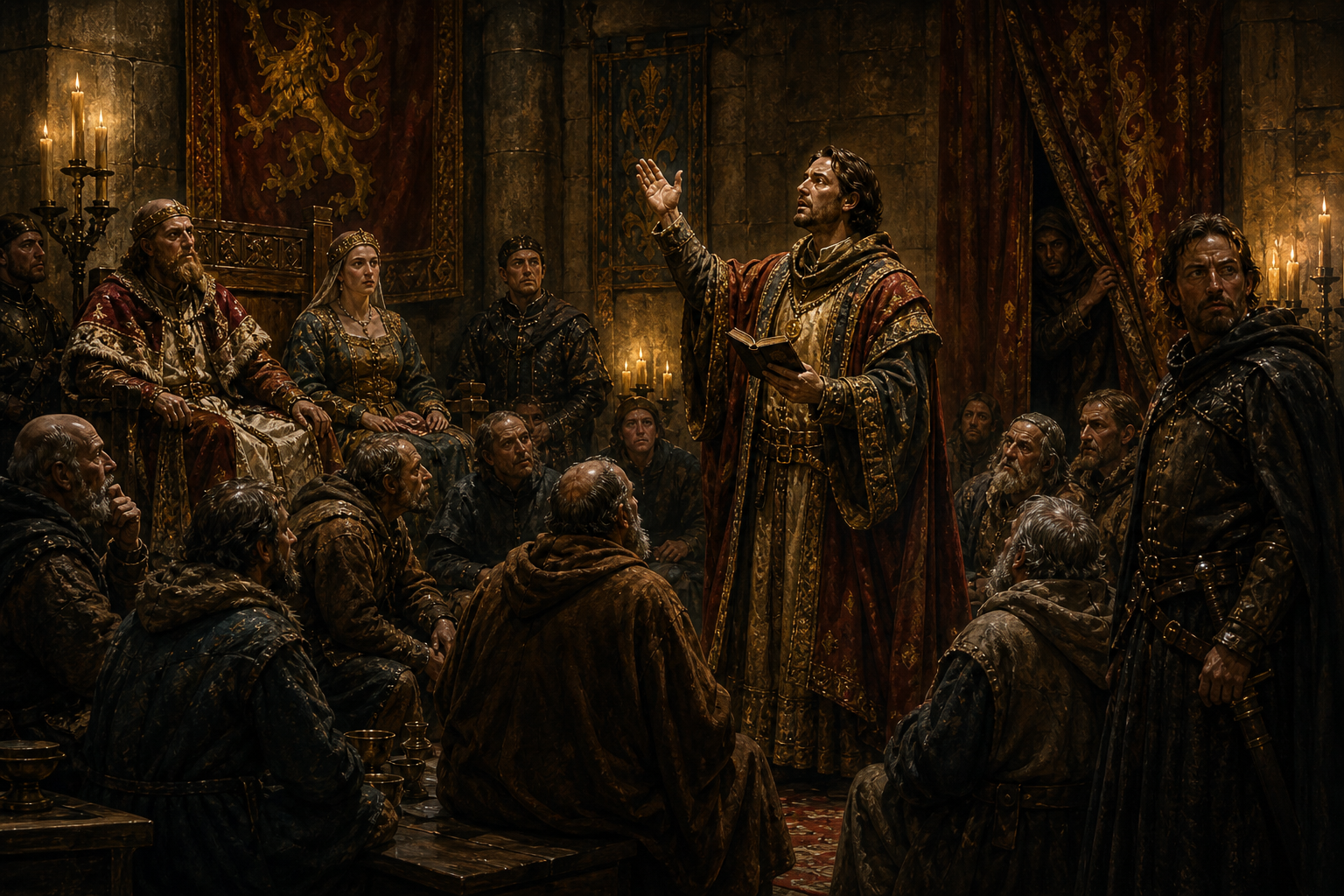
Enthrall is crowd-control without direct command. Modern versions make other creatures harder to notice; Pathfinder 1e and D&D 3.5e instead hold an audience spellbound for as long as the caster continues speaking or singing.
At a Glance
| Modern level | 2nd-level Enchantment |
|---|---|
| 2024 classes | Bard, Warlock |
| 2014 classes | Bard, Warlock |
| PF1e | Bard 2, Cleric 2 |
| D&D 3.5e | Bard 2, Cleric 2 |
| Best use | Hold attention while allies move, search, escape or act elsewhere |
Choose Your Edition
The spell changed sharply between editions. Do not import the long-duration friendly-audience rules into fifth edition, and do not use the modern Perception penalties in PF1e or D&D 3.5e.
Enthrall — 5.5e / 2024
| Level | 2nd |
|---|---|
| School | Enchantment |
| Casting Time | Action |
| Range | 60 feet |
| Components | V, S |
| Duration | Concentration, up to 1 minute |
| Classes | Bard, Warlock |
Choose creatures you can see within range. Each target makes a Wisdom saving throw. A creature that you or your companions are fighting automatically succeeds.
On a failed save, the target takes a −10 penalty to Wisdom (Perception) checks and Passive Perception until the spell ends.
The current spell is therefore a distraction tool rather than a charm. It does not make a creature friendly, prevent it from acting, or force it to listen to a particular message.
Enthrall — 5e / 2014
| Level | 2nd |
|---|---|
| School | Enchantment |
| Casting Time | 1 action |
| Range | 60 feet |
| Components | V, S |
| Duration | 1 minute |
| Classes | Bard, Warlock |
Choose creatures you can see within range that can hear you. Each target makes a Wisdom saving throw. A creature immune to being charmed succeeds automatically. If you or your companions are fighting a target, it has Advantage on the save.
On a failed save, the target has Disadvantage on Wisdom (Perception) checks made to perceive creatures other than you. The effect on a target ends if it can no longer hear you. The spell ends entirely if you are incapacitated or can no longer speak.
Important: the 2014 spell does not require Concentration. That is a real edition difference from 2024.
Enthrall — Pathfinder 1e
| School | Enchantment (Charm) [language-dependent, mind-affecting, sonic] |
|---|---|
| Level | Bard 2, Cleric 2 |
| Casting Time | 1 round |
| Components | V, S |
| Range | Medium (100 ft. + 10 ft./level) |
| Targets | Any number of creatures |
| Duration | 1 hour or less |
| Saving Throw | Will negates; see text |
| Spell Resistance | Yes |
You must speak or sing without interruption for a full round. Creatures that fail their saves give you their undivided attention and are treated as friendly while enthralled.
A creature from a group strongly opposed to yours gains a +4 bonus on the saving throw. A creature with 4 or more Hit Dice, or Wisdom 16 or higher, remains aware of its surroundings and is only indifferent; it receives a new save if it witnesses something it opposes.
The effect continues while you keep speaking or singing, up to 1 hour. Enthralled creatures take no action during the performance and spend 1d3 rounds afterward discussing or reacting to it. New arrivals must also save.
Hostile onlookers can attempt one collective Charisma challenge to break the performance by jeering and heckling. An overt hostile act against the audience ends the spell and can turn the former audience unfriendly or hostile.
Enthrall — D&D 3.5e
| School | Enchantment (Charm) [Language-Dependent, Mind-Affecting, Sonic] |
|---|---|
| Level | Bard 2, Cleric 2 |
| Casting Time | 1 round |
| Components | V, S |
| Range | Medium (100 ft. + 10 ft./level) |
| Targets | Any number of creatures |
| Duration | 1 hour or less |
| Saving Throw | Will negates; see text |
| Spell Resistance | Yes |
The 3.5e SRD version uses the same core audience mechanic as PF1e: a full round of uninterrupted speaking or singing, friendly enthralled listeners, special resistance for strongly opposed groups, partial awareness for tougher or wiser creatures, and a one-time heckling challenge from hostile observers.
The spell lasts only while the performance continues, to a maximum of 1 hour. Violence against the audience breaks the effect and can sharply worsen the listeners’ attitudes.
What Changed?
- 2024: Concentration, no charm-immunity clause, opponents already being fought automatically succeed, and failed saves take a flat −10 to Perception and Passive Perception.
- 2014: no Concentration; targets must hear you; charm immunity gives automatic success; combat gives Advantage on the save; failed saves impose Disadvantage on Perception checks to notice creatures other than you.
- PF1e and 3.5e: the spell is a long public performance that changes audience attitude and attention rather than applying the fifth-edition Perception mechanic.
Best Uses
Distract while someone else acts. One character holds the audience while another searches, slips through a guarded doorway, moves a prisoner, changes a document or studies the true threat.
Buy time before open conflict. The spell is strongest when a scene has not yet become a fight. Modern versions are poor choices once the targets are already fighting the party; legacy d20 versions can collapse as soon as overt violence starts.
Create a public diversion. A market, court, guildhall, military camp, festival, parley ground or crowded quay gives the spell enough witnesses for its attention-stealing role to matter.
Tactics and Limits
Enthrall is not mass obedience. It does not force listeners to surrender weapons, betray allies or follow commands. Its strength is narrower: it makes the speaker unusually difficult to ignore.
Plan the party’s next action before the spell is cast. A distraction is useful only if someone takes advantage of the attention it creates.
In PF1e and 3.5e, hostile voices can fight the performance socially, and violence can turn the crowd against the caster. In fifth edition, the spell’s limitations are mechanical rather than attitudinal: hearing, combat state, Perception penalties and the caster’s ability to continue speaking all matter by edition.
Related Magic
- Disguise Self — helps the speaker appear to be someone the audience expects to hear.
- Calm Emotions — useful when the crowd is already volatile.
- Invisibility — lets an ally exploit the distraction.
- Silence — can disrupt speech-based magic, but positioning matters because Enthrall itself has verbal components.
- Suggestion — targets behaviour directly rather than merely drawing attention.
- Bard Spells — all four edition lists.
Sources and Licensing
- D&D 2024 Basic Rules — Enthrall. SRD 5.2 material is available under CC BY 4.0.
- D&D 2014 Basic Rules — Enthrall. SRD 5.1 material is available under CC BY 4.0.
- Pathfinder 1e Core Rulebook — Enthrall. Open Game Content under OGL v1.0a.
- D&D 3.5 SRD — Enthrall. Open Game Content under OGL v1.0a.
Keep this reference growing
If this page helped with your reading or game, you can support its upkeep or explore the curated books.
Explore the Bookshop — epics, classics and stories behind imagined worlds.