
Goibhniu, Irish God of Smithing, Brewing, and the Deathless Feast
Goibhniu, Irish God of Smithing, Brewing, and the Deathless Feast
Goibhniu tempers the spear that never misses, mends the warrior who should have died, and draws the ale that keeps the divine host young.
- Pantheon: Celtic Pantheon
- Tradition: Irish / Tuatha Dé Danann
- Divine Rank: Intermediate Deity
- Alignment: Neutral Good
- Home Realm: Tír na nÓg, in the Ever-Young Forge-Hall
- Portfolio: Smithcraft, weapons, battle repair, sacred brewing, craft-healing, hospitality, the deathless feast, honest workmanship, oath-bound tools, and the protection of sworn communities
- Titles: The Smith of the Tuatha Dé Danann, Keeper of the Deathless Feast, Master of Three Strokes, Host of the Ever-Young Hall, The Hammer at the Feast
- Aliases and Related Names: Goibniu, Goibhniu, Gobniu, Gobhniu; related in neighbouring traditions to Welsh Gofannon and Gaulish Gobannus
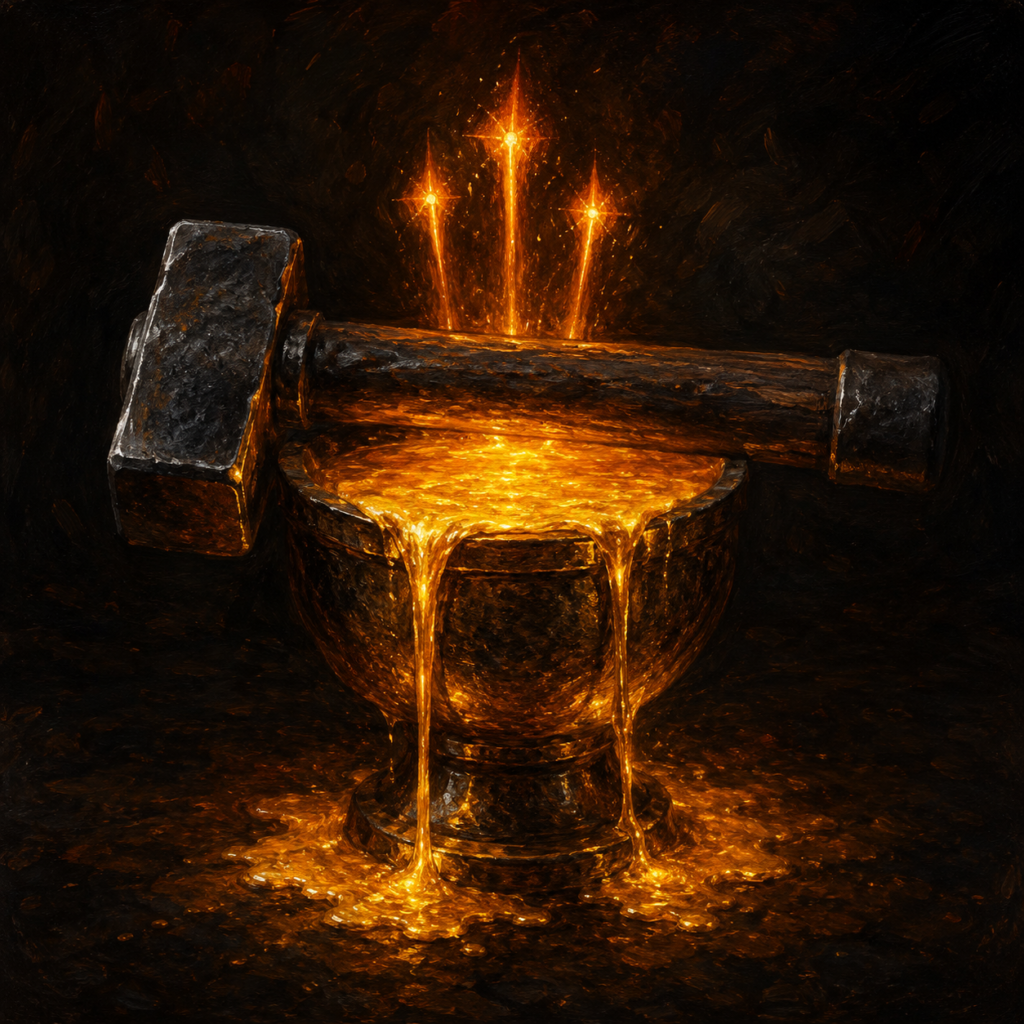
- Holy Symbol: A hammer laid across an overflowing cup, with three sparks rising above the rim
- Favoured Weapons: Warhammer and spear
- Sacred Signs: A cracked blade mending in the fire, ale that does not sour, three sparks rising from a cold anvil, a wound closing after a smith’s blessing, a spearhead glowing before it is thrown
- Worshippers: Smiths, armourers, brewers, alewives, battlefield healers, guild masters, oath-crafters, siege engineers, shieldwrights, warriors who maintain their own arms, and communities that gather around forge and feast
- Traditional Allies: Lugh, Dian Cécht, Luchta, Creidhne, Nuada, Brigid
- Traditional Foes: Fomorian raiders, tribute-lords, saboteurs, weapon-poisoners, false craftsmen, oath-breakers, and rulers who send sworn fighters to war with knowingly defective arms
Overview
Goibhniu is the divine smith of the Tuatha Dé Danann, but his forge is not only a place of iron, bronze, spearheads, and war-hammers. It is also a hall of survival. Weapons leave his hand ready for battle, broken gear returns from his anvil whole, and the warriors of the gods gather at his feast to escape age, sickness, and decay.
He is not a god of needless slaughter. He is the god who makes sure a people under attack are not defeated by dull blades, split hafts, empty cups, hunger, cowardice, or neglect. His sacred work is preparation: the right weapon, the right repair, the right drink, the right oath, the right hand on the hammer at the right moment.
Where Goibhniu is honoured, craft is not decoration. A badly made hinge, a watered ale, a brittle blade, a cheated apprentice, and a lord who sends soldiers to war with rotten shields are all spiritual failures. The forge is a court. The feast is a covenant. The finished thing must be worthy of the hand that made it.
The deathless feast is not a casual promise of permanent immortality for ordinary mortals. In mortal hands, its blessings usually appear as resistance to age, sickness, poison, despair, exhaustion, decay, and spiritual wasting. True undying youth belongs to the Otherworld and the divine host, not to every guest who steals a cup.
Divine Identity
Goibhniu is an Intermediate Deity because his power is not merely professional craft. He sustains the war-making capacity and deathless vitality of a divine people. His forge changes the outcome of battles. His feast preserves the gods from age and decay. His craft sits between creation, healing, warfare, hospitality, and oath-law.
He is lower in cosmic scale than the great sovereign and world-ordering deities, but higher than a local craft spirit or guild patron. A campaign can use him as a direct divine patron for smith-priests, warrior-artisans, brewers, armour-blessers, forge-oracles, and guilds that hold a city together.
Goibhniu’s divinity is best understood through four sacred acts:
- He makes the weapon that does not fail.
A spearhead from Goibhniu’s forge is more than sharp metal. It is a promise that a rightful cast will not miss. - He restores what battle breaks.
A broken blade, a split haft, a cracked shield, or a warrior pierced by a hostile point may all come under his law of repair. - He pours the deathless feast.
The cup of Goibhniu is not ordinary drink. It is the Otherworld’s answer to age, sickness, despair, and decay. - He judges false craft.
A weapon sold as sound when it is cracked, a feast-cup poisoned under guest-right, or a master who steals an apprentice’s work offends him as directly as a desecrated altar.
Mythic Role
Goibhniu’s role is divine logistics made holy.
He gives a people the means to endure. Lugh may lead, Nuada may rule, Dian Cécht may heal, and the Morrígan may stir battle-fury, but Goibhniu makes sure the spearhead exists, the rivet holds, the shield is repaired, the cup is passed, and the host can rise again.
His forge is not separate from the battlefield. It is the hidden heart of the battlefield. Armies collapse when tools fail, wagons break, armour splits, ale turns foul, water spoils, and the wounded cannot be restored. Goibhniu stands against that collapse.
In divine myth, he is one of the great craft powers of the Tuatha Dé Danann. With Luchta and Creidhne, he completes the sacred chain of making: wood, metal, fitting, finish, repair, and readiness. His craft does not end when the weapon leaves the forge. A weapon remains under his judgement for as long as it is used.
Appearance
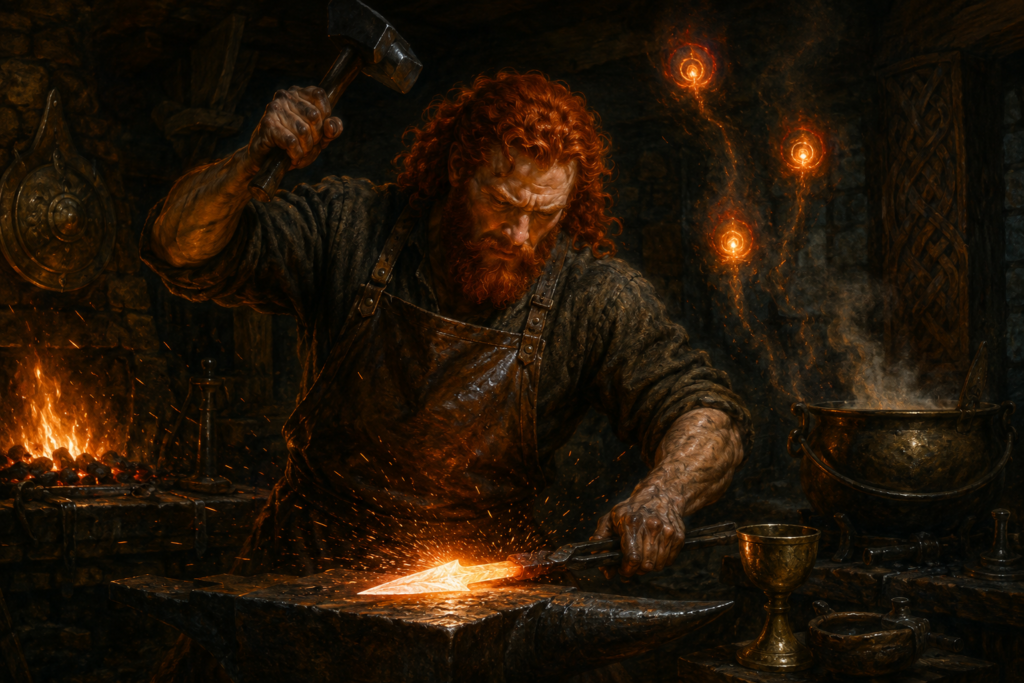
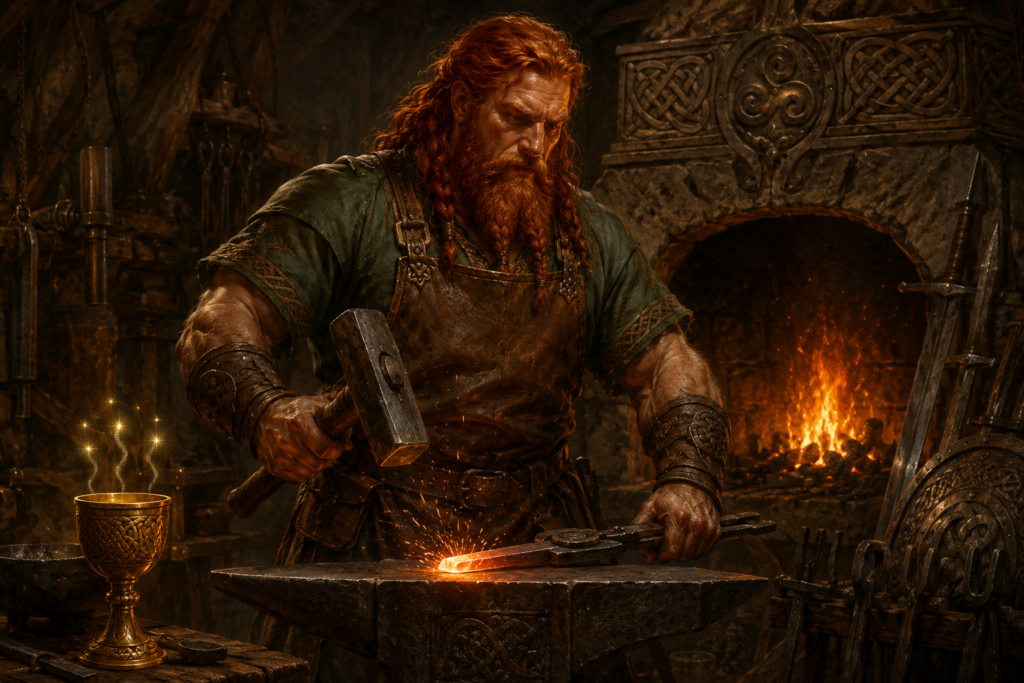
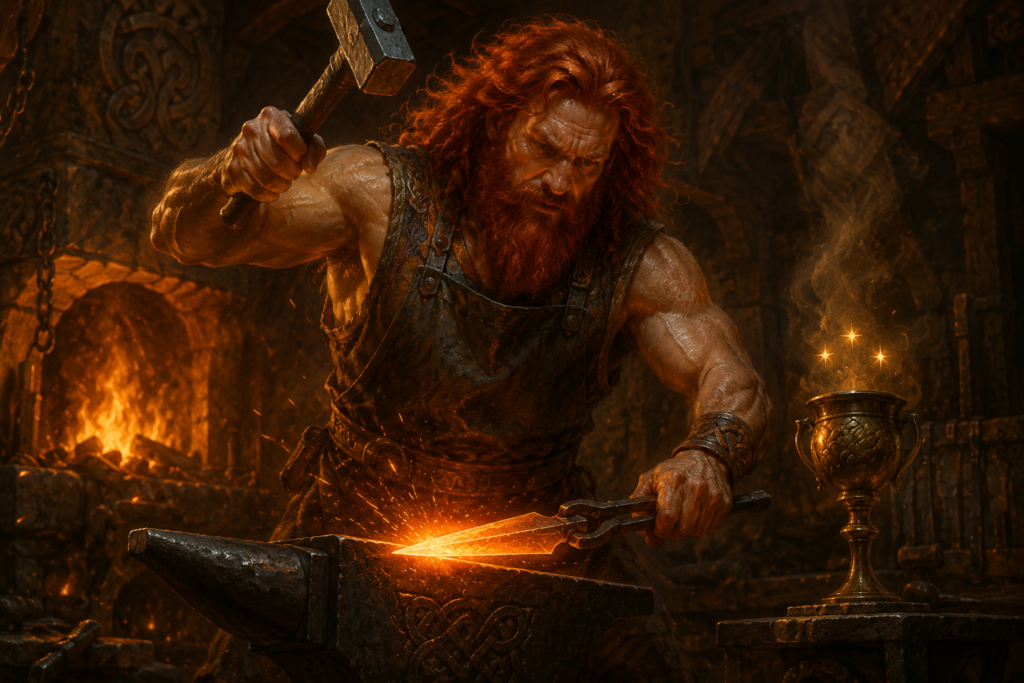
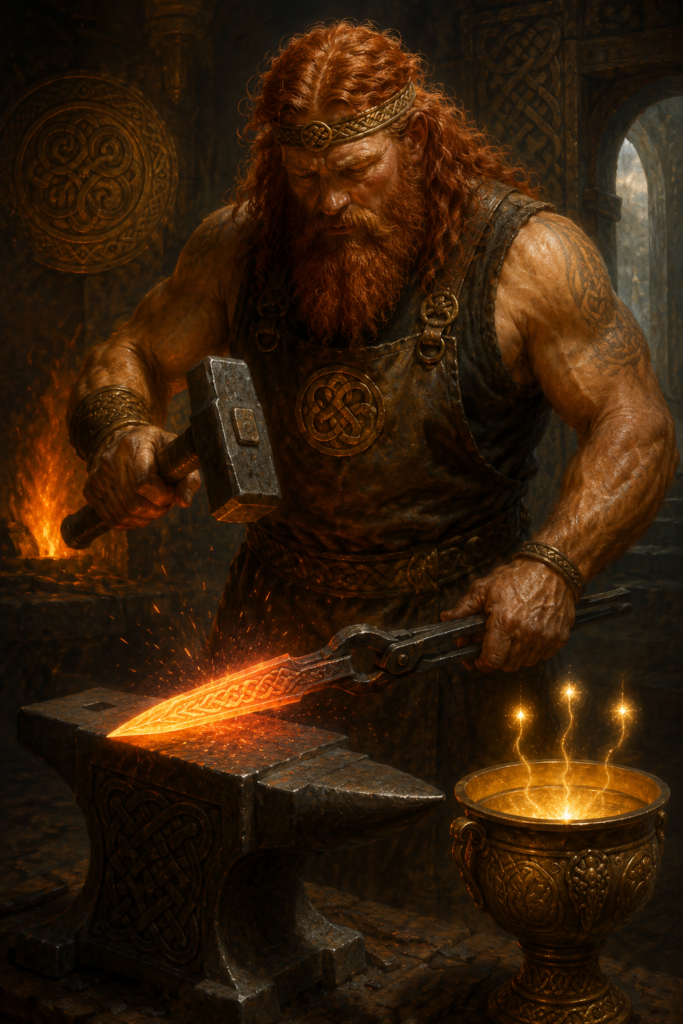
Goibhniu appears as a broad-shouldered Irish smith with fire-bright hair, a heavy beard, scarred hands, and calm eyes that measure the worth of every tool, oath, and person in the room. His clothing is practical: leather apron, wool tunic, soot-darkened cloak, bronze pins, iron tongs at the belt, and a hammer that looks old enough to have shaped the first spearhead.
In divine manifestation, his forge glows without consuming fuel. Three sparks rise from each hammer-stroke. Ale steams in a bronze cup beside the anvil. The floor is marked with old spearpoints, broken blades, repaired shields, and the names of warriors who returned because his craft held.
He is not usually colossal. His true divine form may appear Huge in combat, but that is only the battle-shape of his presence. In the forge-hall, he may look like a powerful mortal smith until the hammer falls and the whole room answers.
When angered, he does not rage wildly. The forge goes silent. The cup stops steaming. Every flawed tool in the room reveals itself at once.
Sacred Law, Offerings, and Taboos
Sacred Law
- A thing made under Goibhniu’s eye must be fit for its purpose.
- A weapon must not be falsely blessed.
- A cup must not be poisoned under a guest-roof.
- A master must not steal the work of an apprentice.
- A lord must not send sworn fighters to battle with knowingly defective arms.
- A brewer must not water ceremonial ale.
- A smith must not sell a cracked blade as sound.
- A healer must not leave a removable thorn, splinter, arrowhead, nail, or shard in a wound through laziness or pride.
- A feast must name the dead before the living drink deeply.
Offerings
Good iron, clean charcoal, first ale of a successful brewing, repaired tools, a masterwork nail, a spearhead forged for defence rather than conquest, bread and ale shared with apprentices, and the public mending of a poor household’s broken tools.
The best offering is a finished thing made honestly.
Taboos
Poisoned drink, false metal, brittle ceremonial weapons, unpaid apprentices, oath-blades made for treachery, and wasteful destruction of useful tools.
A temple-forge of Goibhniu that knowingly blesses bad craft loses its fire. A feast-hall that poisons guests loses the sweetness of its drink. A guild that steals apprentice work hears hammer-blows in the night until restitution is made.
Relationships
- Lugh: Goibhniu respects Lugh as a battle-leader who understands the value of skill. Lugh’s many arts do not diminish Goibhniu’s craft; they prove that victory belongs to those who know what every hand can do. Priests of Lugh and Goibhniu often work together before campaigns, musters, sieges, and public oaths.
- Dian Cécht: Goibhniu and Dian Cécht are allies through the shared work of survival. One repairs the warrior’s body; the other repairs the warrior’s weapon. Their priests often cooperate after battles, especially when a wound is caused by spearpoint, thorn, metal shard, arrowhead, nail, or cursed blade.
- Luchta: Luchta is Goibhniu’s essential craft-companion, master of wood, frame, haft, beam, wheel, shield-board, handle, and fit. A spearhead is useless without a true haft. A shield boss fails if the board splits. Goibhniu’s forge is strongest when Luchta’s woodcraft stands beside it.
- Creidhne: Creidhne completes the fine work of metal: rivets, bosses, settings, ornament, edge-finish, and binding. Goibhniu shapes the power of the weapon; Creidhne gives it detail, beauty, and exactness. Together with Luchta, they form the divine craft chain of the Tuatha Dé Danann.
- Nuada: Goibhniu honours Nuada as a king marked by loss and restoration. Nuada’s silver hand is a central sign of the sacred bond between kingship, injury, craft, and legitimacy. A flawed king cannot be repaired by ornament alone; the work must restore function, dignity, and lawful capacity.
- Brigid: Goibhniu and Brigid share fire, craft, healing, and sacred inspiration, but their relationship is not simple. Brigid’s grief over Rúadán stands near Goibhniu’s mythic wound. Between them lies a hard truth: craft can preserve life, but battle can force the maker’s hand into killing. Their shrines sometimes share flame, but their priests speak carefully when war, kinship, and mourning meet.
- The Fomorians: Goibhniu opposes Fomorian tribute, sabotage, predatory rule, poisoned hospitality, and the corruption of useful craft. He especially hates enemies who study a people’s tools in order to cripple them.
Currently in the World
Goibhniu’s shrines are found in working places, not silent halls: smithies, guild houses, breweries, armouries, fortress workshops, shipyards, mining towns, bridge-yards, and border settlements that survive because someone keeps the tools sharp and the hinges sound.
In Ireland, his oldest rites remain closest to the sídhe and the memory of the Tuatha Dé Danann. In Wales and Gaulish-descended regions, his related names and craft-echoes appear in different forms, but the campaign treats these as linked traditions rather than automatically identical gods.
Across war-torn Europe, his influence spreads through practical need. Armourers invoke him before a siege. Brewers ask his favour when plague memory, famine, or bad water threatens a town. Battlefield healers call on him when an arrowhead, thorn, nail, or shard must be drawn cleanly from flesh.
He does not bless royal vanity projects. He blesses the blade that holds when a village gate is breached, the horseshoe that saves a messenger, the rivet that keeps a shield whole, and the cup passed around after the dead are named.
Goibhniu’s cult is especially strong where craft, law, and survival overlap. A fortress that cannot trust its armoury, a town that cannot trust its wells, a guild that cannot trust its masters, and a household that cannot trust its tools all call his name.
Divine Scale and Defeat
Goibhniu is an Intermediate Deity. His true divine form cannot be permanently destroyed by ordinary combat. Defeating an avatar, herald, or servant can close one forge, end one feast, or break one manifestation, but it does not kill the god.
- To wound Goibhniu’s power in the campaign, enemies must attack his sacred functions.
- They must poison hospitality.
- They must break the trust between maker and user.
- They must corrupt a masterwork into false craft.
- They must sever the pact between forge, cup, and community.
- They must turn a blessed weapon into an oath-breaking weapon.
- They must make apprentices fear the forge and warriors fear their own shields.
- Even then, the result is not simple divine death. The forge goes cold. The ale sours. Weapons fail at the worst moment. Apprentices dream of leaving. Communities lose the habit of mending what can still be saved.
- Goibhniu can be driven from a place, but he returns wherever honest hands make useful things for those who need them.
Mechanics Tabs
The rules below are mechanics compatible for different game editions.
Goibhniu 5.5e
Goibhniu Pathfinder 1e / 3.5e
Goibhniu 5.5e-Compatible Rules
True Divine Form: Domains, Granted Magic, Boons, and Curses
Divine Rank: Intermediate Deity
Suggested Cleric Domains: Forge, Life, War, Peace
Culture-Specific Domain Emphasis: Smithcraft, battle repair, sacred brewing, hospitality, healing through extraction and mending
Warlock Patron: The Deathless Forge
Paladin Oaths: Devotion, Crown, Glory, or a custom Oath of the Finished Work
Favoured Weapons: Warhammer and spear
Holy Symbol: Hammer crossed over an overflowing cup with three sparks above it
Sacred Implements: Smith’s tools, brewer’s supplies, anvil, bellows, cup, spearhead, rivet, clean water, butter, charcoal
The Deathless Forge Patron
Warlocks who draw power from Goibhniu’s forge do not receive a casual gift of fire. They become bound to the law of finished work. Their pact weapons must be maintained. Their oaths must not be sold as decoration. Their cups must not poison guests.
A Deathless Forge warlock is often a smith, brewer, armour-keeper, siege artisan, battlefield surgeon, or guild oath-taker. Their magic manifests as sparks, warm iron, steaming ale, ringing hammer-strokes, and wounds closing around removed metal.
Oath of the Finished Work
Paladins who swear this oath defend the bond between craft and duty. They protect apprentices, punish false workmanship, guard feast-right, and stand with communities whose survival depends on sound tools, honest armour, and shared food.
Tenets of the Finished Work
Make It Sound. Do not knowingly offer flawed work as finished.
Guard the Cup. Hospitality is sacred. A guest-cup must not be poisoned or corrupted.
Mend What Can Be Saved. Repair is holy when destruction is not necessary.
Name the Cost. A weapon is never only a weapon. Say who made it, who bears it, and what oath it serves.
Goibhniu’s Always-Prepared Spells
| Spell Level | Always-Prepared Spells |
|---|---|
| Cantrips | mending, resistance, spare the dying, thaumaturgy, produce flame |
| 1st | cure wounds, heroism, searing smite, shield of faith |
| 2nd | aid, heat metal, lesser restoration, magic weapon |
| 3rd | aura of vitality, crusader’s mantle, elemental weapon, revivify |
| 4th | aura of life, death ward, fabricate, fire shield |
| 5th | animate objects, creation, greater restoration, mass cure wounds |
| 6th | heal, heroes’ feast, investiture of flame |
| 7th | regenerate, resurrection |
| 8th | holy aura |
| 9th | mass heal, true resurrection |
Spell Notes
Mending is sacred to Goibhniu and may be used ceremonially even when no mechanical repair is needed.
Heat metal is not merely destructive for his priests. It can also reveal false metal, hidden flaws, poisoned rivets, brittle welds, and cursed armour.
Fabricate represents divine craft, but Goibhniu does not bless mass-produced fraud. A thing made magically under his name must still be fit for its purpose.
Heroes’ feast is his central divine spell. In his cult, it represents the mortal echo of the Fled Goibhnenn.
Regenerate and greater restoration are appropriate because Goibhniu’s mythology joins craft, repair, extraction, and healing.
Divine Boons
Boon of Three Strokes. Once per long rest, the blessed creature may complete one hour of mundane smithing, repair, brewing, or toolwork in three perfect actions. This cannot create a magic item by itself, but it can repair a broken mundane weapon, armour piece, shield, tool, hinge, lock, brewing vessel, chain, wheel, or gate fitting.
Boon of the True-Cast Spear. Once per long rest, when the blessed creature makes an attack with a spear, javelin, thrown hammer, or crafted weapon they personally maintain, they may add +10 to the attack roll after seeing the d20 but before the result is declared.
Boon of the Deathless Cup. Once per long rest, the blessed creature may share a cup, flask, or bowl with up to six willing creatures. Each creature gains temporary hit points equal to twice the blessed creature’s proficiency bonus and has advantage on saving throws against poison and disease for 8 hours.
Boon of Sound Craft. The blessed creature gains proficiency with smith’s tools or brewer’s supplies. If already proficient, they gain expertise with one of those tools. This boon is revoked if the creature knowingly sells false work as sound.
Divine Curses
Curse of the False Edge. A creature that knowingly sells, blesses, or gifts a flawed weapon as sound has disadvantage on attack rolls with manufactured weapons until it repairs the harm, confesses the fraud, and makes restitution.
Curse of Sour Ale. A creature that poisons a guest-cup, violates hospitality, or corrupts ceremonial drink cannot benefit from magical healing from potions, feasts, or restorative drinks until the curse is lifted.
Curse of the Unmended Thorn. A healer, surgeon, priest, or craftsman who knowingly leaves a removable shard, thorn, arrowhead, nail, or metal splinter in a patient suffers disadvantage on Medicine checks and tool checks until the injury is corrected.
Curse of the Cold Forge. A guild, shrine, or lordly workshop that repeatedly blesses bad craft loses Goibhniu’s favour. Its fires smoke, its metal becomes brittle, its ale sours, and its apprentices begin to dream of leaving.
Using This Deity’s Forms
Servants are suitable for low- to mid-level play and appear as blessed smiths, cupbearers, forge-spirits, rivet-wardens, and tool-guardians.
Heralds carry Goibhniu’s direct authority into mortal settlements, divine courts, and battlefields. They are best used when a forge-law, feast-oath, or disputed weapon must be judged.
Avatars are rare but campaign-facing. They appear when a community’s forge-law, battlefield survival, or sacred hospitality is under direct threat.
The true divine form belongs in mythic-tier play, divine negotiation, planar crisis, or the defence of Tír na nÓg itself.
D&D 5.5e Stat Block: Goibhniu, True Divine Form
Goibhniu, Smith of the Deathless Feast
Medium Deity, Neutral Good
Armor Class 24
Initiative +13
Hit Points 610
Speed 40 ft.
Proficiency Bonus +9
| STR | DEX | CON | INT | WIS | CHA |
|---|---|---|---|---|---|
| 30 (+10) | 18 (+4) | 30 (+10) | 28 (+9) | 26 (+8) | 26 (+8) |
Saving Throws Str +19, Con +19, Int +18, Wis +17, Cha +17
Skills Arcana +18, Athletics +19, History +18, Insight +17, Medicine +17, Perception +17, Religion +18
Tool Mastery Smith’s tools +27, brewer’s supplies +27, carpenter’s tools +18, mason’s tools +18
Damage Resistances cold, lightning, radiant; bludgeoning, piercing, and slashing from nonmagical attacks
Damage Immunities fire, poison
Condition Immunities charmed, exhaustion, frightened, poisoned
Senses truesight 120 ft., passive Perception 27
Languages Irish, Old Irish, Welsh, Gaulish, languages of his worshippers; telepathy 120 ft.
Challenge 33
Traits
Intermediate Deity. Goibhniu cannot be permanently slain outside the conditions of a divine-scale campaign. If reduced to 0 hit points outside his true realm, his form breaks into sparks, spilled ale, and cooling iron. He reforms in the Ever-Young Forge-Hall unless his forge, feast, and name have been ritually severed.
Human-Shaped Divine Form. Goibhniu is not described in the surviving myths as a giant. His true divine form appears Medium: a powerful human-shaped divine smith whose scale is expressed through forge-fire, sacred craft, the deathless cup, and the authority of his work rather than through giant size.
Master of Three Strokes. When Goibhniu repairs, crafts, or reforges an object, he completes in three actions what would normally take hours. In combat, he may restore one destroyed or damaged non-artifact weapon, shield, armour piece, gate, chain, lock, bridge fitting, wheel, tool, or forge implement within 120 feet at the start of each of his turns.
Weapons That Strike True. A weapon forged or blessed by Goibhniu counts as magical. Once per turn, when Goibhniu hits with a weapon attack, the attack deals an extra 22 fire damage and ignores resistance to bludgeoning, piercing, and slashing damage.
Deathless Feast Aura. Allies of Goibhniu within 60 feet have advantage on saving throws against poison, disease, exhaustion, effects that would instantly kill them, effects that reduce their hit point maximum, and effects that prevent healing. When an ally in the aura starts its turn at 0 hit points, it automatically stabilizes.
Forge-Hall Presence. Magical fire created by hostile creatures within 120 feet cannot harm Goibhniu unless he allows it. Mundane metal weapons carried by hostile creatures glow red-hot when they strike him.
False Craft Revealed. Goibhniu automatically knows whether a manufactured object within 120 feet is cracked, poisoned, cursed, falsely blessed, badly made, or deliberately weakened.
Legendary Resistance. Goibhniu can choose to succeed on a failed saving throw 4 times per day.
Actions
Multiattack. Goibhniu makes three attacks, using Forge-Hammer or True-Cast Spear in any combination.
Forge-Hammer. Melee Weapon Attack: +19 to hit, reach 5 ft., one target. Hit: 36 bludgeoning damage plus 22 fire damage. If the target is wearing manufactured armour or carrying a manufactured shield, it must succeed on a DC 26 Constitution saving throw or the item is damaged until repaired. A damaged armour piece or shield imposes a −2 penalty to AC. This effect does not stack with itself.
True-Cast Spear. Ranged or Melee Weapon Attack: +19 to hit, range 120/360 ft. or reach 5 ft., one target. Hit: 31 piercing damage plus 22 radiant fire damage. This attack ignores half cover and three-quarters cover.
Deathless Draught. Goibhniu gives a divine draught to one creature within 30 feet. The creature regains 80 hit points, ends one disease or poison affecting it, and gains immunity to the poisoned condition for 1 hour.
Reforge the Broken. Goibhniu targets up to three creatures or objects within 90 feet. Each living creature regains 45 hit points. Each object is repaired as though restored by powerful divine mending. A destroyed non-artifact object can be restored if at least half its substance remains.
Draw the Thorn. Goibhniu targets one creature within 60 feet. One embedded object, arrowhead, thorn, shard, splinter, curse-point, or poisoned wound is drawn out and destroyed. The creature regains 55 hit points and ends one poisoned, diseased, bleeding, or ongoing wound effect affecting it.
Bonus Actions
Spark of the Anvil. Goibhniu blesses one manufactured weapon, shield, tool, or armour piece within 60 feet. Until the start of his next turn, the item counts as magical, cannot be broken by nonmagical damage, and grants its bearer advantage on one attack roll, saving throw, or ability check made using it.
Reactions
The Tool Holds. When an allied creature within 60 feet would suffer a critical hit, Goibhniu causes the creature’s armour, shield, weapon, or worn tool to hold at the vital moment. The critical hit becomes a normal hit, and the creature gains 20 temporary hit points.
False Edge Fails. When a hostile creature within 60 feet makes an attack with a manufactured weapon, Goibhniu may force the attacker to reroll the attack and use the lower result if the weapon is cracked, cursed, stolen, poisoned, falsely blessed, or made for oath-breaking.
Legendary Actions
Goibhniu can take 3 legendary actions, choosing from the options below.
Hammer Stroke. Goibhniu makes one Forge-Hammer attack.
Cup of Courage. One ally within 60 feet gains 25 temporary hit points and advantage on its next saving throw.
Draw the Thorn. Goibhniu ends one poisoned condition, bleeding effect, disease, embedded-object effect, or ongoing wound effect on a creature within 60 feet.
Quench or Kindle. Goibhniu extinguishes a fire or causes a forge-bright flame to erupt in a 20-foot cube within 90 feet. Hostile creatures in the area must make a DC 26 Dexterity saving throw, taking 28 fire damage on a failed save, or half as much on a success.
Domain Actions
On initiative count 20, Goibhniu may use one domain action while in his forge, feast-hall, shrine, armoury, brewery, battlefield workshop, or consecrated craft-space.
The Anvil Answers. Three damaged allied weapons, shields, tools, or armour pieces within 120 feet are fully repaired and count as magical for 1 minute.
The Feast Is Poured. Allies within 60 feet regain 25 hit points and end the frightened condition.
The False Edge Fails. One hostile manufactured weapon, shield, tool, lock, or piece of armour within 120 feet reveals its flaw. Until initiative count 20 on the next round, attacks with that item are made with disadvantage, or checks using that item are made with disadvantage.
Three Sparks Rise. Three allied creatures within 60 feet may immediately stand from prone, draw or recover one weapon or tool, and make one weapon attack or tool-based ability check.
D&D 5.5e Avatar: The Smith at the War-Fire
Medium Deity Avatar, Neutral Good
Armor Class 21
Initiative +9
Hit Points 285
Speed 35 ft.
Proficiency Bonus +6
| STR | DEX | CON | INT | WIS | CHA |
| 26 (+8) | 16 (+3) | 24 (+7) | 22 (+6) | 22 (+6) | 20 (+5) |
Saving Throws Str +14, Con +13, Int +12, Wis +12
Skills Athletics +14, Arcana +12, Medicine +12, Perception +12, Religion +12
Tool Mastery Smith’s tools +18, brewer’s supplies +18
Damage Resistances fire, poison; bludgeoning, piercing, and slashing from nonmagical attacks
Condition Immunities frightened, poisoned
Senses truesight 60 ft., passive Perception 22
Languages Irish, Old Irish, languages of his worshippers
Challenge 18
Traits
Battlefield Smith. At the start of each of the avatar’s turns, one damaged weapon, shield, tool, or armour piece within 60 feet is repaired.
Sacred Brewer. The avatar and allies within 30 feet have advantage on saving throws against poison and disease.
Sound Work. The avatar has advantage on checks made to repair, identify, bless, or judge manufactured objects.
Actions
Multiattack. The avatar makes two Forge-Hammer attacks.
Forge-Hammer. Melee Weapon Attack: +14 to hit, reach 10 ft., one target. Hit: 21 bludgeoning damage plus 13 fire damage.
War-Fire Spear. Ranged or Melee Weapon Attack: +14 to hit, range 60/180 ft. or reach 10 ft., one target. Hit: 19 piercing damage plus 13 fire damage.
Cup of the Forge-Hall. One creature within 30 feet regains 55 hit points and ends one disease or poison affecting it.
Repair the Line. Up to three allies within 60 feet may each repair one damaged weapon, shield, tool, or armour piece they carry. Each ally also gains 15 temporary hit points.
Reactions
The Rivet Holds. When an ally within 30 feet is hit by an attack, the avatar grants the ally +3 AC against that attack, potentially causing it to miss.
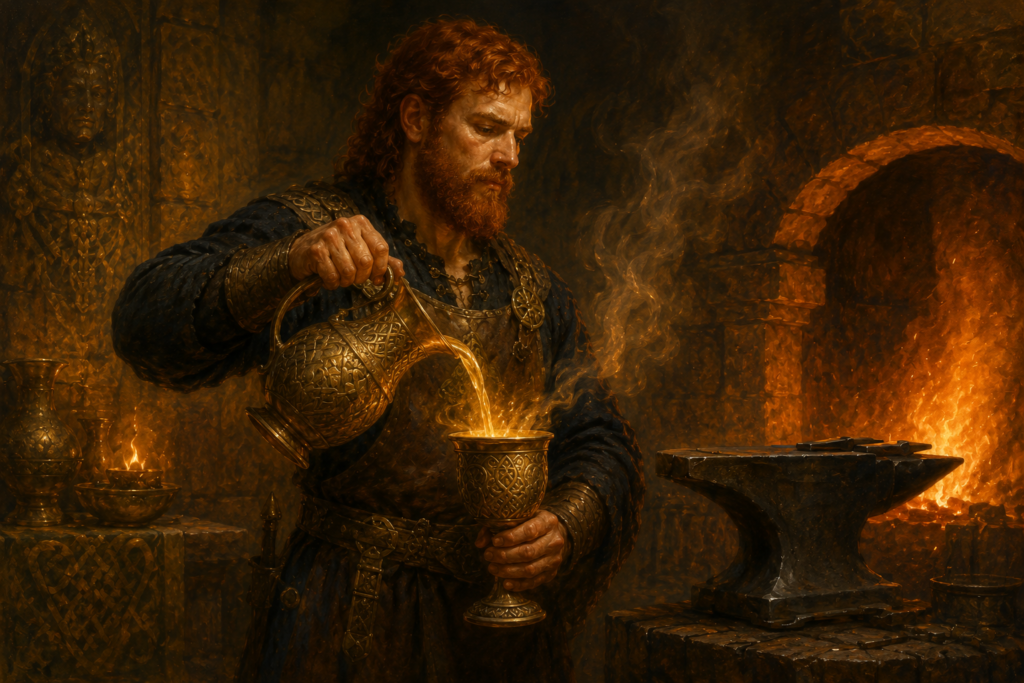
D&D 5.5e Herald: The Cupbearer at the Anvil
Medium Deity Herald, Neutral Good
Armor Class 18
Initiative +6
Hit Points 142
Speed 30 ft.
Proficiency Bonus +4
| STR | DEX | CON | INT | WIS | CHA |
| 20 (+5) | 14 (+2) | 20 (+5) | 16 (+3) | 18 (+4) | 18 (+4) |
Saving Throws Con +9, Wis +8, Cha +8
Skills Medicine +8, Persuasion +8, Religion +7
Tool Mastery Smith’s tools +11, brewer’s supplies +11
Damage Resistances fire, poison
Condition Immunities poisoned
Senses darkvision 60 ft., passive Perception 14
Languages Irish, Old Irish, one local language
Challenge 10
Traits
Cup Before Combat. Allies who drink with the herald during a short rest gain 15 temporary hit points.
Keeper of Sound Craft. The herald can identify cursed, cracked, poisoned, brittle, stolen, falsely made, or falsely blessed weapons and tools by touch.
Guest-Right Ward. The herald has advantage on saving throws against poison and against effects created by creatures who have violated hospitality within the past day.
Actions
Multiattack. The herald makes two Hammer or Spear attacks.
Hammer. Melee Weapon Attack: +9 to hit, reach 5 ft., one target. Hit: 14 bludgeoning damage plus 7 fire damage.
Spear. Melee or Ranged Weapon Attack: +9 to hit, reach 5 ft. or range 30/120 ft., one target. Hit: 12 piercing damage plus 7 fire damage.
Healing Ale. The herald chooses up to three creatures within 30 feet. Each regains 18 hit points and has advantage on its next saving throw against poison, disease, or exhaustion.
Judge the Work. The herald touches one manufactured object. If it is flawed, cursed, poisoned, stolen, or falsely blessed, the flaw becomes visible as red heat, black soot, sour vapour, or a ringing crack.
D&D 5.5e Servant: Three-Spark Forge-Warden
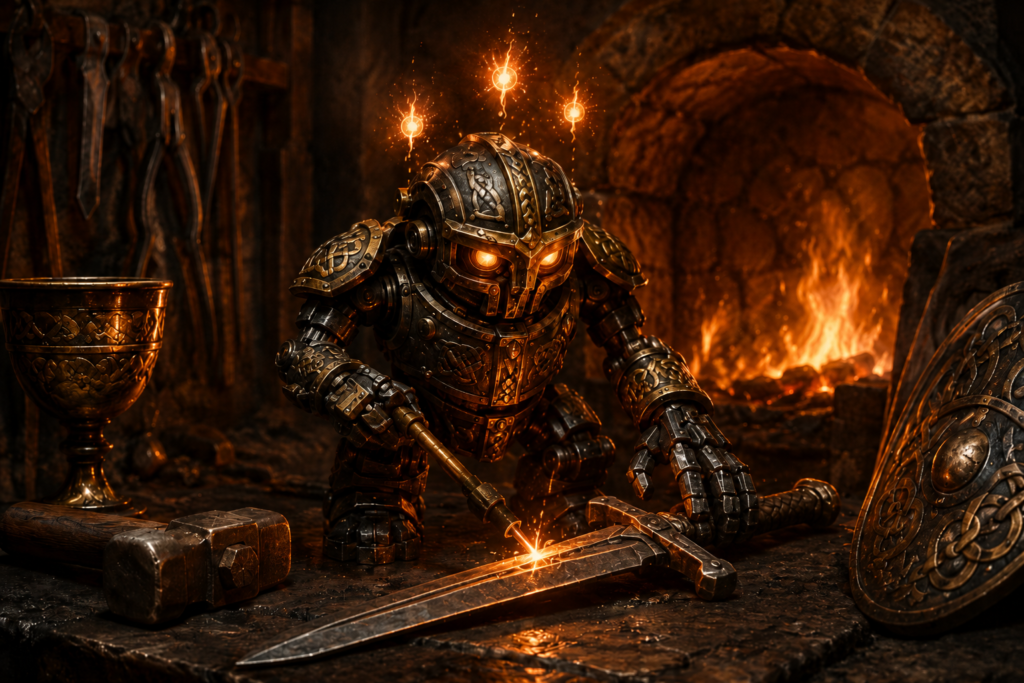
Small Construct, Neutral Good
Armor Class 16
Initiative +3
Hit Points 58
Speed 25 ft., climb 20 ft.
Proficiency Bonus +3
| STR | DEX | CON | INT | WIS | CHA |
| 14 (+2) | 16 (+3) | 16 (+3) | 10 (+0) | 14 (+2) | 10 (+0) |
Saving Throws Dex +6, Con +6
Skills Perception +5
Damage Resistances fire, poison
Condition Immunities poisoned
Senses darkvision 60 ft., passive Perception 15
Languages understands Irish and the language of its maker but usually speaks in metallic knocks and sparks
Challenge 4
Traits
Forge Familiar. A forge-warden can inhabit a working forge, anvil, armoury, or sacred cup. While inhabiting it, the object cannot be accidentally broken, spoiled, or poisoned.
Three Sparks Warning. When a cursed or flawed weapon is brought within 30 feet, the forge-warden sheds three sparks and rings like struck metal.
Actions
Spark-Bite. Melee Spell Attack: +6 to hit, reach 5 ft., one target. Hit: 10 fire damage.
Mend Tool. The forge-warden repairs one damaged mundane weapon, tool, shield, lock, hinge, chain, or piece of armour within 5 feet.
Goibhniu Pathfinder 1e / 3.5e-Compatible Rules
True Divine Form: Domains, Granted Magic, Boons, and Curses
Divine Rank: Intermediate Deity
Alignment: Neutral Good
Favoured Weapon: Warhammer or spear
Cleric Alignments: LG, NG, CG, LN, N
Pathfinder Domains: Artifice, Community, Fire, Good, Healing, Protection, War
Suggested Subdomains: Toil, Cooperation, Ash, Restoration, Defense, Tactics
3.5e Domains: Craft, Fire, Good, Healing, Protection, War
Portfolio Spell-Like Abilities: fabricate, major creation, heal, heroes’ feast, greater magic weapon, make whole, ironwood, wall of iron, regenerate, resurrection, true resurrection
Pathfinder Divine Boons
1st Boon — Sound Work. The worshipper gains a +4 sacred bonus on Craft checks involving metal, weapons, armour, brewing, toolmaking, or battlefield repair.
2nd Boon — Three-Stroke Repair. Once per day, the worshipper may use fabricate, make whole, or greater magic weapon as a spell-like ability.
3rd Boon — Feast Against Decay. Once per week, the worshipper may prepare a sacred feast for up to twelve creatures. Those who partake gain the effects of heroes’ feast and remove disease.
Pathfinder Divine Curse
A creature cursed by Goibhniu suffers a −4 penalty on attack rolls with manufactured weapons and a −4 penalty on Craft checks. Weapons made by the cursed creature gain the broken condition after the first natural 1 rolled with them unless the creature confesses the false work and repairs the harm done.
A creature that poisons a guest-cup or corrupts ceremonial drink also loses the benefit of magical food, drink, potions, and restorative feasts until the curse is lifted.
Pathfinder True Divine Form: Goibhniu
Goibhniu, Smith of the Deathless Feast
CR 33 / MR 10
NG Medium Deity
Init +13; Senses truesight 120 ft.; Perception +50
AC 49, touch 25, flat-footed 40
hp 760
Fort +34, Ref +27, Will +31
Defensive Abilities divine resilience, forge-body, mythic recovery; DR 20/epic and cold iron; Immune aging, disease, fear, fire, poison; Resist cold 30, electricity 30; SR 44
| STR | DEX | CON | INT | WIS | CHA |
|---|---|---|---|---|---|
| 42 (+16) | 28 (+9) | 38 (+14) | 34 (+12) | 32 (+11) | 32 (+11) |
Speed 40 ft.
Base Atk +33; CMB +49; CMD 68
Melee divine warhammer +52/+47/+42/+37
Ranged true-cast spear +45
Special Attacks three-stroke forging, deathless draught, reforge the broken, spear that does not miss
Mythic Power 23/day, surge +1d12
Spell-Like Abilities CL 33rd; concentration +44
At will — fabricate, greater magic weapon, heat metal, make whole, minor creation, remove disease
3/day — heal, heroes’ feast, major creation, wall of iron, regenerate
1/day — mass heal, resurrection, true resurrection
Note: Mythic subtype benefits are already included and must not be added a second time.
Human-Shaped Divine Form. Goibhniu is not described in the surviving myths as a giant. His true divine form appears Medium: a powerful human-shaped divine smith whose scale is expressed through forge-fire, sacred craft, the deathless cup, and the authority of his work rather than through giant size.
Special Abilities
Three-Stroke Forging. Goibhniu may repair or complete a non-artifact manufactured object as a full-round action. If the object is broken, destroyed, or sundered, at least half its substance must remain.
Spear That Does Not Miss. Once per round, Goibhniu may declare a spear attack to be a true-cast strike before rolling. The attack ignores concealment short of total concealment and ignores non-mythic miss chances.
Deathless Draught. As a standard action, Goibhniu may heal one creature within 30 feet for 150 hit points and remove poison, disease, fatigue, exhaustion, and one curse effect tied to a wound, thorn, shard, or weapon-point.
Forge-Body. Goibhniu is immune to fire and poison. Metal weapons that strike him become hot enough to reveal flaws, curses, poison, or false blessing.
Pathfinder Avatar: Smith at the War-Fire
CR 18
NG Medium deity avatar
Init +9; Senses darkvision 60 ft.; Perception +29
AC 34, touch 16, flat-footed 29
hp 310
Fort +22, Ref +16, Will +20
DR 10/cold iron; Immune fire, poison; Resist cold 20
| STR | DEX | CON | INT | WIS | CHA |
| 34 (+12) | 20 (+5) | 28 (+9) | 24 (+7) | 24 (+7) | 22 (+6) |
Speed 35 ft.
Base Atk +18; CMB +30; CMD 45
Melee +3 flaming warhammer +33/+28/+23
Special Attacks battlefield repair, healing cup, forge-fire strike
Spell-Like Abilities CL 18th; concentration +24
At will — heat metal, make whole
3/day — greater magic weapon, heal
1/day — heroes’ feast
Special Abilities
Battlefield Repair. Once per round, the avatar may remove the broken condition from one weapon, shield, armour piece, or tool within 60 feet.
Healing Cup. Three times per day, the avatar may heal one creature within 30 feet for 90 hit points and remove poison or disease.
Pathfinder Herald: The Cupbearer at the Anvil
CR 10
NG Medium outsider
Init +6; Senses darkvision 60 ft.; Perception +18
AC 25, touch 13, flat-footed 22
hp 145
Fort +14, Ref +10, Will +13
Immune poison; Resist fire 20
| STR | DEX | CON | INT | WIS | CHA |
| 24 (+7) | 16 (+3) | 22 (+6) | 16 (+3) | 20 (+5) | 18 (+4) |
Speed 30 ft.
Base Atk +10; CMB +17; CMD 30
Melee masterwork warhammer +18/+13
Special Abilities healing ale, detect false craft, bless weapon, repair object
Spell-Like Abilities CL 10th; concentration +14
At will — mending, purify food and drink
3/day — make whole, cure serious wounds
1/day — heroes’ feast
Special Abilities
Healing Ale. Once per day, the herald may share blessed drink with up to six creatures. Each creature heals 3d8+10 hit points and gains a +4 sacred bonus on saving throws against poison and disease for 8 hours.
Detect False Craft. The herald may identify flawed, cursed, poisoned, brittle, stolen, or falsely blessed crafted objects by touch.
Worshippers and Servants
Goibhniu’s priesthood is practical. A priest who cannot mend a hinge, clean a wound, bless a cup, or judge a flawed blade is not ready to speak for him.
His temples are usually working forges with a feast-room attached. The altar is an anvil. The sacred cup is kept near the quenching trough. Apprentices are protected by temple law. A stranger who enters under guest-right must not be poisoned, robbed, or mocked for poverty.
Common Servants
Forge-blessed smiths who can hear flaws in metal.
Ale-wardens who guard feast-halls from poison and false hospitality.
Rivet spirits that haunt armouries and prevent catastrophic failure.
Three-spark messengers that appear in cold ashes when Goibhniu has judged a craft-oath.
Deathless cupbearers who appear before a battle that should be survived, but only if the host’s cause is worthy.
Hammer-priests who bless armouries before sieges and condemn false weapons in public.
Thorn-drawers who specialise in removing arrowheads, spearpoints, splinters, nails, cursed shards, and poisoned metal from flesh.
Using Goibhniu in Your Game
Goibhniu works best when craft has consequences. He is ideal for stories about siege survival, cursed weapons, poisoned ale, battlefield healing, divine smith-guilds, broken oaths, lost masterworks, apprentice exploitation, sabotaged armouries, and communities that survive because someone knows how to make, mend, brew, and share.
He should not feel like a shopkeeper god who hands out magic items. His gifts come with craft-law. A weapon from Goibhniu carries an obligation. A cup from his hall makes the drinker part of a covenant. A repaired blade asks why it broke, who neglected it, and whether it should be drawn again.
Use him when the campaign needs a god who makes the practical sacred. He is not remote theology. He is the ring of the anvil before dawn, the cup passed after burial, the repaired shield on the gate, and the spearhead that holds because the maker did not lie.
Adventure Hooks
The Spear That Never Missed
A spearhead forged in Goibhniu’s name has killed the wrong person. The weapon was never meant to miss under oath, which means either the oath was twisted, the target was falsely named, or the weapon has been ritually corrupted. Goibhniu’s priests demand judgement before the spear is used again.
The Ale Has Soured
A fortress shrine dedicated to Goibhniu loses its sacred brewing overnight. The ale curdles, the forge smokes black, and every repaired weapon cracks within a day. The cause is not a monster in the cellar, but a hidden act of false craft: a lord has been sending soldiers to the wall with knowingly flawed armour.
Rúadán’s Old Wound
A Fomorian cult tries to reopen the mythic wound once dealt to Goibhniu. They do not need to kill the god; they only need to make his forge hesitate before a coming war. The party must protect three sites at once: a smithy, a healing well, and a feast-hall where the deathless cup is being prepared.
Relics and Signs
The Three-Stroke Hammer: A divine hammer that can complete a weapon, repair a shield, or close a wound in three blows.
The Cup of the Ever-Young Hall: A bronze cup whose drink protects against age, disease, poison, and despair for one night.
The True-Cast Spearhead: A spearhead that never misses when thrown under a rightful oath, but turns on oath-breakers.
The Anvil Spark: A coal that never cools unless placed in a false forge.
The Rivet of Goibhniu and Creidhne: A tiny bronze rivet that can hold together a gate, shield, bridge, or oath beyond mundane strength.
The Haft of Luchta: A wooden haft that cannot split while used in defence of a sworn household, hall, or community.
The Thorn-Drawing Tongs: Small iron tongs that can remove arrowheads, thorns, splinters, cursed nails, and hidden shards without worsening the wound.
Mythic and Historic Context
Goibhniu, also written Goibniu, Gobniu, or Gobhniu, is an Irish mythological smith of the Tuatha Dé Danann. His name is strongly associated with smithcraft, weapon-making, and divine artisan work. Related Celtic smith figures, including the Welsh Gofannon and the Gaulish Gobannus, belong in the wider comparison, but this entry treats Goibhniu first as the Irish divine smith rather than treating every Celtic smith figure as the same god.
In Cath Maige Tuired, Goibhniu stands among the crucial powers of the Tuatha Dé Danann during the war against the Fomorians. When Lugh asks what each divine power can contribute to the battle, Goibhniu promises that for every spear or sword broken in combat, he will provide a new weapon in its place. He also declares that no spearpoint forged by his hand will make a missing cast. This is the strongest source for presenting him as a god of battlefield readiness, weapon reliability, divine logistics, and sacred repair.
The same tale shows that Goibhniu’s work is not isolated craft. Luchta the carpenter supplies spearshafts and wooden fittings, while Creidhne the brazier supplies rivets, bosses, rims, and fine metalwork. Together they form a divine craft-chain: spearhead, haft, rivet, shield, hilt, finish, and readiness. Goibhniu should therefore not be presented as a solitary generic forge god. His mythic force is strongest when he stands within the working craft-triad of the Tuatha Dé Danann.
Encyclopaedia Britannica also preserves Goibhniu’s role as one of a trio of divine craftsmen with Luchta and Creidhne. It further connects him with the Fled Goibhnenn, the otherworld feast whose special ale is said to confer immortality on those who drink it. In the campaign, this becomes the basis for Goibhniu’s deathless feast, sacred brewing, feast-law, and protection against age, sickness, poison, despair, and decay.
The deathless feast should be handled carefully. In mythic terms, it belongs to the Otherworld and to the divine host. In mortal play, its blessing should usually appear as protection, renewal, healing, resistance to wasting, and a temporary taste of deathless vitality rather than a simple guarantee of permanent immortality for any mortal who steals or drinks from the cup.
The Rúadán episode in Cath Maige Tuired gives Goibhniu a sharper battle-myth. Rúadán, sent by the Fomorians, obtains a spearpoint, rivets, and shaft from the divine craftsmen, then turns the weapon against Goibhniu. Goibhniu pulls out the spear, casts it back, and kills Rúadán before being made whole again through the healing well. This supports Goibhniu as a god of weapon-points, extraction, wound-survival, retaliation under craft-law, and battle repair, but it does not make him a general war god. His centre remains craft.
The early Irish material known as the St Gall Incantations preserves Goibhniu’s name in a charm against a thorn. For this entry, that source supports a careful game-facing reconstruction of Goibhniu’s healing aspect: the harmful point is drawn from flesh just as the flaw is drawn from metal. This does not prove a fully documented historical healing cult, but it gives strong mythic permission for Goibhniu’s priests, servants, and relics to deal with thorns, splinters, arrowheads, spearpoints, poisoned shards, and cursed metal lodged in the body.
The Ever-Young Forge-Hall, forge-law, apprentice protections, rivet spirits, deathless cupbearers, divine curses, relics, and mechanics in this entry are campaign constructions. They are designed to express the attested source material in playable form while keeping Goibhniu’s core identity intact: Irish divine smith, maker of unfailing weapons, companion of Luchta and Creidhne, provider of the deathless feast, and sacred craftsman of the Tuatha Dé Danann.
Keep this reference growing
If this page helped with your reading or game, you can support its upkeep or explore the curated books.
Explore the Bookshop — epics, classics and stories behind imagined worlds.