
Witches of the Howling Moon
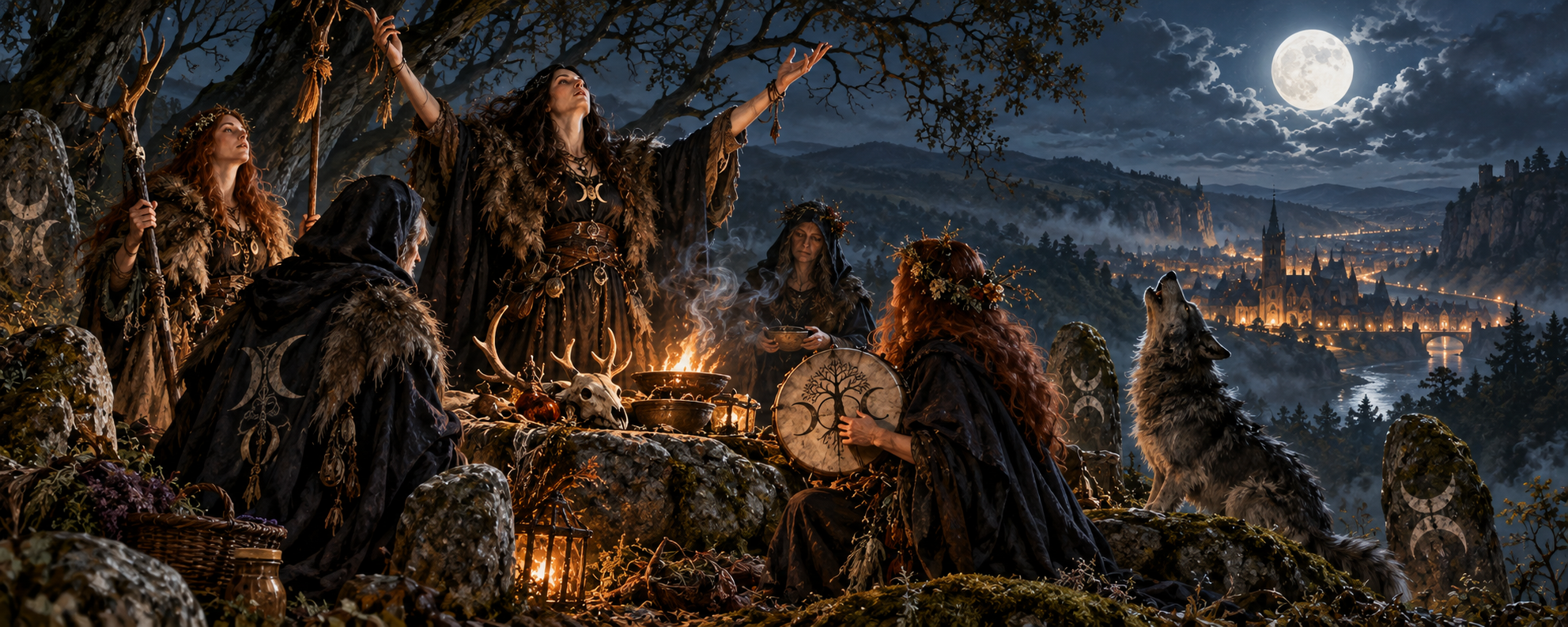
A network of moon-song covens · From Burgundy and the Upper Rhine to the Carpathians
A singer comes to the cabin outside Dole carrying a verse that none of its witches taught her. She learned it from a sister-circle beyond the eastern mountains. Its words proclaim that the moon’s blessing need no longer be asked for: it may be given. The women who sheltered the traveller must decide whether the new verse is a genuine summons from their wider cult or an excuse for turning people into beasts against their will.
The Witches of the Howling Moon are not one cabin of outcasts. They are a dispersed cult of connected covens, recognising one another by the moon-song and a common winter oath. Their circles range from the Free County of Burgundy through the Upper Rhine and Black Forest to a distant Carpathian branch. Some shelter afflicted people and teach restraint; others hold that becoming a wolf is an honour even when the candidate has not agreed. They share a rite, not a conscience.
The old woodland circle outside Dole remains the best-established western meeting place. Its Lorelei singers, Faerie witches and Craft of the Wise practitioners keep their own traditions and membership. What happens at Dole can embroil other circles, but the witches here cannot simply order every distant member to obey.
At a Glance
| Nature | Secret moon-song cult and mutual-aid network of autonomous witch covens |
|---|---|
| Reach | Five established circles in Burgundy, the Jura, Upper Rhine, northern Black Forest and Carpathian uplands; travelling members between them |
| Western meeting place | A concealed cabin outside Dole; not headquarters of the entire cult |
| Dole members | 9–21 witches in the local variable roster. Sample NPCs by level. |
| Wider membership | Several circles and itinerant initiates; numbers kept separately, not a single imaginary census |
| Common observance | Full-moon song; local Faunae Festivals on the first full moon of winter |
| Authority | Each circle chooses its speaker; emissaries meet when safe. No permanent high priestess or sovereign |
| Faith and alignment | A lunar goddess of living song; no single alignment or proven named Outer Planar patron |
| Internal rift | Protection and consent versus the coercive ‘Red Verse’ teaching that transformation must be spread |
| Current threats | Werewolf hunts near Dole, a disputed eastern verse and informants following winter messengers |
What Is Happening Right Now?
The Unwanted Verse
An eastern messenger has brought Dole a variation of the moon-song that calls unwilling transformation a sacred duty. It bears the correct private closing note, so it cannot be dismissed as a tavern forgery. The Dole speaker wants the messenger questioned before anyone sings the new words. A younger Lorelei wants to know whether the Carpathian circle has truly changed its teaching; another proposes burning every copy. The characters can accompany a reply eastward, find the singer who first carried the verse west, or discover who has been adding its last line.
The Court Wants Names
Officers serving Countess Adeline are gathering testimony about the killings around Dole. The local coven might identify a genuine wolf-changer, but some witnesses fear that admitting any link to a moon-song cult will condemn the innocent with the guilty. Gilles Garnier is neither a proven member nor the cult’s agent. Evidence that a particular witch aided him must be pursued against that witch, not treated as proof against all five circles.
The Salt-Road Missing Singer
A courier carrying copied rites between Dole and the Jura has failed to meet the next singer. The last known stop was a provisions exchange used by salt carriers. The Salt-Road coven fears an official seizure; the Upper Rhine circle suspects that someone within the cult is intercepting messages that reject the Red Verse. A recovered satchel could settle the matter, but whoever opens it must choose whether to tell the authorities which villagers helped deliver it.
Winter Without a Common Answer
Each circle is preparing for its own Faunae Festival. Dole has invited representatives from neighbouring covens, not the entire continent. The Carpathian singers are weeks away, and no message can guarantee their arrival. If the dispute remains unresolved, each local gathering may swear a different oath: one protecting the right to refuse transformation, another treating refusal as disobedience to the moon.
The Five Circles and Their Roads
The Howling Moon is a chain of refuges and teachers rather than an occult kingdom. Five circles recognise one another’s moon-song, but they keep separate lodgings, food, candidates and enemies. Between them move itinerant singers carrying memorised verses, herbs, letters and news. An answer from a distant circle must actually travel by road or river; the song does not transmit orders magically across Europe.
Dole — The Woodland Circle
In the Free County of Burgundy, the existing cabin beyond Dole shelters the Lorelei-majority circle recorded in the older witch rules. It teaches the complete seasonal song, trains candidates, keeps a few supplies and guards the names of people who sought sanctuary after a curse. It can protect an individual for a night, but a magistrate with a lawful warrant or an armed crowd can break its secrecy. Its witches are presently divided about cooperating with the court over Garnier.
The Jura — The Salt-Road Circle
Witches along the tracks serving Poligny and the salt markets meet at changing outlying farms and woodland shelters rather than a permanent grand lodge. Their trade is practical: keeping travellers alive, remembering which shepherd saw what and passing messages with muleteers who cross the hills. The circle distrusts shapechangers who prey on livestock. Tales of the Werewolves of Poligny concern it directly, but those men are not members by association or simply because the same forests shelter both.
The Upper Rhine — The River Chorus
Near Strasbourg, the cult survives through a few trusted singers among travelling healers, copying houses and river carriers. They use the city’s trade traffic for correspondence and acquire manuscripts the woodland circles could never obtain. This is a clandestine circle, not a recognised city guild or an institution controlling Strasbourg’s magistrates. Their greatest fear is not wolves but a seized bundle of letters naming households far beyond the city.
The Northern Black Forest — The Fir Ring
Beyond Baden, a smaller coven serves woodland settlements, charcoal burners and people passing between the bath town and the higher forest. It takes omens from wolf calls but also understands real wolf behaviour and the cost of losing livestock. Members argue against deliberately spreading lycanthropy: a village cannot be asked to tolerate a predator merely because a distant priestess calls it blessed. Their weakness is isolation; they may learn of a persecution weeks after the refugees most needed them.
The Carpathians — The Night Chorus
In the eastern mountain country, the furthest acknowledged branch regards the wolf-change as a possible sacred vocation. Its elders preserve harsher verses than are sung in Dole. Most still require an initiate’s consent; a militant minority teaches the Red Verse, arguing that the moon may choose a person regardless of the person’s wishes. The branch is divided, not a nest of identical villains. Its proximity to other Carpathian occult powers is no proof of obedience to Dracula, the Scholomance or an infernal patron.
The travellers between them. A singer carrying news may belong to one circle, have been trained by another and owe shelter to a third. Such travellers keep the network alive but have no right to compel admission or levy taxes. Their reports are imperfect, delayed and vulnerable to forgery—the central weakness of a cult that relies on a shared song more than on written charters.
Membership and the Moon Moot
There is no crowned witch-queen and no secret priesthood that rules every circle from a single tower. Each recognised coven admits its own members, maintains its own refuge and appoints a song-speaker for dealings with outsiders. The speaker represents the decisions of that circle, not the private conscience of everyone in it. When two circles quarrel, an emissary carries the grievance; a seasonal Moon Moot of attending speakers may settle common questions, but its decisions work only while the circles choose to honour them.
Across the network, Lorelei singers carry much of the shared rite. Faerie witches bring enchantment and knowledge of strange neighbours; Craft of the Wise practitioners are often trusted with household charms, wounds and stores. There is no imposed racial or alignment test. The older random roster gives Dole 7–14 Lorelei, 1–4 Faerie and 1–3 Craft of the Wise witches (9–21 in all). Roll 6 + 1d8, 1d4 and 1d3 respectively if generating a variable local circle; these are not levels, all members are not equally powerful, and the numbers do not describe the wider cult. Other circles differ in size and skill, and itinerant members are counted at home rather than every shelter they visit.
| Standing | Rights and obligations | Limit of authority |
|---|---|---|
| Listener | A guest or candidate allowed to hear part of a local moon-song and perform a useful service | Does not learn lodge routes or gain the protection of the wider network |
| Sworn singer | Learns the answering verse, attends full-moon rites and may ask a sister-circle for help | Another circle can refuse shelter if admission endangers its members |
| Hearth-keeper | Controls supplies, guest arrangements, apprentices’ instruction and the circle’s meeting place | Cannot bind other covens with personal promises |
| Travelling voice | Carries messages, recruits candidates and records which circles have altered their words | May report a dispute, but cannot pronounce a stranger guilty or command a hunt |
| Song-speaker | Chosen locally to represent that circle at a Moon Moot and settle its immediate policy | Has no rank over another circle’s speaker |
The Two Teachings
The Keepers of the Answer, strongest around Dole and the Fir Ring, hold that the lunar gift carries the right to decline it. They shelter some afflicted lycanthropes, pursue dangerous ones when necessary and condemn the use of curses to force membership. They do not demand that everyone be peaceful: a witch who knowingly feeds a traveller to a werewolf can be cast out and brought before local judgement.
Adherents of the Red Verse argue that becoming a wolf can be a revelation too important to leave to ordinary fear. Some want to persuade willing initiates; the extremists have begun arguing for deliberate, unwanted transformation. Their teachings are strongest within a portion of the distant Night Chorus, although western sympathisers have copied its words. Neither camp has expelled the other from the whole network. Dole’s refusal to accept the new verse could split the cult and deprive travellers of shelters they have relied upon for years.
Joining usually begins with a travelling member’s introduction and a winter oath before the home circle. A novice learns to recognise a wolf without assuming every wolf is a curse-bearer, is taught the moon-song, and swears not to betray a guest’s whereabouts. Leaving the circle is possible, but a former member who sells route names or spreads an unwanted curse cannot expect continued sanctuary. Punishment is local and concrete: refused lodging, loss of a voice at the next moot, repayment for harm, or—if a crime has been committed—exposure to the relevant magistrates.
Howling Moon Members — NPCs by Level
The Dole roster gives the number of witches, not their strength. Choose the level that fits the role and the situation. A level-1 listener can be the only witness to a murder; a level-10 speaker can be overruled by their own circle. These are four generic character builds for any of the five circles, not new named leaders or a claim that every member of a tradition is identical.
| Generic member | Class level | Best for |
|---|---|---|
| Moon-Song Listener | 1 | A witness, novice healer or errand-runner, not a combat leader |
| Travelling Singer | 3 | A discreet messenger who can arrange introductions and assess a suspicious oath |
| Hearth-Keeper | 6 | Keeper of sanctuary stores, teacher of apprentices and mediator during a search |
| Moon Moot Speaker | 10 | A powerful local spellcaster who can arbitrate or inflame the Red Verse dispute |
Choose your rules edition: expand a member below to open its rules. D&D 5e (2024) is the first, selected tab, followed by Pathfinder 1e and D&D 3.5e. The 2024 Witch is this site’s original D&D 5e (2024)-compatible class (not an official SRD monster); Pathfinder uses Intelligence, hexes and a d6 Hit Die; the site’s 3.5e legacy Witch uses Wisdom, Coven spell slots and a d4 Hit Die. These are example NPC characters by class level; fifth-edition Challenge Ratings are deliberately unassigned pending encounter balance tests. They do not automatically gain lycanthropy.
Moon-Song Listener — Level 1 · Lorelei novice · Dole
Use: A witness, novice healer or errand-runner, not a combat leader. Wants: A senior member to hear testimony before the magistrates arrive. Cannot: Knows the local answer but not sister-circle locations.
Moon-Song Listener — D&D 5e (2024)
Medium Humanoid (human), any alignment; level 1 Witch (default Classical tradition), class-built NPC, no assigned CR.
AC 12 (15 with Mage Armor); Initiative +2 (12); HP 7 (Witch level 1, d6 class Hit Dice); Speed 30 ft.
Saves Int +5, Wis +3; Skills Arcana +5, Medicine +3; Senses passive Perception 11; Languages Common and local language; PB +2; Spell attack +5; spell DC 13.
Edition note: D&D fifth edition (2024 rules), using SpiralWorlds’ own Intelligence-based Witch class. This is a class-level NPC, not a Challenge Rating-calibrated Monster Manual creature. Use the 2024 spell and concentration rules.
Traits
Familiar and patron. Has a Witch familiar and patron-linked magic as detailed in the site’s 2024 Witch. A familiar does not cast independent spells or supply another concentration slot.
Hexcraft. Hexcraft is not yet available (Witch level 2).
Actions
Dagger. Melee or Ranged Attack Roll: +4 to hit, reach 5 ft. or 20/60 ft.; Hit 4 (1d4+2) Piercing.
Toll the Dead. Magic action; one seen target within 60 ft. makes a DC 13 Wisdom save. On a failure it takes 1d8 Necrotic damage (1d12 if missing Hit Points).
Spellcasting. Witch spell slots: 2 first-level. Prepared spells (4): Cure Wounds, Fog Cloud, Mage Armor, Sleep. Cantrips: Guidance, Message, Toll the Dead. Spell Concentration, action economy, class bonus spells and prepared-spell rules follow the site Witch class.
Moon-Song Listener — Pathfinder 1e
Witch 1; CR approximately 1/2 with NPC gear (provisional; adjust for equipment and magic); Medium human, any alignment.
Defense
Init +6 (Improved Initiative); AC 12, touch 12, flat-footed 10 (AC 16 when Mage Armor is active); hp 5 (1d6 + 1); Fort +1, Ref +2, Will +3; Senses Perception +1.
Offense
Speed 30 ft.; Melee dagger -1 (1d4−1/19–20); Ranged light crossbow +2 (1d8/19–20, 80-ft. increment). Spells Witch CL 1, concentration +4; highest spell DC 14 (spell level 1). Slots/day: 3 cantrips and two first-level spells, including the bonus spell for Intelligence.
Statistics
Str 8, Dex 14, Con 12, Int 16, Wis 12, Cha 12; BAB +0; CMB -1; CMD 11; Skills Spellcraft +7, Heal +5; Feats Improved Initiative and Combat Casting, with remaining selections per NPC build.
Examples prepared: Cure Light Wounds, Mage Armor, Sleep. Hexes: Evil Eye (Will save DC 13; the target’s save controls the duration). A familiar stores spells but cannot independently use its witch’s slots. Use the official Pathfinder Witch and this site’s conversion for the precise available hexes and daily preparation.
Moon-Song Listener — D&D 3.5e / d20 Witch
| Size / Type | Medium Humanoid (human), level 1 legacy Witch, any alignment |
|---|---|
| Hit Dice / HP | 1d4 + 1 (4 hp) |
| Initiative / Speed | +2; 30 ft. |
| AC | 12 (+2 Dex), touch 12, flat-footed 10 |
| BAB / Grapple | +0 / -1 |
| Attack | Dagger -1 melee (1d4−1/19–20) or light crossbow +2 ranged (1d8/19–20) |
| Saves | Fort +1, Ref +2, Will +5 |
| Abilities | Str 8, Dex 14, Con 12, Int 12, Wis 16, Cha 12 |
| Skills | Spellcraft +5, Knowledge (Witchcraft) +5, Heal +4; skill assignments are sample values |
| Spellcasting | Wisdom casting; spell save DC 14 at highest spell level 1; per-day baseline: 3 cantrips, one first-level spell plus bonus spells for Wisdom |
| Class Features | Create Talisman, Dabble, Familiar and Vulnerability |
| Challenge | Approximate CR equals class level before special gear and preparation; validate at the table |
Prepared spells: Choose a 1st-level Witch spell in the Book of Shadows; no Coven bonus slot at level 1. The legacy Witch is a Wisdom-based d4 caster, not the Pathfinder Int/d6 Witch. Do not import 2024 Hexcraft or the Pathfinder Hex class feature. For full spell eligibility and Dabble/Coven distinctions, use the site’s original d20 Witch.
Travelling Singer — Level 3 · Lorelei or Faerie courier · Jura / Rhine
Use: A discreet messenger who can arrange introductions and assess a suspicious oath. Wants: Recover a courier bag naming the households that offered sanctuary. Cannot: Cannot order another coven to shelter a stranger.
Travelling Singer — D&D 5e (2024)
Medium Humanoid (human), any alignment; level 3 Witch (default Classical tradition), class-built NPC, no assigned CR.
AC 12 (15 with Mage Armor); Initiative +2 (12); HP 17 (Witch level 3, d6 class Hit Dice); Speed 30 ft.
Saves Int +5, Wis +3; Skills Arcana +5, Medicine +3; Senses passive Perception 11; Languages Common and local language; PB +2; Spell attack +5; spell DC 13.
Edition note: D&D fifth edition (2024 rules), using SpiralWorlds’ own Intelligence-based Witch class. This is a class-level NPC, not a Challenge Rating-calibrated Monster Manual creature. Use the 2024 spell and concentration rules.
Traits
Familiar and patron. Has a Witch familiar and patron-linked magic as detailed in the site’s 2024 Witch. A familiar does not cast independent spells or supply another concentration slot.
Hexcraft. Known Hexes: Fortune Charm, Slumber Hex and Dread Hex. Hexcraft 2 uses/Long Rest, d6. Fortune Charm (Reaction): +1d6 to a roll by a creature within 60 feet after the d20 is rolled, before the outcome. Slumber Hex (Magic action): DC 13 Wisdom save within 60 feet; on failure Incapacitated, Speed 0 until end of target’s next turn or until damaged/roused.
Actions
Dagger. Melee or Ranged Attack Roll: +4 to hit, reach 5 ft. or 20/60 ft.; Hit 4 (1d4+2) Piercing.
Toll the Dead. Magic action; one seen target within 60 ft. makes a DC 13 Wisdom save. On a failure it takes 1d8 Necrotic damage (1d12 if missing Hit Points).
Spellcasting. Witch spell slots: 4 first-level, 2 second-level. Prepared spells (6): Cure Wounds, Fog Cloud, Healing Word, Mage Armor, Hold Person, Moonbeam. Cantrips: Guidance, Message, Toll the Dead. Spell Concentration, action economy, class bonus spells and prepared-spell rules follow the site Witch class.
Travelling Singer — Pathfinder 1e
Witch 3; CR approximately 2 with NPC gear (provisional; adjust for equipment and magic); Medium human, any alignment.
Defense
Init +6 (Improved Initiative); AC 12, touch 12, flat-footed 10 (AC 16 when Mage Armor is active); hp 14 (3d6 + 3); Fort +2, Ref +3, Will +4; Senses Perception +1.
Offense
Speed 30 ft.; Melee dagger +0 (1d4−1/19–20); Ranged light crossbow +3 (1d8/19–20, 80-ft. increment). Spells Witch CL 3, concentration +6; highest spell DC 15 (spell level 2). Slots/day: 4 cantrips, three first-level and two second-level spells, including Intelligence bonus spells.
Statistics
Str 8, Dex 14, Con 12, Int 16, Wis 12, Cha 12; BAB +1; CMB +0; CMD 12; Skills Spellcraft +9, Heal +7; Feats Improved Initiative and Combat Casting, with remaining selections per NPC build.
Examples prepared: Cure Light Wounds, Mage Armor, Hold Person, Blindness/Deafness. Hexes: Evil Eye and Slumber; Will save DC 14 for Slumber, subject to each hex’s frequency limit. A familiar stores spells but cannot independently use its witch’s slots. Use the official Pathfinder Witch and this site’s conversion for the precise available hexes and daily preparation.
Travelling Singer — D&D 3.5e / d20 Witch
| Size / Type | Medium Humanoid (human), level 3 legacy Witch, any alignment |
|---|---|
| Hit Dice / HP | 3d4 + 3 (11 hp) |
| Initiative / Speed | +2; 30 ft. |
| AC | 12 (+2 Dex), touch 12, flat-footed 10 |
| BAB / Grapple | +1 / +0 |
| Attack | Dagger +0 melee (1d4−1/19–20) or light crossbow +3 ranged (1d8/19–20) |
| Saves | Fort +2, Ref +3, Will +6 |
| Abilities | Str 8, Dex 14, Con 12, Int 12, Wis 16, Cha 12 |
| Skills | Spellcraft +7, Knowledge (Witchcraft) +7, Heal +6; skill assignments are sample values |
| Spellcasting | Wisdom casting; spell save DC 15 at highest spell level 2; per-day baseline: 4 cantrips, two first-level + one Coven spell, one second-level slot, plus Wisdom bonus spells |
| Class Features | Dabble, Familiar, Coven spell slots (from level 2) and Brew Potion (from level 3) |
| Challenge | Approximate CR equals class level before special gear and preparation; validate at the table |
Prepared spells: 1st- and 2nd-level legacy Witch spells from the Book of Shadows; Coven spell separately chosen from an eligible domain. The legacy Witch is a Wisdom-based d4 caster, not the Pathfinder Int/d6 Witch. Do not import 2024 Hexcraft or the Pathfinder Hex class feature. For full spell eligibility and Dabble/Coven distinctions, use the site’s original d20 Witch.
Hearth-Keeper — Level 6 · Craft of the Wise healer · Dole / Black Forest
Use: Keeper of sanctuary stores, teacher of apprentices and mediator during a search. Wants: Treat an injured guest while avoiding a raid on the hidden lodging. Cannot: Can close her own doors but cannot expel a member of another circle.
Hearth-Keeper — D&D 5e (2024)
Medium Humanoid (human), any alignment; level 6 Witch (default Classical tradition), class-built NPC, no assigned CR.
AC 12 (15 with Mage Armor); Initiative +2 (12); HP 38 (Witch level 6, d6 class Hit Dice); Speed 30 ft.
Saves Int +7, Wis +4; Skills Arcana +7, Medicine +4; Senses passive Perception 11; Languages Common and local language; PB +3; Spell attack +7; spell DC 15.
Edition note: D&D fifth edition (2024 rules), using SpiralWorlds’ own Intelligence-based Witch class. This is a class-level NPC, not a Challenge Rating-calibrated Monster Manual creature. Use the 2024 spell and concentration rules.
Traits
Familiar and patron. Has a Witch familiar and patron-linked magic as detailed in the site’s 2024 Witch. A familiar does not cast independent spells or supply another concentration slot.
Hexcraft. Known Hexes: Mending Charm, Fortune Charm and Witch’s Ward. Hexcraft 3 uses/Long Rest, d8. Mending Charm (Bonus Action) heals 2d8+4 HP to a creature within 30 ft. (each target benefits only once per Short/Long Rest). Protective Charm (Reaction, Classical Tradition): spend a use to reduce damage to a creature within 30 ft. by 2d8+4.
Actions
Dagger. Melee or Ranged Attack Roll: +5 to hit, reach 5 ft. or 20/60 ft.; Hit 4 (1d4+2) Piercing.
Toll the Dead. Magic action; one seen target within 60 ft. makes a DC 15 Wisdom save. On a failure it takes 2d8 Necrotic damage (2d12 if missing Hit Points).
Spellcasting. Witch spell slots: 4 first-level, 3 second-level, 3 third-level. Prepared spells (10): Cure Wounds, Fog Cloud, Healing Word, Hex, Mage Armor, Hold Person, Invisibility, Moonbeam, Hypnotic Pattern, Remove Curse. Cantrips: Guidance, Mending, Message, Toll the Dead. Spell Concentration, action economy, class bonus spells and prepared-spell rules follow the site Witch class.
Hearth-Keeper — Pathfinder 1e
Witch 6; CR approximately 5 with NPC gear (provisional; adjust for equipment and magic); Medium human, any alignment.
Defense
Init +6 (Improved Initiative); AC 12, touch 12, flat-footed 10 (AC 16 when Mage Armor is active); hp 33 (6d6 + 12); Fort +4, Ref +4, Will +6; Senses Perception +1.
Offense
Speed 30 ft.; Melee dagger +2 (1d4−1/19–20); Ranged light crossbow +5 (1d8/19–20, 80-ft. increment). Spells Witch CL 6, concentration +10; highest spell DC 17 (spell level 3). Slots/day: 4 cantrips; four first-level, four second-level and three third-level spells, including Int bonus slots.
Statistics
Str 8, Dex 14, Con 12, Int 18, Wis 12, Cha 12; BAB +3; CMB +2; CMD 14; Skills Spellcraft +13, Heal +10; Feats Improved Initiative and Combat Casting, with remaining selections per NPC build.
Examples prepared: Cure Light Wounds, Mage Armor, Hold Person, Dispel Magic, Bestow Curse. Hexes: Evil Eye, Slumber, Healing and Misfortune; hex DC 17 where a save is permitted. A familiar stores spells but cannot independently use its witch’s slots. Use the official Pathfinder Witch and this site’s conversion for the precise available hexes and daily preparation.
Hearth-Keeper — D&D 3.5e / d20 Witch
| Size / Type | Medium Humanoid (human), level 6 legacy Witch, any alignment |
|---|---|
| Hit Dice / HP | 6d4 + 6 (21 hp) |
| Initiative / Speed | +2; 30 ft. |
| AC | 12 (+2 Dex), touch 12, flat-footed 10 |
| BAB / Grapple | +3 / +2 |
| Attack | Dagger +2 melee (1d4−1/19–20) or light crossbow +5 ranged (1d8/19–20) |
| Saves | Fort +3, Ref +4, Will +9 |
| Abilities | Str 8, Dex 14, Con 12, Int 12, Wis 18, Cha 12 |
| Skills | Spellcraft +10, Knowledge (Witchcraft) +10, Heal +10; skill assignments are sample values |
| Spellcasting | Wisdom casting; spell save DC 17 at highest spell level 3; per-day baseline: 5 cantrips; 3+1 Coven first-level, 2+1 Coven second-level and 1+1 Coven third-level, plus Wisdom bonus spells |
| Class Features | Dabble, Familiar, Brew Potion, Trackless Step and Bewitch; the legacy Hex feature starts at level 8, not level 2 |
| Challenge | Approximate CR equals class level before special gear and preparation; validate at the table |
Prepared spells: Prepared spells through level 3 using the legacy Book of Shadows, plus the appropriate Coven slot at each level. The legacy Witch is a Wisdom-based d4 caster, not the Pathfinder Int/d6 Witch. Do not import 2024 Hexcraft or the Pathfinder Hex class feature. For full spell eligibility and Dabble/Coven distinctions, use the site’s original d20 Witch.
Moon Moot Speaker — Level 10 · Senior witch · Western or Carpathian circle
Use: A powerful local spellcaster who can arbitrate or inflame the Red Verse dispute. Wants: Keep her own circle united until she can hear witnesses from the east. Cannot: Represents one coven, not an empire of all witches.
Moon Moot Speaker — D&D 5e (2024)
Medium Humanoid (human), any alignment; level 10 Witch (default Classical tradition), class-built NPC, no assigned CR.
AC 12 (15 with Mage Armor); Initiative +2 (12); HP 62 (Witch level 10, d6 class Hit Dice); Speed 30 ft.
Saves Int +9, Wis +5; Skills Arcana +9, Medicine +5; Senses passive Perception 11; Languages Common and local language; PB +4; Spell attack +9; spell DC 17.
Edition note: D&D fifth edition (2024 rules), using SpiralWorlds’ own Intelligence-based Witch class. This is a class-level NPC, not a Challenge Rating-calibrated Monster Manual creature. Use the 2024 spell and concentration rules.
Traits
Familiar and patron. Has a Witch familiar and patron-linked magic as detailed in the site’s 2024 Witch. A familiar does not cast independent spells or supply another concentration slot.
Hexcraft. Known Hexes: Binding Hex, Evil Eye, Fortune Charm and Witch’s Ward. Hexcraft 4 uses/Long Rest, d8. Binding Hex (Bonus Action): DC 17 Wisdom save within 60 ft. or target’s Speed is halved and it loses Reactions until your next turn. Old Road (Classical Tradition, Bonus Action): expend a use to teleport 30 ft., optionally with one willing nearby ally.
Actions
Dagger. Melee or Ranged Attack Roll: +6 to hit, reach 5 ft. or 20/60 ft.; Hit 4 (1d4+2) Piercing.
Toll the Dead. Magic action; one seen target within 60 ft. makes a DC 17 Wisdom save. On a failure it takes 2d8 Necrotic damage (2d12 if missing Hit Points).
Spellcasting. Witch spell slots: 4 first-level, 3 second-level, 3 third-level, 3 fourth-level, 2 fifth-level. Prepared spells (15): Cure Wounds, Fog Cloud, Healing Word, Hex, Mage Armor, Hold Person, Invisibility, Moonbeam, Silence, Counterspell, Hypnotic Pattern, Remove Curse, Greater Invisibility, Polymorph, Scrying. Cantrips: Guidance, Mending, Message, Minor Illusion, Toll the Dead. Spell Concentration, action economy, class bonus spells and prepared-spell rules follow the site Witch class.
Moon Moot Speaker — Pathfinder 1e
Witch 10; CR approximately 9 with NPC gear (provisional; adjust for equipment and magic); Medium human, any alignment.
Defense
Init +6 (Improved Initiative); AC 12, touch 12, flat-footed 10 (AC 16 when Mage Armor is active); hp 55 (10d6 + 20); Fort +5, Ref +5, Will +8; Senses Perception +1.
Offense
Speed 30 ft.; Melee dagger +4 (1d4−1/19–20); Ranged light crossbow +7 (1d8/19–20, 80-ft. increment). Spells Witch CL 10, concentration +15; highest spell DC 20 (spell level 5). Slots/day: 4 cantrips; six first-level, five second-level, four third-level, four fourth-level, three fifth-level spells with Int bonus slots.
Statistics
Str 8, Dex 14, Con 14, Int 20, Wis 12, Cha 12; BAB +5; CMB +4; CMD 16; Skills Spellcraft +18, Heal +14; Feats Improved Initiative and Combat Casting, with remaining selections per NPC build.
Examples prepared: Cure Light Wounds, Mage Armor, Hold Person, Dispel Magic, Bestow Curse, Dimension Door, Baleful Polymorph. Hexes: Evil Eye, Slumber, Healing, Misfortune and an eligible Major Hex; save DC 20 where required. A familiar stores spells but cannot independently use its witch’s slots. Use the official Pathfinder Witch and this site’s conversion for the precise available hexes and daily preparation.
Moon Moot Speaker — D&D 3.5e / d20 Witch
| Size / Type | Medium Humanoid (human), level 10 legacy Witch, any alignment |
|---|---|
| Hit Dice / HP | 10d4 + 10 (35 hp) |
| Initiative / Speed | +2; 30 ft. |
| AC | 12 (+2 Dex), touch 12, flat-footed 10 |
| BAB / Grapple | +5 / +4 |
| Attack | Dagger +4 melee (1d4−1/19–20) or light crossbow +7 ranged (1d8/19–20) |
| Saves | Fort +4, Ref +5, Will +12 |
| Abilities | Str 8, Dex 14, Con 12, Int 12, Wis 20, Cha 12 |
| Skills | Spellcraft +14, Knowledge (Witchcraft) +14, Heal +15; skill assignments are sample values |
| Spellcasting | Wisdom casting; spell save DC 20 at highest spell level 5; per-day baseline: 6 cantrips; 4+1 Coven first-level, 4+1 second-level, 3+1 third-level, 2+1 fourth-level, 1+1 fifth-level, plus Wisdom bonus spells |
| Class Features | Familiar, Dabble (second Art), Brew Potion, Trackless Step, Bewitch, Hex (from level 8) and Coven spells |
| Challenge | Approximate CR equals class level before special gear and preparation; validate at the table |
Prepared spells: Prepared spells through level 5, including eligible Coven spells, from the Book of Shadows. The legacy Witch is a Wisdom-based d4 caster, not the Pathfinder Int/d6 Witch. Do not import 2024 Hexcraft or the Pathfinder Hex class feature. For full spell eligibility and Dabble/Coven distinctions, use the site’s original d20 Witch.
Using the Members in Play
Lorelei, Faerie and Craft of the Wise describe teaching and practice. Swap a named Witch Tradition for the default Classical tradition in the 2024 sample if the NPC’s speciality demands it; apply that tradition’s real features rather than granting free spell-like powers. A listener may negotiate, a courier may conceal a letter, a hearth-keeper may heal and a speaker may demand a Moon Moot; none can command all five circles by rank alone.
A Red Verse adherent uses one of the same class builds with different convictions and permitted prepared spells. Supporting unwanted transformation does not automatically confer a contagious bite, immunity to normal weapons or a bonus curse ability. To make the witch an actual lycanthrope, apply the matching edition’s separate werewolf mechanics and recalculate encounter difficulty.
The numeric profiles follow the site’s Witch rules and, for Pathfinder, the published Witch class. The existing Open Game License and 2003 Liber Mysterium source notices remain below on this same faction page. For campaign use, the witch’s current goal and willingness to bargain matter more than a putative rank.
What the Cult Can Offer — and Demand
Its real strength is the chance of finding someone who knows a trustworthy traveller at the next river crossing or mountain road. A circle’s hospitality is conditional; a spoken welcome is not a free pass to every lodge on the continent. Goods, letters and injured people must still be moved by ordinary routes.
| Favour | What is required | Likely complication |
|---|---|---|
| Shelter and treatment near Dole | Identify any pursuer and accept the hearth-keeper’s precautions | Countess Adeline’s officers may have a lawful question about a guest |
| Guidance over the Jura salt roads | Carry food or a sealed note between known singers | The courier may know of the Poligny werewolves without being their ally |
| A discreet Rhine introduction | Provide a reliable name and accept a meeting away from the city’s courts | The stranger approached may be watched by officials or blackmailed by a rival coven |
| Knowledge of a curse or moon rite | Bring the afflicted person’s history and agree not to force a ritual | Remove Curse and the werewolf rules vary by edition; no promised miracle |
| A place at the next Moon Moot | Earn the trust of one speaker and take responsibility for an unfinished grievance | Another speaker may reject the invitation, and the Red Verse dispute can become dangerous |
A party can work for the cult, expose one of its predators, persuade a circle to reject the Red Verse or protect a courier without joining at all. If a member turns someone against their will, the entire cult need not be guilty—but it must decide whether protecting the culprit means abandoning its own oath.
Patrons, Enemies and Unwelcome Neighbours
The cult survives through ordinary households: a forester willing to offer a bed, a boatman willing to carry letters, an apothecary willing to take payment after a patient recovers. Some are sworn singers; most are merely neighbours or clients. Helping one witch once does not make a whole village part of the Howling Moon.
The Free County’s court has a responsibility to investigate killings around Dole. A witness should be protected, but a claim of sacred song does not excuse murder. Gilles Garnier is an immediate danger to the Dole circle because his attacks invite searches; his association with the cult is unproved. The Werewolves of Poligny threaten the Jura circle’s roads, but their terrible bargains must not be mistaken for Howling Moon doctrine without evidence.
Elsewhere, the cult meets witch groups with different patrons and purposes. The Daughters of the Flame are neither subordinate sisters nor established allies. Carpathian powers, including Dracula’s household and the Scholomance, have their own interests; proximity to the Night Chorus is not proof of allegiance, sponsorship or control. The worship of a goddess of living song is a cultic belief, not evidence of an undisclosed infernal contract or command over every wolf in the region.
Adventures with the Howling Moon
The Oath with a Missing Line
A Carpathian emissary reaches the Jura carrying two authorised copies of the winter oath. One contains the new line permitting unwilling transformation; the other lacks it. Both bear the correct answer to the moon-song. The Salt-Road circle offers shelter in return for a discreet investigation. The party can trace who copied the words, put the dispute before the Moon Moot, or publish the texts to warn potential victims. Public exposure may stop a forced turning—and destroy refuges used by innocents.
A Statement for the Magistrates
A Dole witch saw a real shapechanging attack but fears the judges will treat her testimony as a confession of cult membership. The characters can arrange a protected hearing, recover physical evidence or seek a second witness. The magistrates need a credible account, not an accusation against five covens. If the party fails, frightened villagers begin acting on rumours, and both dangerous werewolves and innocent neighbours benefit from the confusion in different ways.
The Ledger in the Market
A merchant acquires a bundle of winter provisions containing a travelling singer’s delivery ledger. The entries record separate stops in the Jura and on the Rhine, but someone has added a false signature authorising supplies for the Red Verse’s converts. The merchant wants compensation; a town clerk wants names. The characters may buy the bundle, expose the forged entry or follow the goods. A genuine informant will be uncovered if the deliveries can be checked—provided the party does not publish every innocent host’s address.
The Winter Assembly
Representatives from three western circles are due at a neutral clearing. A fourth arrives with an afflicted youth who claims that his change was forced. The accused singer insists the initiation was willing and offers witnesses of their own. The party can investigate before the oath, keep the factions apart or seek a ruling that each circle can enforce. Bloodshed would make the Red Verse martyrs of its harshest advocates; ignoring the boy would drive the Keepers of the Answer toward breaking the cult.
If No One Interferes
First moon: different versions of the song circulate. Dole bars an eastern messenger; one Jura singer secretly copies the forbidden line. Second moon: a forced transformation is reported along a distant route. The Red Verse’s advocates call the victim blessed; the Keepers demand testimony. Winter gathering: western speakers refuse the new oath, splitting safehouses and turning couriers into liabilities. People who once moved safely between circles have to choose allegiance, and the violent minority now operates without the restraint of any common judgement.
A party that finds the source of the altered verse can stop the split, persuade individual covens to reject coercion or expose an actual crime. Ending the Red Verse need not mean hunting everyone who sings under the moon. Equally, siding with the cult does not require defending every witch who uses its name.
Moon-Song, Oath and Older Magic
The cult’s recognised circles sing at each full moon, answering the night voices of their own country. At the first full moon of winter, each circle holds its Faunae Festival, receives candidates and renews its oath. Envoys may attend another circle’s gathering, but the entire network does not travel to Dole every year. The witches revere a goddess who gave creatures the gift of song; no particular named deity has yet been established as the patron of every circle.
At Dole, practitioners following the older d20 witch rules may pursue Astromancy and Knowledge (Astronomy). The original source’s 30% chance that an NPC witch is a lycanthrope applies to generating members of that local coven; it is not a fixed proportion across five circles and cannot prove any particular witch guilty. The source sets no alignment restriction.
Howling Moon Domain — Legacy d20 Rules
What it does: This is the cult’s dangerous, older Liber Mysterium domain: its magic ranges from calming beasts and carrying messages to compelling enemies, spreading lycanthropy and a lethal final wail. The spells below are the nine domain spell levels, not Witch character levels. It is a distinct 2003 d20 option, not an official D&D 2024 or Pathfinder Witch subclass.
| Original source | Liber Mysterium: The Netbook of Witches and Warlocks, Howling Moon coven/domain |
|---|---|
| Game rules | Legacy d20 / D&D 3.5e-compatible adaptation. The source’s unrevised spell summaries are checked against the actual individual spell rules below. |
| Users | Eligible divine domain casters; members of the source’s Witch class can take its domain spells as Coven spells, according to their own slots and qualifications. |
| Granted power | With Greater Divine Dominion, rebuke lycanthropes as an evil cleric rebukes undead, 3 + Charisma modifier times per day. Apply the normal legacy turning/rebuking procedure, replacing undead with lycanthropes. |
| Other patron domains | Animal, Luck and Travel are separately listed as possible coven patron domains; selecting one does not grant this domain’s rebuking power. |
Howling Moon Domain Spells
Select the domain spell for the spell level your character can actually cast. The list belongs to the older ruleset; check the linked spell’s 3.5e or legacy panel rather than its 2024 or Pathfinder mechanics.
| Spell level | Domain spell | Effect and important limitations |
|---|---|---|
| 1 | Sleep | Magical slumber. The original domain summary says 2d4 Hit Dice; standard D&D 3.5e Sleep affects up to 4 HD (Will negates). See the legacy ruling below. |
| 2 | Animal Infusion | The 2003 domain names this spell but does not supply a verified full procedure. For a ready-to-use 3.5e game, substitute Animal Messenger (send an animal to deliver a message). |
| 3 | Greater Magic Fang | One natural weapon gains +1 enhancement to attacks and damage per four caster levels (maximum +5); alternatively all natural weapons gain +1. Lasts 1 hour/level. |
| 4 | Lesser Geas | Imposes a task on a creature of 7 HD or fewer; a successful Will save resists. The target must carry out the command within the spell’s restrictions. |
| 5 | Song of Discord | Will negates; each affected creature has a 50% chance each round to attack its nearest creature, not necessarily an ally. Otherwise it acts normally. |
| 6 | Curse of Lycanthropy | Touch a humanoid; Fortitude negates. On failure the target becomes an afflicted lycanthrope of the kind determined by the material component. |
| 7 | Martyr’s Cry | Caster wails; if the caster dies within two hours, listeners face a delayed Bestow Curse effect the following morning (Will negates; spell resistance applies). |
| 8 | Animal Shapes | Transforms willing allies (up to one per caster level) into a chosen animal form; use the legacy spell’s restrictions and duration. |
| 9 | Wail of the Banshee | D&D 3.5e: potentially kills up to one eligible living target per caster level; Fortitude negates. Do not substitute Pathfinder 1e’s damage-based version. |
Two Source Rulings That Matter
Rebuking uses: The 2003 text contradicts itself by saying both “once per day” and “3 + Charisma modifier” uses. For this playable legacy adaptation, use 3 + Charisma modifier times per day, the usual turning/rebuking frequency. The power is not available just from knowing the domain spells; Greater Divine Dominion is required under the source rules.
Sleep and the missing spell: The source’s one-line Sleep description uses 2d4 HD, while standard 3.5e Sleep uses a fixed 4-HD cap. Use the 4-HD spell when running normal D&D 3.5e, or retain 2d4 HD only if deliberately playing the unrevised source variant. Animal Infusion is not treated as a defined spell until its complete text can be verified; Animal Messenger is an explicitly optional level-2 replacement that fits the cult’s travelling singers.
Using This Domain With Other Editions
| Edition | Status |
|---|---|
| D&D 5e (2024) | No official Howling Moon domain/subclass by this name. Use the site’s 2024 Witch or build and label a separate conversion; do not import legacy rebuking uses or death effects unchanged. |
| D&D 5e (2014) | No official 2014 conversion. Do not assume that these are cleric Domain Spells or 2014 curse mechanics. |
| Pathfinder 1e | Not a default Pathfinder Witch patron/domain. Use the Pathfinder Witch’s own patron, familiar and hex rules unless a documented campaign adaptation is expressly chosen. |
| D&D 3.5e / legacy d20 | Original intended rules family. Choose the source’s domain and witch Coven spell rules, with the two explicit rulings above. |
At the table: Curse of Lycanthropy is a sixth-level spell with a resisted touch effect—not an automatic power available to every member of the cult. The Werewolf entry explains how lycanthropy operates under the chosen game edition. A travelling level-3 singer cannot simply cast this sixth-level domain spell.
The coven oath: I, (name), hereby solemnly swear to follow the path of the moonsong. At all times, I shall sing the song of the goddess, and I shall call out each moon when all of her creatures call out to her.
These are inherited rules from a distinct legacy witch tradition; see Witch and Witch Traditions for the playable classes and options appropriate to other editions.
Records and Further Paths
The woodcut below is later historical imagery associated with European werewolf stories, not the coven’s heraldry or a portrait of its members. The witches have no documented hereditary coat of arms.

Original Game Source
Liber Mysterium
The Netbook of Witches and Warlocks
By Timothy S. Brannan and The Netbook of Witches and Warlocks Team
The Dole coven’s original Lorelei, Faerie and Craft of the Wise membership, moon-song, Faunae Festival and Howling Moon domain are adapted from Liber Mysterium: The Netbook of Witches and Warlocks. The additional Jura, Upper Rhine, Black Forest and Carpathian circles, their politics, the Moon Moot and the Red Verse dispute are original campaign-world expansion, not claims about that book’s contents. Its older game rules retain their own publication and licence context; modern editions should not be treated as mechanically identical. For a complete discussion of this work’s publication, see Timothy S. Brannan’s account of the Witch books.
For the surrounding campaign, explore Dole, the Free County of Burgundy, Gilles Garnier and Werewolf. The coven’s current disputes can be pursued without assuming that everyone nearby is guilty or every rumour is true.
Open Game Content and Licence
The Liber Mysterium coven’s legacy membership dice, spell-domain material and ritual mechanics are used as Open Game Content under Open Game License 1.0a. The original source names, citations and copyright holders are retained below; new setting narrative, original artwork and site presentation are not designated Open Game Content.
Open Game License version 1.0a and copyright notices
OPEN GAME LICENSE Version 1.0a
The following text is the property of Wizards of the Coast, Inc. and is Copyright 2000 Wizards of the Coast, Inc (“Wizards”). All Rights Reserved.
1. Definitions: (a)”Contributors” means the copyright and/or trademark owners who have contributed Open Game Content; (b)”Derivative Material” means copyrighted material including derivative works and translations (including into other computer languages), potation, modification, correction, addition, extension, upgrade, improvement, compilation, abridgment or other form in which an existing work may be recast, transformed or adapted; (c) “Distribute” means to reproduce, license, rent, lease, sell, broadcast, publicly display, transmit or otherwise distribute; (d)”Open Game Content” means the game mechanic and includes the methods, procedures, processes and routines to the extent such content does not embody the Product Identity and is an enhancement over the prior art and any additional content clearly identified as Open Game Content by the Contributor, and means any work covered by this License, including translations and derivative works under copyright law, but specifically excludes Product Identity. (e) “Product Identity” means product and product line names, logos and identifying marks including trade dress; artifacts; creatures characters; stories, storylines, plots, thematic elements, dialogue, incidents, language, artwork, symbols, designs, depictions, likenesses, formats, poses, concepts, themes and graphic, photographic and other visual or audio representations; names and descriptions of characters, spells, enchantments, personalities, teams, personas, likenesses and special abilities; places, locations, environments, creatures, equipment, magical or supernatural abilities or effects, logos, symbols, or graphic designs; and any other trademark or registered trademark clearly identified as Product identity by the owner of the Product Identity, and which specifically excludes the Open Game Content; (f) “Trademark” means the logos, names, mark, sign, motto, designs that are used by a Contributor to identify itself or its products or the associated products contributed to the Open Game License by the Contributor (g) “Use”, “Used” or “Using” means to use, Distribute, copy, edit, format, modify, translate and otherwise create Derivative Material of Open Game Content. (h) “You” or “Your” means the licensee in terms of this agreement.
2. The License: This License applies to any Open Game Content that contains a notice indicating that the Open Game Content may only be Used under and in terms of this License. You must affix such a notice to any Open Game Content that you Use. No terms may be added to or subtracted from this License except as described by the License itself. No other terms or conditions may be applied to any Open Game Content distributed using this License.
3. Offer and Acceptance: By Using the Open Game Content You indicate Your acceptance of the terms of this License.
4. Grant and Consideration: In consideration for agreeing to use this License, the Contributors grant You a perpetual, worldwide, royalty-free, non-exclusive license with the exact terms of this License to Use, the Open Game Content.
5. Representation of Authority to Contribute: If You are contributing original material as Open Game Content, You represent that Your Contributions are Your original creation and/or You have sufficient rights to grant the rights conveyed by this License.
6. Notice of License Copyright: You must update the COPYRIGHT NOTICE portion of this License to include the exact text of the COPYRIGHT NOTICE of any Open Game Content You are copying, modifying or distributing, and You must add the title, the copyright date, and the copyright holder’s name to the COPYRIGHT NOTICE of any original Open Game Content you Distribute.
7. Use of Product Identity: You agree not to Use any Product Identity, including as an indication as to compatibility, except as expressly licensed in another, independent Agreement with the owner of each element of that Product Identity. You agree not to indicate compatibility or co-adaptability with any Trademark or Registered Trademark in conjunction with a work containing Open Game Content except as expressly licensed in another, independent Agreement with the owner of such Trademark or Registered Trademark. The use of any Product Identity in Open Game Content does not constitute a challenge to the ownership of that Product Identity. The owner of any Product Identity used in Open Game Content shall retain all rights, title and interest in and to that Product Identity.
8. Identification: If you distribute Open Game Content You must clearly indicate which portions of the work that you are distributing are Open Game Content.
9. Updating the License: Wizards or its designated Agents may publish updated versions of this License. You may use any authorized version of this License to copy, modify and distribute any Open Game Content originally distributed under any version of this License.
10. Copy of this License: You MUST include a copy of this License with every copy of the Open Game Content You Distribute.
11. Use of Contributor Credits: You may not market or advertise the Open Game Content using the name of any Contributor unless You have written permission from the Contributor to do so.
12. Inability to Comply: If it is impossible for You to comply with any of the terms of this License with respect to some or all of the Open Game Content due to statute, judicial order, or governmental regulation then You may not Use any Open Game Material so affected.
13. Termination: This License will terminate automatically if You fail to comply with all terms herein and fail to cure such breach within 30 days of becoming aware of the breach. All sublicenses shall survive the termination of this License.
14. Reformation: If any provision of this License is held to be unenforceable, such provision shall be reformed only to the extent necessary to make it enforceable.
15. COPYRIGHT NOTICE
Open Game License v 1.0a Copyright 2000, Wizards of the Coast, Inc.
System Reference Document Copyright 2003, Wizards of the Coast, Inc.; Authors Jonathan Tweet, Monte Cook, Skip Williams, Bruce R. Cordell, based on original material by E. Gary Gygax and Dave Arneson.
“Witch-finder” Copyright 2003, Dominique Crouzet.
“Witch Knight”, Copyright 2001, Ravenscyre Grey Daegmorgan.
Ritual Magic rules from Relics & Rituals Copyright 2001, Clark Peterson, Sword and Sorcery Studios.
“Divine Dominion” and “Greater Divine Dominion”, Copyright 2001 Bradely H. Bemis.
“Extra Familiar”, Copyright 2001 Paul King.
“Leprechaun” from the Tome of Horrors, Copyright 2002, Necromancer Games, Inc.; Author Scott Greene, based on original material by Gary Gygax.
“Poppet” and “Create Poppet” from Liber Bestarius, Copyright 2002, Eden Studios. Additional non-OGC permission granted by Eden Studios May 27th, 2003.
Liber Mysterium: The Netbook of Witches and Warlocks is Copyright© 2003, Timothy S. Brannan and the Netbook of Witches Team.
Keep this reference growing
If this page helped with your reading or game, you can support its upkeep or explore the curated books.
Explore the Bookshop — epics, classics and stories behind imagined worlds.