
Bestiary · Fey · Greek Mythology
Lampades — Torch-Bearing Nymphs of the Underworld
Pale chthonic nymphs walk the hidden roads of the dead with cold-burning torches, guarding tombs and crossroads, exposing concealed crimes, and opening paths between the mortal world and the Hellenic Underworld.
Game Statistics
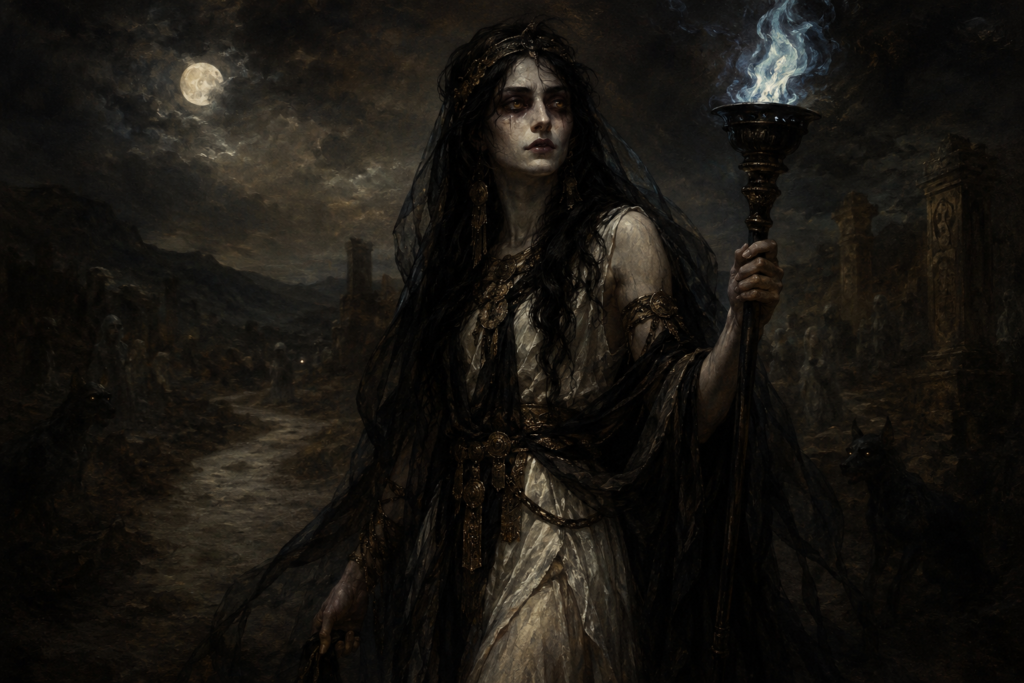
The Lampad is a CR 6 chthonic nymph whose battlefield role remains consistent across the three rules systems below: she reveals hidden spirits, disrupts mortal minds and moves rapidly through darkness, tombs and other liminal ground.
| STR | DEX | CON | INT | WIS | CHA |
|---|---|---|---|---|---|
| 10 (+0) | 18 (+4) | 16 (+3) | 13 (+1) | 16 (+3) | 18 (+4) |
Chthonic Nymph. The Lampad always knows the direction of the nearest grave, corpse, crossroads, underworld shrine or active necromantic disturbance within 1 mile, provided one exists. In graveyards, tombs, caves, crossroads and underworld-tainted ruins, she ignores nonmagical difficult terrain.
Torch of the Hidden Road. The Lampad bears a supernatural torch that produces Bright Light in a 20-foot radius and Dim Light for another 20 feet. She can suppress or restore its light without using an action and can choose which creatures perceive the flame.
Invisible Undead, incorporeal spirits, Ethereal creatures overlapping the illuminated area, magically disguised corpses and similar ghostly presences are visibly outlined while inside its Bright Light.
Cold Iron Aversion. When the Lampad takes damage from a weapon made of cold iron , she cannot use Shadow Crossing until the end of her next turn.
Underworld Witness. The Lampad has Advantage on Wisdom (Insight) checks made to detect a lie concerning death, burial, murder, grave-robbing, broken funerary oaths, the identity of a dead creature or the concealment of a corpse.
Multiattack. The Lampad makes two attacks, using Chthonic Torch or Grave-White Claw in any combination.
Chthonic Torch. Melee or Ranged Spell Attack: +7 to hit, reach 5 ft. or range 60 ft., one target. Hit: 9 (2d8) fire damage plus 9 (2d8) psychic damage. The target must succeed on a DC 15 Wisdom saving throw or be unable to take Reactions until the start of the Lampad’s next turn.
Grave-White Claw. Melee Weapon Attack: +7 to hit, reach 5 ft., one target. Hit: 8 (1d8 + 4) slashing damage plus 7 (2d6) necrotic damage.
Lantern of Unreason (Recharge 5–6). The Lampad raises her torch and momentarily opens mortal perception to the hidden road of the dead. Each creature of her choice in a 30-foot cone must make a DC 15 Wisdom saving throw.
On a failed save, a creature takes 27 (6d8) psychic damage and is overwhelmed by underworld visions until the end of its next turn. While overwhelmed, it cannot take Reactions.
At the beginning of the affected creature’s turn, roll a d6. On a 1–3 it must use as much of its movement as possible to move away from the Lampad by the safest available route. On a 4–6, if another creature is within its reach or range, it must make one weapon attack against a randomly determined eligible creature. If no such attack is possible, it can act normally except that it still cannot take Reactions.
On a successful save, the creature takes half damage and suffers no additional effect.
Spellcasting. The Lampad casts the following spells, requiring no material components. Charisma is her spellcasting ability (spell save DC 15, +7 to hit with spell attacks).
- At will: dancing lights , prestidigitation
- 3/day each: charm person , suggestion , speak with dead
- 1/day each: bestow curse , fear , hypnotic pattern
Shadow Crossing (Recharge 4–6). The Lampad teleports up to 60 feet to an unoccupied space she can see that is in Dim Light, Darkness or torchlight, or that lies within a graveyard, tomb, cave shrine or crossroads.
The Torch Turns. When a creature the Lampad can see hits her with an attack while that creature is inside her torchlight, the Lampad turns the flame toward it. The creature has Disadvantage on the next attack roll it makes before the end of its next turn.
Encounter Role: Controller and skirmisher. A Lampad is strongest where tombs, darkness, grave markers and multiple routes allow her to reposition while forcing enemies to react to her torch.
- At will: dancing lights , prestidigitation
- 3/day each: charm person , darkness , minor image , suggestion , speak with dead
- 1/day each: bestow curse , fear , hypnotic pattern
| STR | DEX | CON | INT | WIS | CHA |
|---|---|---|---|---|---|
| 10 (+0) | 19 (+4) | 16 (+3) | 14 (+2) | 17 (+3) | 21 (+5) |
Cold Iron Aversion (Su). If a Lampad takes damage from a cold iron weapon, she cannot use Shadow Crossing until the end of her next turn.
Maddening Torch (Su). A living creature struck by the Lampad’s chthonic torch must succeed on a DC 19 Will save or become confused for 1 round. A creature that succeeds on this saving throw is immune to that Lampad’s Maddening Torch for 24 hours.
This is a mind-affecting compulsion effect. The save DC is Charisma-based.
Lantern of Unreason (Su). Once every 1d4 rounds as a standard action, a Lampad may cast the full glare of her torch through a 30-foot cone. Living creatures in the area must succeed on a DC 19 Will save or become confused for 1 round and take 4d6 points of nonlethal damage from supernatural disorientation.
A successful save negates the confusion and halves the nonlethal damage. This is a mind-affecting compulsion effect. The save DC is Charisma-based.
Torch of the Hidden Road (Su). The Lampad’s torch sheds light as a normal torch unless she suppresses it. Within 20 feet of the flame, the Lampad perceives invisible undead, incorporeal spirits, nearby ethereal creatures and magically disguised corpses as faint luminous outlines.
Such creatures gain no concealment from invisibility against the Lampad while they remain in the illuminated area.
Shadow Crossing (Su). Three times per day as a move action, a Lampad may teleport up to 60 feet to a space she can see in dim light, darkness or torchlight, or to a space inside a graveyard, tomb, cave shrine or crossroads.
This otherwise functions as dimension door , except that the Lampad may act normally after arriving.
Underworld Witness (Ex). A Lampad gains a +4 racial bonus on Sense Motive checks against a creature attempting to conceal murder, grave-robbing, violation of a funerary oath, the location of a corpse or the true identity of a dead creature.
| STR | DEX | CON | INT | WIS | CHA |
|---|---|---|---|---|---|
| 10 | 19 | 16 | 14 | 17 | 21 |
A Lampad avoids straightforward melee when possible. She exposes hidden enemies and spirits, turns her torch against vulnerable minds and uses Shadow Crossing to control the battlefield. A Lampad defending a tomb or procession usually warns trespassers before attacking unless they have already violated the dead.
Cold Iron Aversion (Su). If a Lampad takes damage from a cold iron weapon, she cannot use Shadow Crossing until the end of her next turn.
Maddening Torch (Su). A living creature struck by the Lampad’s chthonic torch must succeed on a DC 19 Will save or become confused for 1 round. A creature that successfully saves is immune to that Lampad’s Maddening Torch for 24 hours.
This is a mind-affecting compulsion effect. The save DC is Charisma-based.
Lantern of Unreason (Su). Once every 1d4 rounds, the Lampad may raise her torch as a standard action, affecting living creatures in a 30-foot cone. Affected creatures must make a DC 19 Will save.
Failure causes confusion for 1 round and 4d6 points of nonlethal damage. Success negates the confusion and halves the damage. This is a mind-affecting compulsion effect. The save DC is Charisma-based.
Shadow Crossing (Su). Three times per day as a move action, the Lampad may teleport up to 60 feet to a space she can see in dim light, darkness or torchlight, or to a space within a graveyard, tomb, cave shrine or crossroads.
This otherwise functions as dimension door , except that the Lampad may act normally after arriving.
Spell-Like Abilities. Caster level 8th. Save DCs are Charisma-based.
- At will: dancing lights , prestidigitation
- 3/day each: charm person , darkness , minor image , suggestion , speak with dead
- 1/day each: bestow curse , fear , hypnotic pattern
Torch of the Hidden Road (Su). Within 20 feet of her torch, a Lampad can perceive invisible undead, incorporeal spirits, nearby ethereal creatures and magically disguised corpses as faint luminous outlines. Such creatures gain no concealment from invisibility against the Lampad while they remain within the light.
Underworld Witness (Ex). A Lampad gains a +4 racial bonus on Sense Motive checks against creatures attempting to conceal murder, grave-robbing, violation of a funerary oath, the location of a corpse or the true identity of a dead creature.
Overview
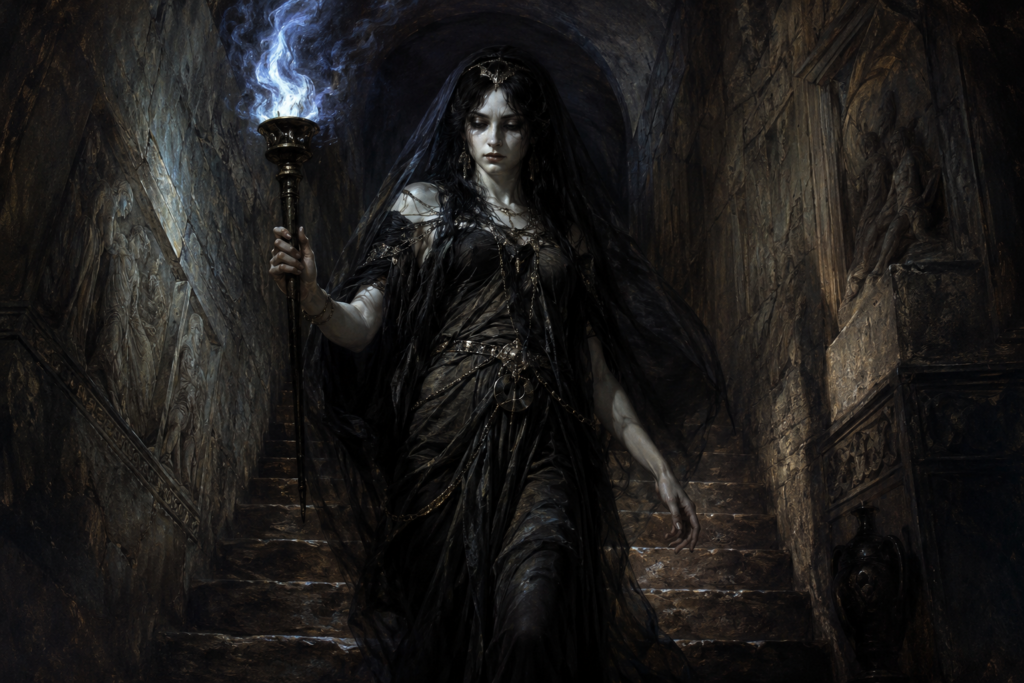
Lampades are nymphs of the Underworld, bound not to bright rivers or woodland glades but to tomb mouths, grave-roads, cavern shrines, crossroads and the nocturnal processions of Hecate .
Their supernatural office is one of passage and revelation: they illuminate roads travelled by the dead and expose what mortals have concealed along them.
A Lampad’s flame may reveal a hidden corpse, an unseen ghost , stolen grave goods, a false name carved above a tomb or an underworld road invisible in ordinary light. Those who stare too deeply into that flame may glimpse truths for which the living mind is poorly prepared.
- Underworld fey, not an ordinary woodland or water spirit.
- Closely associated with Hecate , ghosts, crossroads, tombs and torch processions.
- Not automatically evil; threshold-law and duty matter more than cruelty.
- Cold iron disrupts a Lampad’s supernatural movement and protection.
- Her torch reveals hidden spirits and turns supernatural revelation into a weapon.
- A procession is an omen or supernatural event rather than simply a wandering monster group.
Appearance
A Lampad appears as a pale, grave-beautiful nymph with long dark hair and eyes the colour of amber, wet bronze or buried flame. Her beauty is austere rather than inviting: the beauty of an ancient statue glimpsed underground by torchlight.
She may wear grave-white linen, black wool, dark veils, bronze girdles, funerary ribbons or ritual cloth darkened by smoke. Keys, grave coins, black wool cords, bone charms and small bronze bells sometimes hang from her clothing.
Every Lampad carries a torch. Its shaft may be bronze, dark iron, cypress wood or bone, while the flame burns blue-white, violet, green-gold or ember-red, sometimes with a strangely dark centre. Its light need not produce heat.
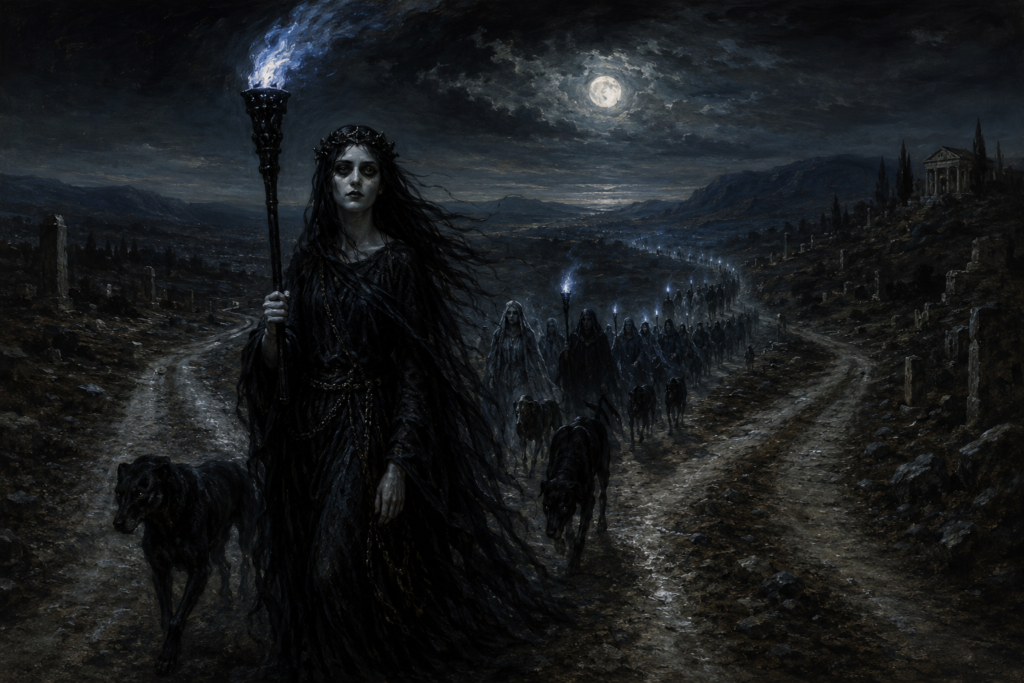
Black dogs may appear at the edge of her light, while ghosts turn instinctively toward the flame.
Combat Tactics
A Lampad does not begin a fight by rushing into melee. She first decides whether intruders are lost travellers, legitimate mourners, grave-robbers, oath-breakers or deliberate enemies of the dead. If words can resolve the trespass, she prefers them. The torch rises when warning has failed or the offence is already obvious.
Once battle begins, she controls position and judgment rather than merely trading blows. She uses Lantern of Unreason against clustered enemies, relocates with Shadow Crossing, and attacks from the edge of torchlight.
She particularly favours enemies who carry stolen grave goods, conceal a death or have become separated from their companions.
In a procession, Lampades overlap their torchlight and attack from different angles. One keeps the road open, another disrupts pursuers, and another remains close to the soul, corpse, shrine object or underworld gate the procession is protecting.
Habitat and Ecology
Lampades appear wherever traffic from the Hellenic Underworld touches mortal ground. They favour crossroads, graveyards, tomb-roads, cave shrines, old burial grounds, necropoleis, boundary stones, plague pits, battlefield graves, underground sanctuaries and ruins where ancient funerary rites remain potent.
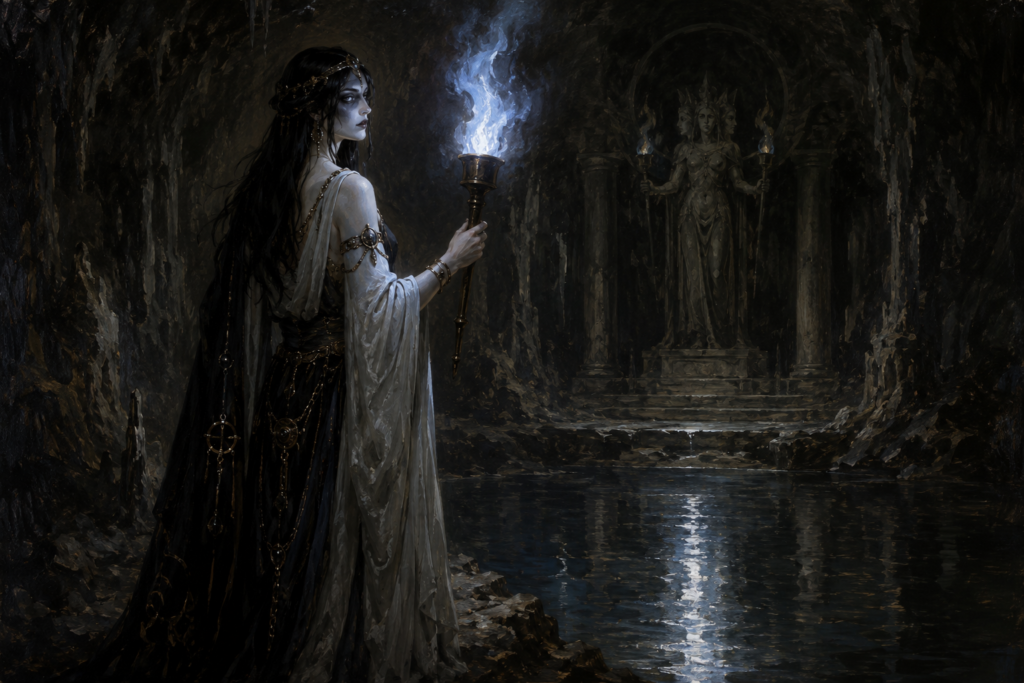
They may also appear beside cavern lakes, underground rivers or deep pools, but such waters matter because they mark underworld boundaries or passages. A Lampad is not an ordinary water nymph and does not haunt a lake merely because water is present.
A Lampad rarely maintains a lair in the ordinary sense. Instead she holds a threshold: a tomb door, cave mouth, stair, bridge, shrine gate, crossroads stone or section of grave-road over which she has accepted responsibility.
Lampades are supernatural fey rather than ordinary members of an ecosystem. They accept offerings associated with burial, crossroads rites and the honouring of the dead, but such gifts are matters of ritual obligation and relationship rather than a conventional food supply.
The Processions of Hecate
A group of Lampades is commonly called a procession. The appearance of several Lampades together should be treated as an event rather than as a random encounter.
Three Lampades walking a road after moonset may indicate that a significant soul is being escorted, an ancient tomb has been opened, an escaped spirit is being returned, or a hidden entrance to the Underworld has become active.
Nine torch-bearers may announce a rite of unusual importance or the approach of Hecate herself.
A procession may include ghosts , black dogs , mortal ritual attendants, dead initiates and other recognised servants of the Hellenic powers.
The Lampades need not explain the procession to witnesses. Often the mystery of what they are escorting is the encounter.
Behaviour
Lampades are formal, observant and unnervingly patient. They rarely waste words, but neither do they attack the living merely for approaching.
A Lampad commonly begins an encounter with a question whose significance is not immediately obvious:
- Who lies beneath the unmarked stone?
- Why was the corpse denied its name?
- Which of you carries what belongs to the dead?
- Who swore the oath that was broken here?
- Which road did you take to reach this place?
She watches the answers as carefully as she hears them. A lie involving death, burial or a broken funerary duty is far more likely to provoke her than ordinary boasting or deception.
Lampades particularly respect those who bury abandoned dead, restore desecrated tombs, return stolen offerings or ensure that a forgotten person is properly named.
They are correspondingly hostile to grave-robbers, corpse thieves, oath-breakers and those who deliberately imprison souls that should have passed onward.
Relationships
Hecate
Hecate is the Lampades’ defining divine association. They bear torches in her nocturnal retinue and serve where crossroads, ghosts, witchcraft, thresholds and the roads of the dead meet.
A Lampad need not receive a spoken command from Hecate before acting; guarding such boundaries is intrinsic to her supernatural office.
Persephone
As Queen of the Hellenic Underworld, Persephone’s authority naturally intersects with Lampad duties. Lampades may appear on roads, at rites and within sanctuaries associated with Persephone without ceasing to be identified most strongly with Hecate.
Hades
Lampades recognise the laws and sovereignty of the Hellenic Underworld. They are not merely palace servants of Hades, but the roads, gates and rites they guard exist within the greater underworld order over which he reigns.
Ghosts
The Lampad’s torch makes hidden spirits visible and helps distinguish a soul that merely lingers from one that has been deliberately trapped.
Some ghosts follow the flame willingly. Others flee because it exposes a road they have spent years refusing to take.
Black Dogs
Dark hounds are natural companions for encounters involving Hecate, crossroads and the dead. A black dog pacing silently beyond the torchlight may be the first sign that a processional road has claimed the surrounding ground.
Other Nymphs
Lampades recognise their kinship with other nymphs but belong to a distinctly chthonic sphere. Where another nymph may embody a spring, grove or sacred landscape, the Lampad embodies the charged threshold through which the living, the dead or both may pass.
Treasure and Remains
Lampades do not accumulate wealth like brigands or dragons. Objects found in their keeping normally have ritual purpose or belonged to people whose passage they oversee.
Possible finds include:
- funerary coins and burial offerings;
- bronze or iron keys whose locks are no longer obvious;
- black candles and sealed vessels of grave-oil;
- small shrine bowls and ritual cups;
- bone combs, black wool cords and silver dog charms;
- lead tablets bearing curses, names or directions;
- burial masks and fragments of funerary jewellery;
- maps of underworld roads scratched into stone, pottery or metal;
- tokens entrusted to a dead traveller and never intended for the living.
A Lampad’s extinguished torch may leave supernatural ash useful in magic involving ghosts, crossroads, confession, dream-visions or underworld passage.
A living chthonic flame taken by force normally dies outside the Lampad’s keeping, although an exceptional torch may survive as the focus of an adventure or unique magical relic.
Adventure Hooks
The Torch at the Three Roads
Every new moon a pale woman carrying a cold blue torch appears at a crossroads outside town. Travellers who follow her return with names written in ash across their skin. The local lord wants the apparition destroyed, but every name belongs to somebody buried under a false identity.
The Grave That Will Not Stay Closed
A sealed tomb opens from the inside every night although the corpse has never moved. A Lampad waits beside the coffin without harming anyone who enters. She is not guarding the dead woman. She is waiting for the living person who stole the woman’s final oath.
The Procession Beneath the Battlefield
Torchlight begins moving beneath an old battlefield and soldiers long dead can be heard singing below the earth. Several Lampades are opening a forgotten grave-road so the unburied can finally leave.
Disturbing the procession sends the dead into panic; helping it quiets the battlefield for the first time in generations.
The Missing Ninth Torch
Eight Lampades stand motionless around a cave mouth where there should be nine. The missing torch-bearer entered the mortal world while pursuing an escaped spirit and has not returned. Until she does, neither the procession nor the souls following it can continue.
The Road Beneath the Road
A Lampad offers to guide the characters through an impossible journey by taking a hidden route used by the dead. The road is much shorter than any mortal path, but the characters must obey funerary taboos while travelling it and may not answer any voice that calls them by name from beyond the torchlight.
Historical and Mythological Context
In Greek and Roman literary tradition, the Lampades are underworld nymphs identified above all by their torches and their association with Hecate . The surviving evidence is brief, so their secure ancient mythological foundation is narrower than the abilities needed for a tabletop monster.
The traditional Lampades are torch-bearing nymphs accompanying Hecate on her nocturnal movements. They are also associated with the torch-bearing world of the Eleusinian Mysteries, and broader underworld-nymph traditions connect them with Persephone as well as Hecate.
Their precise parentage is not securely stated in the surviving tradition. SpiralWorlds therefore does not impose a compulsory genealogy upon them or present later speculative parentage as established ancient myth.
The maddening supernatural power of the Lampad’s torch on this page is a SpiralWorlds game interpretation. It develops the ancient image of the chthonic torch into a distinctive monster ability rather than presenting a modern game mechanic as a claim about the surviving ancient sources.
This makes the Lampad a creature of revelation rather than a generic supernatural seductress. Her light exposes the dead, hidden crimes and roads beneath the mortal world. The resulting monster remains recognisably rooted in the torch-bearing underworld nymph while giving the Dungeon Master a clear and memorable role at the table.
Mythic Identity
- Mythic Role: Underworld torch-bearer, grave-road guide, crossroads witness and threshold guardian.
- Primary Associations: Hecate , ghosts , tombs, torches, crossroads, night processions and roads of the dead.
- Usual Alignment: Neutral.
- Native Realm: The Hellenic Underworld and mortal thresholds connected to it.
- Common Grouping: Solitary witness, pair, triad or procession.
- Encounter Theme: Something concerning the dead has been hidden, interrupted, violated or left unfinished.
Lampades are fey because they are nymphs , but they are not bright courtly fair folk.
They are chthonic fey: ritual-bound spirits associated with the boundary separating mortal roads from those travelled by the dead.
They belong to Hecate’s underworld tradition, not to the Nine Hells and not to an ordinary lake or generic fairy court. A Lampad walking through a mortal settlement should therefore be understood as an omen that an underworld matter has followed her there.
Sources and Further Reading
SpiralWorlds: Hecate · Persephone · Hades · The Realm of Hades · Nymph · Ghost · Black Dog
Mythological reference: Theoi Project — Lampades .
The expanded powers, encounter behaviour, grave-road duties and game statistics are SpiralWorlds adaptations built around the traditional torch-bearing underworld-nymph identity.
Keep this reference growing
If this page helped with your reading or game, you can support its upkeep or explore the curated books.
Explore the Bookshop — epics, classics and stories behind imagined worlds.