
 Buy me a coffee
CC Fighter, Savage Fighter Background
Savage Fighter Background
A savage fighter is a hardened warrior from a remote, untamed land, shaped by survival, instinct, and distrust of the soft structures of civilization.
Overview
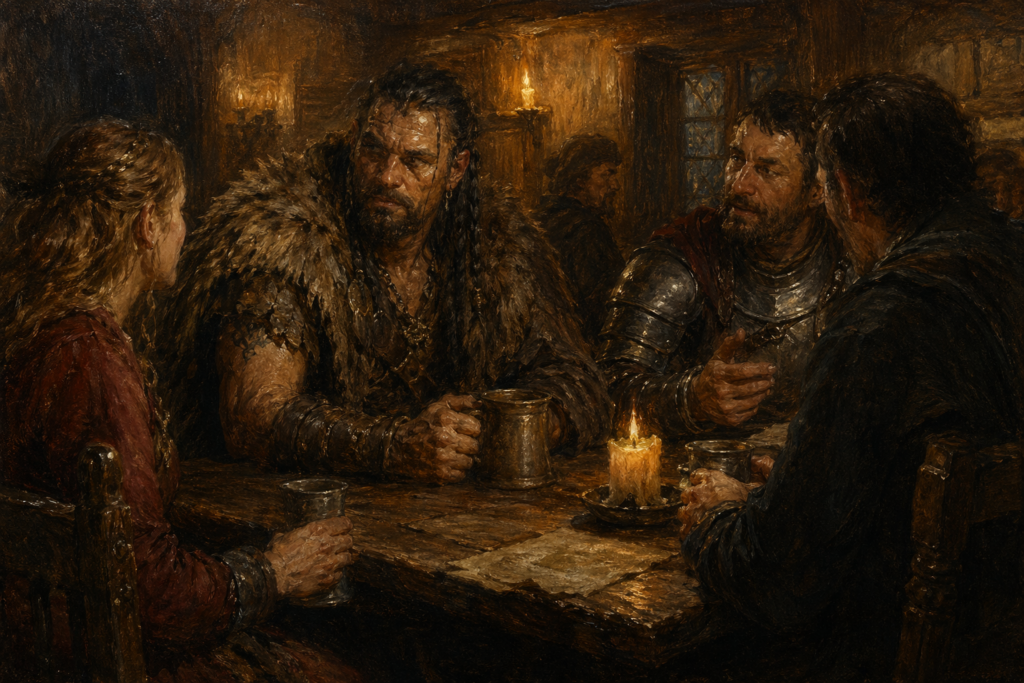
Not every fighter is forged in a training yard, noble court, or mercenary camp. Some are shaped instead by hard country, deep forest, frozen valleys, broken hills, marshland, steppe, or jungle — places where survival depends on endurance, instinct, memory, and strength rather than walls, coin, or law. The Savage comes from such a place. To settled folk, he may seem rough, alien, or uncultured. To those who travel beside him, he is something far more formidable: a hardened survivor whose judgement has been tested by hunger, weather, beasts, and death.
The Savage is not merely “from the wild.” He comes from a people or homeland so removed from urban life that many of civilization’s ordinary assumptions seem strange, fragile, or faintly absurd. Stone keeps, wheeled wagons, mills, crossbows, books, schools, guilds, contracts, coin-led trade, and studied arcane learning may all feel artificial to him. He understands the world through spoor, silence, blood, weather, danger, and need. Where other fighters trust armouries, institutions, and drilled formations, the Savage trusts the body, the senses, and the lessons of a land that kills the careless.
This background works best when it is tied to a real and living way of life. The Savage may come from mountain clans, forest hunters, marsh-folk, steppe riders, island spear-fishers, tundra survivors, jungle guardians, or the last defenders of a sacred frontier now pressed by settlers, soldiers, empire, monsters, or change. He is strongest as a character when he feels like the product of a coherent culture, not a stereotype.
Few Savages leave home by choice. Most are driven out by necessity. A monster may have ravaged their homeland. Raiders or settlers may have broken the old balance. A sacred place may have been defiled. He may be an exile, a scout, an avenger, a refugee, or simply one of the few who can still act while others cling to a dying way of life. Adventuring is rarely his dream. More often, it is what remains.
Roleplaying
The Savage does not merely dislike cities. He is unsettled by the assumptions behind them.
He may not understand why food is bought instead of hunted, why a noble claims land he has never walked, why contracts matter more than spoken oath, or why learned men trust books more than memory. He is often suspicious of studied magic, elaborate devices, mechanical weapons, and customs that place law, symbol, or ritual between a person and the truth of what stands before them.
That does not make him foolish. In many ways, the Savage is sharper than his city-born companions. He notices silence in the woods, a taint in the water, weakness in a wall, tension in a room, or the wrong kind of stillness in a ruin. He reads danger directly. He trusts what can be tested by the senses and proved through action.
His weaknesses are cultural and temperamental rather than intellectual. He may be blunt where diplomacy is needed, contemptuous where patience would serve better, or openly hostile when confronted by something he cannot fit into his own understanding of the world. He is used to surviving through personal strength, practical skill, and stubborn endurance. When these fail him, his frustration can be fierce.
A well-played Savage should feel like a true outsider with a coherent worldview, not comic relief, not a fool, and not a generic angry wild man. He brings pressure into a party because he sees the weaknesses of civilized life clearly: its softness, its dependence, its corruption, and its distance from necessity. At the same time, he must slowly decide whether the wider world contains anything worth learning, defending, or becoming.
Traits
The Savage background is defined by the following themes:
- Wilderness Survivor: You are accustomed to harsh environments, long hardship, and the practical labour of staying alive where comfort cannot be relied upon.
- Suspicion of the Unnatural: You are instinctively wary of overt magic, strange devices, constructs, and forces that seem to violate the natural order of the world you know.
- Blunt Worldview: You tend to judge people by courage, usefulness, endurance, and visible action rather than status, education, or manners.
- Hardship Tempered: Hunger, cold, exhaustion, pain, and fear are familiar to you. Discomfort alone rarely shakes your resolve.
- Outsider to Civilization: Urban customs, written law, coin-based society, guild structures, and cultivated manners are foreign ground to you.
- Sense the Unnatural: You can instinctively detect the presence of magic, but only in the crudest way. You know whether magic is present in an area, but gain no further information. You do not identify its source, school, strength, or exact nature. In the original version, this functions as Detect Magic at will, using your own character level, but only to determine whether magic is present. This is treated as an extraordinary ability rather than normal spellcasting.
This is a strong thematic feature and helps distinguish the Savage from a mere wilderness fighter.
Starting Equipment
The Savage begins with no starting money.
Instead, choose up to three of the following weapons:
- Battleaxe
- Club
- Dagger
- Greataxe
- Greatclub
- Halfspear
- Javelin
- Longspear
- Shortbow with 20 arrows
- Shortspear
- Sling
- Throwing axe
In addition, you begin with:
- Leather armour or hide armour
- A small selection of low-cost, practical, handmade, or wilderness items approved by the Game Master
The following restrictions apply:
- No starting equipment may be masterwork
- The Savage is illiterate, as a barbarian
- The Savage may not spend skill points during character creation to read and write
Character Hooks
- The Last Survivor: A monster, curse, raiding host, or supernatural horror destroyed your people’s camp, village, or sacred hunting ground. You now travel to avenge them or to survive in a world you were never meant to know.
- Driven Out by Expansion: Settlers, soldiers, miners, loggers, or nobles pushed into your homeland and broke the old balance. You left because there was nothing left to defend, or because you intend to strike back.
- Exile of the Clan: You broke a taboo, failed a duty, lost an honour-duel, or were blamed for an omen. Adventuring is not your ambition but your punishment, or your last chance to return with honour.
- Bearer of an Old Oath: You were sent beyond your homeland to recover a sacred object, slay a creature of ill omen, or learn why the outer world has begun to poison your own.
- The One Who Must Learn: Your elders knew the old life could not survive unchanged. You were sent out to study the wider world, to learn its strengths and weaknesses, and to decide whether your people must fight it, flee it, or adapt to it.
- The Unbroken Stranger: You simply do not belong in ordinary society. Yet battle, hardship, and travel make sense to you in a way settled life never will. Among adventurers, usefulness matters more than manners.
Why This Background Works
The Savage works because it creates immediate tension without requiring melodrama. He arrives in the campaign carrying a complete way of surviving, judging, and enduring, then finds himself in a world that treats that way of life as rough, backward, or expendable. That gives him pride, vulnerability, anger, and room to grow.
He also sharpens the setting around him. Cities feel stranger when seen through his eyes. Wizards seem more dangerous. Merchants seem more slippery. Taverns feel louder, softer, and more decadent. Priests, nobles, and officials must prove themselves in deeds rather than titles. A good Savage does not merely add wilderness flavour; he makes the whole campaign world feel newly visible.
Most importantly, the Savage works because his strength is not abstract. It is lived. He has been cold, hungry, hunted, wounded, and alone. He knows what survival costs. That gives weight to his actions and credibility to his judgement.
Using This Background in Your Game
Use the Savage when you want a fighter-shaped character whose strength comes from hardship rather than formal training alone. He fits naturally into campaigns about borderlands, vanishing old ways, colonized frontiers, sacred landscapes under pressure, monster-haunted wilderness, and the violent meeting of different cultures.
This background is especially strong when the character’s homeland matters. Do not leave it vague if you can help it. Give the Savage a real people, a real land, real customs, real enemies, and real losses. The more specific his origin is, the more powerful his reactions to the wider world become.
In party play, the Savage creates tension best when he is played with discipline. He should not refuse every inn, attack every wizard, or sabotage every social scene. The point is not childish rejection. The point is friction, judgement, and gradual adaptation. He should challenge the party’s assumptions, not constantly derail them.
For Game Masters, the Savage is a useful lens for showing the cost of civilization’s expansion. Through him, old shrines, broken hunting grounds, vanished peoples, and sacred places under threat become personal rather than decorative. He can also serve as the party’s truest measure of whether a place feels natural, corrupted, or wrong.
Savage Fighter Background 5.5e / 2024
Savage Fighter Background, Pathfinder 1e
Savage Fighter Background 3.0
Savage Fighter Background 5.5e / 2024
The Savage background suits characters shaped by hard living, wilderness survival, and distrust of the artificial or arcane. It works especially well for fighters, barbarians, rangers, and other martial characters whose strength comes from endurance, instinct, and relentless self-reliance.
Ability Score Suggestions: Strength, Constitution, Wisdom
Skill Proficiencies: Choose two:
- Athletics
- Intimidation
- Nature
- Perception
- Survival
Tool Proficiency: Choose one:
- Herbalism Kit
- Leatherworker’s Tools
- Woodcarver’s Tools
- Carpenter’s Tools
Equipment:
- A hunting spear, handaxe, or club
- A shortbow with 20 arrows or a sling with 20 bullets
- A hunting knife
- Traveller’s clothes or rough hide garments
- A trophy taken from a beast, rival, or homeland
- A belt pouch containing 5 GP in barter goods, crude ornaments, or unfamiliar coin
Savage Feature
Instinct for the Unnatural: You possess a raw, instinctive sensitivity to supernatural disturbance. As an action, you can sense whether there is an active magical effect, enchanted object, or supernatural presence within 30 feet of you that is not behind total cover. You learn only whether such a presence exists, not its nature, location, school, or strength. You can use this feature a number of times equal to your proficiency bonus, and you regain all expended uses when you finish a long rest.
This keeps the spirit of the original without letting the background grow too broad.
Optional Origin Feat
Wild-Blooded Instinct
- Increase your Strength, Constitution, or Wisdom by 1, to a maximum of 20.
- You gain proficiency in Survival or Perception.
- When you make a Wisdom check to notice danger, tracks, or unnatural disturbance in the environment, you can give yourself Advantage. You may do so a number of times equal to your proficiency bonus per long rest.
- As an action, you can sense the presence of magic within 30 feet, though you learn nothing more than that it is there.
Savage Fighter Background, Pathfinder 1e
The Savage fits naturally into Pathfinder as a regional, cultural, or social background for characters shaped by wilderness life and estrangement from civilized norms. It is especially suitable for barbarians, fighters, rangers, slayers, hunters, and other martial survivors.
Suggested Class Fit: Barbarian, Fighter, Ranger, Slayer, Hunter, Brawler
Suggested Skills: Climb, Handle Animal, Intimidate, Knowledge (nature), Perception, Survival, Swim
Literacy: The Savage begins illiterate unless literacy is granted by class, house rule, or specific campaign background.
Starting Wealth: Instead of normal starting wealth, the Savage begins with:
- Leather armour or hide armour
- Any three weapons from the approved Savage list
- A small number of low-value wilderness items approved by the GM
No starting gear may be masterwork.
Savage Special Ability
Sense the Unnatural (Ex): A Savage can detect the presence of magic by instinct rather than study. He may use this ability at will as a standard action. It functions similarly to detect magic, using the Savage’s character level as the caster level, except that it reveals only whether magic is present within the area. It does not reveal the number of magical auras, their location, their strength, or their school. This is an extraordinary ability.
This remains close to the source material and preserves the background’s distinctive identity.
Optional Pathfinder Trait Version
Savage Instinct: You gain a +1 trait bonus on Survival checks and Perception checks made in natural environments. In addition, once per day, you may sense whether magic is present within 30 feet, but gain no further information.
Savage Fighter Background 3.0
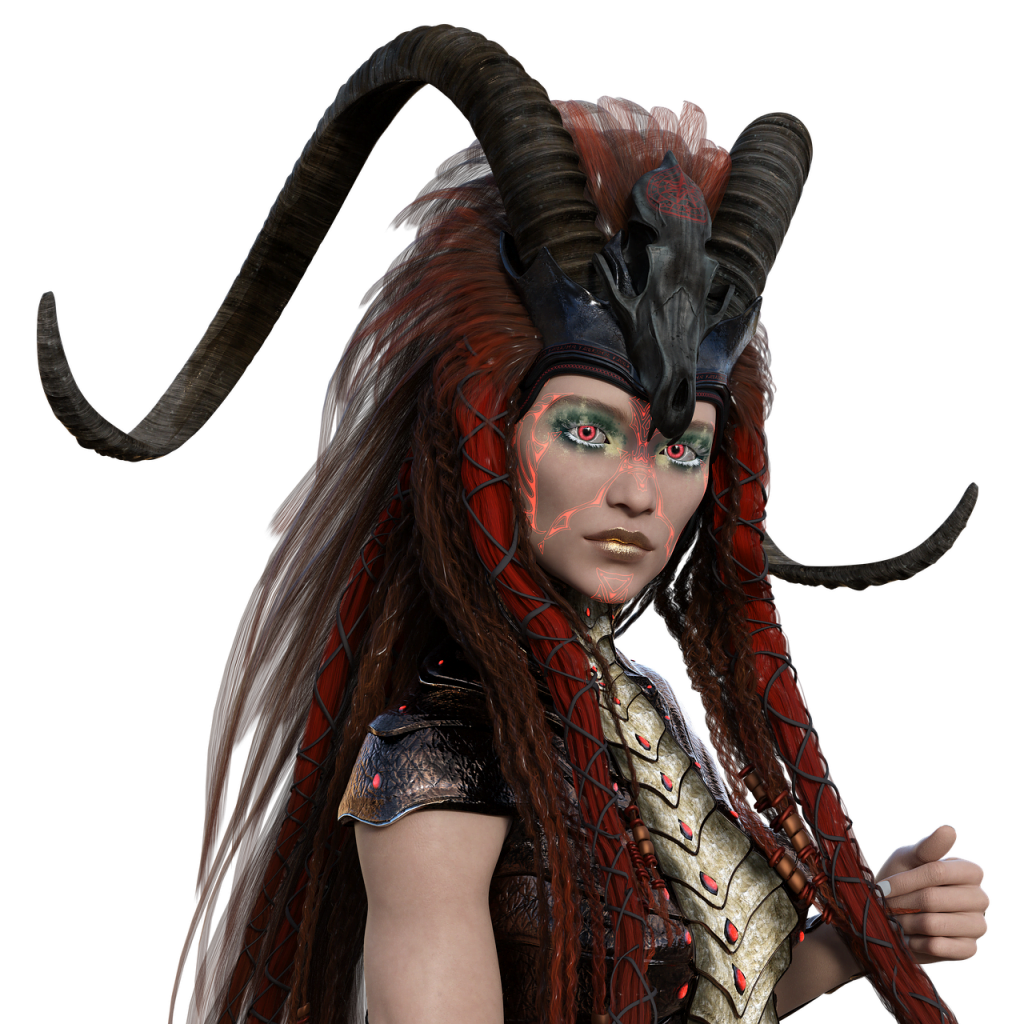
Often mistaken for a tribesman by those who know no better, the savage comes from a primitive land that the corruption of civilization has never touched.
The Quintessential Fighter
Author Matthew Sprange
Publisher Mongoose Publishing
Publish date 2002
Whereas the tribesman is fully aware of the great cities and may even trade with them, the savage has never even seen a stone building, a horse-drawn wagon or a mechanical weapon such as the crossbow. However, he is a tremendous fighter, having survived by his own wits and Strength, rather than layers of metal armour and powerful weapons. The savage is very much in tune with his surroundings and can overcome the greatest adversities in the deep wilderness where other fighters may stumble and fail.
Adventuring: Few savages choose to leave their homes by choice. They may be forced out by a terrible creature that slays all in its path, or may face the encroachment of civilisation upon their way of life. Forced to confront the outside world, the savage fits in nowhere within normal society and many naturally gravitate towards the life of an adventurer, where they will find other, though very different, outcasts and misfits. An adventuring party benefits from the savage’s indomitable will and strength in battle, whilst the savage himself can begin to live within civilisation, having a circle of close friends to shield him from its worst excesses.
Role-Playing: The savage has no understanding of civilisation and the way it works. He believes in only what he sees and will never have come across any kind of mechanical device, a book, or organised and studied magic. He is extremely suspicious of anything new that does not fit into his well-defined world view and is likely to vent his unease through hostility. for his entire life, the savage has been able to depend on nothing more than himself and his own skills.
When these prove insufficient, his frustration can be enormous. He is also likely to spurn anything he considers unnatural – this will likely include mechanical weapons, magic and warm beds within noisy taverns. Only after a great deal of exposure to such things may he slowly come to accept them.
Bonuses: The savage is deeply suspicious of anything beyond his own experience and can often sense when he is in the presence of anything unnatural. He may use Detect Magic (at his own character level) at will, though he will only ever be able to determine that magic is present within any given area – he may not gain any more detailed information than this. This is an extraordinary ability.
Personalities: The savage does not begin with any starting money at all. Instead he may pick up to three of the following; Battleaxe, club, Dagger, Greataxe, Greatclub, halfspear, javelin, longspear, shortbow and 20 arrows, shortspear, sling and throwing axe. In addition, he is equipped with leather or hide armour and may have a variety of low cost and primitive items permitted by the Game Master. No equipment may be masterworked. The savage is also illiterate, as the barbarian, but may not spend skill points in order to be able to read and write during character creation.