
Huecuva — The Faithless Dead
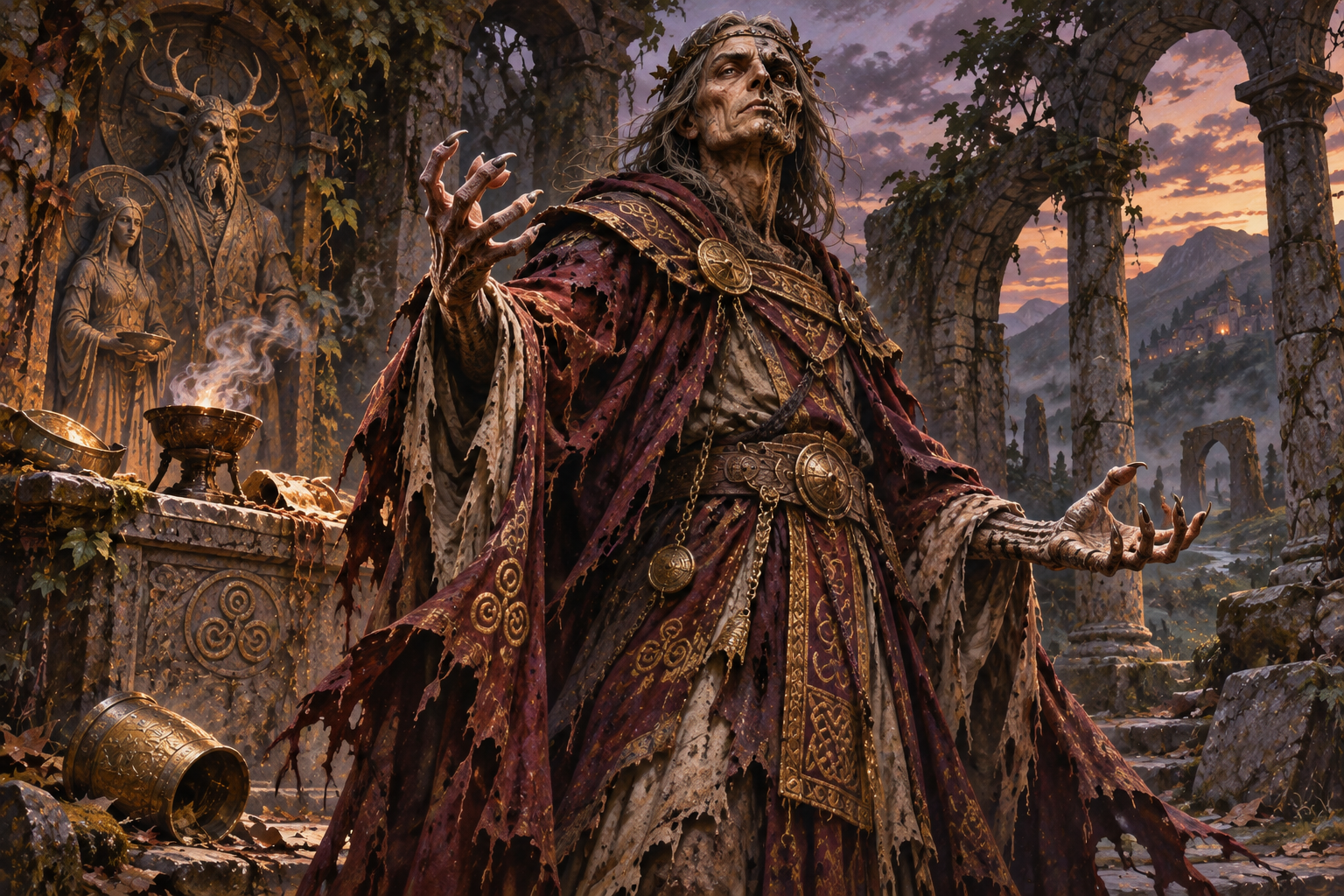
At noon, the traveller looks every inch a temple keeper. He knows the proper prayers, bows before the old images, and offers to show the visitors the reliquary. Only the smell is wrong: a trace of grave dust follows him through the sunlit passage. When evening reaches the shrine, his borrowed face folds away. Beneath the vestments stands a corpse with blackened claws and a mouth opened in a scream that has no breath behind it.
At a Glance
| Creature | Huecuva (also called Heucuva) — the faithless dead |
|---|---|
| Nature | Medium Chaotic Evil Undead; a fallen priest or a sacred corpse corrupted after burial |
| Appearance | Frail, shrivelled body wearing decayed ceremonial vestments; appears deceptively alive by daylight |
| Origin | A priest whose betrayals made a curse possible, or the remains of an innocent divine servant violated by powerful necromancy |
| Haunts | Abandoned sanctuaries, forgotten temple vaults, looted shrines, ruined monasteries and plague graves |
| Temperament | Cunning but damaged in mind, with particular malice towards the faithful |
| Threats | Filth fever, daylight disguise, claws and an aura shielding other Undead against sacred power |
| Counterplay | Learn whose corpse has been used, identify the false priest by its smell, and employ silver, magic or consecrated rites |
| In the World | 1454 CE: the dead may still walk the shrines whose gods and priests they betrayed |
A Huecuva does not arise because a god has stopped existing or because faith itself is false. The gods of Midgard are real, and the creature is an example of the consequences of a divine covenant betrayed or deliberately profaned. A priest who served a god sincerely may be cursed after death by another power; a priest who willingly sold the shrine’s secrets may have fashioned the conditions of his own damnation. In either case the thing that emerges is hostile and Undead. It does not prove its former owner was evil.
During the day the creature bears a convincing semblance of the person who once occupied its body. After sunset that illusion fails, exposing the desiccated flesh and funerary cloth. This is not the wandering grief of a Ghost or the mindlessness of an ordinary Zombie. The Huecuva has enough memory to recognise the shrine’s doors, rituals and old enemies, but not enough wisdom to conceal every mistake.
Huecuva Statistics
Huecuva — D&D 2024
Medium Undead, Chaotic Evil · CR 2 (450 XP; PB +2) · Original conversion
AC 14 (grave-hardened hide); Initiative +2 (12); HP 39 (6d8+12); Speed 30 ft.
| STR | DEX | CON | INT | WIS | CHA |
|---|---|---|---|---|---|
| 13 (+1) | 14 (+2) | 14 (+2) | 4 (−3) | 12 (+1) | 12 (+1) |
Skills Deception +3, Perception +3, Stealth +4; Damage Resistances Necrotic and Bludgeoning, Piercing and Slashing damage from nonmagical, non-silvered attacks; Damage Immunities Poison; Condition Immunities Charmed, Exhaustion, Frightened, Poisoned; Senses Darkvision 60 ft., Passive Perception 13; Languages understands the languages known in life, but can speak only through False Humanity.
Traits
Aura of Faithlessness. The Huecuva and friendly Undead within 30 ft. of it have Advantage on Wisdom saving throws against effects that Turn Undead and on saving throws against effects that deal Radiant damage. A creature cannot benefit from more than one Huecuva’s aura at a time.
False Humanity. From dawn until sunset the Huecuva is surrounded by an illusion that reproduces the sight, voice and physical appearance it possessed in life, as if by Disguise Self. A creature that closely interacts with it can use an Action to make a DC 12 Intelligence (Investigation) check and recognise the deception. Its scent is unaffected: anyone standing within 5 ft. can notice grave dust and corruption with a DC 12 Wisdom (Perception) check. The illusion disappears at sunset and does not return until dawn.
Undead Nature. The Huecuva requires no air, food, drink or sleep. Its intellect is damaged and its speech is halting, but it obeys no master merely by being Undead.
Actions
Multiattack. The Huecuva makes two Diseased Claw attacks.
Diseased Claw. Melee Attack Roll +4, reach 5 ft., one target. Hit: 6 (1d6+2) Slashing damage plus 3 (1d6) Necrotic damage. A living target makes a DC 12 Constitution Saving Throw or contracts Filth Fever.
Desecrating Cry (Recharge 5–6). Each living creature of the Huecuva’s choice within 15 ft. that can hear it must make a DC 12 Wisdom Saving Throw. On failure, it takes 7 (2d6) Psychic damage and has the Frightened condition until the end of its next turn. On success, it takes half damage and suffers no condition.
Disease: Filth Fever
A living creature infected by the claws feels no illness until 1d3 days later. At the end of each Long Rest after symptoms begin it must make a DC 12 Constitution Saving Throw. Failure gives the Poisoned condition until the end of its next Long Rest and one level of Exhaustion. Two consecutive successes cure the disease; Lesser Restoration or another disease-curing effect ends it immediately. Exhaustion already gained remains until recovered by the normal rules.
Variants
Desecrated Innocent. A Huecuva animated from the body of a faithful priest is just as malevolent in undeath, but the living priest’s actions and divine standing are unchanged. Its Aura of Faithlessness extends to 60 ft. rather than 30 ft., and its body bears a ritual brand left by its necromantic creator. This variant does not automatically change CR.
Original D&D 2024 CR 2 interpretation, not a published Monster Manual stat block. Abilities are defined here without requiring a template or older edition.
Huecuva — D&D 2014
Medium Undead, Chaotic Evil · CR 2 (450 XP) · Original conversion
AC 14 (grave-hardened hide); HP 39 (6d8+12); Speed 30 ft.
| STR | DEX | CON | INT | WIS | CHA |
|---|---|---|---|---|---|
| 13 (+1) | 14 (+2) | 14 (+2) | 4 (−3) | 12 (+1) | 12 (+1) |
Skills Deception +3, Perception +3, Stealth +4; Damage Resistances Necrotic and Bludgeoning, Piercing and Slashing damage from nonmagical, non-silvered attacks; Damage Immunities Poison; Condition Immunities Charmed, Exhaustion, Frightened, Poisoned; Senses Darkvision 60 ft., Passive Perception 13; Languages understands the languages known in life, but can speak only through False Humanity.
Traits
Aura of Faithlessness. The Huecuva and friendly Undead within 30 ft. of it have Advantage on Wisdom saving throws against effects that Turn Undead and on saving throws against effects that deal Radiant damage. A creature cannot benefit from more than one Huecuva’s aura at a time.
False Humanity. From dawn until sunset the Huecuva is surrounded by an illusion that reproduces the sight, voice and physical appearance it possessed in life, as if by Disguise Self. A creature that closely interacts with it can use an Action to make a DC 12 Intelligence (Investigation) check and recognise the deception. Its scent is unaffected: anyone standing within 5 ft. can notice grave dust and corruption with a DC 12 Wisdom (Perception) check. The illusion disappears at sunset and does not return until dawn.
Undead Nature. The Huecuva requires no air, food, drink or sleep. Its intellect is damaged and its speech is halting, but it obeys no master merely by being Undead.
Actions
Multiattack. The Huecuva makes two Diseased Claw attacks.
Diseased Claw. Melee Weapon Attack +4, reach 5 ft., one target. Hit: 6 (1d6+2) Slashing damage plus 3 (1d6) Necrotic damage. A living target makes a DC 12 Constitution saving throw or contracts Filth Fever.
Desecrating Cry (Recharge 5–6). Each living creature of the Huecuva’s choice within 15 ft. that can hear it must make a DC 12 Wisdom saving throw. On failure, it takes 7 (2d6) Psychic damage and has the Frightened condition until the end of its next turn. On success, it takes half damage and suffers no condition.
Disease: Filth Fever
A living creature infected by the claws becomes ill after 1d3 days. At the end of each Long Rest during the illness it makes a DC 12 Constitution saving throw. On failure its Strength and Dexterity scores each decrease by 1d4 (to a minimum of 1). Two consecutive successes cure the disease and restore the scores over its next Long Rest. Lesser Restoration or another disease-curing spell ends the infection and restores the reductions immediately.
Variants
Desecrated Innocent. A Huecuva animated from the body of a faithful priest is just as malevolent in undeath, but the living priest’s actions and divine standing are unchanged. Its Aura of Faithlessness extends to 60 ft. rather than 30 ft., and its body bears a ritual brand left by its necromantic creator. This variant does not automatically change CR.
Original D&D 2014 CR 2 interpretation, not a published Monster Manual stat block. Abilities are defined here without requiring a template or older edition.
Huecuva — Pathfinder 1e
CE Medium Undead · CR 2 (600 XP) · Published Bestiary 3
Initiative +6; Senses Darkvision 60 ft., Perception +5; Aura Faithlessness (30 ft.).
AC 15, touch 12, flat-footed 13 (+2 Dex, +3 Natural); HP 16 (3d8+3); Fort +2, Ref +3, Will +4; DR 5/Magic or Silver; Immune Undead traits.
Speed 30 ft.; Melee 2 Claws +4 (1d4+1 plus Disease); Special Abilities Faithlessness, False Humanity, Filth Fever.
| STR | DEX | CON | INT | WIS | CHA |
|---|---|---|---|---|---|
| 13 (+1) | 14 (+2) | — | 4 (−3) | 12 (+1) | 12 (+1) |
BAB +2; CMB +3; CMD 15; Feats Improved Initiative, Weapon Focus (Claw); Skills Perception +5, Stealth +7; Languages one language known in life; Environment any; Organisation solitary, pair, cloister (3–10); Treasure standard.
Special Abilities
Aura of Faithlessness (Su). The Huecuva and any Undead within 30 ft. gain a +2 Profane bonus on Will saves made to resist Channeled Energy and Positive Energy effects.
Disease (Ex). Filth Fever: injury; Fort DC 12; onset 1d3 days; frequency 1/day; effect 1d3 Dexterity damage and 1d3 Strength damage; cure two consecutive saves. This is the Bestiary 3 Huecuva’s printed version: ordinary Filth Fever elsewhere uses Constitution damage rather than Strength damage. Use the explicitly printed monster ability here, or the campaign’s standard Filth Fever consistently, not an unannounced blend.
False Humanity (Su). During daylight the Huecuva appears as the living person it once was, as Disguise Self. A creature interacting directly with it may attempt a DC 12 Will save to perceive the truth. The illusion never hides the corpse’s faint grave-dust stench; a creature with Scent gains +4 on that Will save. At night the illusion ends even if the Huecuva does not know that night has fallen.
Creating Huecuvas. An 11th-level or higher spellcaster can use Create Undead on the corpse of an evil cleric to create one. A nonevil cleric’s body can also be desecrated this way but requires a DC 20 Caster Level check. Such a violation is an especially vile crime, and the Huecuva formed from a good cleric gains a +4 Profane bonus from its Faithlessness Aura rather than +2 when resisting the listed energy effects.
Pathfinder Roleplaying Game Bestiary 3 — Huecuva, © 2011 Paizo Publishing, LLC, with the original Bonus Bestiary from 2009. The published Strength-damage discrepancy is retained explicitly.
Huecuva — D&D 3.5e
Always Chaotic Evil · Medium Undead · CR 7 · Huecuva 5th-level Cleric example (Fiend Folio)
HD 5d12+3 (35 HP); Initiative −1; Speed 30 ft. (20 ft. in Full Plate); AC 23 (−1 Dex, +4 Natural, +8 Full Plate, +2 Large Steel Shield), touch 9, flat-footed 23; BAB/Grapple +2/+4; Fort +5, Ref +3, Will +9; DR 10/Silver; Turn Resistance +2; Darkvision 60 ft.
| STR | DEX | CON | INT | WIS | CHA |
|---|---|---|---|---|---|
| 15 (+2) | 9 (−1) | — | 4 (−3) | 19 (+4) | 14 (+2) |
Attack Slam +5 Melee (1d6+2 plus Huecuva Blight) or Masterwork Morningstar +6 Melee (1d8+2); Full Attack one Slam or one Morningstar; Special Attacks Huecuva Blight, Rebuke Undead 5/day, Cleric Spells; Feats Brew Potion, Lightning Reflexes, Scribe Scroll, Toughness; Skills Concentration +8, Knowledge (Religion) +4, Spellcraft +4; Possessions Full Plate, Large Steel Shield, Morningstar, crossbow and minor potions and scrolls.
Special Abilities
Huecuva Blight (Ex). Injury on a Slam: Fort DC 14; incubation 1 day; each day thereafter the victim takes 1d2 Strength and 1d2 Constitution damage on failure. Two consecutive successful Fortitude saves or Remove Disease end the infection.
Rebuke Undead (Su). The Huecuva can rebuke or command Undead as an evil 5th-level Cleric five times per day. Its former holy vows have become profane obedience to the power that animates it.
Cleric Spellcasting. Casts as a 5th-level evil Cleric (save DC 14 + spell level; prepared spells per day 5/5/4/3 including domain spells). Typical spells prepared: 0 — Detect Magic, Guidance, Resistance, Virtue, Cure Minor Wounds; 1st — Bane, Bless, Cause Fear (domain), Command, Sanctuary; 2nd — Bull’s Strength, Desecrate (domain), Hold Person, Spiritual Weapon; 3rd — Animate Dead (domain), Bestow Curse, Invisibility Purge. Domains Death (Death Touch 1/day) and Evil (+1 caster level for Evil spells).
Undead Traits. The Huecuva has no Constitution score, does not breathe, and is immune to mind-affecting effects, Poison, Sleep, Paralysis and Stunning, as well as effects covered by the Undead type. Healing and positive energy affect it according to Undead rules.
Huecuva Template
The original Huecuva is an acquired template for a Humanoid with at least one level in Cleric, Druid, Paladin or Monk. Its Type changes to Undead; Natural Armour improves by +4; Turn Resistance +2; Strength +2, Wisdom +2, Charisma +2, Intelligence −6 (minimum 1), Constitution becomes —; and the creature gains a Slam attack, Huecuva Blight, Toughness, DR 10/Silver and an adjustment of +2 to the base creature’s CR. Divine powers of fallen Clerics convert to the Death and Evil domains and Rebuke Undead. The full template, not a fixed CR 2 monster, governs other character levels.
Published Huecuva template and 5th-level Cleric example: Fiend Folio (2003), p. 94, originally 3.0 and used with the 3.5 update. These older rules are not interchangeable with the Pathfinder CR 2 example; the CR 7 sample is preserved separately.
What Is Happening Right Now?
The last keeper of a hill shrine has been seen walking its court again, though the village buried him a generation ago. He wears the same gold clasp and offers prayers that every elder remembers. By day he distributes healing herbs to passing travellers. At dusk the doors close, the clasp turns green with corrosion, and the dead in the old burial yard begin to stir. A village girl says the keeper has not looked at the shrine’s god once since he returned.
Why the Dead Priest Returns
The dead may rise from a holy place for two very different reasons. Some priests turn against their sworn gods while living. They steal offerings, betray supplicants, call hostile powers into the sanctuary or try to make the deity’s worship serve their own hunger. Such a priest may die unrepentant, and the curse that returns it to the world draws strength from the breach between oath and deed.
But a faithful priest may have been killed and its body desecrated by an enemy. The soul of the dead can remain innocent even when the returned corpse is twisted into something evil. A necromancer may take the body as an act of insult to the god or to the living community, forcing the hands that once gave healing to spread disease. A company that learns the difference can expose the actual wrongdoer instead of condemning the priest whose face they see.
The Huecuva’s intellect is poor but not absent. It remembers the best-hidden doors of its sanctuary and the people it hated, though not always their names. Its False Humanity allows it to approach pilgrims, offer blessings and invite strangers into the narrow rooms beneath the temple. At night it reveals a throat too dry to speak and hands sharp enough to break skin.
Under the Daylight Veil
Someone who knew the priest in life may notice the strangest things. It repeats the same greeting each day, forgets that a loved one has died, or offers a blessing in words no longer used at the shrine. The smell of grave dust does not vanish in sunlight. A faithful hound may refuse to enter the room where the keeper sits, and the oldest shrine servant may be able to recognise the dead by its gait before the veil fails.
When the sun sets the illusion disappears in an instant. The corpse remains dangerous in daylight, but darkness removes its greatest protection: the belief that it is still a living priest. The monster may retreat to the sanctuary where the graveyard’s other Undead gather, then return at dawn wearing the same apparently familiar face.
The Aura of Faithlessness
The Huecuva’s curse reaches beyond its own body. Skeletons and other lesser dead within its presence resist sacred power more readily, because the shrine’s old wards have been inverted. A party that expects ordinary Skeletons or Zombies may discover that a priest’s turning fails where it succeeded elsewhere. The Huecuva itself may be hidden behind an altar or beneath a sacristy stair, defending the dead until it is found and destroyed.
It is often wise to separate the faithless corpse from its followers. A Ghoul fights for food; a Huecuva seeks those who still believe in the vows it discarded. Even its disease is an insult to the acts of healing it once performed.
Signs of the False Keeper
- A funeral name is spoken by a man who ought to have been buried beneath the sanctuary
- The scent of earth and decay follows a priest whose vestments appear newly washed
- Sacred wards fall silent when Undead are brought within thirty paces of the old altar
- Claw-shaped wounds on a traveller fester days after leaving the shrine
- The keeper refuses to meet anyone after sunset, although his room is lit
- A reliquary is found empty, and the blessing over its door has been recited backwards
Encounters
The Pilgrim’s Blessing. Travellers shelter at a shrine whose keeper appears alive at noon. A young pilgrim knows that her grandparents buried him. When she attempts to warn the others, the Huecuva asks her to carry a sealed vessel into the cemetery, where lesser dead are gathering.
The Innocent’s Bones. The body of a beloved healer has been raised and made into a Huecuva. The villagers blame the healer for the illness spreading through the sanctuary. The heroes can find the necromancer’s ritual brand beneath the robes, recover the remains and clear the priest’s name.
The Cloister of Nine. A ruined hill monastery is inhabited by a cloister of Huecuvas. Each wears the daylight face of a former priest and knows a different part of the place’s history. Their faithlessness shields other Undead beneath the crypt, and the company must identify the one that maintains the unholy ward.
The Desecration Rite
An evil necromancer seeking this creature may turn to Create Undead. The act is not justified by the target’s former religious disputes: the raising of an innocent priest as an instrument of plague is a deliberate profanation. A Cleric of the offended deity may be sent to recover the remains. Remove Disease can save a living victim, while Remove Curse may help break the bindings around the grave, but destroying the Huecuva does not automatically reveal the guilty necromancer.
Laying the Shrine to Rest
The shrine’s rightful god is still present in the world and may receive prayers from its surviving worshippers. The heroes can return stolen offerings, burn the corrupted shroud, consecrate the ground and restore the name of the dead keeper to its records. If the creature came from a corrupted soul, the rite marks the end of the curse. If it came from an innocent body’s violation, the ritual serves as an apology to the living and to the departed priest, while judgment falls on the necromancer who committed the act.
Related Creatures and Sources
The creature’s campaign language is chosen from those the fallen temple keeper knew in life rather than assuming a universal spoken Common. Older printed stat blocks may specify Common; their rules remain attributed below.
The Ghoul carries hunger and paralysis; the Revenant is driven by a different unfinished purpose; the Shadow can inhabit a desecrated sanctuary without retaining its former vocation. The Huecuva is instead the blasphemed or betraying religious dead, dangerous because it remembers the practice of faith well enough to turn it against the living.
Rules and licensing. The Pathfinder 1e creature is the Huecuva from Pathfinder Bestiary 3 (2011), also published in the Bonus Bestiary (2009). The older Cleric-based Huecuva is from Fiend Folio (2003), p. 94, with a 3.5 update. The D&D 2024 and 2014 versions above are original conversions, not official Monster Manual stat blocks. The separate published versions have different CRs, disease details and divine abilities; their mechanics should never be silently merged.
Return to the Undead Bestiary.
Full Open Game License 1.0a and Section 15 notices
OPEN GAME LICENSE Version 1.0a
The following text is the property of Wizards of the Coast, Inc. and is Copyright 2000 Wizards of the Coast, Inc (“Wizards”). All Rights Reserved.
1. Definitions: (a)”Contributors” means the copyright and/or trademark owners who have contributed Open Game Content; (b)”Derivative Material” means copyrighted material including derivative works and translations (including into other computer languages), potation, modification, correction, addition, extension, upgrade, improvement, compilation, abridgment or other form in which an existing work may be recast, transformed or adapted; (c) “Distribute” means to reproduce, license, rent, lease, sell, broadcast, publicly display, transmit or otherwise distribute; (d)”Open Game Content” means the game mechanic and includes the methods, procedures, processes and routines to the extent such content does not embody the Product Identity and is an enhancement over the prior art and any additional content clearly identified as Open Game Content by the Contributor, and means any work covered by this License, including translations and derivative works under copyright law, but specifically excludes Product Identity. (e) “Product Identity” means product and product line names, logos and identifying marks including trade dress; artifacts; creatures characters; stories, storylines, plots, thematic elements, dialogue, incidents, language, artwork, symbols, designs, depictions, likenesses, formats, poses, concepts, themes and graphic, photographic and other visual or audio representations; names and descriptions of characters, spells, enchantments, personalities, teams, personas, likenesses and special abilities; places, locations, environments, creatures, equipment, magical or supernatural abilities or effects, logos, symbols, or graphic designs; and any other trademark or registered trademark clearly identified as Product identity by the owner of the Product Identity, and which specifically excludes the Open Game Content; (f) “Trademark” means the logos, names, mark, sign, motto, designs that are used by a Contributor to identify itself or its products or the associated products contributed to the Open Game License by the Contributor (g) “Use”, “Used” or “Using” means to use, Distribute, copy, edit, format, modify, translate and otherwise create Derivative Material of Open Game Content. (h) “You” or “Your” means the licensee in terms of this agreement.
2. The License: This License applies to any Open Game Content that contains a notice indicating that the Open Game Content may only be Used under and in terms of this License. You must affix such a notice to any Open Game Content that you Use. No terms may be added to or subtracted from this License except as described by the License itself. No other terms or conditions may be applied to any Open Game Content distributed using this License.
3. Offer and Acceptance: By Using the Open Game Content You indicate Your acceptance of the terms of this License.
4. Grant and Consideration: In consideration for agreeing to use this License, the Contributors grant You a perpetual, worldwide, royalty-free, non-exclusive license with the exact terms of this License to Use, the Open Game Content.
5. Representation of Authority to Contribute: If You are contributing original material as Open Game Content, You represent that Your Contributions are Your original creation and/or You have sufficient rights to grant the rights conveyed by this License.
6. Notice of License Copyright: You must update the COPYRIGHT NOTICE portion of this License to include the exact text of the COPYRIGHT NOTICE of any Open Game Content You are copying, modifying or distributing, and You must add the title, the copyright date, and the copyright holder’s name to the COPYRIGHT NOTICE of any original Open Game Content you Distribute.
7. Use of Product Identity: You agree not to Use any Product Identity, including as an indication as to compatibility, except as expressly licensed in another, independent Agreement with the owner of each element of that Product Identity. You agree not to indicate compatibility or co-adaptability with any Trademark or Registered Trademark in conjunction with a work containing Open Game Content except as expressly licensed in another, independent Agreement with the owner of such Trademark or Registered Trademark. The use of any Product Identity in Open Game Content does not constitute a challenge to the ownership of that Product Identity. The owner of any Product Identity used in Open Game Content shall retain all rights, title and interest in and to that Product Identity.
8. Identification: If you distribute Open Game Content You must clearly indicate which portions of the work that you are distributing are Open Game Content.
9. Updating the License: Wizards or its designated Agents may publish updated versions of this License. You may use any authorized version of this License to copy, modify and distribute any Open Game Content originally distributed under any version of this License.
10. Copy of this License: You MUST include a copy of this License with every copy of the Open Game Content You Distribute.
11. Use of Contributor Credits: You may not market or advertise the Open Game Content using the name of any Contributor unless You have written permission from the Contributor to do so.
12. Inability to Comply: If it is impossible for You to comply with any of the terms of this License with respect to some or all of the Open Game Content due to statute, judicial order, or governmental regulation then You may not Use any Open Game Material so affected.
13. Termination: This License will terminate automatically if You fail to comply with all terms herein and fail to cure such breach within 30 days of becoming aware of the breach. All sublicenses shall survive the termination of this License.
14. Reformation: If any provision of this License is held to be unenforceable, such provision shall be reformed only to the extent necessary to make it enforceable.
15. COPYRIGHT NOTICE
Open Game License v 1.0a Copyright 2000, Wizards of the Coast, Inc.
System Reference Document Copyright 2000–2003, Wizards of the Coast, Inc.; Authors Jonathan Tweet, Monte Cook, Skip Williams, Rich Baker, Andy Collins, David Noonan, Rich Redman, Bruce R. Cordell, John D. Rateliff, Thomas Reid and James Wyatt, based on original material by E. Gary Gygax and Dave Arneson.
Pathfinder Roleplaying Game Bestiary 3 Copyright 2011, Paizo Publishing, LLC; Authors Jesse Benner, Jason Bulmahn, Adam Daigle, James Jacobs, Michael Kenway, Rob McCreary, Patrick Renie, Chris Sims, F. Wesley Schneider, James L. Sutter and Russ Taylor, based on material by Jonathan Tweet, Monte Cook and Skip Williams.
Pathfinder Roleplaying Game: Bonus Bestiary Copyright 2009, Paizo Publishing, LLC; Author Jason Bulmahn.
Fiend Folio Copyright 2003, Wizards of the Coast, Inc. is separately credited as a non-OGL source for the 3.5-era example and is not declared Open Game Content by this notice.
Keep this reference growing
If this page helped with your reading or game, you can support its upkeep or explore the curated books.
Explore the Bookshop — epics, classics and stories behind imagined worlds.