
Glabrezu Demon – Corrupt Bargain Fiend
A glabrezu does not ask what a soul is worth; it asks what the soul wants badly enough to betray itself.
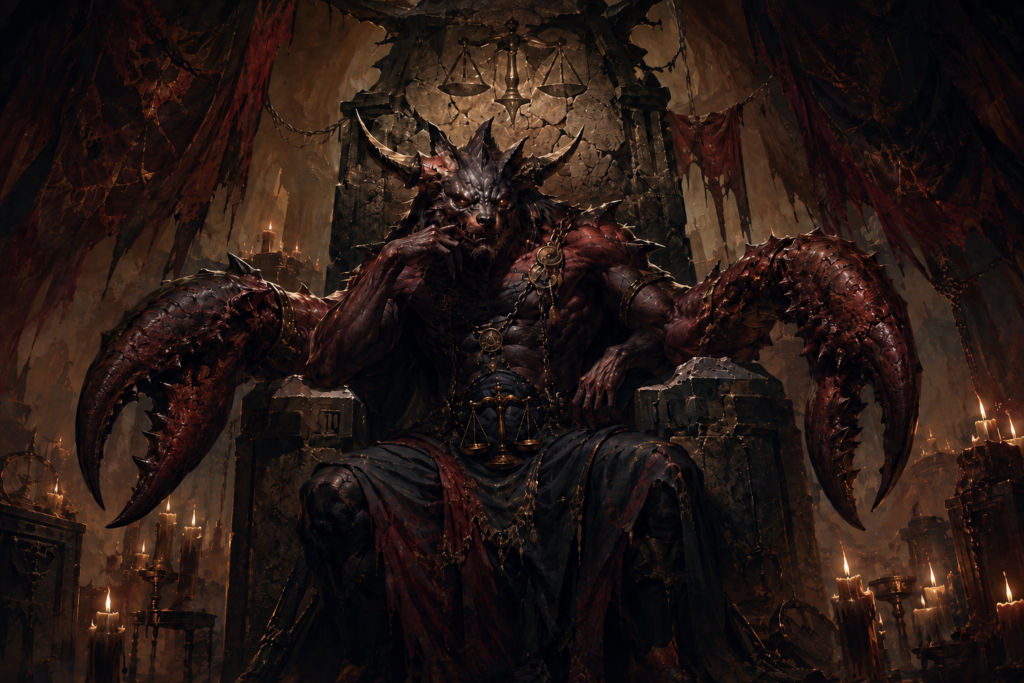
A glabrezu is a towering demon of corrupt bargains, monstrous violence, and deliberate ruin. It is not merely a brute with claws. It studies hunger, shame, ambition, inheritance disputes, forbidden love, court politics, failed faith, and desperate grief, then offers the one gift that will make everything worse.
Where lesser demons slaughter, a glabrezu bargains first. It promises a throne to the overlooked heir, vengeance to the humiliated knight, wealth to the bankrupt lord, forbidden spellcraft to the frustrated mage, fertility to a dying bloodline, victory to a besieged commander, or absolution to someone who has already done something unforgivable.
The glabrezu rarely needs to lie plainly. It lets the mortal name the desire, then arranges the world so that desire destroys kin, oath, law, reputation, and soul.
Overview
The glabrezu is a high demon of temptation, treachery, and ruinous desire. In battle, it is a huge four-armed horror with crushing pincers, smaller manipulative hands, spell-like deception, and a mind clever enough to exploit hesitation. In society, it is a whispered patron of broken dynasties, murderous succession plots, cursed inheritances, false miracles, and bargains made in locked rooms.
A glabrezu should feel different from a balor, marilith, vrock, or hezrou. It is not a commander of open infernal war, not a plague-stinking beast, and not a mere battlefield demon. It belongs in stories where someone important wants something too badly.
Its arrival should make players ask: who invited it, what did it promise, and what has already been paid?
Appearance
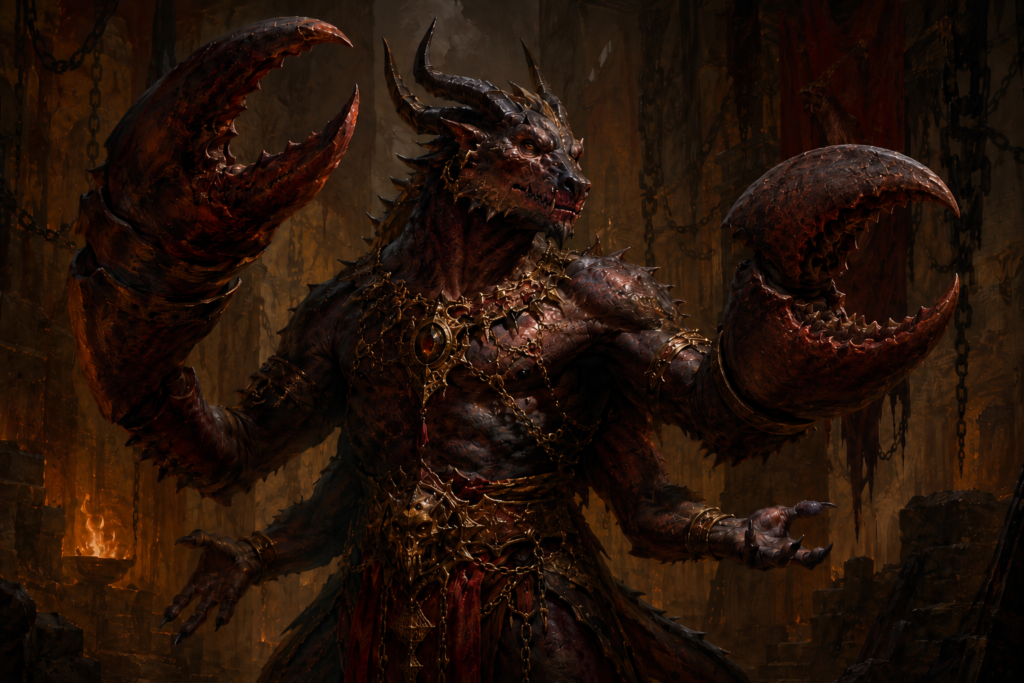
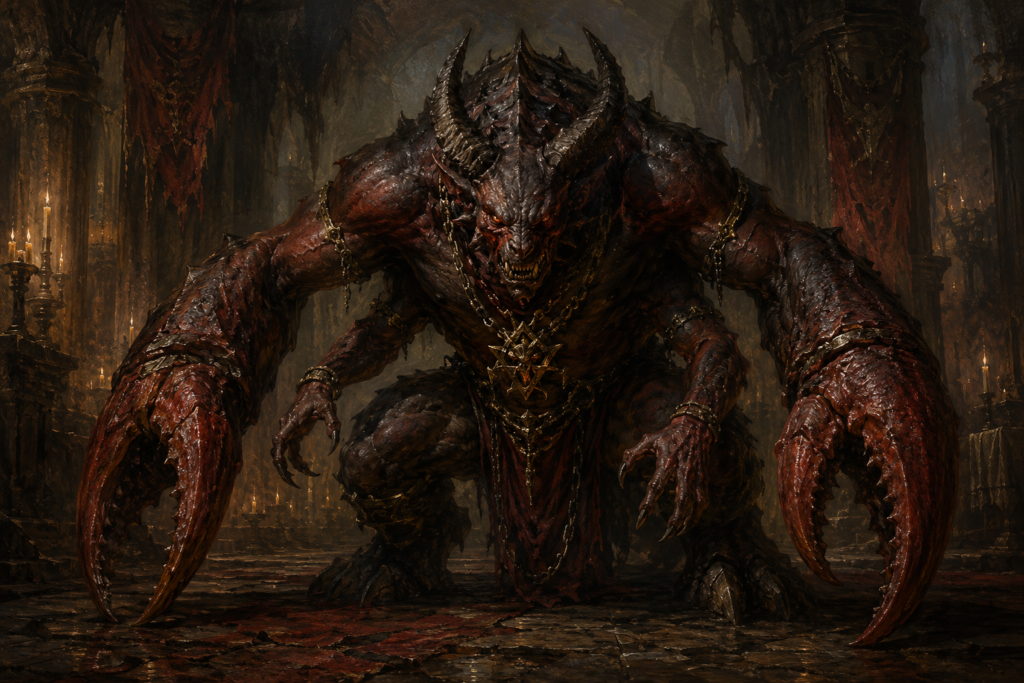
A glabrezu stands as a massive, hunched, four-armed demon, combining the weight of an ogre, the posture of a predatory ape, and the cold intelligence of a court assassin. Its upper limbs end in enormous crab-like pincers capable of crushing armour, shields, doors, and bodies. Beneath them, a second pair of smaller humanoid arms emerges from the torso, suited to writing contracts, turning keys, lifting goblets, opening reliquaries, or placing a hand gently on the shoulder of the damned.
Its head is bestial and horned, often doglike or lupine, with deep-set eyes that burn with patient violet, ember-red, or corpse-blue intelligence. Its skin may be dark red, black, bruised purple, or smoky iron-grey. It smells of hot copper, incense ash, old blood, and the air after lightning strikes stone.
The smaller hands are important. They make the monster worse. They allow it to gesture like a priest, write like a lawyer, touch like a confidant, and murder like a demon.
Habitat
Glabrezus are native to the Abyss and appear where mortal desire has already weakened the boundary between prudence and damnation. They are drawn to:
- noble courts with disputed succession;
- wizard towers where forbidden research has stalled;
- plague-struck towns praying for impossible cures;
- mercenary camps before a doomed campaign;
- prisons, torture chambers, and execution yards;
- ruined temples where old vows were broken;
- treasure vaults, inheritance halls, and sealed family crypts;
- crossroads where desperate bargains have been made before.
They rarely appear first as obvious invaders. A glabrezu prefers to be summoned, invited, inherited through a pact, released from an object, or bound beneath a legal-looking bargain.
Ecology
A glabrezu does not feed only on flesh. It feeds on moral collapse. It delights in the moment when a mortal freely chooses the first unforgivable act and then needs the demon to help conceal it.
In the Abyss, glabrezus occupy the middle ground between raw violence and courtly corruption. They are strong enough to dominate lesser demons and intelligent enough to avoid becoming expendable soldiers for greater ones. They may serve demon princes, abyssal cults, or their own long schemes, but their loyalty is always conditional.
On the mortal plane, a glabrezu may remain hidden for months or years behind a patron, relic, family curse, sealed mirror, talking statue, ancestral sin, corrupted miracle, or impossible legal judgement. Its visible manifestation is often late in the story. By the time the characters see the demon clearly, several people may already be compromised.
Behaviour
A glabrezu is patient by demonic standards. It listens. It flatters. It offers options. It lets the victim believe they remain in control.
It prefers bargains that create continuing corruption rather than single acts of destruction. A murdered rival is useful. A murdered rival whose death must be concealed, blamed on an innocent party, justified through forged law, and protected through further killings is far better.
A glabrezu wants dependency. It wants the victim to return, ask again, defend the first bargain, silence witnesses, and eventually become unable to imagine life without the demon’s help.
It speaks as if everything is negotiation. Even in combat, it offers terms.
Mechanics Tabs
The rules below are mechanics compatible for different game editions.
Glabrezu 5.5e / 2024
Glabrezu Pathfinder 1e / 3.5e
Glabrezu 5e
Glabrezu Pathfinder
Glabrezu 5.5e / 2024-Compatible Version
Glabrezu
Huge Fiend (Demon), Chaotic Evil
Armor Class 17
Initiative +2
Hit Points 189 (18d12 + 72)
Speed 40 ft.
| STR | DEX | CON | INT | WIS | CHA |
|---|---|---|---|---|---|
| 22 (+6) | 14 (+2) | 19 (+4) | 16 (+3) | 17 (+3) | 18 (+4) |
Saving Throws Str +11, Con +9, Wis +8, Cha +9
Skills Deception +9, Insight +8, Intimidation +9, Perception +8, Persuasion +9
Damage Resistances cold, fire, lightning; bludgeoning, piercing, and slashing from nonmagical attacks
Damage Immunities poison
Condition Immunities poisoned
Senses truesight 120 ft., passive Perception 18
Languages Abyssal, telepathy 120 ft.
Challenge 13 (10,000 XP)
Proficiency Bonus +5
Traits
Demonic Restoration. If the glabrezu dies outside the Abyss, its body collapses into foul smoke, black ichor, and chitinous fragments. Its essence reforms in the Abyss unless prevented by powerful magic, divine judgement, or campaign-specific planar law.
Magic Resistance. The glabrezu has Advantage on saving throws against spells and other magical effects.
Siege Claws. The glabrezu deals double damage to objects and structures with its Pincer attacks.
Tempter’s Appraisal. The glabrezu has Advantage on Wisdom (Insight) checks made to determine what a creature wants, fears, envies, or regrets.
Two Crushing Pincers. Each of the glabrezu’s pincers can grapple one creature. While grappling a creature with a pincer, that pincer cannot attack a different target.
Actions
Multiattack. The glabrezu makes two Pincer attacks and two Fist attacks. It can replace one Fist attack with Deceptive Spellcasting.
Pincer. Melee Weapon Attack: +11 to hit, reach 10 ft., one target. Hit: 17 (2d10 + 6) bludgeoning damage. If the target is Huge or smaller, it is Grappled (escape DC 17). Until the grapple ends, the target is Restrained.
Fist. Melee Weapon Attack: +11 to hit, reach 5 ft., one target. Hit: 11 (2d4 + 6) bludgeoning damage.
Bite. Melee Weapon Attack: +11 to hit, reach 5 ft., one target. Hit: 15 (2d8 + 6) piercing damage plus 7 (2d6) necrotic damage.
Deceptive Spellcasting. The glabrezu casts one of the following spells, requiring no material components and using Charisma as the spellcasting ability, spell save DC 17:
At will: darkness, detect magic, dispel magic
3/day each: confusion, fly, major image
1/day each: power word stun, reverse gravity
Offer Ruinous Bargain. One creature within 60 feet that can hear and understand the glabrezu must make a DC 17 Wisdom saving throw. On a failed save, the creature is Charmed by the glabrezu for 1 minute. While Charmed in this way, the creature believes the glabrezu can help it achieve one urgent desire, though it is not forced to obey suicidal commands. The creature repeats the saving throw whenever it takes damage from the glabrezu or its allies, ending the effect on itself on a success. A creature that succeeds is immune to this glabrezu’s Offer Ruinous Bargain for 24 hours.
This is not mindless domination. The glabrezu cannot make a creature want something alien to itself. It magnifies what is already there.
Bonus Actions
Crush the Promised. The glabrezu deals 13 (2d6 + 6) bludgeoning damage to one creature it is grappling.
Optional Reaction
Name the Price. When a creature within 60 feet that can hear and understand the glabrezu fails a d20 Test, the glabrezu offers immediate aid. If the creature accepts, it rerolls the d20 and must use the new roll. Until the creature finishes a Long Rest, it has Disadvantage on the next saving throw it makes against the glabrezu’s charm, illusion, or bargain effects.
Use this reaction when you want the glabrezu’s corrupt bargain identity to matter mechanically during combat or negotiation. Omit it for a simpler fight.
Notes
A glabrezu should not hand out unrestricted wishes as casual encounter treasure. If wish-granting or wish-like fulfilment is used, make it a story bargain rather than a normal combat action. The granted desire should be real, costly, and corrupting.
The glabrezu’s bargain abilities should not remove player agency. They should sharpen existing desire, fear, pride, resentment, or desperation. A character who accepts a bargain should feel tempted by something that already matters to them.
Glabrezu 5e
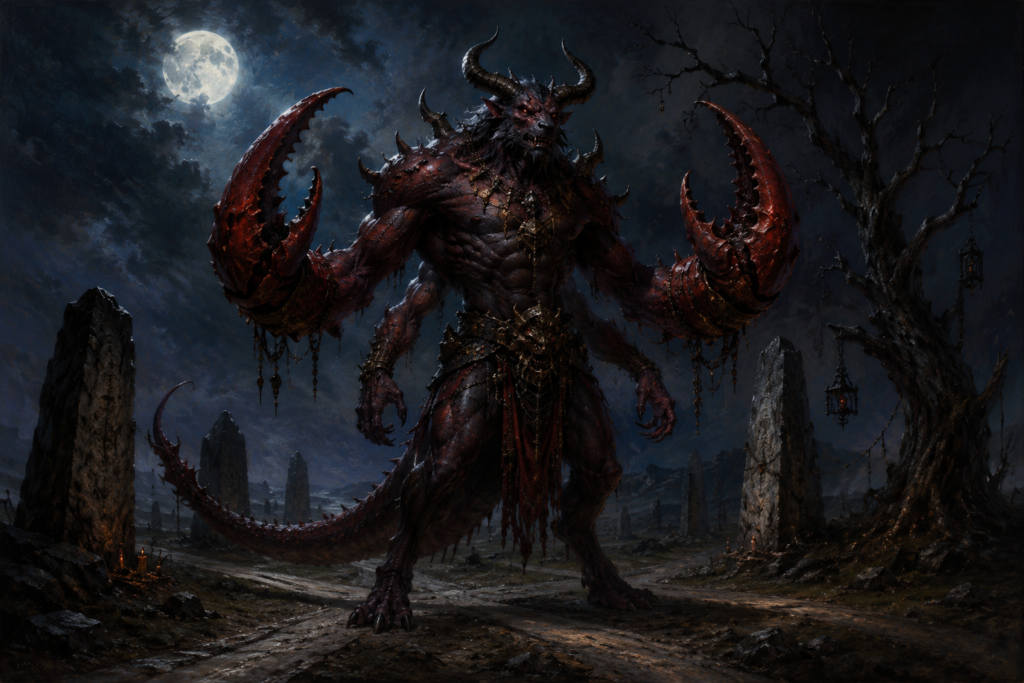
Four arms grace the torso of this towering monstrosity. The monster’s eyes shine with a mix of intelligence and cruelty.
Family: Demons
Large fiend (demon), chaotic evil
Armor Class 17 (natural armor)
Hit Points 157 (15d10 + 75)
Speed 40 ft.
| STR | DEX | CON | INT | WIS | CHA |
|---|---|---|---|---|---|
| 20 (+5) | 15 (+2) | 21 (+5) | 19 (+4) | 17 (+3) | 16 (+3) |
Saving Throws Str +9, Con +9, Wis +7, Cha +7
Damage Resistances cold, fire, lightning; bludgeoning, piercing, and slashing from nonmagical attacks
Damage Immunities poison
Condition Immunities poisoned
Senses truesight 120 ft., passive Perception 13
Languages Abyssal, telepathy 120 ft.
Challenge 9 (5,000 XP)
Special Traits
- Innate Spellcasting: The glabrezu’s spellcasting ability is Intelligence (spell save DC 16). The glabrezu can innately cast the following spells, requiring no material components:
- At will: darkness, detect magic, dispel magic
- 1/day each: confusion, fly, power word stun
- Magic Resistance: The glabrezu has advantage on saving throws against spells and other magical effects.
Actions
- Multiattack: The glabrezu makes four attacks: two with its pincers and two with its fists. Alternatively, it makes two attacks with its pincers and casts one spell.
- Pincer: Melee Weapon Attack: +9 to hit, reach 10 ft., one target. Hit: 16 (2d10 + 5) bludgeoning damage. If the target is a medium or smaller creature, it is grappled (escape DC 15). The glabrezu has two pincers, each of which can grapple only one target.
- Fist: Melee Weapon Attack: +9 to hit, reach 5 ft., one target. Hit: 7 (2d4 + 2) bludgeoning damage.
Glabrezu Pathfinder
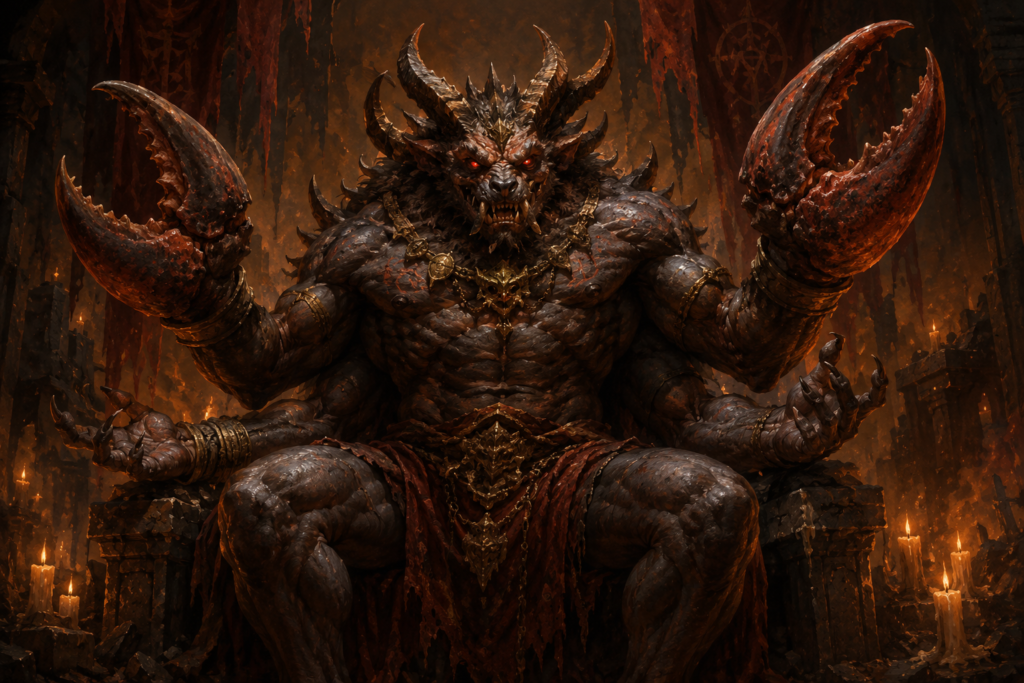
Four arms grace the torso of this towering monstrosity. The monster’s eyes shine with a mix of intelligence and cruelty.
Whereas the succubus is a demon that works her wiles by exploiting the physical lusts and needs of her prey, the glabrezu is a tempter of a different sort. Ferocious and bestial in form, the glabrezu is in fact a master of trickery and lies. With its ability to cloak its true form in pleasant illusions, the glabrezu uses its magic to grant wishes to mortal humanoids as a method of rewarding those who succumb to its guile and deceit. A wish granted by a glabrezu always fulfills the wisher’s need in the most destructive way possible—although such methods might not be immediately apparent. A struggling weaponsmith might wish for fame and skill at his craft, only to find that his best patron is a cruel and sadistic murderer who uses the weapons to further his destructive desires. A lonely man who wishes for a companion might have his wish granted in the form of a lost love returned to “life” as a vampire, and so on—the glabrezu is nothing if not creative in addressing a mortal’s desires.
A glabrezu stands 18 feet tall and weighs just over 6,000 pounds. These treacherous demons form from the souls of the treasonous, the false, and the subversive—souls of mortals who, in life, bore false witness or used treachery and deceit to ruin the lives of others.
Glabrezu CR 13
XP 25,600
CE Huge outsider (chaotic, demon, evil, extraplanar)
Init +0; Senses darkvision 60 ft., true seeing; Perception +26
DEFENSE
AC 28, touch 8, flat-footed 28 (+20 natural, –2 size)
hp 186 (12d10+120)
Fort +18, Ref +4, Will +11
DR 10/good; Immune electricity, poison; Resist acid 10, cold 10, fire 10; SR 24
OFFENSE
Speed 40 ft.
Melee 2 pincers +20 (2d8+10/19–20), 2 claws +20 (1d6+10), bite +20 (1d8+10)
Space 15 ft.; Reach 15 ft.
Special Attacks rend (2 pincers, 2d8+15)
Spell-Like Abilities (CL 14th)
Constant—true seeing
At will—chaos hammer (DC 19), confusion (DC 19), dispel magic, mirror image, reverse gravity (DC 22), greater teleport (self plus 50 lbs. of objects only), veil (self only), unholy blight
1/day—power word stun, summon (level 4, 1 glabrezu 20% or 1d2 vrocks 50%)
1/month—wish (granted to a mortal humanoid only)
STATISTICS
Str 31, Dex 11, Con 31, Int 16, Wis 16, Cha 20
Base Atk +12; CMB +24; CMD 34
Feats Cleave, Great Cleave, Improved Critical (pincer), Persuasive, Power Attack, Vital Strike
Skills Bluff +28, Diplomacy +22, Intimidate +22, Knowledge (history) +18, Knowledge (local) +18, Perception +26, Sense Motive +18, Stealth +7, Use Magic Device +17; Racial Modifiers +8 Bluff, +8 Perception
Languages Abyssal, Celestial, Draconic; telepathy 100 ft.
ECOLOGY
Environment any (Abyss)
Organization solitary or troop (1 glabrezu, 1 succubus, and 2–5 vrocks)
Treasure standard
Treacherous Wishcraft
Source PCS:DR
When a glabrezu grants a wish to a mortal, the glabrezu can grant the wish to the mortal without fulfilling it in the most destructive way possible. By granting the mortal the wish in this manner, the glabrezu can also cause one of the following effects to automatically affect the wisher (no save).
- Curse: The wisher becomes affected by the effects of bestow curse, heightened to 9th level.
- Mark of Treachery: The wisher gains a mark of treachery somewhere on her body. This mark appears as a fist-sized tattoo that combines the seven-pointed spiral of the sign of the Abyss and the glabrezu’s name (not its true name) written in Abyssal in a circle within the sign. This mark can only be removed by a miracle or wish, and only then if the caster makes a DC 30 caster level check. As long as the wisher is marked, the glabrezu can observe the world through the marked person’s senses and can communicate telepathically with her. At any point thereafter, the glabrezu can demand a service of the marked person—this allows the glabrezu to affect that person with a geas/quest to carry out the service if the person agrees to do the service.Agreeing to this causes the mark to fade. If the marked person refuses, she is immediately affected by a destruction spell (CL 14th, DC 22) and the glabrezu can demand the service again 1 round later. A mark of treachery persists through death and any resurrections that follow.
- Psychosis: The wisher immediately becomes chaotic evil and gains psychosis.
GLABREZU LORE
Originally posted by Eric Cagle
Evandar_TAybara of the Wizards Community forums.
Characters with ranks in Knowledge (The planes) can learn more about glabrezus. When a character makes a successful skill check, the following lore is revealed, including the lore from the lower DCs.
| Knowledge (The planes) | |
| DC | Result |
| 17 | This reveals the HD, tanar’ri traits, and special qualities of the glabrezu. |
| 22 | Glabrezus are terrible demons that corrupt mortals with enticements of wealth and power. |
| 27 | Glabrezus prefer subterfuge and deceit over fighting, especially if they have little to gain from outright conflict. |
| 32 | Glabrezus are capable of granting a single wish to a mortal. If that wish is not used to cause incalculable suffering to something or someone, then the Glabrezu demands terrible evil or tremendous sacrifice in payment. |
Section 15: Copyright Notice
Pathfinder RPG Bestiary. Copyright 2009, Paizo Publishing, LLC; Author: Jason Bulmahn, based on material by Jonathan Tweet, Monte Cook, and Skip Williams.
Glabrezu Pathfinder 1e / 3.5e-Compatible Version
Glabrezu CR 13
XP 25,600
CE Huge outsider (chaotic, demon, evil, extraplanar)
Init +2; Senses darkvision 60 ft., true seeing; Perception +26
Defense
AC 28, touch 10, flat-footed 26
hp 186 (12d10 + 120)
Fort +18, Ref +10, Will +13
DR 10/good; Immune electricity, poison; Resist acid 10, cold 10, fire 10
SR 24
Offense
Speed 40 ft.
Melee 2 pincers +23 (2d8+10 plus grab), 2 claws +18 (1d8+5), bite +18 (1d8+5)
Space 15 ft.; Reach 15 ft.
Special Attacks crushing pincers, ruinous bargain, sneak bargain
Spell-Like Abilities CL 14th; concentration +20
Constant—true seeing
At will—chaos hammer, confusion, darkness, detect magic, dispel magic, mirror image, reverse gravity, teleport self plus carried objects only
3/day—power word stun
1/month—wish for a mortal creature only, subject to GM adjudication and demonic corruption
Statistics
Str 31, Dex 14, Con 31, Int 16, Wis 20, Cha 23
Base Atk +12; CMB +24 (+28 grapple); CMD 36
Feats Combat Casting, Improved Initiative, Iron Will, Persuasive, Power Attack, Vital Strike
Skills Bluff +25, Diplomacy +21, Intimidate +25, Knowledge (planes) +18, Perception +26, Sense Motive +20, Spellcraft +18, Stealth +9, Use Magic Device +21
Languages Abyssal, Celestial, Draconic; telepathy 100 ft.
Ecology
Environment any Abyssal realm or mortal site of temptation
Organization solitary, conspiracy with 1–4 cult agents, or court corruption with dominated or willing servants
Treasure double standard
Special Abilities
Crushing Pincers (Ex). A glabrezu that begins its turn grappling a creature with a pincer deals pincer damage automatically as part of maintaining the grapple. Each pincer can grapple only one creature at a time.
Ruinous Bargain (Su). As a standard action, a glabrezu may offer a bargain to one intelligent creature within 60 feet that can hear and understand it. The creature must succeed at a DC 22 Will save or become fascinated for 1 round and take a –2 penalty on saves against the glabrezu’s enchantment and illusion effects for 24 hours. This is a mind-affecting compulsion effect. The save DC is Charisma-based.
Sneak Bargain (Su). Once per day, when a creature knowingly accepts a benefit from the glabrezu, such as information, release from a grapple, escape from danger, or magical aid, the glabrezu may place a demonic mark on that creature. For 24 hours, the glabrezu gains a +4 profane bonus on Bluff, Diplomacy, Intimidate, and Sense Motive checks against that creature.
Notes
The Pathfinder 1e / 3.5e-compatible glabrezu should preserve two things: physical brutality and corrupt temptation. Its pincers make it dangerous in melee, but its spell-like abilities and wish-like bargain identity are what separate it from a generic Huge demon.
The monthly wish should be handled as a story tool, not a free reward. It should fulfil the wording, expose the desire, and create consequences. A glabrezu should grant what was asked for in a way that makes the asker responsible for what follows.
Glabrezu Bargains
| d6 | Desire Offered | Hidden Price |
|---|---|---|
| 1 | A crown, title, office, or inheritance | A rightful claimant must be disgraced, exiled, or killed. |
| 2 | A cure for plague, infertility, madness, or wasting sickness | Another household must quietly provide the death, grief, or corruption that balances the gift. |
| 3 | Revenge against a guilty enemy | The revenge must also destroy someone innocent, making justice impossible to separate from murder. |
| 4 | Forbidden spellcraft or completed research | The first successful use harms a student, loved one, patron, or witness. |
| 5 | Wealth, debt relief, or restored estates | The money comes from tombs, stolen dowries, murdered creditors, or ruined heirs. |
| 6 | Love, loyalty, or public admiration | Consent, memory, truth, or reputation is altered, leaving the recipient loved for a lie. |
Combat Tactics
A glabrezu should fight like a tempter who happens to be a siege engine.
It opens with control, confusion, darkness, isolation, or magical misdirection where possible. It tries to separate the morally vulnerable from the physically dangerous. It targets the healer, oath-bound knight, ambitious mage, frightened noble, or character with a secret.
In melee, it uses its pincers to seize and crush one or two targets while its smaller arms cast, gesture, manipulate objects, open doors, drag hostages, or display proof of a bargain. It likes fighting in rooms where furniture, pillars, chains, balconies, curtains, altars, or treasure create obstacles.
A glabrezu does not always fight to the death. If badly wounded, it offers a bargain: life for betrayal, treasure for silence, a secret for escape, or a favour that will become a future adventure problem.
Combat Personality
A glabrezu should talk during battle. It should name things the characters want. It should mock ideals with precise evidence. It should offer practical benefits. It should sound intelligent, cruel, and almost reasonable.
Good glabrezu combat lines:
- “You came here because someone lied. I can tell you who.”
- “Kill him now and I will give you the name of the traitor.”
- “Your oath is already broken. I merely noticed first.”
- “I do not need your soul. I need your permission.”
- “Ask. Just ask. That is all damnation ever requires.”
Do Not Run It As
Do not run a glabrezu as a random clawed demon in an empty room. If a glabrezu appears, someone nearby should already have wanted something, accepted something, hidden something, betrayed something, or become tempted to do so.
The monster’s strength matters, but its identity is the bargain. A glabrezu encounter should leave evidence: a contract, a false miracle, a compromised noble, a murdered heir, a rewritten confession, a spell that should not work, or a victim who insists the demon has been fair.
Adventure Hooks
The Prince Who Won Too Quickly
A young ruler defeats three rivals in a single winter with impossible luck. Assassins miss, armies arrive late, witnesses die, and sealed letters appear exactly when needed. The court praises divine favour. In truth, a glabrezu has been advising the prince through a bronze mirror inherited from his mother’s line.
The Cure Beneath the Abbey
A plague village survives after the abbot makes a midnight bargain. The sick recover, but each saved household quietly sends one unwanted person into the crypts. The abbot claims it is quarantine. The glabrezu beneath the abbey calls it balance.
The Widow’s Inheritance
A noble widow suddenly gains legal documents proving her claim to several estates. Every document is perfect. Every witness remembers signing. Every seal is genuine. The only flaw is that the dead former owners have begun clawing their way out of the family cemetery.
The Wizard’s Finished Spell
A failed archmage completes a legendary spell overnight. The formula works, but each casting rewrites one past betrayal so that it was always justified. Former friends become enemies. Old crimes become lawful. The glabrezu does not guard the spellbook. It waits beside it, smiling.
The Knight Who Asked for Justice
A disgraced knight bargains for proof that his lord framed him. He receives the proof, then uses it to begin a private war. The glabrezu has not lied. The knight was innocent. That does not make what follows clean.
How a Glabrezu Enters Play
Use the glabrezu’s bargain before revealing the demon. Good signs include:
- a desperate person suddenly becoming calm, successful, and evasive;
- a legal dispute resolving too perfectly;
- a ruler gaining power while losing all old friendships;
- witnesses insisting they changed their minds freely;
- a miracle saving one life while making another life disposable;
- contracts surviving fire, water, knives, and denial;
- dogs refusing to enter the room where the bargain was made;
- a victim saying, “It never forced me.”
The glabrezu should create investigation, temptation, and combat. If it only appears as a clawed brute in a room, it loses much of its danger.
Treasure
A glabrezu’s treasure should look like the remains of bargains, not a random hoard.
Use double standard treasure for Pathfinder-style play or a major fiendish relic hoard for 5.5e-style play. Good treasure includes:
- sealed contracts written in mortal blood;
- noble signet rings from extinct houses;
- a crown that appears legitimate only to those who desire rule;
- spellbooks finished in a second handwriting;
- black pearls, rubies, and coins stamped with dead rulers;
- a bronze mirror through which the glabrezu once advised a court;
- Abyssal legal tablets;
- a key to a prison, vault, or soul-bound reliquary;
- jewellery belonging to victims who “got what they wanted”;
- one powerful magic item that is useful but morally stained.
Example Treasure Parcel
A glabrezu’s hidden chamber contains 8,000 gp in mixed coin and gemstones, a ruby-studded ducal coronet worth 5,000 gp, a bronze mirror of Abyssal communication, three sealed noble confessions, a +2 weapon once used in a betrayal, a scroll of plane shift, and a contract naming one living ruler as the demon’s “uncollected debtor.”
Treat this as a model parcel, not mandatory loot. Adjust the exact magic items and coinage to match the party’s level, edition, and campaign economy.
Glabrezu Names
A glabrezu may use a courtly, legal, priestly, or monstrous name depending on the victim.
Examples:
- Azhruul the Kindly Price
- Varkhess of the Open Hand
- Lord Claw-of-Promises
- Thamrakuun the Witness
- Bhezrath Who Grants
- Orzagul the Second Signature
- The Advocate Below
- The Red Benefactor
- The Four-Handed Patron
- The Duke of Yes
Historical and Mythic Context
The glabrezu is not an ancient folklore creature in the way a lamia, manticore, drekavac, or sirrush is. It is a game-origin demon from Dungeons & Dragons and the wider d20 fantasy tradition, where it became one of the classic powerful demons of the Abyss: huge, four-armed, physically brutal, magically dangerous, and especially associated with corrupt bargains and wish-like temptation.
Its deeper mythic pattern, however, is much older than the game creature itself. The glabrezu belongs to the same imaginative family as the tempter, the false patron, the crossroads spirit, the corrupting adviser, and the supernatural giver of ruinous gifts. Across myth, legend, and literature, these figures do not merely attack the body. They offer power, wealth, love, vengeance, knowledge, or victory in a form that exposes the weakness of the person who accepts.
That makes the glabrezu especially useful in a late medieval fantasy campaign. It fits courts where inheritance is disputed, abbeys where miracles are politically useful, towers where scholars want forbidden knowledge, plague towns desperate for cures, and noble houses willing to trade law for survival. The demon’s body is monstrous, but its true role is social and moral: it turns desire into evidence, ambition into crime, grief into leverage, and need into damnation.
In play, the glabrezu should preserve its D&D and Pathfinder identity while being framed through this older mythic pattern of the corrupt bargain. It is not simply a clawed fiend from the Abyss. It is the demon who gives mortals what they asked for, then lets the price unfold through law, family, oath, reputation, and soul.
Useful rules references include the open 5e SRD-style glabrezu entry and Pathfinder’s glabrezu entries, which preserve the creature’s demon type, Huge size, pincers, magic, and corrupting role. 5e SRD glabrezu reference; Pathfinder 1e glabrezu reference; Pathfinder 2e glabrezu reference.
Keep this reference growing
If this page helped with your reading or game, you can support its upkeep or explore the curated books.
Explore the Bookshop — epics, classics and stories behind imagined worlds.