
Manticore — Man-Eating Lion-Beast of the East
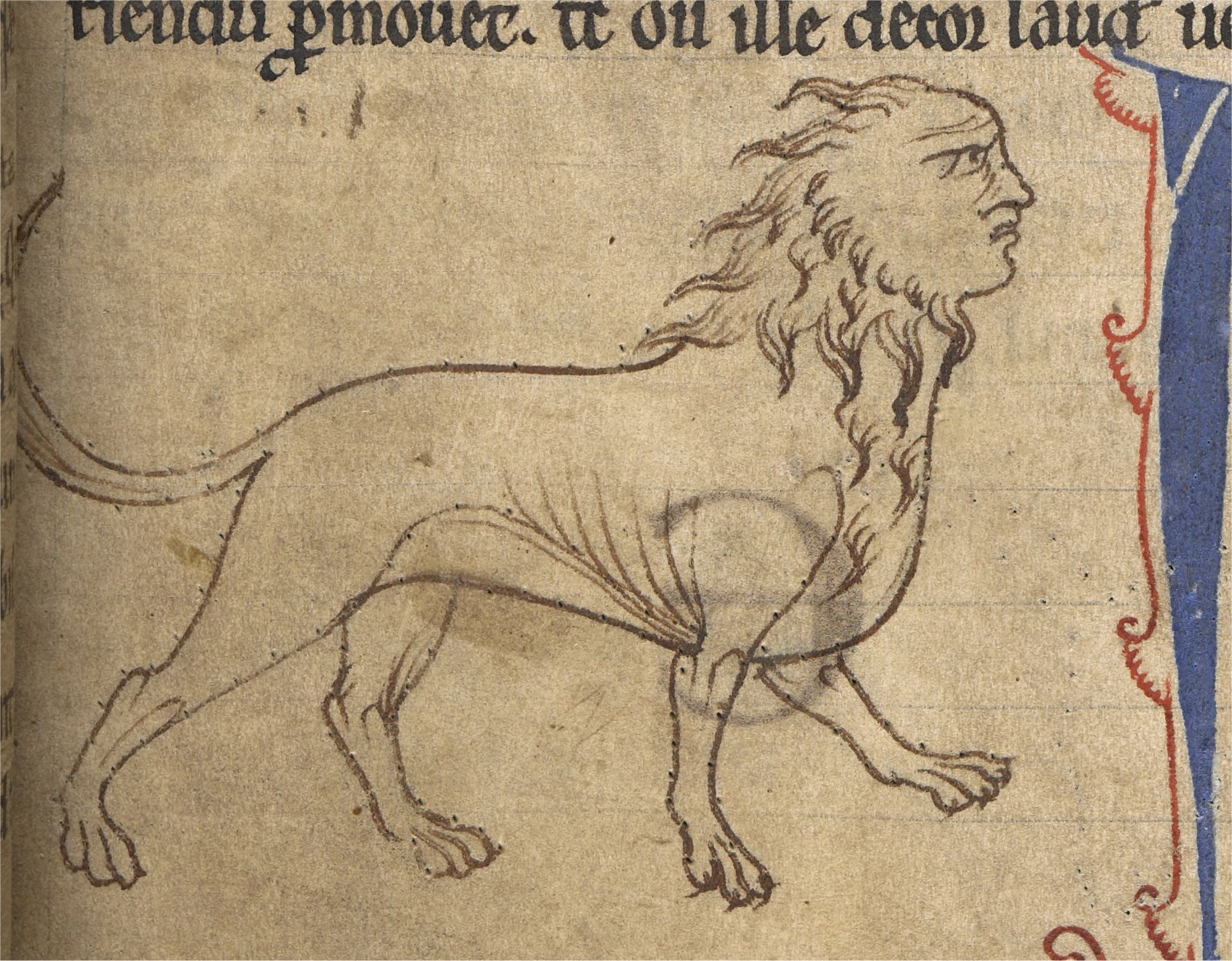
A red lion-bodied man-eater with a human-like face, killing tail-spikes and an unnervingly human voice.
The manticore is a deliberate hunter of people rather than an animal that merely happens to attack them. Classical accounts describe a blood-red beast as large as a lion, with a human-like face, three rows of teeth, great speed and a tail armed with long stings that can be fired like arrows. Later bestiaries preserved that core image, while fantasy roleplaying traditions added powerful wings and turned the missile-tail into its signature battlefield weapon.
At a Glance
Rules by Edition
Manticore
Large Monstrosity, typically Lawful Evil
AC 14; Initiative +3 (13)
HP 68 (8d10 + 24)
Speed 30 ft., Fly 50 ft.
17 (+3)
16 (+3)
17 (+3)
7 (−2)
12 (+1)
8 (−1)
Skills Perception +4
Senses Darkvision 60 ft.; Passive Perception 14
Languages Common
CR 3 (700 XP); PB +2
Traits
Tail Spikes. The manticore carries 24 hardened tail spikes. A Tail Spike attack expends one. It regrows all expended spikes when it finishes a Long Rest.
Human Mimicry. The manticore can imitate a short phrase in a humanoid voice it has heard. A listener who has reason to doubt the sound can identify the imitation with a successful DC 13 Wisdom (Insight) check.
Actions
Multiattack. The manticore makes three attacks, using Bite, Claw or Tail Spike in any combination.
Bite. Melee Attack Roll: +5, reach 5 ft. Hit: 8 (1d10 + 3) Piercing damage.
Claw. Melee Attack Roll: +5, reach 5 ft. Hit: 6 (1d6 + 3) Slashing damage.
Tail Spike. Ranged Attack Roll: +5, range 100/200 ft. Hit: 7 (1d8 + 3) Piercing damage.
Manticore
Large monstrosity, usually lawful evil
Armor Class 14 (natural armor)
Hit Points 68 (8d10 + 24)
Speed 30 ft., fly 50 ft.
17 (+3)
16 (+3)
17 (+3)
7 (−2)
12 (+1)
8 (−1)
Skills Perception +4
Senses darkvision 60 ft., passive Perception 14
Languages Common
Challenge 3 (700 XP)
Traits
Tail Spikes. The manticore has 24 tail spikes. A spike is expended when fired; all expended spikes regrow after a long rest.
Human Mimicry. The manticore can imitate short phrases in voices it has heard. A suspicious listener can distinguish the imitation with a DC 13 Wisdom (Insight) check.
Actions
Multiattack. The manticore makes three attacks with its bite, claws or tail spikes.
Bite. Melee Weapon Attack: +5 to hit, reach 5 ft., one target. Hit: 8 (1d10 + 3) piercing damage.
Claw. Melee Weapon Attack: +5 to hit, reach 5 ft., one target. Hit: 6 (1d6 + 3) slashing damage.
Tail Spike. Ranged Weapon Attack: +5 to hit, range 100/200 ft., one target. Hit: 7 (1d8 + 3) piercing damage.
Manticore CR 5
XP 1,600
LE Large magical beast
Init +2; Senses darkvision 60 ft., low-light vision, scent; Perception +9
Defense
AC 17, touch 11, flat-footed 15 (−1 size, +2 Dex, +6 natural)
hp 57 (6d10+24)
Fort +9, Ref +7, Will +3
Offense
Speed 30 ft., fly 50 ft. (clumsy)
Melee bite +10 (1d8+5), 2 claws +10 (2d4+5)
Ranged 6 spikes +8 (1d8+2/19–20)
Space 10 ft.; Reach 5 ft.
Special Attacks spikes
Statistics
Str 20, Dex 15, Con 19, Int 7, Wis 12, Cha 9
Base Atk +6; CMB +12; CMD 24
Feats Flyby Attack, Multiattack, TrackB, Weapon Focus (spikes)
Skills Fly +3, Perception +9, Survival +5; Racial Modifiers +4 Perception
Languages Common
Special Ability
Spikes (Ex). As a standard action, a manticore can fire six tail spikes. Make a separate ranged attack roll for each spike. All chosen targets must be within 30 feet of one another. The manticore carries 24 spikes and regrows expended spikes within 24 hours.
Ecology
Environment warm hills, marshes and broken country
Organization solitary, pair or pride (3–6)
Treasure standard
Manticore
Large Magical Beast
Hit Dice 6d10+24 (57 hp)
Initiative +2
Speed 30 ft. (6 squares), fly 50 ft. (clumsy)
Armor Class 17 (−1 size, +2 Dex, +6 natural), touch 11, flat-footed 15
Base Attack/Grapple +6/+15
Attack claw +10 melee (2d4+5) or 6 spikes +8 ranged (1d8+2/19–20)
Full Attack 2 claws +10 melee (2d4+5) and bite +8 melee (1d8+2); or 6 spikes +8 ranged (1d8+2/19–20)
Space/Reach 10 ft./5 ft.
Special Attacks spikes
Special Qualities darkvision 60 ft., low-light vision, scent
Saves Fort +9, Ref +7, Will +3
Abilities Str 20, Dex 15, Con 19, Int 7, Wis 12, Cha 9
Skills Listen +5, Spot +9, Survival +1
Feats Flyby Attack, Multiattack, TrackB, Weapon Focus (spikes)
Environment warm marshes and hills
Organization solitary, pair or pride (3–6)
Challenge Rating 5
Treasure standard
Alignment usually lawful evil
Spikes (Ex)
With a snap of its tail, a manticore can loose a volley of six spikes as a standard action. Make an attack roll for each spike. This attack has a range of 180 feet with no range increment, and all targets must be within 30 feet of one another. It can launch only 24 spikes in any 24-hour period.
Behaviour
A manticore does not hunt like a lion. It prefers to understand what it is attacking first. It watches roads, watering places, isolated farms and caravan camps, learns where armed travellers stand, and begins with tail fire from a position that is difficult to reach. If the prey breaks formation, the manticore closes on the weakest or most isolated target.
Its intelligence is low by human standards but high enough for grudges, traps, bargaining and tactical retreat. A manticore that has learned a person’s voice may imitate a cry for help, a sentry’s challenge or a familiar call from beyond a wall. It does not need to be a flawless mimic; uncertainty is often enough to draw someone into the open.
Signs Before Initiative
- Long black or dark tail-spikes are driven into timber well above a person’s head.
- A carcass has been fed on from above or dragged to a rocky ledge.
- Human tracks stop abruptly where blood and lion-like prints begin.
- A distant voice repeats the same short phrase with exactly the same rhythm.
- Shepherds have abandoned open pasture but still use fields beneath overhangs or tree cover.
If Violence Starts
In open country, the manticore stays airborne and fires spikes until opponents reach cover or force it to close. It circles rather than hovering in one place, using height and range to make return fire difficult. When it attacks in melee it chooses a wounded target and commits quickly, then climbs away before a second front can form.
Do not run a pride as identical monsters in a line. One manticore should pressure the front, another cut off retreat, while a third waits for someone to become isolated. They are cruel enough to exploit surrender and intelligent enough to abandon a fight that has become obviously unwinnable.
Homes, Haunts and Range
Classical traditions place the manticore in distant eastern and southern lands, with India especially prominent in the earliest accounts and “Aethiopia” appearing in Roman retellings. In play, manticores suit dry hills, broken savanna, escarpments, ruined hill forts and river gorges where they can roost above road traffic.
Where African traditions are being used, connect the creature to the African Bestiary. For ancient and eastern traditions, it also fits routes through Persia and toward India rather than being treated as a generic temperate monster.
Using a Manticore in an Encounter
The voice in the ravine. A missing caravan guard keeps calling from below a cliff. The party can hear him clearly, but the same sentence repeats every few minutes.
The empty remount station. Horses remain tethered and supplies are untouched, but every roof and palisade is studded with tail-spikes.
The paid guardian. A warlord has fed a manticore prisoners for months and believes this makes the creature loyal. The manticore sees the arrangement differently.
The wounded pride. Hunters kill one member of a pride and retreat to a fortified village. The surviving manticores stop attacking livestock and begin studying watch changes instead.
Captivity, Training and Value
Older equipment material on this entry priced a young manticore at 7,000 gp and professional training at 2,500 gp. Those figures can remain useful in campaigns that use legacy fantasy-economy prices, but they should not imply that a manticore becomes safe. Training requires removing or covering back-spikes if the beast is to carry a rider, and even a conditioned manticore remains an intelligent predator capable of deciding that its handler is weaker than it is.
Classical and Medieval Sources
Ctesias and later writers
The earliest surviving tradition describes an Indian man-eater with a human face, lion-sized red body and scorpion-like tail that fires long stings. A useful collection of ancient testimonia is the Manticore source page at Theoi.
Medieval bestiary image
The hero is a public-domain manticore from British Library Add MS 11283, preserved through Wikimedia Commons.
Rules Sources and Licensing
The 5.5e/2024 and 5e/2014 blocks are page-specific compatibility adaptations using the respective fifth-edition rules frameworks. They preserve the familiar flying, tail-spike skirmisher role without claiming to reproduce a closed-source monster entry.
The Pathfinder 1e block is a compatibility conversion from the older d20 manticore statistics retained on this page. The D&D 3.5e block preserves the legacy statistics already associated with the entry. Alignment describes a common tendency, not compulsory behaviour.
Keep this reference growing
If this page helped with your reading or game, you can support its upkeep or explore the curated books.
Explore the Bookshop — epics, classics and stories behind imagined worlds.