
 Buy me a coffee
Lampades — Torch-Bearing Nymphs of the Underworld
Lampades are pale underworld nymphs who walk before Hecate with black torches, guiding the dead, exposing hidden guilt, and burning madness into the eyes of the living.
Overview
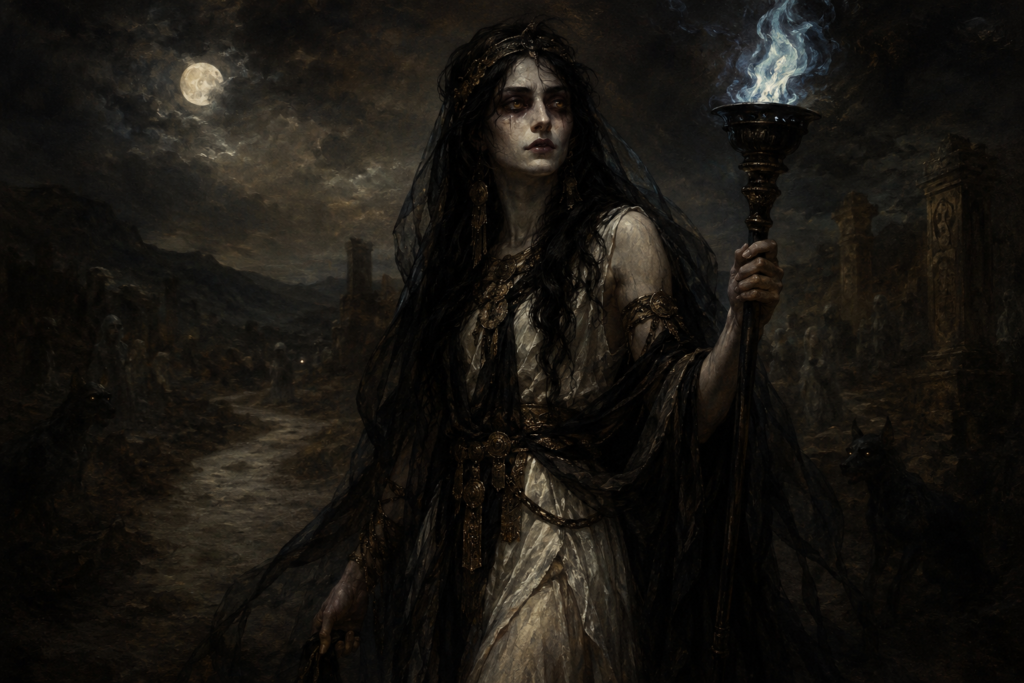
Lampades are chthonic nymphs of the underworld, bound to grave-roads, crossroads, tomb mouths, cavern shrines, and the night processions of Hecate. They are not ordinary woodland nymphs, lake spirits, or seductive water-fey. Their power is older and colder: torchlight, threshold law, ghost-road duty, and the terrible clarity of seeing what should have remained hidden.
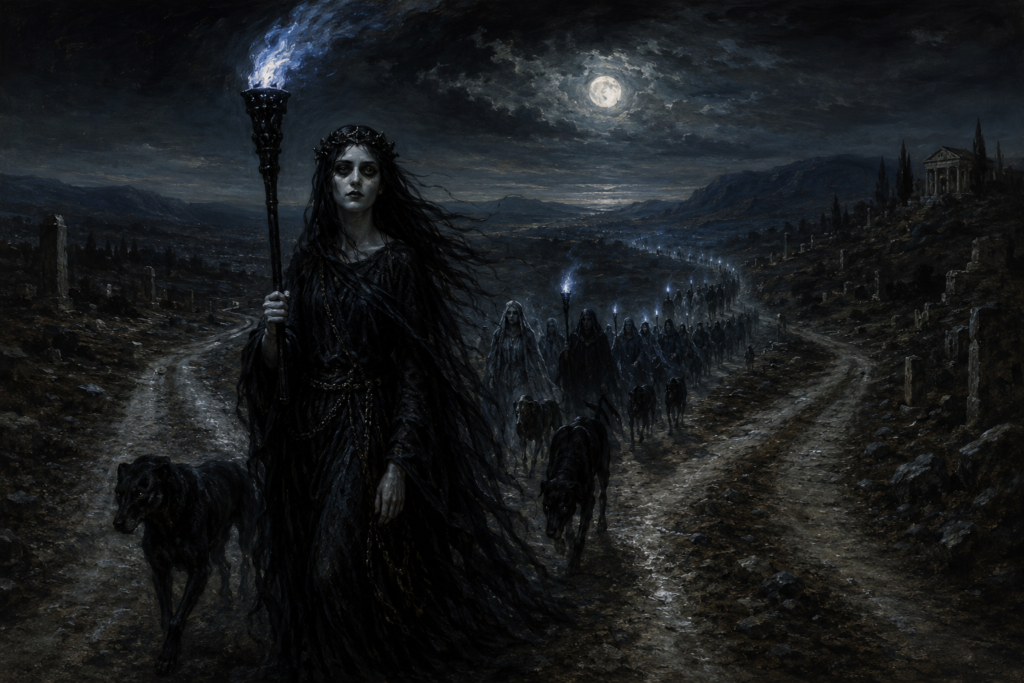
A Lampad procession appears when the living world and the dead world press close together. Their torches shine at crossroads after moonset, inside caves where old offerings rot, beside graves sealed under false names, and across battlefields where the unburied still whisper beneath the soil.
Their light does not merely reveal darkness. It reveals guilt, ghosts, broken oaths, stolen grave goods, hidden corpses, false testimony, and the path beneath the path. A mortal who looks too long into that flame may flee, confess, turn on an ally, or hear the dead calling by name.
Appearance
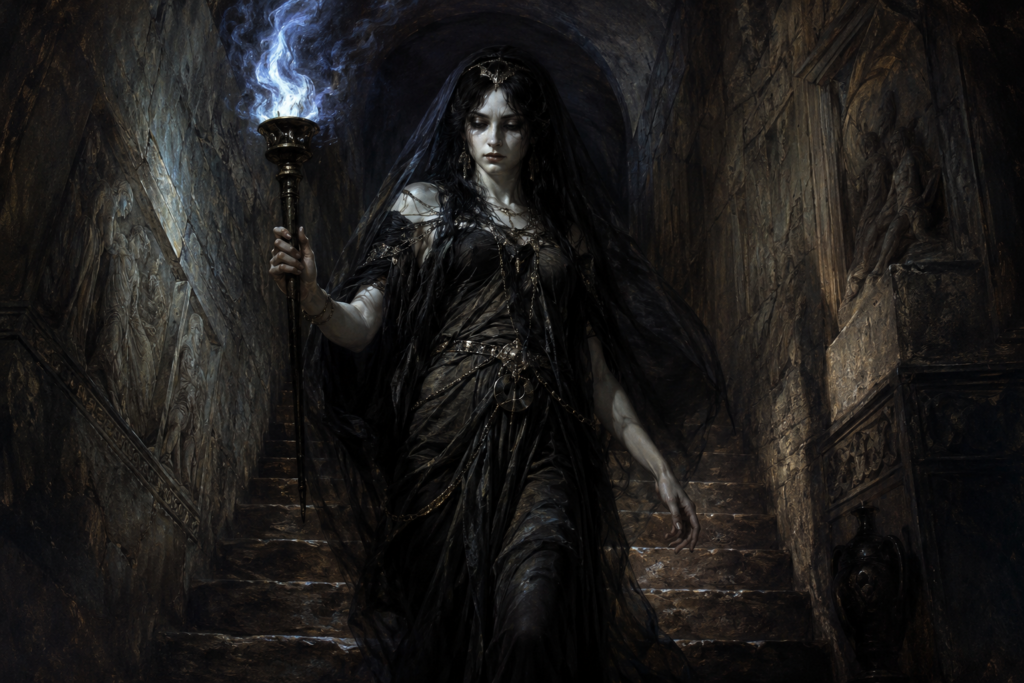
A Lampad appears as a pale, grave-beautiful nymph with long black hair, ash-white or moon-cold skin, and eyes like amber, wet bronze, or buried fire. Her beauty is not warm. It is the beauty of a statue glimpsed underground by torchlight.
She wears dark veils, grave-white linen, black wool, bronze girdles, funeral ribbons, or ritual cloth stained with smoke. Some carry keys, grave coins, bone charms, black wool cords, or bronze bells. A faint smell of burnt cypress, damp stone, crossroads dust, and old offerings often surrounds her.
Every Lampad carries a torch. Its shaft may be bronze, black iron, bone, cypress wood, or a branch burned from a tree that grew beside a tomb. Its fire may shine blue-white, violet, ember-red, green-gold, or black at the heart. The flame can light a wall without warming it and can reveal a ghost without comforting the living.
Black dogs sometimes follow at the edge of her light. Ghosts turn their faces toward her torch. Liars often look away before they understand why.
Habitat
Lampades appear where underworld traffic touches the mortal world.
They are most often found at crossroads, graveyards, tomb roads, cave shrines, old necromantic paths, boundary stones, plague pits, battlefield burial grounds, ruined temples, underground sanctuaries, and moonlit routes used by ghosts.
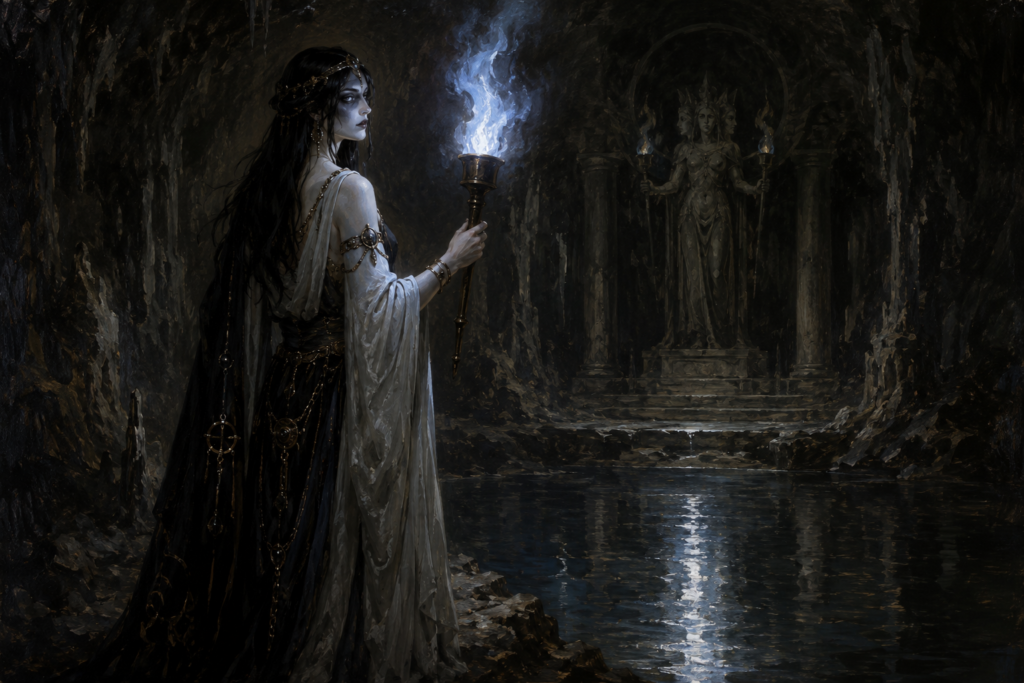
They may appear near deep pools, underground rivers, or cavern lakes, but those places should feel like underworld thresholds rather than ordinary water-nymph habitat. A Lampad beside water is guarding a death-road, drowned oath, buried passage, or underworld crossing. She is not a lake seductress.
A Lampad rarely holds a lair in the ordinary sense. She holds a threshold: a tomb door, cave mouth, bridge, shrine gate, stair into darkness, crossroads stone, or grave-road where the dead pass and the living should not follow lightly.
Ecology
Lampades are not animals and do not belong to a normal food chain. They are sustained by underworld power, shrine offerings, death rites, oath-memory, and the authority of Hecate’s procession.
They gather in small groups called processions. A procession may include three Lampades, nine Lampades, black hounds, ghostly attendants, witch-priests, dead initiates, or lesser underworld spirits. A solitary Lampad is usually a witness, omen-bearer, road guardian, or shrine sentinel.
Their origin remains deliberately uncertain. Some are ancient underworld nymphs. Some may arise from torch-bearing mystery rites, grave-road vows, or powerful death processions. Their parentage is not fixed here because the source tradition does not require a firm genealogy.
Behaviour
Lampades are calm, formal, observant, and difficult to intimidate. They do not usually begin by attacking. They ask questions. They watch faces. They raise the torch and let the guilty condemn themselves.
A Lampad cares about burial, naming, oath-keeping, offerings, grave goods, crossroads law, and the proper passage of the dead. She may spare a murderer long enough to force confession, guide a lost child away from a tomb road, or destroy armed intruders who rob a shrine.
She is most dangerous when the party has done something wrong, or when someone in the party is protecting a lie. Her magic turns concealed guilt into battlefield pressure.
Characters who respect the dead, return stolen grave goods, bury the unnamed, answer honestly, or complete an interrupted rite may survive without combat. Characters who mock death rites, loot tombs, falsify testimony, hide murder, or attack a procession are treated as enemies of the road.
Killing a Lampad can have serious religious and political consequences in lands where Hecate’s rites, Hellenic underworld customs, local shrine law, or grave-road protections are recognised. If she is actively killing travellers without lawful cause, local rulers may still sanction action against her, but the killing remains a dangerous act against a death-road power.
Quick Rules Reference
- Underworld fey, not ordinary woodland fey.
- Native to the Hellenic Underworld and mortal thresholds touched by Hecate’s road.
- Torchlight reveals ghosts, hidden guilt, false names, and underworld paths.
- Fear, madness, charm, confession, and misdirection are her main threats.
- Cold iron can disrupt her movement and protection.
- Best used with ghosts, black dogs, witch-priests, tomb roads, grave-wights, or other Lampades.
- Not automatically evil; she is a threshold guardian, guide, witness, and punisher.
Mechanics Tabs
The rules below are mechanics compatible for different game editions.
Lampades 5.5e
Lampades Pathfinder 1e / 3.5e
Lampades 3.0e
Lampades 5.5e-Compatible Rules
Lampad
CR 6
Medium Fey, Neutral
Armor Class 16
Initiative +4
Hit Points 105
Speed 30 ft.
Proficiency Bonus +3
| STR | DEX | CON | INT | WIS | CHA |
|---|---|---|---|---|---|
| 10 (+0) | 18 (+4) | 14 (+2) | 13 (+1) | 16 (+3) | 18 (+4) |
Saving Throws Dex +7, Wis +6, Cha +7
Skills Arcana +4, Deception +7, Insight +6, Perception +6, Religion +4, Stealth +7
Damage Resistances cold, necrotic, psychic
Condition Immunities frightened
Senses darkvision 120 ft., passive Perception 16
Languages Greek, Sylvan, one underworld tongue
Challenge 6
Traits
Chthonic Nymph. The Lampad can sense the direction of the nearest grave, corpse, crossroads, underworld shrine, or active necromantic disturbance within 1 mile. In graveyards, tombs, caves, crossroads, and underworld-tainted ruins, she ignores nonmagical difficult terrain.
Torch of the Hidden Road. The Lampad carries a magical torch. She decides whether its light is visible to each creature within range. The torch sheds bright light in a 20-foot radius and dim light for another 20 feet. Invisible undead, ethereal creatures, magically disguised corpses, and ghostly presences are outlined while inside the torch’s bright light.
Cold Iron Aversion. When the Lampad takes damage from a cold iron weapon, she cannot use Shadow Crossing until the end of her next turn.
Underworld Witness. The Lampad has advantage on Wisdom checks made to sense lies involving death, burial, murder, oath-breaking, grave goods, or false names.
Actions
Multiattack. The Lampad makes two attacks, using Stygian Torch or Grave-White Claw in any combination.
Stygian Torch. Melee or Ranged Spell Attack: +7 to hit, reach 5 ft. or range 60 ft., one target. Hit: 9 fire damage plus 9 psychic damage. The target must succeed on a DC 15 Wisdom saving throw or be unable to take reactions until the start of the Lampad’s next turn.
Grave-White Claw. Melee Weapon Attack: +7 to hit, reach 5 ft., one target. Hit: 8 slashing damage plus 7 necrotic damage.
Lantern of Unreason. Recharge 5–6. The Lampad raises her torch and releases a 30-foot cone of underworld fire. Each creature of her choice in the cone must make a DC 15 Wisdom saving throw. On a failed save, a creature takes 27 psychic damage and is overcome by underworld visions until the end of its next turn. While overcome, the creature cannot take reactions and must either move up to half its speed away from the Lampad or make one weapon attack against a target chosen at random within reach or range. On a successful save, the creature takes half damage and suffers no additional effect.
Spellcasting. The Lampad casts the following spells, requiring no material components. Charisma is her spellcasting ability, spell save DC 15, +7 to hit with spell attacks.
At will: dancing lights, detect magic, minor illusion, thaumaturgy
3/day each: charm person, misty step, suggestion, speak with dead
1/day each: bestow curse, fear, hypnotic pattern
Bonus Actions
Shadow Crossing. Recharge 4–6. The Lampad teleports up to 60 feet to an unoccupied space she can see in dim light, darkness, torchlight, a graveyard, a tomb, or a crossroads.
Reactions
The Torch Turns. When a creature the Lampad can see hits her with an attack while inside her torchlight, she imposes disadvantage on the next attack roll that creature makes before the end of its next turn.
Lampades Pathfinder 1e / 3.5e-Compatible Rules
Lampad
CR 6
XP 2,400
N Medium fey, chthonic
Init +8; Senses darkvision 120 ft., low-light vision; Perception +14
Defense
AC 20, touch 15, flat-footed 15
hp 52
Fort +5, Ref +10, Will +9
DR 5/cold iron
Resist cold 10, negative energy 10
Immune fear
Offense
Speed 30 ft.
Melee stygian torch +8 touch or claw +8
Stygian Torch 1d6 fire plus 2d6 mind-affecting damage; see Maddening Torch
Claw 1d4 plus 1d6 negative energy
Special Attacks maddening torch, underworld witness
Spell-Like Abilities CL 8th; concentration +13
At will: dancing lights, detect magic, ghost sound, prestidigitation
3/day: charm monster, deeper darkness, minor image, suggestion, speak with dead
1/day: bestow curse, fear, hypnotic pattern
Statistics
| STR | DEX | CON | INT | WIS | CHA |
| 10 (+0) | 19 (+4) | 16 (+3) | 14 (+2) | 17 (+3) | 21 (+5) |
Base Atk +4; CMB +4; CMD 19
Feats Dodge, Improved Initiative, Mobility, Weapon Finesse
Skills Bluff +16, Diplomacy +13, Knowledge (planes) +13, Knowledge (religion) +13, Perception +14, Sense Motive +14, Spellcraft +10, Stealth +15, Use Magic Device +13
Languages Greek, Sylvan, Undercommon or a campaign underworld tongue
Special Abilities
Maddening Torch. Any creature within 30 feet that can see the Lampad’s torch must succeed on a DC 19 Will save or become confused for 1 round. A creature that succeeds is immune to that Lampad’s Maddening Torch for 24 hours. This is a mind-affecting fear and compulsion effect. The save DC is Charisma-based.
Torch of the Hidden Road. Invisible undead, ethereal creatures, disguised corpses, and ghostly presences are outlined while within the Lampad’s torchlight. The Lampad gains a +4 bonus on Perception and Sense Motive checks involving death, burial, murder, grave goods, or false names.
Shadow Crossing. Three times per day as a move action, the Lampad may teleport up to 60 feet to a space in dim light, darkness, torchlight, a graveyard, a tomb, a cave shrine, or a crossroads. This functions as dimension door, except the Lampad may act normally after using it.
Underworld Witness. A Lampad gains a +4 bonus on Sense Motive checks against creatures concealing murder, grave-robbing, oath-breaking, or knowledge of an unburied dead person.
3.5e Notes
For 3.5e use, replace Perception with Listen and Spot, and replace CMD/CMB with normal grapple rules. If the campaign does not use mind-affecting damage, treat the extra damage from Stygian Torch as nonlethal damage caused by terror, visions, and supernatural disorientation.
Lampades Pathfinder 3.0e
Nymphs of the Underworld companions of Hecate, goddess of witchcraft and crossroads, they were a gift from Zeus for Hecate’s loyalty in the Titanomachy. They bear torches and accompany Hecate on her night-time travels and hauntings. The light of the Lampades’ torches has the power to drive one to madness.
Originally Posted by JarionSilverblades of the Wizards Community forums.
Drawn by the enchanting sounds of panpipes, the bard saw the most beautiful woman he had ever laid eyes upon, her hair was black as shadows, her skin the color of the purest marble, and her large eyes like the finest amber.
Often found at the edge of lakes, ponds, or streams, playing their panpipes. These fey appear much as a nymph does, they have slightly pointed ears , long flowing black hair, smooth flawless skin, and eyes the color of amber. They Speak in a tone that can lull even the most vigilant warrior to lay down his weapon, always calm, caring, and angelic when she speaks.
| Lampades | |
| Medium fey | |
| HD | 5d6+5 (20 hp) |
| Initiative | +3 |
| Speed | 30 ft. (6 squares), Swim 20ft. (4 squares) |
| AC | 15 (+3 Dexterity, +2 Natural), touch 15, flat-footed 12 |
| BAB/Grapple | +2/+2 |
| Attack | Claw +6 melee 1d4+1 |
| Full Attack | 2 Claws +6 melee 1d4+1 |
| Space/Reach | 5 ft./5 ft. |
| Special Attack | Kiss of evil, Spell-like abilities. |
| Special Qualities | Charismatic Grace, Damage reduction 5/ cold iron and Magic, Low-Light Vision |
| Saves | Fort +6, Ref +11, Will +10 |
| Abilities | Strength 10, Dexterity 17, Constitution 12, Intelligence 14, Wisdom 15, Charisma 19. |
| Skills | Bluff +9, Concentration +8, Diplomacy +14, Escape Artist +8 (+10 with ropes), Hide +10, Listen +7, Move Silently +10, Spot +7, Sense Motive +9, Perform (Wind instruments) +12* (+16 with panpipes), Swim +8, and Rope Use+4 (+6 with bindings) |
| Feats | Ability Focus (Kiss of evil), Weapon Finesse |
| Environment | Any Underground or Temperate Forest (night) – Minauros, the Third of the Nine Hells of Perdition (Aeaea, the realm of Hecate) |
| Organization | Solitary or band (2-20) |
| CR | 6 |
| Treasure | Standard |
| Alignment | Usually Chaotic Evil |
| Advancement | By Character class. |
| LA | +3 |
Combat
Lampades never fight unless they have to, they would rather use their charm monster ability to either turn their enemy into an ally, or get her enemies to fight each other instead. If a Lampades must fight they do so with their claws or a manufactured weapon, often attacking with a manufactured weapon as their primary, and a claw as a natural secondary attack.
Kiss of evil (Su): A Lampades most dangerous ability is her kiss of evil. 1/Week a Lampades, can use it’s kiss of evil ability on a willing, helpless, or with a successful grapple check on an unwilling person, a grapple must be maintained for 1 round. This ability functions like the Morality Undone spell (Caster level 10, DC 21), except target touched, also if the kiss is successfully maintained for 5 consecutive rounds the effect is permanent. The DC is Charisma based.
Charismatic Grace(Ex): A Lampades adds their Charisma modifier if any as an enchantment bonus on all saving throws.
Spell-like Ability (Sp): At will –charm monster (DC 18), suggestion ( DC 16), and summon instrument (Panpipes only, no limit on duration), caster level 6, the save DCs are Charisma-based.
Skills: A syrinx has a +8 racial bonus on any Swim check to perform some special action or to avoid a hazard. She can always choose to take a 10 on Swim checks, even if distracted or endangered. She can use the run action while swimming, provided she swims in a straight line. *When using panpipes a syrinx also gains a +4 profane bonus on all preform checks.
Combat Tactics
A Lampad does not open combat by clawing. She positions enemies inside torchlight, separates them with illusion, forces Wisdom or Will saves, and exposes the character most compromised by guilt, stolen grave goods, oath-breaking, or fear of the dead.
Against armed intruders, she uses Lantern of Unreason or Maddening Torch first, then shifts position with Shadow Crossing. She wants enemies confused, scattered, confessing, or turning on one another beneath the torch.
She is strongest with allies. Use her with black hounds, ghosts, witch-priests, underworld cultists, grave-wights, or two lesser Lampades carrying side torches. A solitary Lampad works best as an omen, shrine guardian, witness, or negotiation encounter rather than a simple fight.
She retreats if her torch is ritually quenched, if cold iron disrupts her repeatedly, or if the party completes the duty she guards: naming the dead, returning grave goods, burying a body, confessing a murder, or opening the correct underworld road.
Treasure and Remains
Lampades do not hoard treasure in the ordinary sense. Their possessions are ritual objects, grave tokens, offerings, and tools of underworld passage.
Possible treasure includes funeral coins, bronze keys, black candles, grave-oil, old shrine bowls, bone combs, black wool cords, silver dog charms, underworld maps scratched onto lead tablets, curse tablets, burial masks, and ash-filled reliquaries.
A Lampad’s extinguished torch is valuable but dangerous. Its ash may be used in magic involving ghosts, crossroads, confession, fear, dream-visions, and underworld travel. A living torch taken by force may curse the bearer with dreams of processions beneath the earth.
Adventure Hooks
The Torch at the Three Roads
Every new moon, a pale woman with a black torch appears at a crossroad outside the town. Those who follow her return with names of the dead written in ash on their skin. The local lord wants her destroyed, but the names all belong to people buried under false identities.
The Grave That Will Not Stay Closed
A tomb keeps reopening from the inside, though the corpse has not moved. A Lampad stands inside each night, silently holding her torch over the coffin. She will not attack unless disturbed. She is waiting for the person who stole the dead woman’s final oath.
The Procession Under the Battlefield
Soldiers hear singing beneath an old battlefield and see torchlight moving below the soil. A procession of Lampades is guiding the unburied dead toward a hidden underworld road. If the party interrupts, the dead rise in panic. If they help complete the rite, the battlefield finally becomes quiet.
Mythic Identity
Mythic Role: Underworld torch-bearer, grave-road guide, crossroads witness, shrine guardian, madness-bringer
Primary Associations: Hecate, ghosts, tombs, crossroads, torches, night processions, underworld roads
Usual Alignment: Neutral
Native Realm: The Hellenic Underworld and its mortal thresholds
Common Grouping: Solitary witness, pair, triad, or procession
Lampades are fey because they are nymphs, but they are not bright courtly fair folk. They are chthonic fey: death-adjacent, ritual-bound, and tied to the boundary between the mortal road and the road of the dead.
They belong to Hecate’s underworld procession, not to the Nine Hells, not to ordinary lakes, and not to a generic fairy court. A Lampad may enter mortal roads, tombs, ruins, battlefields, plague pits, and crossroads, but she does so as a torch-bearer of the dead road.
Lampades are not automatically evil. A Lampad may terrify the living, curse a grave-robber, or drive a murderer mad, but her violence usually comes from underworld duty rather than malice. She is a witness before she is a killer.
Historic and Mythic Context
![By Elihu Vedder - [1], Public Domain, https://commons.wikimedia.org/w/index.php?curid=31657914, Lampades](https://spiralworlds.com/wp-content/uploads/2021/02/Elihu_Vedder_-_The_Pleiades_1885.jpg)
The Lampades belong to Greek myth as torch-bearing nymphs of the underworld. Their name is connected with lamps or torches, and their strongest surviving mythic identity places them in the train of Hecate, moving through night, ghosts, crossroads, tombs, and chthonic rites. The Lampades entry at Theoi preserves the essential source core: these are underworld nymphs whose torches belong to Hecate’s night-wandering company.
Hecate herself is a liminal goddess: a power of crossroads, thresholds, magic, spirits, night roads, and the border between the living and the dead. This makes the Lampades more than decorative attendants. They are torch-bearers of the dead road, witnesses of hidden crimes, and figures who reveal what mortals would rather leave buried.
The mythic tradition does not require a firm parentage for the Lampades, so this entry does not invent one as fact. In play, they are treated as chthonic nymphs bound to Hecate’s procession and to places where the mortal world touches the underworld: grave roads, tomb mouths, cave shrines, old crossroads, battlefield burial grounds, and necromantic thresholds.
This version deliberately avoids turning the Lampades into ordinary lake nymphs, seducing panpipe spirits, devils, or generic evil fey. Their danger comes from torchlight, madness, ghostly revelation, death-law, and threshold duty. A Lampad is not simply a monster waiting beside a pool. She is a sign that the underworld has noticed something: an unnamed corpse, a stolen grave gift, a false oath, an unburied battlefield, or a soul-road that should not be open.
The Lampades are best used where Hellenic underworld belief still has force. They may appear in Greek lands, ruined classical sanctuaries, cave shrines, crossroads under Hecate’s protection, or any place where older chthonic rites have survived beneath later custom. They are not random wandering fey. They are processional, ritual, and ominous: the torch before the ghost-road, the witness at the grave, and the light that makes guilt visible.