
Clockwork Soldier
At a Glance
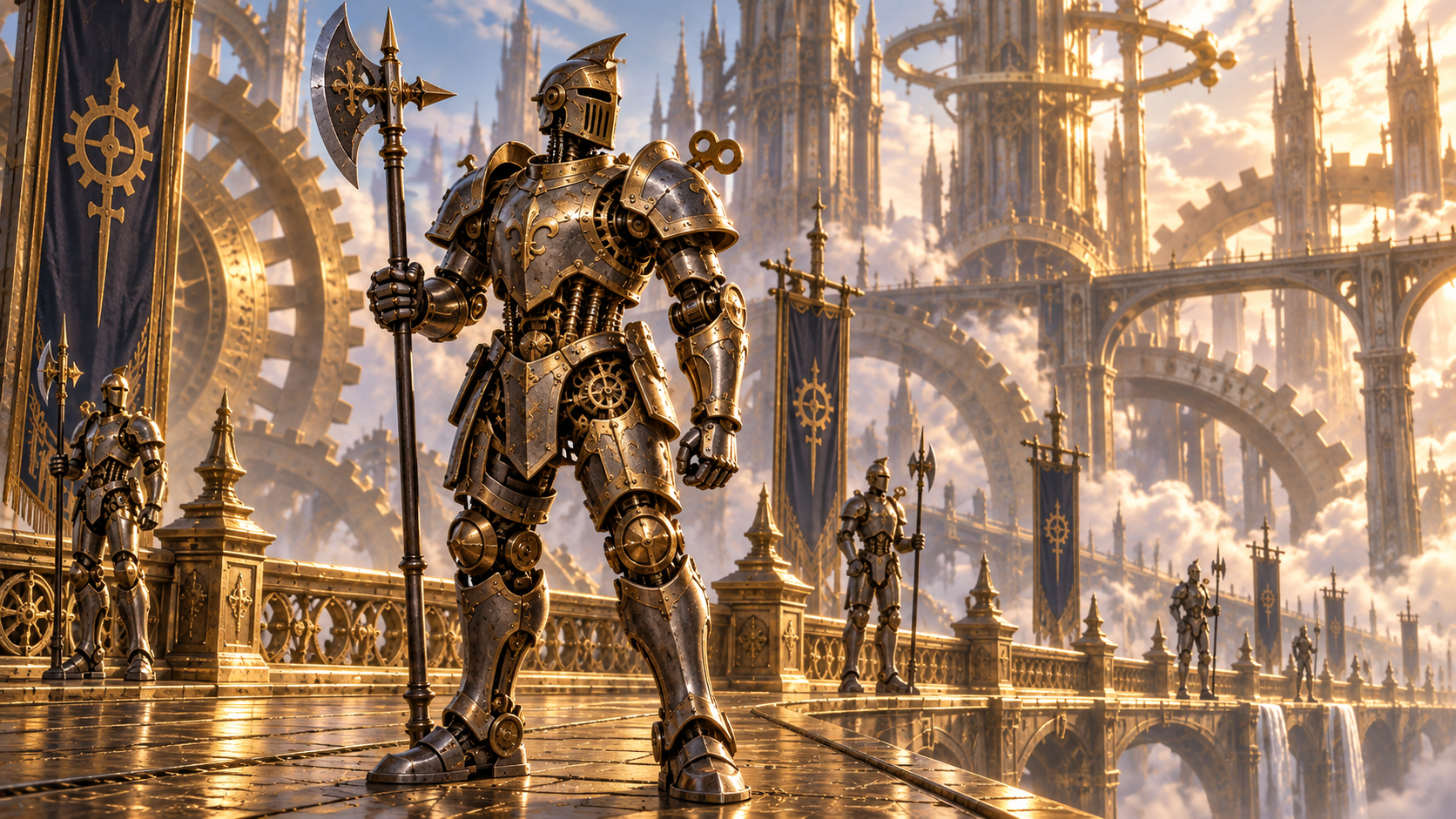
A Clockwork Soldier is a heavily built magical automaton designed to hold gates, guard important people and fight in disciplined formations. It does not tire, panic or retreat unless ordered. Its greatest strengths are reach, relentless obedience and defensive positioning; its greatest weakness is that precise programming makes it less adaptable than a living veteran.
Game Statistics
Choose the ruleset being played. Each edition below is self-contained, including its own construction and repair guidance.
Clockwork Soldier — 5.5e / 2024
Medium Construct, Unaligned
AC 17
Initiative +3 (13)
HP 60 (8d8 + 24)
Speed 30 ft.
| STR | DEX | CON | INT | WIS | CHA |
|---|---|---|---|---|---|
| 16 (+3) | 12 (+1) | 16 (+3) | 5 (−3) | 12 (+1) | 3 (−4) |
Saving Throws Dex +3
Skills Perception +3
Immunities Poison, Psychic; Charmed, Exhaustion, Frightened, Paralyzed, Petrified, Poisoned
Senses Darkvision 60 ft.; Passive Perception 13
Languages understands Common but can’t speak
CR 3 (700 XP; PB +2)
Traits
Immutable Form. The soldier is immune to effects that would alter its physical form.
Electrical Disruption. When the soldier takes Lightning damage, it can’t take Reactions until the start of its next turn.
Actions
Multiattack. The soldier makes two Halberd attacks.
Halberd. Melee Attack Roll: +5, reach 10 ft. Hit: 8 (1d10 + 3) Slashing damage.
Overdrive Flurry (Recharge 6). The soldier makes three Halberd attacks. After the attacks, its AC becomes 15 and it can’t take Reactions until the start of its next turn.
Reaction
Hold the Line. When a creature the soldier can see enters or leaves its 10-foot reach using its movement, the soldier makes one Halberd attack against that creature. This attack counts as an Opportunity Attack. On a hit, the target’s Speed is reduced by 10 feet until the end of the current turn.
Construction & Repair
A standard Clockwork Soldier is valued at about 37,000 gp before its weapon, but that figure is a setting value rather than a replacement 5.5e crafting formula. Construction requires a specialist workshop, precision clockwork components and magical construct expertise; use the campaign’s normal downtime and magic-item creation procedures. Repair likewise follows the campaign’s construct and magic-item repair rules rather than the Pathfinder cost formula.
Clockwork Soldier — 5e / 2014
Medium Construct, Unaligned
Armor Class 12 (natural armor)
Hit Points 45 (6d8 + 18)
Speed 30 ft.
| STR | DEX | CON | INT | WIS | CHA |
|---|---|---|---|---|---|
| 13 (+1) | 13 (+1) | 16 (+3) | 5 (−3) | 10 (+0) | 1 (−5) |
Skills Athletics +5, Intimidation −3
Damage Immunities poison, psychic
Condition Immunities charmed, exhaustion, frightened, paralyzed, petrified, poisoned
Senses darkvision 60 ft., passive Perception 10
Languages Common
Challenge 1 (200 XP)
Traits
Immutable Form. The soldier is immune to any spell or effect that would alter its form.
Intimidating Legions. When the soldier makes a Charisma (Intimidation) check, it gains a bonus equal to the number of other clockwork soldiers the target can see or hear.
Magic Resistance. The soldier has advantage on saving throws against spells and other magical effects.
Actions
Halberd. Melee Weapon Attack: +3 to hit, reach 10 ft., one target. Hit: 7 (1d10 + 2) slashing damage.
Overdrive Flurry (Recharge 6). The soldier makes four halberd attacks. After taking this action, it is stunned until the end of its next turn.
Construction & Repair
The 37,000 gp figure remains the creature’s setting value rather than a native 2014 5e crafting formula. Building or repairing one uses the campaign’s chosen construct, magic-item and downtime rules.
What Changed in 5.5e?
- The 5.5e version is a separate CR 3 design rather than an update to this CR 1 creature.
- Its armour and hit points are substantially higher.
- Electrical Disruption adds explicit player-facing counterplay.
- Hold the Line gives the newer version a stronger defender role.
- Overdrive Flurry no longer leaves the construct stunned for an entire turn.
Clockwork Soldier — Pathfinder 1e
Clockwork Soldier CR 6
XP 2,400
N Medium construct (clockwork)
Init +6; Senses darkvision 60 ft., low-light vision; Perception +0
Defense
AC 20, touch 14, flat-footed 16 (+2 Dex, +2 dodge, +6 natural)
hp 64 (8d10+20)
Fort +2, Ref +6, Will +2
DR 5/adamantine
Immune construct traits
Weaknesses vulnerable to electricity
Offense
Speed 30 ft.
Melee +1 halberd +18/+13 (1d10+14/×3)
Special Attacks latch
Statistics
Str 28, Dex 15, Con —, Int —, Wis 11, Cha 1
Base Atk +8; CMB +17 (+19 disarm); CMD 31 (33 vs. disarm)
Bonus Feats Improved Initiative, Lightning Reflexes
SQ efficient winding, proficient, standby, swift reactions
Special Abilities
Efficient Winding (Ex). A clockwork soldier can function for 2 days per Hit Die every time it is wound.
Latch (Ex). A soldier can attempt to disarm or grapple as a standard action without provoking an attack of opportunity and receives a +2 bonus on disarm checks. It also gains a +2 bonus to CMD against attempts to disarm it.
Proficient (Ex). A clockwork soldier is proficient with all simple and martial weapons.
Standby (Ex). A clockwork soldier can enter standby as a standard action. While on standby it cannot move or act. It remains aware of its surroundings but takes a −4 penalty on Perception checks. Time spent in standby does not count against its wind-down duration. It can leave standby as a swift action; if it does so to initiate combat, it gains a +4 racial bonus on its Initiative check.
Swift Reactions (Ex). A clockwork soldier gains Improved Initiative and Lightning Reflexes as bonus feats and a +2 dodge bonus to AC.
Ecology
Environment any
Organization solitary, pair, trio, troop (3–8), or company (9–12 plus 1–4 clockwork servants)
Treasure standard (+1 halberd, other treasure)
Construction & Repair
CL 12th; Price 37,000 gp
Requirements Craft Construct, geas/quest, heroism, creator must be at least caster level 12th; Craft (clockwork) DC 20
Cost 19,000 gp
The creator begins with 1,000 gp of precisely made clockwork components; the soldier’s weapon is purchased separately. Damage is repaired using the normal Pathfinder construct-repair rules available to its creator.
Clockwork Soldier — D&D 3.5e
| Size/Type | Medium Construct (Clockwork) |
|---|---|
| Hit Dice | 8d10+20 (64 hp) |
| Initiative | +6 |
| Speed | 30 ft. (6 squares) |
| Armor Class | 20, touch 14, flat-footed 16 (+2 Dex, +2 dodge, +6 natural) |
| Base Attack/Grapple | +6/+15 |
| Attack | +1 halberd +16 melee (1d10+14/×3) |
| Full Attack | +1 halberd +16/+11 melee (1d10+14/×3) |
| Space/Reach | 5 ft./5 ft.; 10-ft. reach with halberd |
| Special Attacks | Latch |
| Special Qualities | Construct traits, darkvision 60 ft., low-light vision, DR 5/adamantine, efficient winding, proficient, standby, swift reactions, vulnerability to electricity |
| Saves | Fort +2, Ref +6, Will +2 |
| Abilities | Str 28, Dex 15, Con —, Int —, Wis 11, Cha 1 |
| Skills | — |
| Feats | Improved InitiativeB, Lightning ReflexesB |
| Environment | Any |
| Organization | Solitary, pair, trio, troop (3–8), or company (9–12 plus 1–4 clockwork servants) |
| Challenge Rating | 6 |
| Treasure | Standard, normally including a +1 halberd |
| Alignment | Always neutral |
| Advancement | — |
| Level Adjustment | — |
Special Abilities
Efficient Winding (Ex). A fully wound soldier operates for 16 days.
Latch (Ex). The locking mechanisms in the soldier’s hands allow it to make a disarm or grapple attempt as a standard action without provoking an attack of opportunity. It gains a +2 bonus on disarm checks and a +2 bonus against attempts to disarm it.
Proficient (Ex). A clockwork soldier is proficient with all simple and martial weapons.
Standby (Ex). The soldier can enter standby as a standard action. It cannot move or act while in standby but remains aware of its surroundings and takes a −4 penalty on Listen and Spot checks. Time in standby does not consume its winding duration. It may leave standby as a free action on its turn; if it activates as combat begins, it gains a +4 racial bonus on its Initiative check.
Swift Reactions (Ex). The soldier gains Improved Initiative and Lightning Reflexes as bonus feats and a +2 dodge bonus to AC.
Vulnerability to Electricity. Electricity attacks deal 50% additional damage to the clockwork soldier.
Construction & Repair
CL 12th; Price 37,000 gp
Requirements Craft Construct, geas/quest, heroism, creator must be at least caster level 12th; Craft (clockwork) DC 20
Cost 19,000 gp and 1,440 XP
The body requires 1,000 gp of precisely made clockwork components and the weapon is purchased separately. A creator with Craft Construct can repair the soldier using the normal D&D 3.5 construct-repair rules.
Behaviour
Clockwork soldiers do not behave like living warriors wearing mechanical bodies. Their defining quality is obedience. A soldier ordered to guard a door does not abandon the doorway to chase a fleeing thief. One ordered to protect an ambassador stays close enough to intercept threats even when a more attractive target presents itself. A soldier told to admit no armed visitor may allow an obviously dangerous unarmed spellcaster to pass unless its orders are more sophisticated.
Good programming therefore matters more than intelligence. Experienced commanders define what the soldier must defend, whom it should recognise, when it should warn or attack, how far it may pursue, and which command takes precedence when instructions conflict.
Once combat begins, a clockwork soldier is frighteningly dependable. It does not hesitate because an enemy is larger, flee because its allies have fallen or surrender because it is surrounded. Unless its orders permit withdrawal, it continues until destroyed.
Its behaviour should remain predictable without becoming foolish. Adventurers who observe its instructions, patrol limits and priorities should be able to exploit them.
If Violence Starts
A Clockwork Soldier works best when the battlefield gives its orders meaning. Put one behind a gate, across a narrow bridge, beside a prisoner, in front of a vault or within reach of the person it has been ordered to protect. Avoid dropping it into the middle of an empty room with no objective beyond reducing hit points.
The first round should reveal what the machine was built to do. A gate guard blocks passage. A bodyguard moves between attackers and its charge. A formation closes ranks. A dormant soldier activates when someone crosses a marked boundary.
Once the directive becomes clear, the encounter gains alternatives to simple destruction. Characters can lure the construct without technically violating its command, block the route it patrols, present recognised authority, alter its instructions, separate it from its commander or create a situation its programming cannot resolve.
Encounter Patterns
Gate Sentry
One soldier stands directly behind a portcullis, gate or narrow entrance. It begins in standby and activates when an unauthorised creature crosses the threshold. It stays within reach of the defended point and does not pursue farther than its orders allow.
Guard Pair
Two soldiers cover the same approach. One blocks passage while the other attacks creatures trying to break the line. They do not scatter after different targets unless their orders require it.
Protected Officer
Two to four soldiers accompany an artificer, noble, magistrate or military officer. Their first concern is keeping attackers away from their assigned charge. Removing, deceiving or isolating the commander may change the entire encounter.
Silent Company
Several soldiers stand motionless among statues, ceremonial armour or machinery. Scuffed floors, wound keys, oil beneath their feet and identical weapon angles can reveal the danger before the activation condition is met.
Encounters and Tactics
Clockwork soldiers favour controlled space. Their halberds are most dangerous in corridors, doorways, bridge approaches and other places where an enemy must enter their reach to advance.
They attack creatures that violate their assigned objective first. A bridge guard attacks whoever attempts to cross. A bodyguard attacks whoever threatens its charge. A soldier ordered to capture may disarm, grapple or restrain instead of immediately trying to kill.
They rarely pursue a retreating opponent unless pursuit is included in their instructions. They do not flee because of casualties, and they do not become tactically brilliant merely because their opponents reveal a clever plan.
Weaknesses and Counterplay
Orders are exploitable. Precise commands create precise boundaries. Discovering them can be as valuable as discovering a physical weakness.
Competing objectives cause problems. Simultaneous threats expose the limits of simple command logic.
Commanders matter. A living officer can redirect a formation. Separating that officer from the constructs makes the soldiers less flexible.
Standby creates opportunity. A dormant soldier remains dangerous, but characters who identify it before activation may have time to investigate, bypass or sabotage it.
Electricity disrupts clockwork mechanisms. Pathfinder clockworks are explicitly vulnerable to electricity. In 5.5e, Lightning damage temporarily disrupts the soldier’s reaction timing instead of dealing automatic extra damage.
Who Builds and Commands Them?
Clockwork soldiers require extraordinary precision. Mortal examples are built by specialist clockmakers, magical engineers, dwarven workshops, military foundries, court artificers and other makers capable of combining exact mechanical work with enchantment.
A standard soldier is valued at 37,000 gp before the price of its weapon. A ruler who owns an entire company has invested in a strategic military resource rather than an everyday household convenience.
The builder does not need to command the construct personally. Authority can be delegated to officers, fortress wardens, household masters or other recognised individuals. The most secure forces use unique winding and command keys, layered orders and clearly defined chains of authority.
See the Artificer for characters trained in magical engineering and construct work, and Clockwork Constructs for the wider equipment catalogue.
Clockwork Soldiers in the Great Mechanism
In the Great Mechanism, clockwork soldiers are not curiosities. They are practical machinery given military form: bridge wardens, patrols, archive sentries, foundry guards, escorts and enforcement tools.
A soldier may guard a bridge because an ancient treaty says the bridge must remain closed. Another may protect a tribunal record until an appeal period expires. A company might patrol a causeway whose jurisdiction requires armed enforcement. One can remain at the same sealed gate for centuries because the clause instructing it to stand down has never been fulfilled.
On the mortal world they are rarer and more conspicuous: expensive machines associated with exceptional workshops, fortified guilds, royal arsenals, dwarven engineering traditions and powerful artificers.
Useful Variants
Bridge Warden
A Bridge Warden retains the halberd and is ordered to hold a specific threshold. Its orders normally prohibit pursuit beyond the bridge, gate or marked boundary, making the limits of its authority part of the encounter.
Capture Soldier
A Capture Soldier carries restraints, a net or another nonlethal control tool and is programmed to disarm, grapple and detain rather than kill. Courts, prisons and lawful planar jurisdictions favour this model.
Pursuit Soldier
A Pursuit Soldier is built for orders that require chasing a target beyond a fixed post. Its command logic is less vulnerable to the simple tactic of stepping outside a sentry boundary, but it gives up some of the positional certainty that makes a standard soldier so effective.
Adventure Hooks
| Hook | Situation |
|---|---|
| The Unexpired Order | A soldier has guarded the same bridge for centuries because the legal condition that ends its watch has technically never occurred. |
| The Stolen Key | Someone has stolen the unique winding and command key for an entire company. The constructs have not yet received new orders. |
| The Empty Armoury | Twelve dormant soldiers disappear from a royal arsenal without a door being forced. |
| The Last Command | A dead artificer’s soldier is still protecting someone who no longer wants protection and interprets every rescue attempt as an attack. |
| Warrant of the Mechanism | A soldier crosses into the mortal world carrying a valid warrant from the Great Mechanism for someone the characters know. |
| Two Masters | A damaged command mechanism retains two contradictory orders. Which command wins depends on exactly what happens around the soldier. |
Related Clockworks and Rules
- Clockwork — the wider construct family, winding, command keys and clockwork traits.
- Clockwork Servant — a repair and support construct commonly deployed with larger formations.
- Clockwork Spy — a small reconnaissance and recording construct.
- Clockwork Constructs — prices and weights for clockwork equipment.
- Artificer — magical engineers, clockmakers and construct specialists.
- The Great Mechanism — the plane where clockwork soldiers serve as wardens, patrols and infrastructure guardians.
- Creature Types — construct rules and type reference.
Sources and Licensing
5.5e / 2024
The 5.5e Clockwork Soldier is an original rules design built for the 2024 rules framework using the System Reference Document 5.2.1. SRD 5.2.1 is published by Wizards of the Coast LLC under the Creative Commons Attribution 4.0 International License.
5e / 2014
The 2014-compatible Clockwork Soldier is retained from Creature Codex.
Section 15 notice: Creature Codex. © 2018 Open Design LLC; Authors Wolfgang Baur, Dan Dillon, Richard Green, James Haeck, Chris Harris, Jeremy Hochhalter, James Introcaso, Chris Lockey, Shawn Merwin, and Jon Sawatsky.
Pathfinder 1e
The Pathfinder Clockwork Soldier appears in Pathfinder Roleplaying Game Bestiary 3, p. 57. Its published halberd damage is 1d10+14.
Archives of Nethys — Clockwork Soldier
Section 15 notice: Pathfinder Roleplaying Game Bestiary 3, © 2011, Paizo Publishing, LLC; Authors Jesse Benner, Jason Bulmahn, Adam Daigle, James Jacobs, Michael Kenway, Rob McCreary, Patrick Renie, Chris Sims, F. Wesley Schneider, James L. Sutter, and Russ Taylor, based on material by Jonathan Tweet, Monte Cook, and Skip Williams.
D&D 3.5e
The 3.5e version is an original conversion using the open d20 System Reference Document’s construct, combat and item-creation rules. Its 8 Hit Dice therefore use a +6 base attack bonus rather than Pathfinder’s +8.
Open Game Content
Mechanical rules material in the Pathfinder 1e, D&D 3.5e and retained 2014 Open Game Content portions remains subject to the Open Game License version 1.0a and the applicable copyright notices. Original explanatory prose, setting material, encounter advice, adventure hooks, artwork and editorial presentation are not designated Open Game Content except where explicitly identified otherwise.