
The Empire of the Orcs
The Empire of the Orcs
Mhurak’s Great Muster is broken, but its command remains alive. Across the grasslands, mountains and caravan roads of Eurasia, Scar-Chiefs raise black standards, Gore-Riders drive monstrous boars through shield walls, and rival khans promise that every divided clan will one day ride beneath a single Universal Fang.
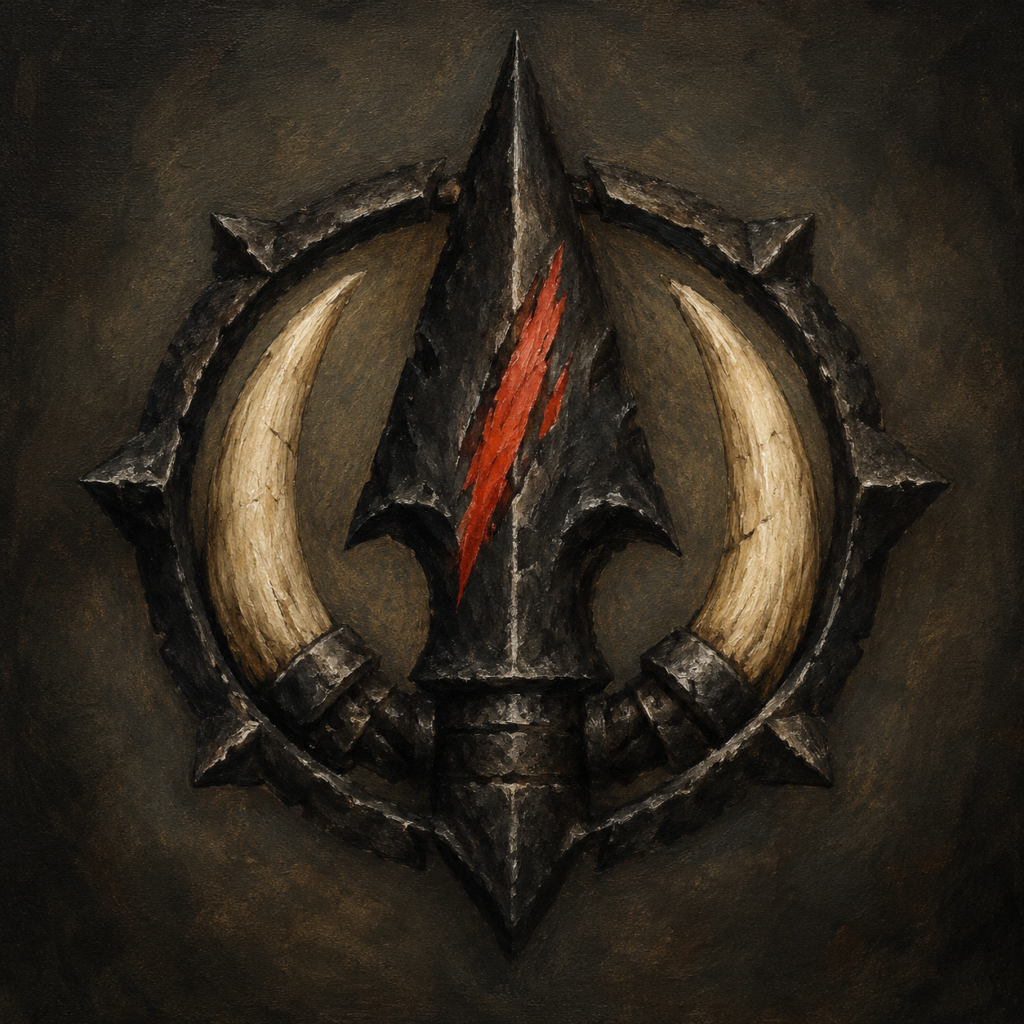
The Empire of the Orcs is a common foreign name for the political world created by Mhurak Stone-Blood’s Great Muster and for the successor powers born from its conquests.
Orcs call the empire the Great Muster, the Black-Standard Reach or Mhurak’s Reach. To them, it remains an unfinished command. Its territories have divided, its ruling bloodlines feud and many subject kingdoms have escaped direct rule, but the right of a sufficiently powerful khagan to gather the clans has never ended.
At its height, the Great Muster reaches from the Pacific frontier and northern China to Persia, the Rus lands, the Black Sea and the approaches to Central Europe. Its strength rests upon orc households, clan standards, remount herds, worg pacts, dire boar war-herds, blood-debts, captured forges and rulers capable of forcing ancient enemies to ride beneath one command.
In 1454, the imperial inheritance is divided among four recognised orc successor powers: the Eastern Fang Host, Ash-Standard Host, Red Fang Reach and Black Anvil Realm. Local khans, towns, subject rulers, clan-hosts and older regional identities survive inside and between those larger spheres, but they do not create additional co-equal successor empires.
These successor powers share ancestry, roads, titles, enemies and memories. Each also regards the others as rivals, prey, temporary allies or future subjects.
The Orc Imperial World at a Glance
| Feature | Campaign Information |
|---|---|
| Campaign Date | 1454 CE |
| Orc Names for the Empire | The Great Muster, the Black-Standard Reach and Mhurak’s Reach |
| Founder | Mhurak Stone-Blood, founder of the Great Muster |
| Dominant People | Orcs |
| Core Populations | Orcs and half-orcs ruling numerous conquered and tributary peoples |
| Ancestral Homeland | The First-Scar Mountains of the Altai and Sayan ranges |
| Imperial Heartland | The First-Clan Lands: the Mongolian Plateau, Orkhon Valley and northern Gobi |
| Seat of the Old Standards | Karakorum |
| Active Imperial Centre | The Great Camp, called the Moving Throne by foreigners |
| Supreme Orc Title | Khagan or Universal Fang |
| Regional Ruler | Khan |
| Great War Leader | Fanglord |
| Clan Ruler | Scar-Chief |
| Champion | Scar-Champion or Iron-Tusk |
| Elite Shock Rider | Gore-Rider or Dire Boar Rider |
| Dire Boar Trainer | Boar-Keeper |
| Spiritual Authority | First-Scar Seer |
| Master Smith | Forge-Keeper |
| Military Standard Officer | Standard-Bearer |
| Principal Successors | Eastern Fang Host, Ash-Standard Host, Red Fang Reach and Black Anvil Realm |
| Law | Scar-Law, witnessed oaths, blood-debt, clan precedent and the command of a recognised ruler |
| Languages | Orc, alongside Chinese, Persian, Turkic, Russian and other subject languages |
| Typical Alignment | Chaotic Evil |
| Greatest Strength | Mounted movement, brutal endurance, night campaigning, remount herds and the ability to gather rival standards beneath one victorious khan |
| Greatest Weakness | Blood-feuds, succession wars, pride, competing standards and obedience dependent upon visible strength |
Orcs of the Great Steppe
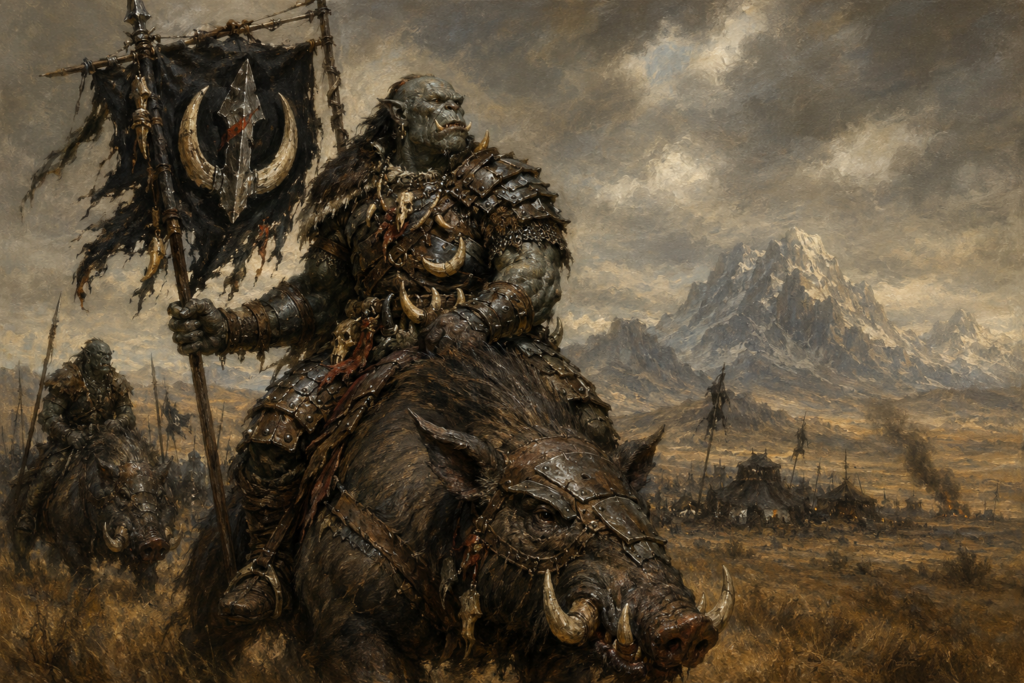
The orcs of Mhurak’s Reach are broad-built, heavy-boned humanoids with long muscular arms, thick necks and powerful jaws. Most stand slightly taller and considerably heavier than neighbouring humans.
Their faces are unmistakably nonhuman. Orcs possess low sloping brows, deep-set eyes, broad flattened noses, heavy cheekbones and lower tusks that project over the upper lip. Their ears are pointed but thick, often torn or clipped by battle, punishment or clan custom.
Skin tones include ash-grey, brown-grey, deep olive-grey, bruised purple-grey and charcoal. Coarse black or dark brown hair grows thickly on the scalp and body. Warriors commonly shave parts of the head while leaving a heavy mane, scalp-lock, war braid or tusk-bound tail of hair.
Old-blood mountain clans retain the strongest subterranean traits. Their eyes see well in darkness, and many find the glare of open daylight painful. They favour night marches, dawn attacks, smoked eye grease, deep-browed helmets and heavy felt hoods. Steppe armies still campaign beneath the sun, but darkness, storm and heavy cloud are regarded as favourable conditions.
Orc colours are blood red, rust, dirty yellow, black, dark green, bone white and greenish purple. Armour consists of practical iron, mail, layered felt, hardened hide, captured lamellar and plates cut from defeated armour. Decoration uses scars, tusks, teeth, coins, enemy braids, broken blades and pieces taken from captured standards.
The richest khans possess silk, gold, silver and finely decorated armour. Orc splendour remains heavy and threatening. Wealth is displayed as evidence of conquest.
Orc Names
Orc personal names are usually short enough to shout during battle. Hard consonants, deep vowels and abrupt endings are common. Names pass between males and females more freely than among many human cultures, although individual clans preserve their own traditions.
Common orc names include:
| Male Names | Female Names | Names Used by Any Orc |
|---|---|---|
| Krusk | Ovak | Ront |
| Thokk | Myev | Grask |
| Holg | Shautha | Keth |
| Imsh | Vola | Urgash |
| Henk | Yevelda | Murrak |
| Dench | Baggi | Vark |
| Kharuk | Ursha | Durg |
| Muzg | Korga | Rukha |
| Gell | Sutha | Vrosh |
| Mhurren | Ownka | Harg |
The founder’s birth name, Mhurak, is old even by orc standards. Later clans rarely give the name to a child. Some consider it sacred; others believe that any orc bearing it must either become a great conqueror or die before reaching adulthood.
An orc usually adds an earned epithet after a significant victory, injury, betrayal or conquest. A weak epithet invites mockery. A respected epithet can become more important than the birth name.
Common forms include:
- Krusk Ash-Standard;
- Ovak Black-Boar;
- Thokk Iron-Tusk;
- Myev Stone-Eye;
- Holg Long-Ride;
- Shautha Worg-Friend;
- Ront Broken-Chain;
- Keth Three-Scars;
- Ursha Dwarf-Bane;
- Murrak Gate-Breaker;
- Vola Night-Spear;
- Grask Boar-Blood.
Clan names describe an ancestral beast, scar, weapon, standard or remembered deed. Major clans include the Black-Tusk, Red-Boar, Stone-Maw, Split-Shield, Night-Worg, Ash-Hide, Broken-Chain and Iron-Spear clans.
A full formal name may combine personal name, epithet and clan:
- Ovak Black-Boar of the Red-Boar Clan;
- Krusk Ash-Standard of the Split-Shield Clan;
- Myev Stone-Eye of the Night-Worg Clan;
- Thokk Iron-Tusk beneath the Standard of Grushak.
What the Empire Means in 1454
The imperial command survives in three forms.
- Mhurak’s Great Muster: the united empire formed when the First Khagan brought rival clans beneath one standard.
- The Inherited Reach: the roads, titles, war customs, remount systems, garrisons and subject obligations left by the conquest.
- The Unfinished Command: the belief that a sufficiently powerful khagan has the right to gather the divided lands again.
Orcs interpret the division of the empire as evidence that Mhurak’s successors lacked the strength to hold what he took.
A khan who seizes Karakorum, defeats rival First-Fang bloodlines and gathers enough standards can declare a new Great Muster. Distant rulers then judge the claim according to fear, profit, kinship, ancestry and the number of armies already destroyed for refusing it.
Orc Titles and Rank
Orc titles identify reputation, household strength, ancestry and the right to command particular warriors. Rank can be inherited, earned, seized or lost.
| Title | Meaning |
|---|---|
| Khagan | A supreme ruler claiming authority over other khans. Mhurak is remembered as the First Khagan. |
| Universal Fang | A ruler claiming command over every orc clan and successor realm. |
| Khan | A ruler of several clans, a khanate or a major territorial host. |
| Fanglord | A great war commander capable of leading several standards in battle. |
| Scar-Chief | The recognised ruler of a clan or large extended household. |
| First Fang | The principal battlefield lieutenant of a khan or Fanglord. |
| Black-Standard Captain | An officer entrusted with a major imperial or clan standard. |
| Standard-Bearer | A warrior who preserves the visible identity, oaths and battlefield position of a clan. |
| Scar-Champion | A proven warrior whose victories give authority beyond inherited rank. |
| Iron-Tusk | A veteran champion, bodyguard or breaker of enemy lines. |
| Gore-Rider | An elite warrior trained to control a dire boar in battle. |
| Boar-Keeper | A specialist responsible for capturing, breeding, feeding and breaking dire boars. |
| Worg Rider | A warrior accepted by an intelligent worg and trusted for scouting, pursuit or night war. |
| First-Scar Seer | A keeper of ancestral memory, earth omens, curse lore and the oldest orc traditions. |
| Forge-Keeper | A master of weapons, ore, captured dwarf techniques and clan forge rights. |
| Road Warden | A commander responsible for messengers, wells, remount stations and the punishment of road thieves. |
| Oath-Keeper | A witness who remembers surrender terms, blood-debts and agreements between standards. |
A Scar-Chief who repeatedly loses warriors, pasture and captives can be challenged. A low-born Scar-Champion who brings victories, food and plunder may gather enough followers to become a Fanglord.
Territorial Authority
Orc authority follows people, animals, wells and fear rather than clean borders.
| Form of Control | Orc Meaning |
|---|---|
| Held Ground | The ruler’s warriors occupy the land, control its wells and punish anyone using it without permission. |
| Ground Beneath a Standard | A clan holds the territory while it continues to recognise a particular khan. |
| Tribute Ground | A town or subject ruler keeps local control while delivering goods, soldiers, hostages or captives. |
| Blood-Contested Ground | Two or more standards claim the same pasture, city, ford or caravan road. |
| Claimed Reach | A khan declares inherited authority but lacks the warriors to enforce it permanently. |
| Dead-Standard Ground | Old forts, stations and settlements remain shaped by an imperial command whose ruler and army have vanished. |
A foreign map may place a valley inside one khanate while three clans use it during different seasons. Orcs regard the remembered rights of those clans as the true boundaries.
The First Orc Clans
Orcs are an ancient nonhuman people born during the Age of Giants.
Their first ancestors are shaped beneath the mountains of northern Asia when giant mining and the forced labour of enslaved dwarves tear open the living foundations of the earth. Orc memory calls the wound the First Scar.
The first orcs awaken in darkness among collapsed mines, dying giant overseers, rebellious dwarf slaves, chained prisoners and creatures released from deeper stone. Their first inheritance is hunger, darkness, iron, blood and the knowledge that anything undefended will be taken.
The earliest clans fight for:
- forge chambers and weapon stores;
- underground water;
- giant food vaults;
- routes to the surface;
- captured dwarf smiths;
- the right to bury their dead in stable stone;
- control of caverns where the Wounded Earth still speaks.
The ancient hatred between dwarves and orcs begins inside the giant slave system. Dwarves are enslaved miners, smiths and rebels competing with the newborn orcs for escape, food and captured forges.
After both peoples emerge from giant domination, the conflict continues. Dwarves remember stolen forge halls and murdered kin. Orcs remember dwarf blades, sealed tunnels and clans left to starve behind collapsed stone.
Mhurak, First Khagan
Mhurak is born thousands of years after the First Scar. He finds an ancient people divided by pride, feud and rival standards and forces them to become something greater and more terrible.
Before Mhurak, the eastern grasslands contain many powerful orc clans. Each possesses burial grounds, hunting ranges, worg pacts, boar-herds, ancestral enemies and remembered injuries. Scar-Chiefs form temporary alliances but abandon them when plunder is divided badly or an old blood-debt returns.
Mhurak understands that an orc host cannot conquer the world while every warrior obeys only inherited kin.
He kills chiefs who refuse submission, adopts useful enemies, elevates low-born champions and redistributes warriors into new military households. He places proven strength above empty ancestry and makes betrayal of the war host a greater offence than many older clan feuds.
Before the unification, Mhurak Stone-Blood carries the blackened standard of a clan destroyed by its own allies and refuses to replace it. After the final assembly of the eastern clans, that battered standard becomes the first imperial banner.
In 1206, the gathered standards proclaim him Khagan, Universal Fang and ruler of the Great Muster.
His authority uses the strengths of orc society:
- clan warriors remain bound to recognised standards;
- Scar-Champions gain rank through victory;
- Fanglords command mixed hosts drawn from several clans;
- Road Wardens guard wells, remounts and messengers;
- First-Scar Seers witness oaths and interpret ancestral approval;
- Forge-Keepers preserve captured weapons and specialist skills;
- Boar-Keepers maintain the rare dire boar war-herds;
- hostages make distant submission visible;
- plunder rewards obedience and exposes weak leadership;
- mass punishment teaches other settlements what resistance costs.
Mhurak gives orc violence direction, distance and memory.
The Great Muster
The Great Muster is both an army and an imperial condition. It exists when enough clans place their standards beneath one khagan.
The host advances in separated columns rather than as one crowded mass. Scouts range far ahead. Remount herds allow riders to change horses repeatedly. Road Wardens mark water and fodder. Subject guides identify crossings, towns and weak points in walls.
Captured engineers provide siegecraft. Dwarven slaves and Forge-Keepers repair armour and construct heavy weapons. Chinese, Persian and other subject specialists maintain engines, records and supplies. Every part of the system serves the same purpose: move the host, feed the host and break whatever refuses the khagan.
The Great Muster rewards surrender when surrender is useful. A city that opens its gates may retain its market, walls and local ruler beneath tribute. A city that resists may be destroyed so thoroughly that the next five cities surrender at the sight of approaching dust.
Orc Conquest
Orcs wage war for land, submission, captives, vengeance, loot, prestige and the right to command.
A strong khan preserves useful institutions inside conquered territory. Tax collectors continue to count grain. Irrigation officers maintain canals. Merchants continue to trade. Local judges hear disputes among subject peoples.
These systems survive because they feed the host and enrich the khan.
A community that submits may provide:
- livestock and remounts;
- grain and winter fodder;
- weapons, iron and armour;
- guides and interpreters;
- soldiers and labourers;
- hostages from ruling families;
- smiths, healers and engineers;
- captives from condemned populations.
A community that resists may face massacre, rape, enslavement, starvation and the destruction of its surrounding land. Fields are burned, animals driven away, wells seized and bridges destroyed. Orc commanders may leave survivors deliberately so they can carry the story ahead of the army.
Gold buys passage, postpones an attack or satisfies the demand of one khan. Land, captives, vengeance and dominance continue to draw other clans.
Half-Orcs of Mhurak’s Reach
Half-orcs are found throughout the lands conquered by the Great Muster.
Many descend from rape, slavery and the seizure of women during war. Others descend from later unions in frontier settlements, military households or subject cities. Their communities inherit unequal status, divided loyalties and memories of coercion.
Orcs judge half-orcs by household, strength and usefulness. A half-orc raised inside a powerful clan may become a warrior, interpreter, Gore-Rider or Scar-Champion. Another may remain an enslaved labourer, mistrusted dependant or disposable levy.
Human communities may fear half-orcs as the visible descendants of conquest. Orc elites may consider them less dependable than full-blooded clan kin. Some half-orcs adopt orc identity completely. Others hate the empire, protect human relatives or seek power wherever they can seize it.
The Breaking of the Great Muster
Mhurak’s descendants inherit an empire too large for weak rulers.
The Great Muster fractures into four principal orc successor powers: the Eastern Fang Host, Ash-Standard Host, Red Fang Reach and Black Anvil Realm. Foreign chronicles often use inherited labels such as Yuan, Golden Horde, Chagatai and Ilkhanate for territories, dynasties or local khanates inside the shattered imperial world, but those are not additional co-equal successor empires.
The successor khans share blood, custom and military tradition, but every succession creates opportunities for rivals. Brothers murder brothers. Mothers hide heirs. Standard-Bearers change allegiance. Subject cities stop paying tribute when no nearby Fanglord can punish them.
Orc rule loses China to the Ming, former Ilkhanate territories fragment, western steppe khanates divide and Central Asian inheritances split between competing rulers. These upheavals reshape local politics without creating new fifth, sixth or seventh successor empires beyond the four recognised powers.
Orc war-singers blame failed khans rather than Mhurak’s command.
The Struggle of 1454
In 1454, Grushak Iron-Tusk leads one of the strongest Oirat-derived confederacies in the First-Clan Lands. His exact alignment among the four recognised successor powers remains contested.
Grushak has destroyed rival hosts, defeated a great Ming army and captured the Ming emperor during the Tumu campaign. His warriors call him a Great Fang and speak openly of placing every eastern standard beneath his command.
His claim remains contested. Grushak possesses victory, captives and warriors, while rival First-Fang bloodlines possess descent from Mhurak. Oirat Scar-Chiefs also fear that a permanent Iron-Tusk dynasty will reduce their own houses to servants.
Orcs recognise Grushak’s strength while plotting to tear him down. A ruler proves the right to command by surviving such plots.
Elsewhere:
- Muzg Red-Fang II rules a powerful eastern khanate and claims the heritage of the Eastern Fang Host;
- Krusk Ash-Standard claims the central inheritance of the Great Horde;
- Ovak Black-Boar rules the Crimean Khanate;
- Myev Stone-Eye holds Kazan through clan strength, river forts and political hostages;
- Holg Long-Ride is one of the most influential Nogai Fanglords;
- former Ilkhanate households preserve rival claims throughout Persia and Central Asia.
The First-Clan Lands
The First-Clan Lands form one of the oldest heartlands of the post-Muster steppe world. Foreigners sometimes describe them with inherited names such as Mongolia, but orcs name the country through clans, rivers, mountains, wells and burial grounds. Their sovereign loyalties are understood through the four recognised successor powers rather than a “Northern Yuan” state.
Grassland wealth is measured in living things: horses, sheep, cattle, goats, dire boars, worg allies, warriors, children, slaves and the number of dependants a household can feed through winter.
A wealthy Scar-Chief displays thousands of animals, dozens of armed relatives, captured standards and enough dried meat to campaign after the first snow.
Clan territory includes:
- summer grazing;
- winter shelter;
- known wells;
- salt grounds;
- river crossings;
- burial mounds;
- hunting country;
- dire boar rooting grounds;
- roads claimed by ancestral victory.
Orcs recognise these boundaries through cairns, skull posts, cut stones, scorched trees and memory. Crossing one without permission may be treated as theft.
The Orkhon Valley
The Orkhon Valley is one of the principal lands of imperial memory. Old capitals, gathering grounds, graves and roads stand along its rivers and grasslands.
Khans seek the valley because it provides pasture and legitimacy. A Muster of Standards held in the Orkhon carries greater weight than the same gathering held in an unknown camp.
Control remains difficult. The valley can be entered from several directions, and a rival host may seize its winter grounds after the previous ruler moves away.
Karakorum, Seat of the Old Standards
Karakorum remains the ceremonial centre of Mhurak’s Reach.
Its ruins and surviving districts contain palaces, markets, shrines, workshops, storehouses and compounds once occupied by foreign merchants and subject priests. Its importance comes from what it remembers.
Orc claimants display captured standards, chained enemies, tribute animals and ancestral relics within the city. A ruler unable to protect the approaches to Karakorum gains little from occupying its walls.
Foreign envoys call Karakorum the capital. Orcs call it the Seat of the Old Standards.
The Great Camp
The true centre of an active orc realm is the ruler’s Great Camp. Foreign chroniclers call it the Moving Throne.
The Great Camp is a travelling concentration of power.
At its centre stand:
- the khan’s heavy audience tent;
- the principal clan and imperial standards;
- the Fang Moot;
- tribute chests and captured relics;
- hostages from subject rulers;
- First-Scar Seers and Oath-Keepers;
- the guarded tents of heirs and rival bloodlines;
- remount lines and messenger horses;
- Forge-Keeper wagons and portable workshops;
- dire boar pens surrounded by heavy timber barriers;
- slave pens and prisoner enclosures.
A weak khan may travel with a few hundred warriors. A powerful khagan leads a moving settlement of thousands, surrounded by herds, merchants, subject soldiers, slaves, worg packs and a small number of carefully guarded war-boars.
The camp smells of horse sweat, boar musk, smoke, blood, wet felt, meat and iron. Its position changes with war, pasture and danger. The ground left behind contains butchered bones, broken arrows, churned mud, deep boar tracks, fire-blackened earth and the graves of animals unable to continue.
The First-Scar Mountains
The Altai and Sayan ranges contain the oldest orc territories and the caverns from which the first clans emerge.
Lowland khans claim authority over the mountains, but First-Scar clans acknowledge limits to any outside command. A Universal Fang may summon their warriors for war. They may still refuse orders concerning ancestral shrines, sealed caverns or dwarf-held forges.
The mountain country contains:
- giant roads cut through solid rock;
- collapsed slave mines;
- lost dwarven forge chambers;
- ettin-held bridges and watch forts;
- First-Scar shrines marked with iron and bone;
- worg territories bound to particular clans;
- wild dire boar herds descended from giant breeding pits;
- star-iron deposits;
- sealed prisons from the Age of Giants;
- ancestral fissures where Seers listen to the Wounded Earth.
Mountain orcs are often heavier, paler and more sensitive to bright sunlight than their steppe kin. They wear deep helmets, dark eye paint and thick hides. Their lower tusks are frequently capped with iron after a recognised victory.
Most imperial Gore-Riders come from the mountain valleys, wooded foothills and broken uplands surrounding the First Scar.
The Forest-Steppe and Sayan Marches
North of the open grasslands, cold forest and broken meadow replace the wide steppe.
Orc clans here maintain smaller horse herds and rely more heavily upon hunting, trapping, river travel, worg packs and dire boars. Warriors use bows, axes, spears, sledges and narrow boats.
Forest Scar-Chiefs control fur routes, hidden iron deposits, boar rooting grounds and crossings into lands haunted by ancient spirits. Their warbands excel at ambush and pursuit beneath tree cover.
Dire boars move through forest, scrub and broken hills more readily than tightly formed horse units. Gore-Riders are therefore commonest in these marches, although even powerful clans maintain only a few.
The Northern Gobi
The northern Gobi contains gravel plains, bare stone, cold desert, sparse grazing and widely separated water.
Desert Scar-Chiefs control the wells.
Hidden stores of dried meat, fodder, bowstrings and water allow local warbands to cross ground that kills unprepared armies. Revealing the location of such a store to a rival creates a blood-debt.
Dire boars endure poor weather but consume too much food and water for most long desert campaigns. Gobi Gore-Riders are usually attached to permanent wells, fortified passes and caravan towns rather than mobile hosts.
The Gobi also contains:
- abandoned Yuan road stations;
- giant skeletons;
- buried shrines;
- petrified forests;
- underground water chambers;
- vast burrowing predators;
- ruined camps whose inhabitants vanished without tracks.
The Ming Frontier
The Ming Empire controls China south of the principal frontier. Orc clans, Oirat-derived hosts and forces aligned with the four recognised successor powers remain active beyond its defended passes.
The Great Wall is a chain of walls, forts, towers and defended routes of varying age and strength.
Orc commanders study gaps, dry riverbeds, mountain tracks and lightly defended stretches between strongpoints. They attack supply lines, seize livestock and disappear before a large Ming force can gather.
Frontier markets provide grain, cloth, tea, weapons and worked metal in exchange for horses, animals, furs and captives. Ming officials use trade to reward cooperative khans. Orc chiefs interpret a closed market as insult and threat.
The Tumu campaign remains one of the greatest recent orc victories. Grushak Iron-Tusk’s host isolates and destroys a much larger Ming army and captures its emperor. Scar-Champions still recite the battle when arguing that settled armies become weak once drawn away from walls and supplies.
Gore-Riders appear in attacks against frontier gates, wagon barriers and fortified villages. Their dire boars smash through light timber works that stop ordinary cavalry.
The Four Oirats
The Four Oirats are a western confederation of powerful orc clans.
Each major clan maintains its own Scar-Chiefs, standards, herds, worg pacts, Boar-Keepers and ancestral claims. They ride together when a ruler such as Grushak Iron-Tusk provides victory and plunder. They separate when obedience threatens their own rank.
Their warriors favour heavy bows, sturdy steppe horses, layered armour and disciplined movement between separated columns. Oirat Fanglords are especially skilled at trapping armies far from water and forcing enemies to march where the orcs want them.
The Red-Boar Clan provides many of Grushak’s Gore-Riders. Their leader, Thokk Iron-Tusk, rides a scarred dire boar named Wall-Eater. The beast carries a heavy hide saddle, chest armour and iron caps over the outer curve of its tusks.
Grushak’s attempt to turn military supremacy into a permanent Universal Fangship creates fear among the chiefs whose warriors made him powerful.
The Eastern Fang Khanate
The Eastern Fang Khanate, called Orcistan by many foreign merchants, descends from the eastern Chagatai inheritance.
Muzg Red-Fang II rules the principal khanate in 1454. His command reaches unevenly across the Ili Valley, the Tian Shan roads, Aksu, Kashgar, Turfan and neighbouring oasis routes.
The khanate contains:
- mounted orc clans controlling grassland and mountain pasture;
- half-orc military households occupying frontier districts;
- fortified oasis cities dependent upon irrigation;
- subject merchants, farmers and craftspeople;
- local governors who obey while the khan remains strong;
- caravan routes joining China, Transoxiana and India;
- Gore-Rider households guarding mountain passes and city gates.
Fanglords maintain camps outside major settlements, hold hostages from merchant families and move warriors between oases whenever tribute weakens.
The cities provide grain, wealth and specialist labour. The clans provide the force that decides who owns them.
The Great Horde
The Great Horde claims the principal inheritance of the western Golden Horde. Its ruler, Krusk Ash-Standard, controls or contests the lower Volga, the Caspian steppe, Sarai and the tribute routes leading towards the Rus lands.
Western orcs have lived among river cities, farming districts and subject populations for generations, but their ruling culture remains built around khans, military households and clan cavalry.
The Great Horde’s power depends upon:
- Volga crossings;
- open pasture;
- tribute from subject rulers;
- access to Sarai;
- the loyalty of mobile Scar-Chiefs;
- the ability to punish Crimea, Kazan and lesser claimants.
Dire boars are rare on the open western steppe. Krusk keeps a ceremonial guard of twelve Gore-Riders whose mounts descend from beasts taken during the conquest of the Caucasus.
The Crimean Khanate
The Crimean Khanate controls much of the Crimean Peninsula and the neighbouring steppe beneath Ovak Black-Boar.
Ovak earns her epithet by killing the previous khan while both are hunting a wild dire boar in the Crimean hills. She returns to camp riding the wounded beast and carrying the dead ruler’s standard.
Crimean orcs combine steppe warfare with fortified settlements, agriculture and Black Sea commerce. Their khans wear richer armour and employ more scribes and merchants than many eastern rulers, but authority still depends upon mounted clans and control of the northern approaches.
Slave raiding is central to the frontier economy. Captives taken from the Rus lands, neighbouring settlements and defeated clans are sold, exchanged, absorbed into households or transported through coastal markets.
The wooded Crimean highlands support several dire boar herds. Ovak’s Black-Boar Guard uses them as heavy mounts during attacks against gates, infantry formations and forest roads.
The Kazan Khanate
The Kazan Khanate occupies the middle Volga and rules a wealthy region of fortified towns, forests, farms and river trade.
Myev Stone-Eye maintains clan households alongside a settled fortress court. Her warriors use cavalry where the country opens, but also employ infantry, river craft, woodland scouts and fortified crossings.
Many Kazan orcs wear heavier mail, carry broad axes and fight dismounted more readily than eastern steppe riders. Forest conditions make long mounted encirclements difficult.
Kazan possesses some of the largest dire boar herds outside the First-Scar Mountains. Its Gore-Riders patrol forest roads, break shield walls and defend river crossings where horsemen have little room to manoeuvre.
Muscovy, rival khans and internal Scar-Chiefs continually test Myev’s strength.
The Nogai Clans
The Nogai domains stretch across the steppe north of the Caspian Sea.
They are a shifting mass of clans, herds and war households whose Scar-Chiefs form alliances according to pasture, marriage, revenge and profit.
Holg Long-Ride is among the most influential Nogai Fanglords. He commands thousands of horses but only three dire boars, each kept as a sign of prestige and released during close assaults rather than long campaigns.
Nogai Fanglords serve as allies, raiders, guides and kingmakers. A khan who hires one Nogai clan may discover that its oldest enemy has joined the opposing army.
The absence of one permanent court makes the Nogai difficult to conquer. Killing one chief rarely binds the next.
The Former Ilkhanate
The Ilkhanate once rules Persia and neighbouring lands as the southwestern successor of the Great Muster.
By 1454, the unified dynasty has fallen, but its orc inheritance remains visible.
Former Ilkhanate lands contain:
- orc military households descended from old garrisons;
- half-orc frontier communities;
- Fanglords serving Timurid rulers;
- exiled khans claiming the Blood of Mhurak;
- abandoned road stations and fortified caravanserais;
- captured black standards kept as royal trophies;
- Forge-Keeper families preserving Persian and dwarven techniques;
- dire boar breeding pits in the Caucasus and northern Persian uplands;
- restoration movements seeking a new southwestern khagan.
These households have absorbed local armour, horses, language and siegecraft. They remain recognisably orcish in rank, feud, war culture and the belief that a strong enough khan can reclaim the old Reach.
The Levantine Limit
Ilkhanate armies reach the Levant but fail to establish permanent orc rule.
At Ain Jalut, the Catfolk-led armies of Kemet and their allies halt the western advance. Later orc forces raid and invade the region, but distance, divided command and determined resistance prevent lasting conquest.
Orc war-singers blame divided Fanglords, poor ground, weak allied standards and commanders who failed to finish the battle.
Kemet remembers the victory as proof that the Great Muster can be broken.
Clan and Household
The orc household includes blood kin, adopted warriors, dependants, clients, hostages, slaves and captured specialists.
Several households gather beneath one clan standard. The standard carries the identity and remembered authority of the clan.
Its markings show:
- the scars and victories of earlier chiefs;
- the ruler currently obeyed;
- recognised worg pacts;
- ownership of dire boar breeding stock;
- ancestral enemies;
- pastures and wells claimed by conquest;
- surrender terms the clan is authorised to accept;
- blood-debts awaiting payment.
A clan standard may incorporate hide, blackened iron, horsehair, boar bristles, tusk caps, enemy braids, dwarf chain, broken weapons and strips cut from defeated banners.
Losing the standard can destroy a clan’s political identity. Capturing one may be more valuable than killing its Scar-Chief.
Scar-Law
Scar-Law binds memory to witnesses, marks, objects and visible consequences.
Orcs distrust laws that exist only as writing in a distant archive. An agreement must be remembered by living witnesses and attached to something that can be displayed: a scar, cord, weapon, hostage, marked bone, dire boar tusk or strip of standard cloth.
Scar-Law remains personal, contested and enforced through strength.
Blood-Debt
A recognised injury creates a debt of blood, livestock, captives, service or land. The injured household decides what repayment is sufficient unless a stronger ruler imposes terms.
Blood-debts pass between generations. A young warrior may inherit an enemy whose name was first cut into a standard before the warrior’s birth.
Envoys
A recognised envoy carries a marked arrow, iron cord, notched blade or fragment of a ruler’s standard.
Killing the envoy is an attack upon the ruler whose mark they carry. The envoy may still be searched, threatened, detained or forced to wait outside the Great Camp.
Surrender
Surrender must be visible. Gates are opened, fires extinguished, standards lowered and hostages delivered.
A khan who accepts surrender may demand animals, grain, labour, weapons, captives and soldiers. A ruler who repeatedly kills communities after formally accepting their submission weakens the value of every later promise.
The restraint is practical and temporary.
Challenge
An orc ruler who appears weak may be challenged by kin, champions or subordinate Scar-Chiefs.
The challenge may take the form of single combat, a trial raid, a contest of followers, the breaking of a wild dire boar or open war between standards.
Feud During the Great Muster
A khagan may command that private feuds cease while the Great Muster rides.
A warrior who continues a forbidden feud weakens the whole host and may be killed as an oath-breaker. Once the campaign ends, the suspended blood-debt returns unless formally settled.
Slavery
Slavery is woven through the orc imperial world.
Captives herd animals, dig wells, repair roads, work fields, carry baggage, mine ore and build fortifications. Skilled slaves are attached to powerful households and guarded carefully.
Orcs particularly value:
- dwarven smiths and miners;
- human siege engineers;
- Chinese armourers and scribes;
- Persian physicians and administrators;
- experienced caravan guides;
- animal handlers capable of surviving among dire boars;
- enemy warriors willing to change standards.
A useful captive may live for years and gain limited authority inside a household. A captive judged useless, defiant or dangerous may be killed immediately.
Enslaved dwarves remain a potent source of hatred. Orc Forge-Keepers prize their knowledge while dwarf holds consider every captive smith an ancestral injury.
Trade, Tribute and Plunder
Orc wealth comes from herds, tribute, slaves, tolls, subject agriculture and war.
The Silk Road is valuable because it carries what the grasslands produce poorly: grain, silk, armour, tea, medicine, worked metal and luxury goods.
Orc rulers protect merchants when protection brings greater wealth than robbery. Road Wardens punish unsanctioned raiders because those raiders steal from the khan as much as from the caravan.
Major goods include:
- horses and remounts;
- sheep, cattle and goats;
- trained dire boars and valuable breeding animals;
- felt, hides, furs and boar bristles;
- iron, armour and weapons;
- grain and preserved food;
- silk, tea, dyes and medicines;
- gold, silver and precious stones;
- captives and enslaved labour;
- information and political hostages.
Trade and raiding follow the same roads. A Fanglord may guard a caravan carrying his token and attack another carrying the mark of a rival khan.
Orc Religion
Orc belief begins with the First Scar.
The oldest clans venerate the Wounded Earth, the Deep Mother, mountain powers, buried ancestors, forge spirits, storms, darkness and the guardians of particular herds or wells.
Mhurak enters this sacred world as the greatest imperial ancestor. He is remembered as the First Khagan who teaches divided standards to move as one host.
Orcs invoke him when:
- calling a Great Muster;
- protecting an envoy;
- opening an imperial road;
- judging a rival khan’s claim;
- dividing conquest between standards;
- promising to finish an old campaign.
First-Scar Seers possess greater authority over ancient matters. They interpret fractures in stone, underground thunder, ancestral dreams, iron that sweats blood and curses attached to dwarf relics.
Other orc spiritual figures include:
- storm-callers;
- bone-diviners;
- war-singers;
- forge-speakers;
- road-blessers;
- oath-breaker hunters;
- Boar-Seers who read omens in tusks, rooting marks and the rage of war-herds.
Orcs fear magic that changes memory, face or identity because it threatens the witnesses and visible marks upon which Scar-Law depends.
Dire Boars
Dire boars are immense, foul-tempered beasts standing higher at the shoulder than many horses. A full-grown animal can reach twelve feet from snout to rump and weigh close to a ton.
Their bodies are dense and steep-backed, with heavy shoulders, short powerful necks and long tusks capable of tearing through mail, timber and flesh. Thick hide, matted bristles and layers of scar tissue protect the chest and flanks.
Dire boars eat roots, carrion, fungi, grain, animals and sometimes their own handlers. Their appetite makes them difficult to maintain during long campaigns. Their aggression makes ordinary stables impossible.
Orcs prize them because the qualities that make them troublesome also make them terrifying in battle.
Boar-Keepers
Boar-Keepers capture young dire boars or isolate piglets from wild herds after killing or driving away the adults. Few handlers survive long enough to master the work.
A trained war-boar recognises its own keeper, rider and feeding calls. It tolerates unfamiliar orcs only when chained, muzzled or surrounded by handlers carrying barbed poles.
Boar-Keepers commonly remove one finger after surviving their first successful capture. Veteran keepers wear strings of broken tusk tips, iron snout rings and heavy hide coats covered in old gore scars.
War-Boar Equipment
A dire boar’s harness uses broad leather and felt straps reinforced with chain. Narrow horse saddles injure the animal and slip across its steep back, so Gore-Riders use deep forked saddles fixed around the chest and belly.
Battle equipment may include:
- layered hide over the shoulders;
- mail protecting the neck and upper chest;
- iron or horn plates above the eyes;
- tusk caps that prevent splintering;
- short blades attached to the outer harness;
- clan colours worked into the bristles with clay, ash or blood;
- heavy reins connected to a reinforced snout ring.
Complete metal barding is uncommon. Excess weight overheats the animal and restricts the violent movement that makes its charge effective.
Gore-Riders
Dire Boar Riders are called Gore-Riders, Boar-Fangs or Great-Tusk Riders. They form a rare elite rather than the principal cavalry of the empire.
Horses remain faster, easier to feed and better suited to long-distance steppe warfare. Worgs provide intelligence, night vision and skilled pursuit. Dire boars provide raw impact.
Gore-Riders are used to:
- break shield walls;
- smash through light gates and wagon barriers;
- attack infantry in forest or broken ground;
- drive through narrow streets during the storming of a town;
- terrify horses and inexperienced troops;
- guard mountain passes and fortified camps;
- carry Fanglords into close battle;
- pursue enemies through scrub too dense for formed horsemen.
A Gore-Rider normally carries a heavy spear, broad axe, curved sword or cluster of javelins. The rider directs the first charge and then fights above the confusion while the boar bites, tramples and tears at anything nearby.
The finest Gore-Riders develop a brutal partnership with their mounts. They recognise the animal’s rage, pain and feeding impulses and use those reactions rather than expecting perfect obedience.
Many riders die during training. Others are killed when a wounded boar turns upon its own unit. Orcs consider both risks evidence that only powerful warriors deserve the title.
Gore-Rider Prestige
Breaking a wild dire boar is a recognised path to rank. A low-born warrior who rides one before witnesses may earn a place among a khan’s Scar-Champions.
Important riders often take boar epithets:
- Black-Boar;
- Tusk-Breaker;
- Red-Gore;
- Boar-Blood;
- Wall-Eater;
- Iron-Snout;
- Deep-Root;
- Shield-Ripper.
The death of a famous mount is commemorated by mounting its tusks upon the rider’s standard. Eating a respected war-boar without the rider’s permission is a blood offence.
Orc War
Orc warfare combines the speed of the steppe with the savagery of a people whose oldest traditions begin in tunnels, slave pits and wars over food.
A major host may contain:
- mounted orc archers;
- armoured lancers;
- shield-bearing infantry;
- Orc Worg Riders;
- Dire Boar Gore-Riders;
- Standard-Bearers;
- Scar-Champions and Iron-Tusks;
- First-Scar Seers;
- subject archers and spearmen;
- captured siege engineers;
- ogres and ettins;
- Forge-Keeper wagons;
- large remount and livestock herds.
A small hungry warband may rush directly into battle. Armies descended from Mhurak’s Great Muster scout, divide, withdraw and return. They attack at night, during storms and against exhausted enemies. They destroy water and fodder. They feign retreat and draw pursuers away from fortifications.
Horse archers isolate and exhaust the enemy. Worg Riders hunt scouts and fugitives. Gore-Riders strike once the opposing formation has lost cohesion.
Their discipline is the fierce temporary unity of warriors who trust their Fanglord to bring victory, plunder and survival. When that trust breaks, the army may fragment with terrifying speed.
The Ming Empire
The Ming Empire is the greatest settled enemy of the eastern orc khanates.
Its walls, cities and enormous armies present targets too strong for ordinary clan raids. Orc rulers therefore exploit distance, weather and political division.
Ming officials attempt to control the frontier by recognising selected khans, opening markets and turning rival clans against one another. Orc rulers accept titles and gifts while continuing to measure the Ming as an enemy and source of wealth.
The victory at Tumu proves that an orc host can destroy a greater human army once it is separated from walls and supplies.
The Timurid Realms
Timurid rulers dominate much of Transoxiana, Afghanistan and Persia.
They inherit lands once held by the Chagatai and Ilkhanate successors and employ orc military households descended from earlier garrisons. These households may serve loyally while waiting for a chance to place their own khan above the Timurid throne.
The Eastern Fang Khanate raids Timurid territory, supports rival claimants and competes for mountain roads, dire boar country and oasis cities.
The Rus Lands and Muscovy
Western orc khanates raid, tax and intervene among the Rus principalities.
Forests, rivers and fortified towns make this different from war on the open steppe. Kazan and Great Horde warriors use river craft, guides, dismounted fighters and Gore-Riders alongside cavalry.
Muscovy grows increasingly strong and resists western tribute. Orc rulers regard this resistance as rebellion against an old imperial command.
The Ninefold Dominion
Hobgoblins belong to the separate Ninefold Dominion.
Hobgoblins build permanent ranks, legal categories, garrisons and siege institutions. Their soldiers obey offices and recorded commands.
Orcs obey leaders, households and standards. Their unity is personal, violent and vulnerable to challenge.
Hobgoblins consider orc rule wasteful and unstable. Orcs consider hobgoblins weak creatures hiding behind records, walls and inherited offices.
Both seek conquest. Neither accepts the other’s claim to universal dominion.
Dwarves
Dwarves are the oldest enemies of the orcs.
The hatred predates Mhurak, the Great Muster and every human empire. It begins inside the giant slave mines of the First Scar.
Orcs accuse dwarves of sealing tunnels, hoarding weapons and abandoning other slaves to die. Dwarves accuse orcs of seizing liberated forges, murdering rebels and enslaving surviving smiths.
The shared past contains enough blood to sustain both memories.
Capturing a dwarven hold, relic or master smith brings enormous prestige to an orc khan. Dwarves treat every orc occupation of a forge as a desecration requiring eventual revenge.
Elves
Elves resist orc expansion into forests, river valleys and wooded uplands.
They shelter escaped captives, support dwarf enemies and use terrain that limits cavalry. Orc war-singers preserve stories of elven ambushes, poisoned arrows and chiefs killed beneath trees where mounted warriors could not manoeuvre.
Orcs regard elves as graceful-looking but treacherous ancestral enemies whose beauty conceals old hatred.
Worgs
Worgs are intelligent allies rather than ordinary mounts.
A worg chooses whether to accept a rider. The pact binds a particular pack and clan through food, territory, vengeance and witnessed obligation.
Worg Riders serve as night scouts, hunters and pursuers. Their mounts can reason, report what they see and refuse suicidal orders.
A Fanglord who mistreats a pack’s young or wastes worg lives may be abandoned or hunted by former allies.
Travelling Through Orc Lands
Travellers crossing the orc imperial world must know who owns the water.
They should learn:
- which standard controls the nearest wells;
- which Scar-Chief claims the pasture;
- which khan that chief currently follows;
- whether the khan is alive;
- what toll is expected;
- which blood-feuds close the road;
- whether dwarves or elves require named protection;
- whether a nearby clan keeps dire boars;
- how far the nearest orc scouts can ride before sunset.
Orc lands rarely feel empty to orcs. Riders recognise smoke, disturbed grass, distant birds, deep rooting marks and herd tracks that reveal movement to trained eyes.
A patrol may watch travellers for hours before appearing. By the time the orcs approach, they may already know the number of mounts, visible weapons, injured companions and likely wealth of the party.
Places of Interest
The First Scar
The vast mountain wound beneath which the first orc clans awaken. Giant mines, dwarf halls, wild dire boar herds and ancestral caverns remain contested beneath the Altai.
Karakorum
The Seat of the Old Standards. Merchants, spies, claimants and war-singers gather among the remains of the old imperial centre.
The Great Camp
The moving centre of a powerful khan’s rule. Its arrival transforms empty grassland into the centre of imperial politics.
The Field of Broken Standards
A burial ground created after a succession war. The dead repeat accusations at night, and pieces of defeated banners push through the soil after heavy rain.
The Red Salt Wells
A chain of Gobi wells whose water has turned the colour of rusted blood. First-Scar Seers believe the wound lies far below the desert.
The Seven-Witness Gate
A fortified entrance near Kashgar where caravan agreements are witnessed by seven parties and secured with seven different tokens.
The Ash Market of Sarai
A market among the damaged districts of the old western capital. Horses, slaves, dire boars, weapons, relics and information change hands beneath rival standards.
The Tumu Road
The road associated with Grushak Iron-Tusk’s destruction of the Ming army. Orc Scar-Champions make pilgrimages to the battlefield, while Ming patrols watch for new gatherings.
The Black Forge Caravan
A moving forge worked by orc Forge-Keepers, half-orc labourers and enslaved dwarves. Several khans claim ownership, while the dwarves prepare to destroy it.
The Boar Pits of Kharuk
Deep timber-walled enclosures built inside an abandoned giant quarry. Boar-Keepers capture and break dire boars here. The oldest breeding sow has learned how to open the inner gates with her tusks.
Wall-Eater’s Grave
A stone mound raised over the remains of a famous dire boar that carried three generations of Red-Boar champions. Its iron-capped tusks were stolen before burial, beginning a feud between five clans.
Regional Dangers
- raids for animals, captives and prestige;
- succession wars between rival khans;
- blood-feuds that reopen without warning;
- stolen or forged safe-conduct tokens;
- dry wells and exhausted pasture;
- night attacks by Worg Riders;
- charges by Dire Boar Gore-Riders;
- wild war-boars escaping their handlers;
- ettins occupying giant roads;
- dwarven armies reclaiming First-Scar forges;
- ancestors haunting stolen standards;
- burrowing monsters beneath the Gobi;
- orc armies destroying every food source around a defended settlement;
- Fanglords forcing travellers to choose between rival standards.
Adventure Hooks
The Empty Great Camp
A khan’s Great Camp is found abandoned. The slaves, hostages, herds, dire boars and treasure remain, but the khan, Iron-Tusks and principal standards have vanished.
The Last Command of Mhurak
An ancient road station opens. Its undead messenger carries an order from the First Khagan addressed to a ruling clan now divided into seven murderous branches.
The First Scar Opens
An earthquake exposes a giant mine beneath the Altai. Orc Seers, dwarf reclaimers, ettins, wild dire boars and rival Forge-Keepers converge upon it.
The Broken Envoy
A hated orc envoy carries the genuine iron cord of a powerful khan. Killing him saves his intended victims but may bring the full vengeance of the Great Camp.
The Seven Black Standards
Seven khans seek the same imperial standard. Each promises wealth and protection. Each plans to kill every other claimant once it is recovered.
The New Universal Fang
A young khan begins reopening the old roads, defeating rival Fanglords and forcing hostile clans into one host. The divided orc empire may be approaching its first true reunification since Mhurak.
The Black-Boar Challenge
Ovak Black-Boar offers rank, land and captives to anyone capable of riding a captured dire boar around the walls of her Great Camp. The animal has already killed six challengers and appears to understand the wagers being made upon it.
The Broken War-Herd
A lightning storm shatters the barriers surrounding an imperial dire boar herd. Twenty enraged animals scatter towards farms, roads and rival camps. Several bear the ownership marks of khans officially at peace.
The Tusks of Wall-Eater
The stolen tusks of Thokk Iron-Tusk’s legendary mount have appeared in a dwarven shrine. The Red-Boar Clan prepares for war, while the dwarves insist the tusks came from an older beast stolen from their ancestors.
Campaign Mechanics
D&D 5E 2024-Compatible Rules
Recognised Safe-Conduct
A creature carrying a genuine safe-conduct has Advantage on Charisma checks made to request passage, hospitality or an audience from orcs who recognise the issuing authority.
The benefit ends when the bearer violates the stated terms, enters the territory of a hostile claimant or is confronted with reliable proof that the issuing ruler is dead or deposed.
Scar-Law Witness
A character who spends at least 10 minutes recording the witnesses, terms and physical tokens of an agreement can make an Intelligence (History) or Wisdom (Insight) check. On a successful DC 15 check, the character recognises one missing element, concealed contradiction or party lacking authority to bind the agreement.
Steppe Pursuit
When a mounted orc patrol pursues travellers across open steppe, resolve the pursuit as a group challenge requiring 4 successes before 3 failures.
- Wisdom (Survival) finds water, firm ground or concealed routes.
- Wisdom (Animal Handling) preserves the mounts.
- Intelligence (Nature) predicts weather and pasture.
- Charisma (Deception) creates a false trail through local witnesses.
The standard DC is 14. Increase it to 16 during drought, winter or pursuit by Orc Worg Riders. A failed challenge allows the patrol to choose the encounter ground and prevents the characters from gaining the benefits of a Short Rest before combat.
Orc Dire Boar Rider
Use an appropriate orc warrior, champion or Fanglord as the rider and a Giant Boar as the mount. The rider and mount are separate creatures for encounter difficulty and XP.
A trained war-boar follows its rider’s direction while the rider remains conscious. When the rider becomes Incapacitated or leaves the saddle, the boar attacks the nearest creature unless a Boar-Keeper succeeds on a DC 15 Wisdom (Animal Handling) check.
A basic Gore-Rider consists of one Orc Warrior and one Giant Boar. An elite Gore-Rider uses an Orc Standard-Bearer, Scar-Champion or Fanglord as the rider.
Regional Encounters: Levels 1–4
| d8 | Encounter | Complication |
|---|---|---|
| 1 | Four Orc Warriors watch from a ridge. | They demand the name of the party’s protector before deciding whether to attack. |
| 2 | A caravan has lost its safe-conduct. | The token was taken by a merchant serving a rival khan. |
| 3 | A wounded worg guards a dead rider. | It demands the return of the rider’s standard fragment. |
| 4 | An apparently abandoned road station contains food and arrows. | The hidden garrison is testing whether travellers steal from the khan. |
| 5 | Escaped captives ask the party for protection. | An orc patrol follows their trail. |
| 6 | An ettin blocks a giant bridge. | One head accepts the toll while the other demands battle. |
| 7 | A young dire boar has escaped from a training pit. | Its Boar-Keeper wants the animal returned alive. |
| 8 | A Standard-Bearer seeks neutral witnesses. | The surrendering settlement intends to murder the orc host during the feast. |
Regional Encounters: Levels 5–10
| d8 | Encounter | Complication |
|---|---|---|
| 1 | A Fanglord and mounted escort demand assistance. | The Fanglord possesses genuine authority but plans to destroy a rebellious village. |
| 2 | A First-Scar Seer investigates underground thunder. | Dwarves are tunnelling towards a captured forge. |
| 3 | Two Great Camps approach the same winter pasture. | Both khans claim the party carries proof of their right to rule. |
| 4 | Two Orc Gore-Riders mounted on Giant Boars block a forest road. | The riders seek an escaped Boar-Keeper rather than the party. |
| 5 | A ruined road station begins signalling. | An undead messenger still obeys Mhurak’s last command. |
| 6 | A dwarven force attacks a First-Scar fortress. | The fortress holds slaves and a sealed giant prison. |
| 7 | An Oirat Standard-Bearer seeks a captured banner. | The banner contains the memory of a murdered khan. |
| 8 | A Timurid army and an orc restoration host approach the same oasis. | The city secretly invited both forces. |
Use the SpiralWorlds orc entry for Orc Warrior, Orc Worg Rider, Orc Standard-Bearer, Orc First-Scar Seer and Orc Fanglord statistics.
Pathfinder 1e Rules
Recognised Safe-Conduct
A genuine safe-conduct grants a +4 circumstance bonus on Diplomacy checks made to request passage, hospitality or an audience from orcs who recognise the issuing authority.
The bonus becomes a –4 penalty when the bearer knowingly violates the terms or presents the token to a hostile claimant.
Scar-Law Witness
After 10 minutes examining an agreement, a character may attempt a DC 20 Knowledge (local), Knowledge (nobility) or Sense Motive check. Success identifies one missing witness, false token, concealed contradiction or person lacking authority to bind the agreement.
Steppe Pursuit
Run a mounted pursuit as 6 checks. The party must succeed at 4 checks to escape. Appropriate skills include Handle Animal, Ride, Survival, Knowledge (geography) and Bluff. The standard DC is 18, rising to 22 during drought, winter or pursuit by Orc Worg Riders.
Failure allows the pursuers to begin the encounter in favourable terrain and gives the party the fatigued condition until it rests for 8 hours.
Orc Dire Boar Rider
Use the Dire Boar statistics for the mount and an appropriate orc warrior, Standard-Bearer, Scar-Champion or Fanglord as the rider. The rider and mount are separate creatures when calculating XP and Encounter Level.
Controlling a trained dire boar in battle requires a DC 15 Ride check when the animal is wounded for the first time, exposed to fire or ordered to charge a creature larger than itself. Failure causes the boar to act according to its violent instincts for 1 round.
A typical Gore-Rider and dire boar form an EL 5 encounter. Two typical Gore-Riders and their mounts form approximately an EL 7 encounter. Increase the Encounter Level when the riders are Scar-Champions, Standard-Bearers or Fanglords.
Regional Encounter Levels
| d8 | Encounter | Complication |
|---|---|---|
| 1 | APL 1–2: four Orc Warriors, EL 3. | The patrol seeks authority and tribute before combat. |
| 2 | APL 2–3: two Orc Warriors and one Orc Standard-Bearer, EL 4. | The standard was stolen from a rival clan. |
| 3 | APL 3–4: two Orc Worg Riders with allied worgs, EL 6. | One worg is negotiating separately with the party. |
| 4 | APL 4–5: one Orc Gore-Rider mounted on a dire boar, EL 5. | The rider wants help recovering a second escaped mount. |
| 5 | APL 5–6: one Orc Fanglord, one Standard-Bearer and six Orc Warriors, EL 8. | The Fanglord offers employment before attacking. |
| 6 | APL 6–7: two Orc Gore-Riders mounted on dire boars, EL 7. | The mounts have scented blood and are becoming difficult to control. |
| 7 | APL 7–8: two First-Scar Seers and an ettin, EL 9. | The ettin has accepted only half of the Seers’ oath. |
| 8 | APL 8–10: one Fanglord, two Standard-Bearers, eight Orc Warriors and two Gore-Riders, EL 10 or higher. | Two standards in the host support rival successors. |
Use the Pathfinder 1e statistics in the SpiralWorlds orc entry and the Pathfinder Bestiary Dire Boar statistics for the mounts.
D&D 3.5e Rules
Recognised Safe-Conduct
A genuine safe-conduct grants a +4 circumstance bonus on Diplomacy checks made to request passage, hospitality or an audience from orcs who recognise the issuing authority.
Scar-Law Witness
After 10 minutes examining an agreement, a character may attempt a DC 20 Knowledge (local), Knowledge (nobility and royalty) or Sense Motive check. Success identifies one false witness, altered token, contradiction or party lacking authority.
Steppe Pursuit
Run the pursuit as 6 checks using Handle Animal, Ride, Survival, Knowledge (geography) and Bluff. The party escapes with 4 successes. The standard DC is 18, increasing to 22 in severe weather or against Orc Worg Riders.
On failure, the pursuers choose the starting positions and the party begins the encounter fatigued.
Orc Dire Boar Rider
Use the D&D 3.5e Dire Boar statistics for the mount and an appropriate orc warrior, barbarian, fighter or Fanglord as the rider.
A dire boar is a Large creature and can carry a Medium orc. The rider and mount are separate creatures when calculating Encounter Level.
A typical orc warrior mounted on a dire boar forms approximately an EL 5 encounter. Two such riders form approximately an EL 7 encounter. A Fanglord mounted on a dire boar can produce an EL 8 or higher encounter depending upon the Fanglord’s Hit Dice and equipment.
A rider must succeed on a DC 20 Ride check to control a wounded dire boar when it wishes to attack a different target. Failure allows the boar to choose its own movement and target for 1 round.
Encounter Conversion
Use the Pathfinder 1e encounter table above with the following conversions:
- ignore CMB and CMD;
- replace Perception with Listen and Spot;
- use the appropriate Knowledge skill for creature identification;
- use the listed Challenge Ratings to calculate Encounter Level;
- remove Pathfinder-only class features where noted in the linked stat blocks;
- count every worg and dire boar as a separate creature when determining Encounter Level.
Use the D&D 3.5e conversion notes under each creature in the SpiralWorlds orc entry.
What People Know
| Knowledge Level | Information |
|---|---|
| Widely Known | The Great Steppe Empire has divided, but orc khanates still dominate much of the Eurasian steppe. |
| Widely Known | Karakorum is the Seat of the Old Standards, while powerful khans rule from travelling Great Camps. |
| Widely Known | Some orc Fanglords ride enormous dire boars into close battle. |
| Learned | The Yuan, Golden Horde, Chagatai Khanate and Ilkhanate descend from Mhurak’s orc-led conquest. |
| Learned | Mhurak is the First Khagan and greatest imperial ancestor, not the creator of the orcs. |
| Specialist | Grushak Iron-Tusk’s claim to become Universal Fang is weakened by rival claims from the Blood of Mhurak. |
| Specialist | The marks on a clan standard identify its rulers, feuds, pacts, claimed ground and authority to accept surrender. |
| Specialist | Dire boar herds are concentrated in the First-Scar Mountains, forest-steppe, Crimea and Kazan. |
| Secret | A lost black standard or imperial seal could cause distant clans to recognise a new Great Muster. |
Frequently Asked Questions
What is the Empire of the Orcs called in Orc?
Orcs commonly call it the Great Muster, the Black-Standard Reach or Mhurak’s Reach.
Who is Mhurak?
Mhurak One-Standard is the mortal orc conqueror who unites the rival clans, becomes the First Khagan and founds the Great Steppe Empire.
Did Mhurak create the orcs?
Orcs arise at the First Scar thousands of years before Mhurak. He gathers their rival standards into the Great Muster but does not create the orc people.
What do orcs call their supreme ruler?
The principal titles are Khagan and Universal Fang. A ruler must possess victory, standards, recognised blood and enough warriors to make the title meaningful.
Are the successor khanates orc-led?
The Yuan, Golden Horde, Chagatai Khanate and Ilkhanate arise from Mhurak’s orc-led Great Muster. Their subject populations vary across Eurasia.
Are hobgoblins part of Mhurak’s empire?
Hobgoblins belong to the separate Ninefold Dominion and possess their own imperial history.
Do all orcs ride dire boars?
Horses remain the principal mounts of the steppe. Dire boars are expensive, violent and difficult to feed. Gore-Riders form rare shock units concentrated in mountain, forest and settled frontier regions.
Are dire boars ordinary mounts?
A dire boar requires specialised handling, reinforced equipment and large amounts of food. Even trained animals may attack their handlers when wounded or frightened.
Can tribute stop an orc invasion?
Tribute can secure a defined agreement from one recognised ruler. Territorial ambition, blood-debt and the claims of rival clans remain.
Historical and Mythic Context
Mhurak is an original orc ruler within SpiralWorlds. He occupies the historical role held by the real-world Temüjin, better known as Genghis Khan, but Mhurak is not Temüjin transformed into an orc. His name, ancestry, religion, titles and civilisation belong to the orc history of SpiralWorlds.
The Great Steppe Empire follows the broad historical geography of the empire founded by Temüjin. Its conquests created the Yuan dynasty, Golden Horde, Chagatai Khanate and Ilkhanate. The Encyclopaedia Iranica overview of the Mongols provides a concise survey of the historical empire and its reach.
The Metropolitan Museum of Art essay on the legacy of Genghis Khan discusses the historical successor states and the movement of goods, artists and technologies across Eurasia.
The eastern Chagatai inheritance is discussed in the Encyclopaedia Iranica entry on the Chaghatayid dynasty and its account of Central Asia during the Mongol and Timurid periods.
The historical Ilkhanids ruled Persia and neighbouring territories from the thirteenth into the fourteenth century. See the Encyclopaedia Iranica Il-Khanids index.
SpiralWorlds transforms this historical framework through its own mythology. Orcs are an ancient, grey-skinned and tusked nonhuman people born at the First Scar. Mhurak One-Standard is the First Khagan who gathers their rival clans into the Great Muster. The successor khanates remain orc-led powers, while hobgoblins belong to the separate Ninefold Dominion.