
Diomedes of Argos, God-Wounder of Troy
A disciplined Argive war-king from the Trojan age, whose spear made gods bleed only when Athena permitted it — and whose greatest danger is not rage, but sacred obedience.
- Alias: Diomedes of Argos; Son of Tydeus; Lord of Argos; the God-Wounder; Athena’s Spear-Hand
- Gender: Male
- Race: Human, divinely favoured heroic war-king
- Occupation: King of Argos, Achaean commander, Trojan War veteran, oath-bound raider, sacred champion of disciplined war
- Homeland: Argos, in the Peloponnese
- Culture: Achaean Greek
- Sacred Allegiance: Athena, with formal honour paid to the Olympian order
- Languages: Greek, Achaean court dialects, battlefield Trojan phrases, military command-signs, sailor’s speech, and enough mercenary language to command mixed companies
- Alignment: Lawful Neutral, with Good tendencies when duty, oath, and just command align
- Affiliations: Argos; the Achaean host; Athena’s war-current; surviving Trojan War veterans; western heroic cults connected to his post-Troy traditions
- Allies: Athena, Odysseus, Sthenelus, Nestor, disciplined captains, temple strategists, oath-bound war leaders
- Enemies: Ares when war becomes appetite; Aphrodite’s protected favourites when desire corrupts duty; oath-breakers; false kings; cowardly commanders; tyrants hiding behind divine patronage
- Abode / Base of Operations: A fortified hero-shrine and hidden war-court tied to Argos, with western coastal cult-sites remembering his exile traditions
- Significant Others: Aegialeia, his wife in Greek tradition; later accounts often make his return to Argos bitter, broken, or impossible
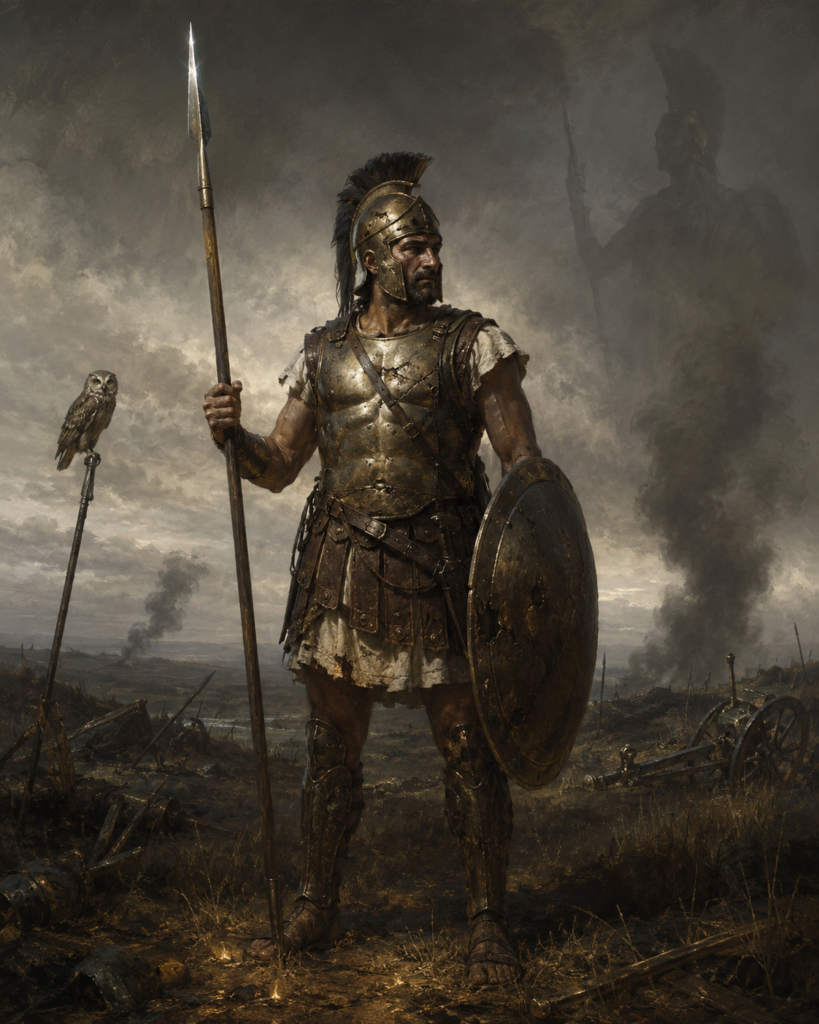
- Usual Appearance: A bronze-armoured Argive king with a scarred spear-hand, a hard soldier’s face, and the controlled stillness of a commander who has already judged the battle
Overview
Diomedes of Argos is not the loudest hero of the Trojan War, nor the most famous, but he may be one of its most dangerous. Achilles burns. Odysseus schemes. Ajax endures. Diomedes obeys, advances, strikes, and stops when the sacred boundary is reached.
He is the son of Tydeus, king of Argos, and one of the great Achaean commanders before Troy. His inheritance is already soaked in siege, vengeance, failed fathers, and divine attention. He does not enter the Trojan War as a glory-drunk youth chasing song. He enters it as a ruler and soldier, already trained by earlier ruin.
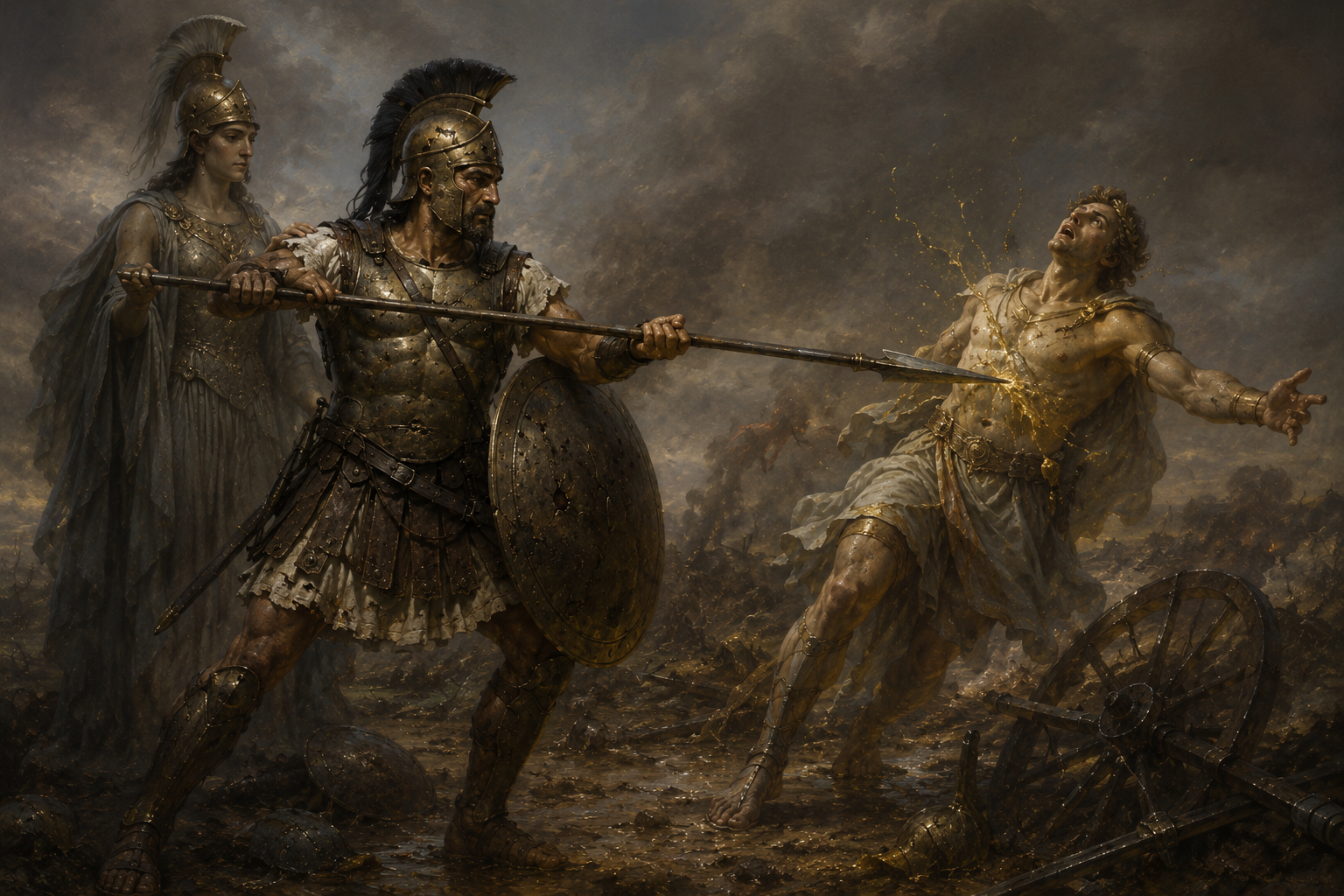
His defining moment comes during his great battlefield aristeia in the Iliad. Athena strengthens him and clears his sight so he can recognise divine powers moving through the war. Under her guidance, Diomedes wounds Aphrodite when she rescues Aeneas. Later, with Athena beside him, he strikes Ares himself.
These are not acts of random impiety. Diomedes does not wound gods because he believes mortals should overthrow heaven. He wounds them because one goddess has made him her permitted spear.
That distinction is the heart of the character. Diomedes is not a god-killer. He is a god-wounder under command. When Athena tells him to strike, he strikes. When Apollo warns him back, he withdraws. His courage is terrifying because it is disciplined enough to stop.
In the 1454 CE campaign present, Diomedes endures as a deathless heroic war-presence preserved by Athena’s unfinished command. He is not merely alive in the ordinary sense, nor is he only a ghost. He is a mortal hero held at the edge of history, permitted to manifest where sacred war, broken oaths, divine interference, or battlefield necessity call him back into the world.
Diomedes in 1454 CE
By 1454 CE, Diomedes is no longer simply the king who sailed to Troy. He is an old war-presence moving through shrines, fortified coastal courts, sealed armouries, and battlefields where the laws of war have been violated. His body is real when Athena permits it. His spear casts a shadow. His shield can turn a blade. Yet he is not free in the way living kings are free.
He cannot simply march into any war that angers him. Athena’s command binds him. Oaths, sacred boundaries, old curses, and the unfinished consequences of Troy limit where he can go and whom he may strike. In some places he appears as a bronze-armoured commander. In others, as a silent figure beside an altar, a voice from behind a sealed war-mask, or a rider seen at dawn before a doomed battle.
He is most likely to awaken when one of four things happens:
- A ruler claims divine sanction while committing cowardice, slaughter, or oath-breaking.
- A war-power, fiend, demigod, or divine champion interferes directly in mortal battle.
- A sacred military relic tied to Athena, Troy, Argos, or the Achaean host is stolen or profaned.
- A siege begins to repeat the spiritual pattern of Troy: pride, desire, oath, divine rivalry, and mass ruin converging around one city.
Diomedes does not belong in every Greek adventure. He should appear when the campaign needs war to become morally sharper. His presence says that the gods are watching, that courage is not enough, and that even divine power may be judged when it enters mortal bloodshed.
Appearance
Diomedes appears as a broad-shouldered warrior-king in the prime of brutal maturity rather than youthful splendour. His face is weathered by siege-smoke, salt air, bronze glare, and divine nearness. He carries himself like a commander who has seen too many champions die because they mistook courage for noise.
His armour is old Achaean bronze, repaired and reworked across centuries of cult remembrance. The cuirass bears scars that no smith has polished away. His shield is practical rather than ornamental, its boss darkened by fire and impact. His helm is crested but not flamboyant; everything about him suggests battlefield use rather than parade display.
His spear is the true centre of his appearance: long, ash-hafted, balanced for both cast and thrust, with a bronze or darkened iron head that seems plain until it enters the presence of a divine, fiendish, or oath-breaking power.
He does not glow. He does not need to. The battlefield around him becomes clearer when he is present. Cowards feel exposed. Liars find themselves speaking too quickly. Commanders become aware of exactly which order they are afraid to give.
Character
Diomedes is stern, restrained, and frighteningly direct. He is not humourless, but his humour is dry and soldierly. He has little patience for ornamental heroism, drunken boasting, or noble incompetence. He respects courage in peasants, sailors, mercenaries, women defending households, and kings who stand where their orders send others.
He is not gentle, but he is not cruel for pleasure. He believes war is already ugly enough without vanity making it worse.
His great virtue is discipline. His great flaw is the same discipline turned inward. When Diomedes believes a command is sacred, lawful, or necessary, he can commit terrible acts without hesitation. He does not naturally ask whether obedience itself has become the trap. That is where a party can matter.
What He Wants
Diomedes wants war to have form, command, oath, and consequence. He despises slaughter masquerading as courage and politics masquerading as necessity.
In play, his aims may include:
- Recovering or guarding a stolen war-relic sacred to Athena.
- Testing whether a mortal ruler deserves command.
- Breaking a tyrant whose victories come from divine favour rather than merit.
- Hunting a war-spirit, fiend, demigod, or monstrous champion that has crossed into mortal battle.
- Preventing a new Troy: a siege where pride, beauty, oath, and divine rivalry threaten to consume whole peoples.
- Learning whether he is still Athena’s chosen instrument, or only an old spear left in the dust.
What He Fears
Diomedes does not fear death in battle. He fears becoming a weapon with no rightful hand to guide it.
He fears fighting without sacred permission. His greatest deeds were not private acts of pride; they were sanctioned by Athena. Without that command, he is still formidable, but the meaning of his violence becomes uncertain.
He fears that the gods use mortals as instruments and discard them when the song of war changes. He rarely says this aloud. It sounds too close to impiety, and Diomedes is not impious. But he has seen enough divine rivalry to know that mortals often pay for quarrels they did not begin.
Most of all, he fears the impossible homecoming. Like many heroes of Troy, victory did not restore the world. It unmade it. Diomedes carries the bitterness of a king who survived the greatest war of his age only to discover that return is sometimes another battlefield.
Why Diomedes Matters in the World
Diomedes is politically dangerous because he proves that divine favour is not the same as divine immunity. A god may be honoured and still opposed. A sacred champion may be revered and still struck. A war may be holy and still judged.
He does not represent mortal rebellion against the gods. That would make him simpler and smaller. He represents something more severe: the lawful moment when one divine order authorises a mortal hand to correct another divine power’s interference.
That makes him explosive in courts, temples, and battlefields. A king who hosts Diomedes gains military legitimacy but also invites scrutiny. A priest who invokes him declares that war must be disciplined, not merely sanctified. A tyrant claiming divine protection may learn that divine favour can be contested.
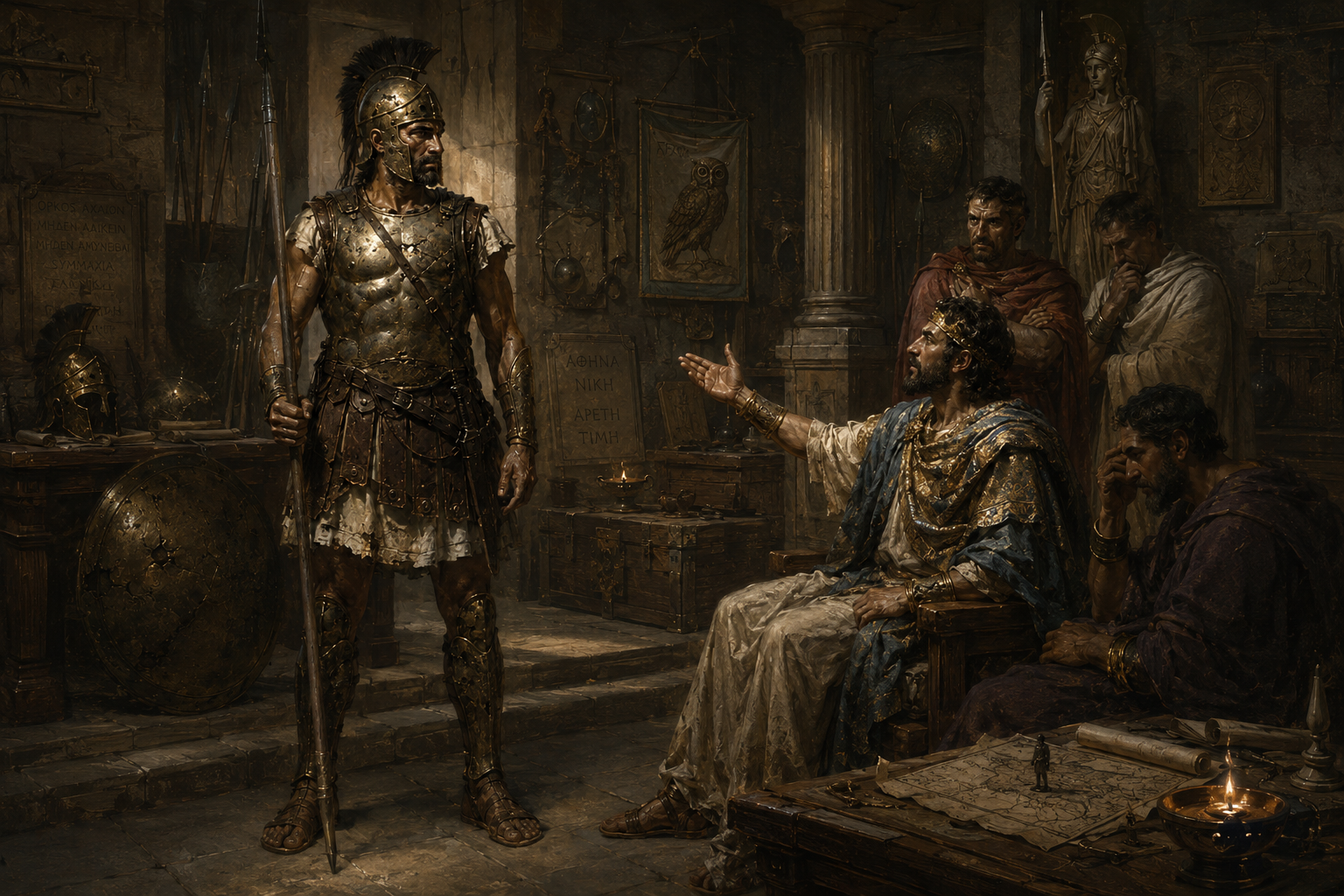
For player characters, Diomedes is not a quest-giver with a famous name attached. He is a test of military and moral seriousness. He wants to know whether they can hold formation, keep an oath, refuse vanity, obey a hard order, and still recognise when obedience itself has become dangerous.
Source and Literary Context
Diomedes of Argos is one of the major Achaean heroes of Homer’s Iliad. His most famous episode occurs in Book 5, where Athena strengthens him during battle, allowing him to recognise divine interference and wound Aphrodite; with Athena’s direct aid, he also strikes Ares. For the primary literary passage, see Theoi’s public-domain presentation of Homer, Iliad Book 5. For visual classical context, Theoi also preserves an ancient vase-scene description of Diomedes battling Aeneas while Athena supports him.
Role in a Campaign
Diomedes should appear when mortal war becomes entangled with divine interference. He belongs in stories of sieges, stolen sacred images, oath-breaking commanders, war-mad armies, divine champions, and battles where victory may cost more than defeat.
Use him as:
A Patron: Diomedes sends the party to recover a stolen Palladium-like relic, expose a false war-priest, or kill a champion protected by corrupt divine favour.
A Judge: He tests whether the party are disciplined enough to be trusted with a sacred military task.
A Rival Commander: He wants the same objective as the party, but will sacrifice sentiment, comfort, and even reputation to preserve the larger campaign.
A Battlefield Ally: He arrives only when a war has crossed a sacred threshold and ordinary courage is no longer enough.
A Tragic Survivor: He has outlived the age that made him meaningful and now seeks one last command worthy of Athena’s attention.
Diomedes should create harder choices, not remove them. If he appears, the question should not be “can he win the fight?” The question should be “what must the players accept, refuse, sacrifice, or expose before his spear can be lawfully drawn?”
Using Diomedes at the Table
Diomedes is too powerful to use as a routine combatant. His power should be conditional, sacred, and consequential. When he enters a scene, the pressure should rise; the players should feel that the war has become more serious, not that the adventure has been solved for them.
Good limits include:
- He can wound divine or semi-divine beings only when Athena’s sanction, a sacred oath, or a campaign-defining ritual permits it.
- He refuses to fight if the party’s cause is brave but unjust.
- He can win a battle but cannot heal the political wound that caused it.
- He may demand a hard sacrifice before he lends his spear.
- He may recognise that the party, not he, must make the final choice.
- He may be unable to enter a city, shrine, battlefield, or tomb because of an old oath, curse, or divine boundary.
The best Diomedes scenes are not displays of famous-NPC power. They are scenes where the players must decide whether they can accept the discipline that makes his power possible.
Adventure Hooks
The Spear Must Not Be Drawn: A temple of Athena keeps Diomedes’ old spear sealed beneath bronze doors. The spear begins to bleed before a coming war, but the priests disagree over whether this is a summons, a warning, or a curse.
Ares Has Entered the Field: A mercenary army becomes unnaturally savage. Prisoners are butchered, commanders stop negotiating, and battle-madness spreads through both sides. Diomedes believes a war-power has crossed into mortal command and asks the party to identify its vessel.
The False God-Wounder: A young warlord claims to have inherited Diomedes’ gift and has begun murdering priests, envoys, and champions under the banner of “mortal freedom.” Diomedes wants him stopped, not because the gods are innocent, but because the boy does not understand the law he is invoking.
The Return to Argos: Diomedes cannot enter his old city without awakening a curse tied to his failed homecoming. The party must go in his place, carrying a sealed bronze token to a queen, a tomb, or a hidden cult that remembers the version of the story he will not speak aloud.
Aphrodite’s Debt: A noble house favoured by Aphrodite has been struck by a wasting curse that no healer can name. The cause is not Aphrodite’s hatred, but an old wound in divine memory. Diomedes may know how to heal it, but doing so requires admitting that even a righteous strike leaves consequences.
The Night Raid: Odysseus’ name has surfaced in a matter of theft, disguise, and a stolen sacred image. Diomedes knows this pattern. He asks the party for help, but the mission will not be honourable in the simple sense. It will be necessary.
Edition Tabs
Diomedes of Argos, D&D 5.5e / 2024
Diomedes of Argos, Pathfinder 1e
Diomedes of Argos, D&D 3.0e
Diomedes of Argos, the God-Wounder D&D 5.5e / 2024
Medium Humanoid, Lawful Neutral
Armour Class 22
Hit Points 315
Speed 30 ft.
| STR | DEX | CON | INT | WIS | CHA |
|---|---|---|---|---|---|
| 24 (+7) | 18 (+4) | 22 (+6) | 18 (+4) | 20 (+5) | 18 (+4) |
Saving Throws Str +15, Dex +12, Con +14, Wis +13, Cha +12
Skills Athletics +15, History +12, Insight +13, Intimidation +12, Perception +13, Persuasion +12, Religion +12, Survival +13
Damage Resistances Bludgeoning, piercing, and slashing from nonmagical attacks; psychic
Condition Immunities Frightened
Senses Truesight 30 ft., passive Perception 23
Languages Greek, Trojan, military command-signs; understands battlefield orders across most disciplined armies
Challenge 24
Proficiency Bonus +8
Traits
Legendary Resistance (3/Day). If Diomedes fails a saving throw, he can choose to succeed instead.
Athena’s Battlefield Sight. Diomedes can see invisible creatures and recognise disguised celestials, fiends, fey, and divine agents within 30 feet. This sight does not reveal every secret of a creature’s identity, but it tells him when a power is more than mortal.
Disciplined Hero. Diomedes has advantage on saving throws against being charmed, frightened, stunned, or magically compelled to abandon his post, betray an oath, or attack an ally.
God-Wounder. Diomedes’ weapon attacks count as magical. Against celestials, fiends, fey, avatars, demigods, divine champions, and creatures currently under direct divine empowerment, his attacks deal an extra 14 force or radiant damage, Diomedes’ choice when he hits.
Sacred Permission. Diomedes cannot use God-Wounder’s extra damage against a true deity unless Athena’s sanction, a rival divine power, a sacred oath, or a campaign-defining ritual has explicitly granted him permission. This keeps his mythic identity powerful without making him a casual god-killer.
Siege Veteran. Diomedes has advantage on ability checks made to read battlefield formations, detect ambushes, judge fortifications, command troops, or identify the weak point in a defensive position.
Unwasted Motion. Opportunity attacks against Diomedes are made with disadvantage.
Actions
Multiattack. Diomedes makes three Spear of Argos attacks, or two Spear of Argos attacks and one Shield Breaker attack.
Spear of Argos. Melee or Ranged Weapon Attack: +15 to hit, reach 10 ft. or range 30/120 ft., one target. Hit: 17 (1d10 + 12) piercing damage, or 18 (1d12 + 12) piercing damage if used with two hands, plus 14 force or radiant damage if God-Wounder applies.
Shield Breaker. Melee Weapon Attack: +15 to hit, reach 5 ft., one target. Hit: 16 (1d8 + 12) bludgeoning damage, and the target must succeed on a DC 23 Strength saving throw or be knocked prone or pushed 10 feet, Diomedes’ choice.
Command the Line. Diomedes chooses up to three allies within 60 feet who can see or hear him. Each chosen ally can use its reaction to move up to half its speed without provoking opportunity attacks, make one weapon attack, or repeat a saving throw against being frightened or charmed.
Athena-Guided Cast. Ranged Weapon Attack: +15 to hit, range 120 ft., one target Diomedes can see. Hit: 35 (4d10 + 13) piercing damage. If the target is flying by magical or divine means, it must succeed on a DC 23 Constitution saving throw or fall up to 60 feet.
The Spear Remembers Blood Divine (Recharge 5–6). Diomedes makes one Spear of Argos attack against a celestial, fiend, fey, avatar, demigod, divine champion, or creature under direct divine empowerment. On a hit, the attack deals an extra 45 force damage, and the target must succeed on a DC 23 Charisma saving throw or lose one active divine, innate, or supernatural trait of the DM’s choice until the end of Diomedes’ next turn. This should suppress a blessing, aura, teleportation, charm aura, regeneration, or similar battle-shaping feature, not erase a creature’s whole nature.
Bonus Actions
Measured Advance. Diomedes moves up to half his speed. Until the start of his next turn, he has advantage on the next melee attack he makes against a creature that damaged one of his allies since the end of his last turn.
War-King’s Assessment. Diomedes studies one creature he can see within 60 feet. Until the end of his next turn, he knows whether that creature has more or fewer current hit points than he does, whether it is under direct divine or magical empowerment, and whether it is frightened, charmed, or compelled.
Reactions
Bronze Interposition. When a creature Diomedes can see hits him or an ally within 5 feet with an attack, Diomedes adds 5 to the target’s AC against that attack, potentially causing it to miss.
Strike Only When Earned. When a creature within Diomedes’ reach misses him with a melee attack, violates a sworn parley, or attacks a helpless creature, Diomedes can make one Spear of Argos attack against it.
Apollo’s Boundary. When Diomedes is about to damage a true deity or sacred being beyond his permitted authority, the DM may trigger this mythic restraint. Diomedes recognises the boundary and can choose either to withdraw the blow or make a DC 23 Wisdom saving throw. On a failure, the attack misses and Diomedes is stunned until the end of his next turn. On a success, the attack lands, but he gains one level of exhaustion after the encounter. This should be used only in major mythic scenes.
Legendary Actions
Diomedes can take 3 legendary actions, choosing from the options below. Only one legendary action can be used at a time and only at the end of another creature’s turn.
Move. Diomedes moves up to half his speed without provoking opportunity attacks.
Spear Attack. Diomedes makes one Spear of Argos attack.
Battlefield Order. One ally Diomedes can see within 60 feet may move up to half its speed or make one weapon attack.
Break the Champion’s Rhythm (Costs 2 Actions). Diomedes chooses one creature within 10 feet. The target must succeed on a DC 23 Wisdom saving throw or have disadvantage on attack rolls against creatures other than Diomedes until the end of its next turn.
God-Wounder’s Pressure (Costs 3 Actions). Diomedes makes one Spear of Argos attack. If it hits a creature affected by God-Wounder, that creature cannot regain hit points until the start of Diomedes’ next turn.
Mythic Trait: Athena’s Permission
When Diomedes is reduced to 0 hit points, he does not die if he is acting under a sacred command, defending an oath, or fighting direct divine interference in mortal war. Instead, he drops to 1 hit point, regains 150 hit points, and the battlefield becomes painfully clear around him.
For 1 minute, his truesight increases to 120 feet, his Spear of Argos attacks deal an extra 7 force damage, and hostile creatures within 30 feet cannot benefit from being invisible.
After this trait activates, Diomedes becomes colder, quieter, and more dangerous. He is no longer proving courage. He is completing an order.
Diomedes of Argos, Pathfinder 1e
CR 23
XP 819,200
Male human fighter 20 / mythic champion 10
LN Medium humanoid (human, mythic)
Init +9; Senses divine battle-sight, true seeing 30 ft.; Perception +34
Defence
AC 41, touch 18, flat-footed 35
hp 410
Fort +28, Ref +20, Will +24
Defensive Abilities bravery +8, disciplined hero, legendary endurance; DR 10/epic; Immune fear; Resist +4 sacred bonus on saves against mind-affecting effects
Offence
Speed 30 ft.
Melee Spear of Argos +42/+37/+32/+27 (1d8+19/19–20 plus god-wounder)
Ranged Spear of Argos +36 (1d8+19/19–20 plus god-wounder)
Special Attacks god-wounder, command the line, spear remembers divine blood, shield breaker
Statistics
Str 30, Dex 20, Con 26, Int 18, Wis 22, Cha 20
Base Atk +20; CMB +33; CMD 48
Feats Combat Reflexes, Critical Focus, Greater Weapon Focus, Greater Weapon Specialization, Improved Critical, Improved Initiative, Iron Will, Leadership, Lunge, Power Attack, Shield Focus, Step Up, Vital Strike, Weapon Focus, Weapon Specialization
Skills Diplomacy +31, Intimidate +34, Knowledge (history) +30, Knowledge (nobility) +30, Knowledge (religion) +30, Perception +34, Profession (soldier) +34, Sense Motive +34, Survival +31, Swim +29
Languages Greek, Trojan, military command-signs
Special Abilities
Divine Battle-Sight (Su). Diomedes can perceive invisible creatures and recognise the presence of celestials, fiends, divine agents, and creatures acting under direct divine empowerment within 30 feet. This functions as a limited true seeing effect focused on battlefield deception and supernatural interference.
Disciplined Hero (Ex). Diomedes gains a +4 sacred bonus on saving throws against charm, compulsion, fear, confusion, and effects that would force him to abandon an oath, betray an ally, or break formation.
God-Wounder (Su). Against celestials, fiends, mythic creatures, divine champions, and creatures under direct divine empowerment, Diomedes’ weapon attacks deal +4d6 force damage. Against true deities, this ability functions only when Athena’s sanction, a rival divine power, a sacred oath, or a campaign-defining ritual grants explicit permission.
Command the Line (Ex). Three times per day, as a standard action, Diomedes grants up to three allies within 60 feet an immediate move action or a melee or ranged attack at their highest base attack bonus. Allies must be able to see or hear him.
Spear Remembers Divine Blood (Su). Once every 1d4 rounds, Diomedes may make a single spear attack against a qualifying divine, fiendish, celestial, or mythic target. On a hit, the target must succeed at a DC 28 Will save or lose one active supernatural blessing, aura, or movement power for 1 round. The save DC is Wisdom-based.
Shield Breaker (Ex). When Diomedes confirms a critical hit or succeeds at a combat manoeuvre check against a shield-bearing or heavily armoured enemy, he may also stagger the target for 1 round unless it succeeds at a DC 28 Fortitude save.
Athena’s Permission (Mythic). Once per day, when Diomedes would be reduced below 0 hit points while acting under a sacred command or defending an oath-bound cause, he instead remains at 1 hit point and heals 150 hit points. For 10 rounds, his divine battle-sight extends to 120 feet and his God-Wounder damage increases to +6d6.
Equipment
Spear of Argos, mythic bronze-headed spear; Achaean king’s cuirass, equivalent to +5 breastplate; scarred bronze shield, equivalent to +4 heavy steel shield; war-king’s cloak; bronze helm; short sword; seal of Argos; old Trojan War tokens; votive token of Athena.
Diomedes of Argos, D&D 3.0e
Trojan War: Roleplaying in the Age of Homeric Adventure
A Mythic Vistas Sourcebook for the d20 System
Written by Aaron Rosenberg
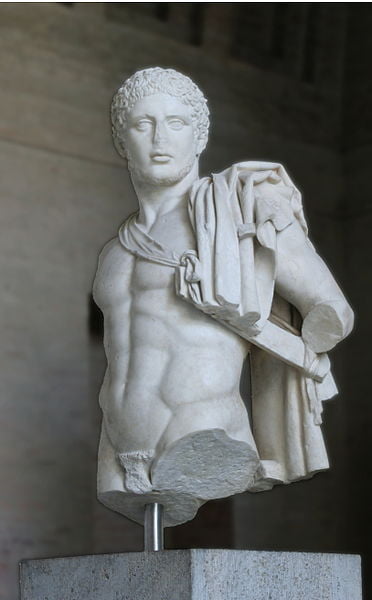
Diomedes, son of Tydeus, is the king of the city-state of Argos. His father was one of the ‘Seven against Thebes,’ a group of warriors who attacked that powerful city but failed to defeat it and died instead. As a young man Diomedes and the other children of the Seven completed what their fathers started, and conquered the city. Diomedes won fame for his skill in battle, and after returning home became the king of Argos. He is a large, powerfully built man with brown hair and brown eyes, and is not particularly good-looking but not ugly either.
Diomedes is one of the more intelligent fighters in the Achaean army, and that, plus his even temperament and good nature, have made him well liked off the battlefi eld, while his sense of strategy and his fighting prowess earned him respect in combat. He is closest with Odysseus, and the two often scout the Trojan forces together.
Late in the war, Diomedes and Glaucus met on the battlefield. Upon exchanging names and lineages, they realize their fathers were friends, and so they vow not to fight one another as long as other foes remain. To prove their friendship, they exchanged armor ‘Diomedes gives Glaucus his +1 layered bronze panoply, and receives Glaucus’ +2 burnished layered bronze panoply in return.
| Diomedes | |
| Male human Charioteer 10/Runner 8 | |
| Medium humanoid | |
| Hit Dice | 10d10+30 plus 8d10+24; hp 153 |
| Initiative | +10 |
| Speed | 40 ft. |
| Armor Class | 25, touch 12, flatfooted 23 |
| Base Attack/Grapple | Base Atk +18; Grp +21; |
| Attack | +22 melee (1d8+4/19- 20, +1 bronze longsword) or +20 ranged (1d8+4, +1 throwing spear) |
| Full Attack | +22/+17/+12/+7 melee (1d8+4/19-20, +1 bronze longsword) or +20 ranged (1d8+4, +1 throwing spear) |
| Space/Reach | 5 ft./5 ft. |
| Special Attacks | extended attack, momentum, sideswipe |
| Special Qualities | SQ agile runner, capture, chariot expertise, difficult target, evasion, fast entry, gauge skill, quick defense, skilled charge, skilled horseman, skillful maneuvering, steady, trained steeds, voice command |
| Saves | Fort +8, Ref +15, Will +6; |
| Abilities | Strength 17, Dexterity 15, Constitution 16, Intelligence 14, Wisdom 13, Charisma 10. |
| Skills | Balance +9, Climb +11, Concentration +9, Drive +15, Handle Animal +7, Intimidate +14, Jump +17, Knowledge (tactics) +17, Listen +9, Ride +10, Spot +8; |
| Feats | Chariot Attack*B, Chariot Shield*, Cleave, Drive-By Attack*B, Endurance, Improved Initiative, Lion of the Field*, Noble*, Power Attack, Run. |
| Environment | – |
| Organization | – |
| Challenge Rating | 18 |
| Treasure | – |
| Alignment | Neutral Good |
Possessions: +1 layered bronze panoply, +1 bronze round shield, +1 bronze longsword, +1 throwing spear
Treasure
Diomedes should not carry random treasure like a dungeon opponent. His possessions are political, sacred, and dangerous.
- Spear of Argos: Priceless heroic relic; should not be casually lootable unless Diomedes dies in a major campaign-defining scene.
- Bronze War-Cuirass: Worth 75,000 gp or more as a relic, but removing it from his cult or tomb may trigger divine consequences.
- Shield of the Achaean Line: Worth 45,000 gp as a magic shield; also functions as a symbol of command among Greek war-cults.
- Seal of Argos: Worth little as metal, but grants authority among old heroic lineages.
- Temple Votives: 5,000–15,000 gp in bronze, silver, engraved plaques, and oath-gifts if found in his shrine. Stealing these should create immediate social and supernatural consequences.
Balance and Use Notes
Diomedes is not built as a fair random encounter. He is a mythic war-king whose presence should mark a major change in the campaign’s scale. His CR assumes he is fighting in a serious battlefield, temple, siege, or divine-conflict scene where his command abilities matter.
To keep him playable:
- Do not use God-Wounder against every monster. It should matter most against divine, fiendish, celestial, fey, mythic, or oath-charged foes.
- Do not let him casually attack true gods. His legend depends on sacred permission, not unlimited divine murder.
- Let him be wrong sometimes. His discipline is powerful, but it can make him rigid.
- Keep the players responsible for the moral choice. Diomedes can change a battle; he should not replace the party’s agency.
Good Scenes for Diomedes
The Silent Inspection: Diomedes walks the party’s camp before dawn and notices every weak strap, dull blade, frightened sentry, and hidden lie.
The God Enters the Battle: A divine or fiendish champion appears on the field. Diomedes does not boast. He simply lowers his spear.
The Refusal: The party asks for help, and Diomedes refuses because their cause is brave but not clean.
The Command: In the middle of battle, Diomedes gives one order that saves hundreds of lives, but requires the party to abandon something personally important.
The Wound Remembered: A servant of Aphrodite, Ares, or another power recognises him and reacts not with awe, but with old hatred.
Keep this reference growing
If this page helped with your reading or game, you can support its upkeep or explore the curated books.
Explore the Bookshop — epics, classics and stories behind imagined worlds.