
Unveil the Truth spell, “Song of the Last Witness”
Unveil the Truth spell, “Song of the Last Witness”
One song, spoken before witnesses, can tear away every lie a life has been forced to wear.
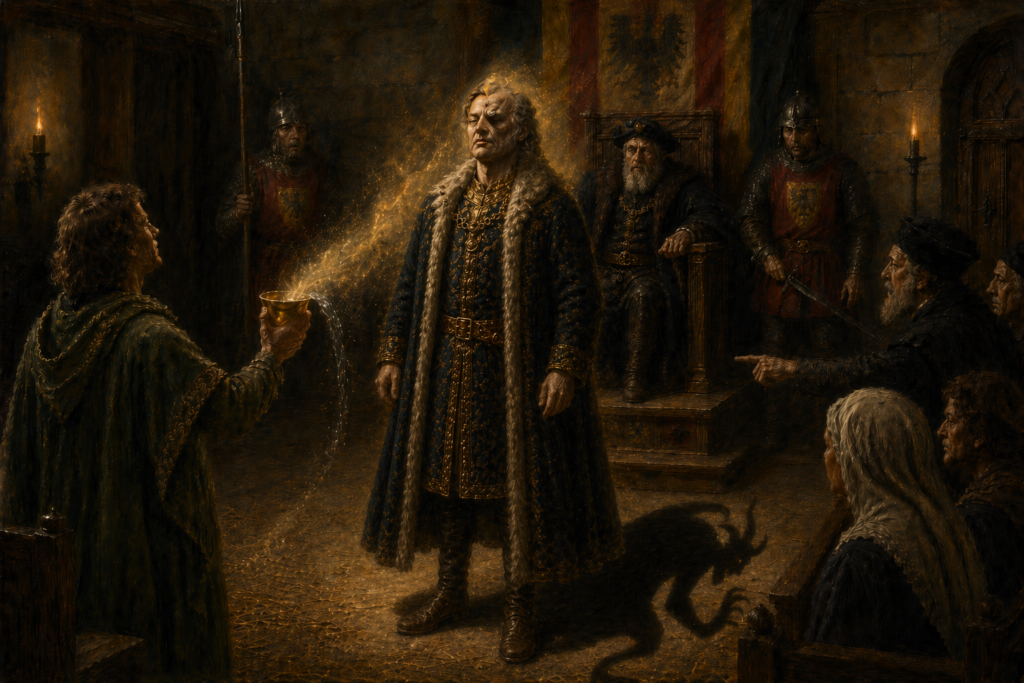
Magic is not always a weapon, a shield, or a road between worlds. At its highest and most perilous pitch, magic becomes judgment: a force that strips away false names, false faces, false honour, and false disgrace until only the truth remains.
Overview
Unveil the Truth spell is a supreme act of revelation, public judgment, and sacred verse. It is not cast in secrecy and cannot be whispered into a corner. The caster must sing, chant, satirise, prophesy, or formally declare the spell before witnesses, drawing attention toward a single creature whose hidden nature is about to be exposed.
This is a spell for courts, sacred assemblies, druidic judgment circles, clan gatherings, public trials, and moments when ordinary testimony has failed. It can expose a murderer beneath a noble title, reveal a loyal servant wrongly accused of treachery, strip away a magical disguise, correct a cursed reputation, or force an assembly to hear what powerful people have tried to bury.
Unlike lesser divinations, the Unveil the Truth spell does not merely identify whether a single statement is false. It reveals the meaningful truth of a person in relation to the matter at hand. The spell concerns itself with consequential truth: guilt, innocence, disguise, curse, oath, betrayal, courage, cowardice, hidden virtue, false accusation, and magical concealment.
The spell is dangerous because the caster cannot turn it into propaganda. Once the magic opens the truth, the caster may shape the telling around what is relevant, but cannot knowingly lie, falsify the revelation, or suppress a major truth that the spell has shown to be central to the declared matter.
Effect
You perform a magical song, chant, poem, satire, prophecy, or formal declaration before witnesses and name one creature within range as the subject of the spell. The magic reveals the subject’s true nature and causes your spoken revelations to be recognised by the audience as truthful, provided the audience can hear and understand you.
For the duration, you learn the most important truths about the target relevant to the accusation, question, public matter, or declared purpose of the spell. These truths may include false identities, disguises, magical transformations, curses, binding oaths, major betrayals, hidden crimes, concealed acts of courage, secret loyalties, unjust accusations, defamation, false reputation, and other consequential facts.
The Unveil the Truth spell does not automatically reveal every memory, private thought, mundane secret, or irrelevant detail of the target’s life. If you declare a specific matter as part of the casting, the spell focuses on truths relevant to that matter. If no matter is declared, the spell reveals only those truths most important to the public situation in which it is cast.
If the target is disguised, shapechanged, polymorphed, masked by illusion, or hidden beneath a false magical form, the spell reveals the deception. At the DM’s discretion, a false form may be suppressed or stripped away for the duration if the concealing magic is weaker than Unveil the Truth.
If the target has been unjustly slandered, cursed with false disgrace, or burdened by magically reinforced defamation, the spell reveals that injustice before the audience. Those who hear the revelation understand the correction as true, though hatred, fear, political convenience, or self-interest may still cause some creatures to act against that truth afterward.
The target cannot attack the caster while the revelation is being performed unless it first overcomes the spell’s protective force. In 5.5e terms, a creature that attempts to attack the caster must succeed on a Wisdom saving throw against your spell save DC or choose a new target or lose the attack. This protection ends early if you attack the target, damage it, or cast another harmful spell against it.
Magic that blocks divination, conceals identity, protects thoughts, or prevents magical detection can interfere with Unveil the Truth. If such magic prevents a revelation, you immediately learn that something is being hidden by magic, though not necessarily what the hidden truth is.
Edition
Unveil the Truth spell 5.5e / 2024
Unveil the Truth spell, Pathfinder 1e
Unveil the Truth spell 3.5
Unveil the Truth spell
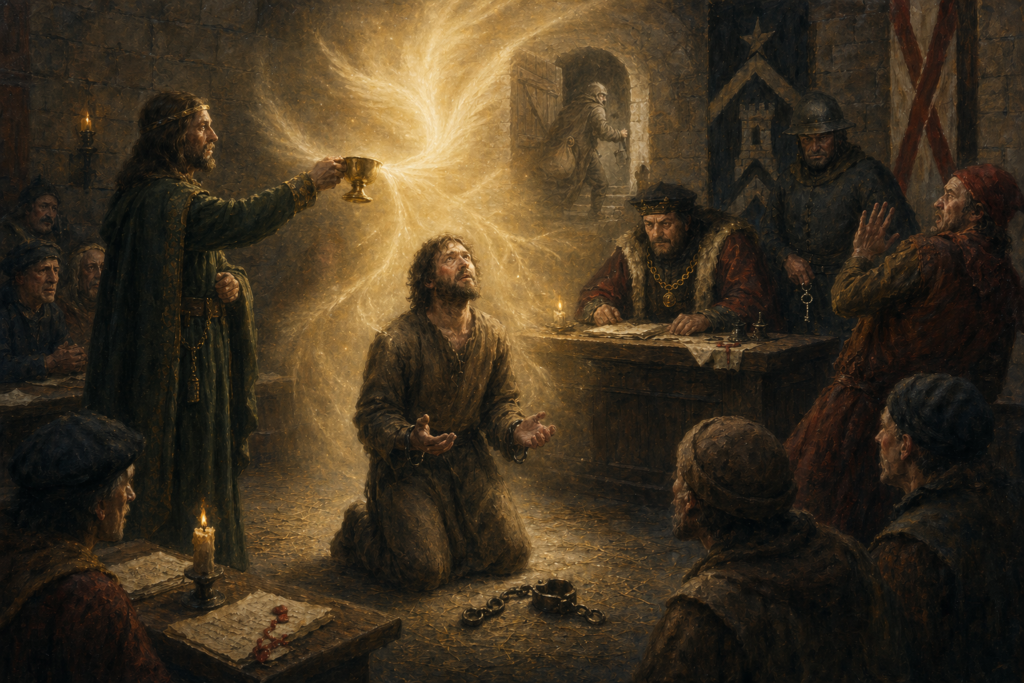
9th-Level Divination
Casting Time: 1 round
Range: 60 feet
Components: V, S, M
Material Component: A small golden cup filled with clear water, which the spell consumes.
Duration: Concentration, up to 1 hour
Available To: Bard, Cleric, Druid, Wizard
Alternative Spell Name: Song of the Last Witness
You name one creature you can see within range and begin a song, chant, satire, judgment, or formal revelation. The spell cannot be cast discreetly. Creatures of your choice within 120 feet that can hear you know that a powerful magical revelation is taking place, though they are not charmed by the spell.
For the duration, you learn major truths about the target that are relevant to the declared purpose of the casting. When you speak or sing those truths aloud, creatures who can hear and understand you recognise that the revelation is magically truthful.
The spell can reveal and publicly expose:
- a false identity, disguise, illusion, assumed name, or concealed station;
- a magical transformation, shapechange, polymorph effect, or false form;
- a curse, geas, oath, pact, or supernatural compulsion affecting the target;
- a major crime, betrayal, act of treachery, or hidden guilt relevant to the spell’s purpose;
- a hidden act of courage, loyalty, sacrifice, or innocence;
- slander, false accusation, magically reinforced defamation, or unjust public disgrace;
- the presence of magic preventing full revelation.
If the target is under an illusion, magical disguise, polymorph effect, or other false form created by a spell of 8th level or lower, that effect is suppressed on the target for the duration. If the effect was created by a 9th-level spell, artifact, deity, legendary being, or similarly powerful source, the DM determines whether Unveil the Truth suppresses it, reveals its presence, or only partially exposes it.
The target cannot attack you for the duration unless it succeeds on a Wisdom saving throw each time it attempts to do so. On a failed save, it must choose a different target or lose that attack. This protection ends if you deal damage to the target or cast a spell that directly harms it.
This spell does not let you read every thought or memory of the target. It reveals significant truths, not trivia. It cannot be used to manufacture lies. You cannot knowingly speak a falsehood as part of the spell, and you cannot deliberately conceal a major truth once the spell has revealed it and that truth is relevant to the declared matter.
When the spell ends, suppressed magical disguises and false forms return if their own durations have not expired. The knowledge spoken before the audience is not erased, though later magic, intimidation, propaganda, or self-interest may still influence what witnesses choose to do with the truth.
Unveil the Truth spell
School: divination
Level: bard 9, cleric 9, druid 9, sorcerer/wizard 9, witch 9
Casting Time: 1 full round
Components: V, S, M
Range: close (25 ft. + 5 ft./2 levels)
Target: one creature
Duration: concentration, up to 1 hour
Saving Throw: none; see text
Spell Resistance: no
You perform a magical song, chant, satire, prophecy, or formal revelation that exposes the truth of one creature before witnesses. This spell cannot be cast discreetly. The caster must speak, sing, or declare the revelation in a manner that can be heard by an audience.
For the duration, you perceive the most important truths about the target relevant to the matter being addressed. These truths may include false identity, disguise, magical transformation, hidden guilt, concealed virtue, treachery, courage, binding oaths, curses, geases, supernatural compulsions, false accusations, slander, and magically reinforced reputation.
When you declare these truths aloud, creatures able to hear and understand you recognise the declaration as magically truthful. This does not force them to like, forgive, obey, pardon, or spare the target, but it prevents honest doubt about the revealed truth.
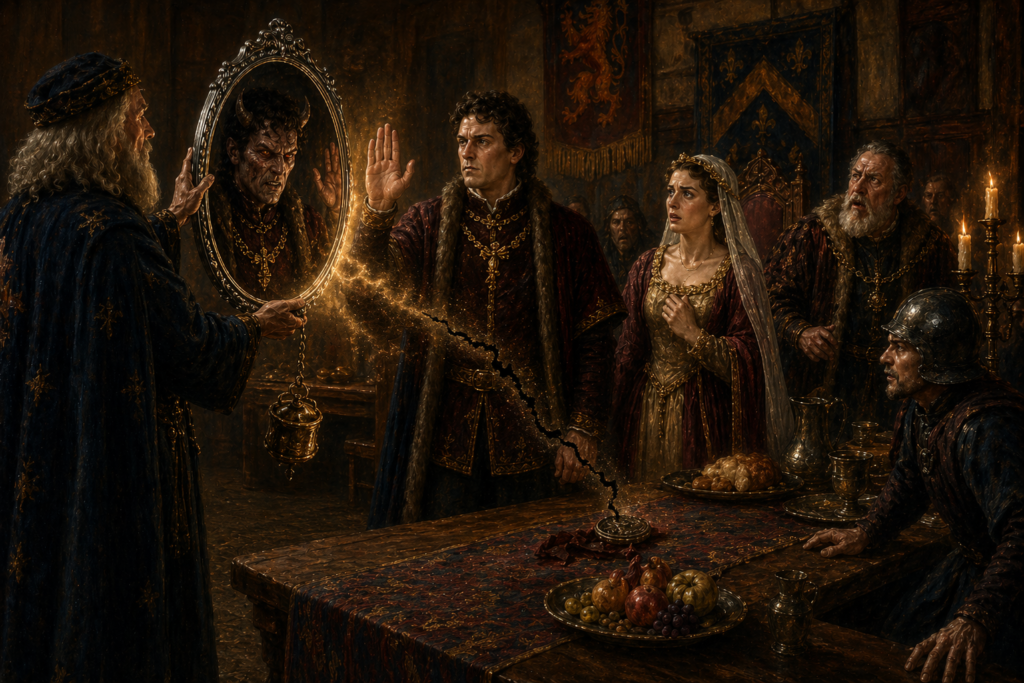
If the target is under the effect of a disguise, illusion, polymorph effect, transmutation, or similar magic that conceals its true form or identity, Unveil the Truth reveals the deception. If the concealing effect is of 8th level or lower, it is suppressed for the duration. Effects of 9th level, artifact power, divine origin, or similarly exceptional strength may resist suppression at the GM’s discretion, though the caster immediately knows that powerful concealment is present.
The target is protected from attacking the caster as though by sanctuary, except there is no initial saving throw to establish the protection. A creature attempting to attack the caster must succeed at a Will save against the caster’s spell DC or lose the attack or choose another target. If the caster attacks or damages the target, this protection ends.
Magic that blocks divination, prevents detection, conceals alignment or thoughts, masks identity, or protects against scrying may interfere with Unveil the Truth. When such magic prevents revelation, the caster learns that concealment magic is obstructing the spell, though not necessarily the hidden information itself.
This spell does not grant unrestricted access to the target’s entire life, memory, or mind. It reveals consequential truths relevant to the declared matter, not trivia. The caster cannot knowingly speak a lie as part of the spell and cannot deliberately withhold a major relevant truth once the spell has revealed it.
Material Component: A small golden cup filled with clear water. The caster drinks a little of the water, throws the remainder toward the target, and the cup dissolves into a golden mist that spreads over the assembly before vanishing.
Unveil the Truth spell
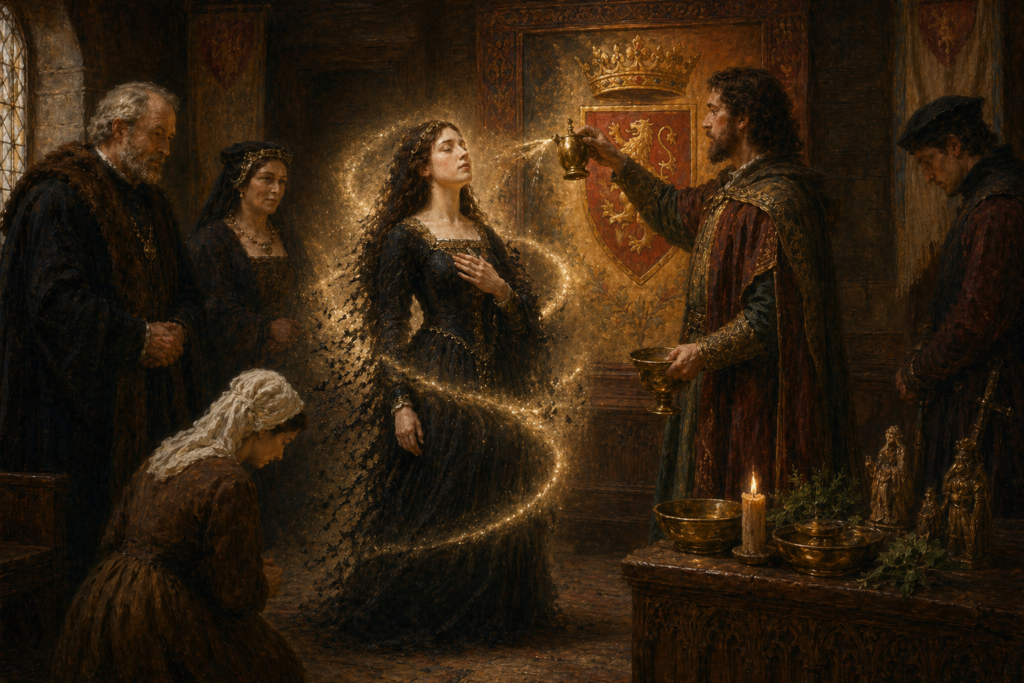
This spell is a magical song of great potency, which reveals the truth about the target of the spell. It typically uncovers lies, dispels disguises and false shapes, but also dissipates curses and defamation.
Celtic Druids and the Tuatha de Dannan
By Dominique Crouzet
Divination
Level: Sorcerer/Wizard 9, Witch 9, Satire 9
Components: V, S, M
Casting Time: 1 full round
Range: Close (25 ft. + 5ft./2 levels)
Target: One creature
Duration: Up to 1 hour
Saving Throw: None
Spell Resistance: No
This spell is a little complex, and produces several different magical effects at once. First of all, it cannot be cast discreetly. On the contrary, the caster must have the attention of a group of creatures. So the spell basically works exactly as an Enthrall spell, enabling the caster to maintain the attention of the audience during all her revelations.
Then the caster is imparted with the ability to see the real nature of her subject; and telling it in rhymes and verses, makes it magically revealed to the audience. As such, the caster will see if the subject is disguised or under a false shape (as with Polymorph-self spell), and telling it will turn back the subject to its true form and appearance.
The caster will see the real alignment and personality of the subject, and even if the subject concealed them, it will nonetheless be revealed to all, as the caster tells it. The caster will learn about the subject’s history; thus will know about his courage or cowardice, his secret scheming and treachery, or his unknown worthy deeds. In telling them to the assembly, everyone will know it is true.
In short, kept secret / magically hidden or not, the caster will see all what is to be known about the target of her spell. Then, upon saying it, all the listeners will know it is true. Likewise, if the subject unjustly suffered from a bad reputation, the caster will learn about it, and telling so will dissipate it among the audience.
Note however, that this spell reveals only what is really important to learn, not trivial or mundane things (unless they were specifically requested by the caster). Also, this spell cannot be used by the caster to tell lies about the subject. She cannot but tell the truth that she discovers. Likewise, she cannot choose to hide things she learns about the subject; she can only choose to concentrate on the important information, and omit to tell what isn’t pertinent or relevant in the context.
The target of this spell does not get any saving throw against it, and moreover is affected as with a Sanctuary spell (with no saving throw) preventing him to attack the caster. Nonetheless, any appropriate magic (spell or item) which can shield the subject from detection spells will also be effective against Unveil the Truth. However, the caster will immediately learn about the magic which hinders her spell.
Material Components: A small golden cup filled with clear water. The caster first drinks a little of this water, and throws the remain in the direction of the target. Then the cup is disintegrated into a golden mist which spreads over the assembly, and then disappears.
Why This Spell Is Dangerous in the World
Unveil the Truth is dangerous because it attacks one of the foundations of power: the ability to control what others believe.
A king may survive a sword wound more easily than a public revelation of murder. A usurper may fear this spell more than an army. A falsely accused knight, disgraced priestess, slandered clan, or cursed heir may see in it the only force capable of restoring their name. Courts, temples, guilds, and noble houses therefore treat the spell with awe and dread.
Its danger is not only magical. It changes witnesses. Those who hear the truth cannot easily return to the old lie. A court may still choose corruption. A mob may still choose hatred. A lord may still suppress the witness. But the spell leaves a wound in falsehood, and everyone present knows where it lies.
Best Uses
Unveil the Truth works best when the truth has public stakes.
Use it to expose a disguised fiend in a royal court, reveal that a condemned prisoner was falsely accused, break a curse of dishonour, uncover the true architect of a betrayal, restore the name of a dead hero, or force a political assembly to confront what it has chosen to ignore.
It is less useful as a casual investigation spell. It should not replace careful inquiry, tracking, testimony, or lesser divinations. Its proper place is the final revelation, the public trial, the sacred assembly, the moment when truth must stop being private knowledge and become social fact.
Tactics
A caster should prepare the ground before using Unveil the Truth. The spell is most powerful when important witnesses are present: rulers, judges, kin, soldiers, priests, guildmasters, clan elders, or the wronged parties themselves.
Because the spell requires public attention and concentration, allies should secure the space before the casting begins. Guards, magical wards, silence-breaking magic, counterspell protection, and trusted witnesses all matter.
The spell is especially effective against enemies who rely on identity, reputation, charm, disguise, or political manipulation. It is less decisive against shameless monsters, creatures with no social standing, or villains whose crimes are already known but tolerated.
DM Notes
This spell should reveal enough truth to matter, not enough truth to destroy the campaign.
Before resolving the spell, decide what the declared matter is. A broad declaration such as “show us who this person truly is” should reveal major identity, motive, and moral truth. A narrower declaration such as “show us whether this knight betrayed the city gate” should focus on that event.
Do not use the spell to bury the table in biography. Give the caster revelations that are dramatic, relevant, and playable. The best results are usually three to five major truths, each capable of changing the scene.
For legendary creatures, divine agents, archfey, demon lords, ancient dragons, and beings protected by artifacts or cosmic law, the spell may reveal partial truths rather than total exposure. A god’s mask may crack without the whole divinity being dragged into mortal language.
Good Combinations
- Zone of Truth: Use before Unveil the Truth to frame testimony and prepare the audience for magical judgment.
- Dispel Magic: Use after the spell reveals protective concealment, especially if a lesser spell is blocking a full revelation.
- True Seeing: Helps the caster or allies confirm visual deceptions while Unveil the Truth reveals the deeper moral and historical truth.
- Geas: Can be exposed by Unveil the Truth, making it useful in stories involving coerced servants, cursed envoys, or magically bound traitors.
- Modify Memory: A strong opposing spell in mystery plots, especially when Unveil the Truth reveals that a witness’s recollection has been tampered with.
Using This Spell in Your Game
Use Unveil the Truth sparingly. It is a campaign-shaping spell, not a routine courtroom trick.
It works best when the adventure has built toward a public reckoning. The players may have gathered witnesses, protected the caster, exposed layers of deception, earned the right to speak before a ruler, or survived attempts to silence them. When the spell is finally cast, it should feel like the last lock opening.
This spell can also be turned against player characters. A hidden pact, a concealed lineage, a false title, a crime committed for good reasons, or an undeserved accusation can all become powerful story material when revealed before the wrong audience.
Spellcasting Culture and Worldbuilding Hooks
In druidic circles, Unveil the Truth may be sung at the edge of a sacred pool, with the golden cup reflecting the accused before the first verse begins.
Among courts, it may be feared as the song no tyrant willingly permits. Some rulers ban it from their halls; wiser ones allow it only under strict ritual law.
Among satirists, bards, and poets, the spell is remembered as the highest and most perilous form of verse: not insult, not mockery, but truth so perfectly spoken that falsehood cannot survive hearing it.
Among witches, it may be used to break curses of reputation, restore the names of the dead, reveal the hidden shape of monsters, or show that a village’s scapegoat was innocent all along.