
Ghoul Glyph Spell
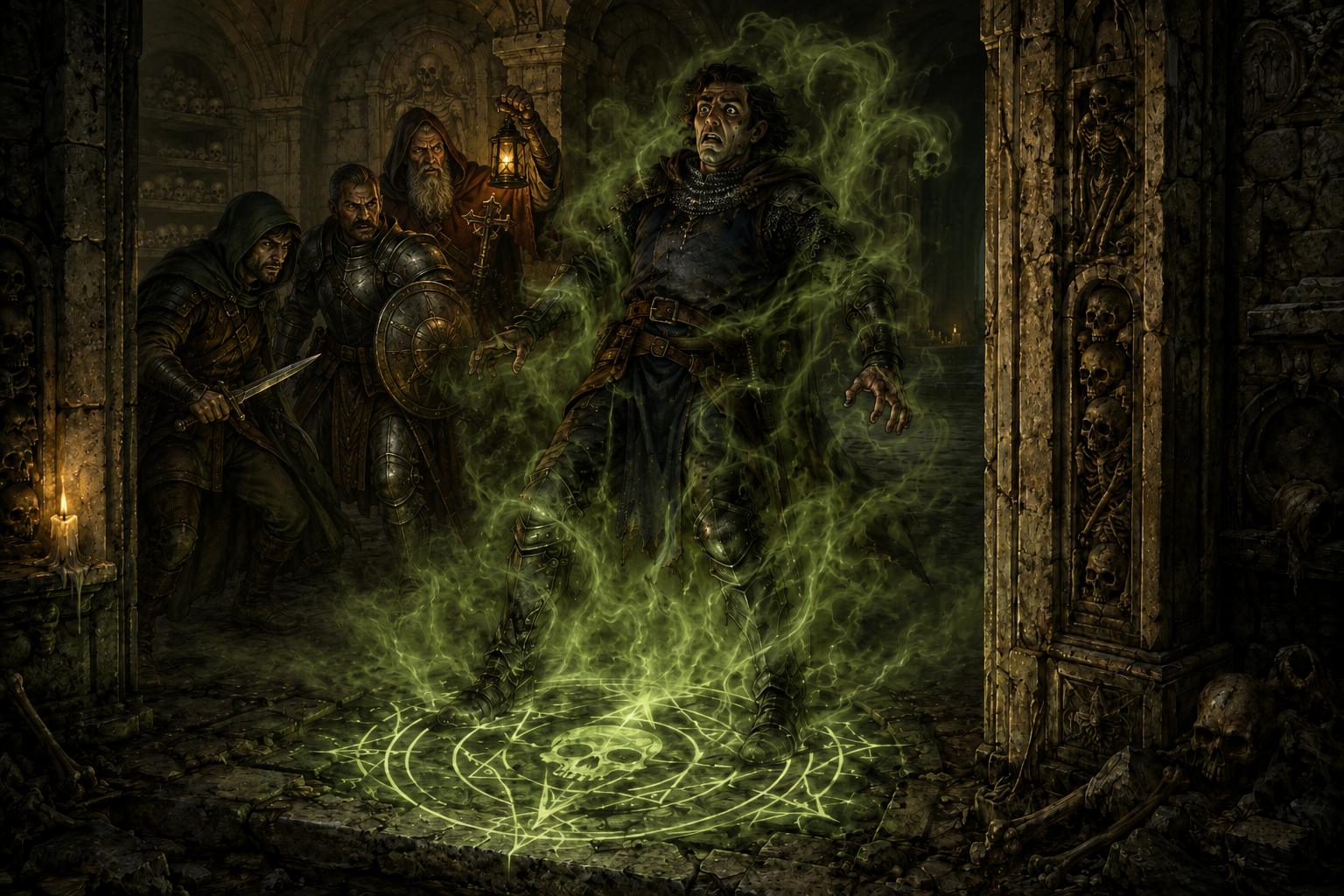
A small necromantic mark freezes the living in place; the Fortitude save determines the carrion stench, not whether the paralysis happens.
Ghoul Glyph is a D&D 3.5e spell from Libris Mortis, later reprinted in Spell Compendium. There is no direct official D&D 5e / 2014, D&D 5.5e / 2024, or Pathfinder 1e version.
The spell’s most important rule is easy to misread: activation paralyses the target for 1d6+2 rounds. The target’s Fortitude save is the “partial” part of the spell because a failed save also makes the paralysed victim exude a 10-foot carrion stench that can impose broad –2 penalties on nearby creatures.
Quick Rules Reference
- 5.5e / 2024: no direct official Ghoul Glyph spell.
- 5e / 2014: no direct official Ghoul Glyph spell.
- Pathfinder 1e: no native core entry.
- D&D 3.5e: Sorcerer/Wizard 2, Hunger 2; Necromancy; 1-minute casting; Touch; permanent until discharged.
- Paralysis: activation paralyses the living target for 1d6+2 rounds.
- Fortitude partial: a failed save causes the paralysed subject to exude the carrion stench; it does not decide whether the initial paralysis occurs.
- Portable object: moving it more than 5 feet causes the glyph to fade.
- Detection/disarming: if noticed, read magic plus DC 13 Spellcraft identifies it; a rogue can Search and Disable Device at DC 27.
- Material: earth from a ghoul’s lair.
Rules
Ghoul Glyph by Edition
5.5e / 2024 — No Direct Official Ghoul Glyph
The 2024 spell list has no direct Ghoul Glyph spell. The former modern version on this page invented a Constitution-save paralysis system, custom triggers, modern disarming checks and a successful-save partial paralysis. Those rules have been removed.
5e / 2014 — No Direct Official Ghoul Glyph
The 2014 rules likewise contain no direct Ghoul Glyph spell. Glyph of Warding is a different spell and should not be used to imply that Ghoul Glyph has an official 5e printing.
Pathfinder 1e — No Native Core Entry
Pathfinder 1e has no native core Ghoul Glyph entry. Importing this spell means importing D&D 3.5e material and should be labelled that way.
Ghoul Glyph — D&D 3.5e
Spell Compendium printing
| School | Necromancy |
|---|---|
| Level | Sorcerer 2, Wizard 2, Hunger 2 |
| Components | V, S, M |
| Casting Time | 1 minute |
| Range | Touch |
| Target | Object touched |
| Duration | Permanent until discharged |
| Saving Throw | Fortitude partial |
| Spell Resistance | Yes |
The glyph is roughly 1 foot across and affects a living creature of Large or smaller size that comes within 5 feet. It can be visible or invisible. A glyph on a portable object fades if the object moves more than 5 feet.
Invisible creatures trigger it normally; creatures passing ethereally do not. Only one Ghoul Glyph can occupy a 5-foot square. Physical or magical probing cannot bypass it, though it can be dispelled; mislead and nondetection can fool it.
Activation paralyses the target for 1d6+2 rounds. If the target also fails the Fortitude save, it exudes a 10-foot carrion stench. Creatures in that radius, including the target, make Fortitude saves or take –2 on attack rolls, weapon damage rolls, saving throws, skill checks and ability checks until the paralysis ends.
Read magic identifies a noticed glyph with DC 13 Spellcraft. A rogue can Search for and Disable it at DC 27.
Material component: earth from a ghoul’s lair.
Libris Mortis printing
The core mechanics are the same, but the original printing triggers when a creature moves to or within 2 feet of the glyph rather than the 5-foot range used by Spell Compendium.
Libris Mortis describes the failed-save stench as retching and nausea, with the same –2 mechanical penalties. It also states the one-glyph-per-5-foot-square, ethereal bypass, DC 13 Spellcraft identification and rogue Search/Disable Device DC 27 rules.
What Changed?
- The fabricated 5.5e/2024 conversion has been removed.
- The Fortitude save is corrected: paralysis happens on activation; the save determines the carrion-stench rider.
- The real 3.5e trapfinding rules are restored: DC 13 Spellcraft with read magic, and rogue Search/Disable Device DC 27.
- The 3.5e printing difference is preserved: 5-foot trigger radius in Spell Compendium, 2-foot trigger radius in Libris Mortis.
- Modern custom trigger logic and thieves’-tools DCs are no longer presented as source rules.
Why This Spell Is Dangerous in the World
A Ghoul Glyph makes architecture hostile. A door, grave-slab, stair, coffin lid, reliquary clasp, sewer arch, narrow bridge, or book-cover can become the moment where the living body stops obeying itself.
The spell is especially feared because it does not merely hold a victim still. It humiliates the body. The target freezes, reeks, retches, and becomes a source of danger to allies. In a tomb passage, that can split a party. In a plague house, it can make rescuers think the victim is already corrupt. In a noble crypt, it can turn a thief’s discovery into public disgrace.
Necromancers use Ghoul Glyphs to defend laboratories, bone-vaults, ghoul-feeding pits, plague carts, corpse doors, and sealed books. Priests of death, corpse-cults, grave robbers, and desperate city watchmen may also use the spell, though respectable authorities usually deny doing so.
The spell’s political danger is simple: it leaves a living witness, but a ruined one. A victim survives long enough to be questioned, blamed, robbed, captured, or sacrificed.
Best Uses in Play
Ghoul Glyph works best when the players can discover, fear, and interact with it before it triggers. It should create decisions rather than simply punish movement.
Strong uses include:
- A tomb corridor where one safe path exists but the signs are half-erased.
- A necromancer’s book bearing a glyph that paralyses a living creature who comes within the glyph’s trigger distance while opening or examining it.
- A plague-cart lock marked to trap looters.
- A noble crypt whose entrance is warded against any living intruder other than the caster, making the trap dangerous even to legitimate heirs who do not know it is there.
- A ghoul-haunted sewer entrance marked by a glyph that the ghouls know how to avoid.
The best Ghoul Glyph scene asks: who steps first, who notices the sign, who risks the disarming attempt, and what arrives while the victim cannot move?
Failure, Risk, and Misuse
Ghoul Glyph should reward caution and trapfinding. In D&D 3.5e, a rogue can Search for and Disable the glyph at DC 27; read magic can identify a noticed glyph with a DC 13 Spellcraft check.
For casters, the main risk is overconfidence. The glyph is small, stationary, and useless once discharged. A moved object loses the glyph. A prepared intruder may dispel it, identify it, avoid it, or trick it with the right magic.
For victims, the danger is positional. Paralysis in an empty room is frightening. Paralysis on a bridge, stair, ghoul tunnel, plague pit, flooded crypt, or battlefield doorway is potentially disastrous.
For the world, misuse creates legal and moral trouble. A Ghoul Glyph on a private crypt may be tolerated. A Ghoul Glyph on a public road, inn door, tax office, market chest, or rented room is a serious crime in most settled places.
Investigation and Counterplay
A Ghoul Glyph should leave clues when the scene benefits from investigation.
Possible clues include:
- Grave-earth dust packed into a carved line.
- Flies gathering where there is no corpse.
- A cold greasy mark on a latch or floor-stone.
- Old scratch marks where someone froze and was dragged away.
- A sour corpse-smell that appears only near one threshold.
- Ghouls avoiding one tile, door, or arch.
- A previous victim’s dropped lantern, bent tool, or broken fingernails.
Counterplay should be concrete. Characters can search, identify, dispel, disable, avoid the marked space, send an unliving creature through first, use ethereal travel, or force an enemy into the trigger area.
Do not let casual poking with a ten-foot pole automatically solve the spell. The glyph is not a pressure plate. It is a necromantic ward against living presence.
How Ghoul Glyph Changes a Scene
Ghoul Glyph changes a scene by making the first step dangerous. The party slows down. The rogue matters. The wizard’s detection matters. The cleric’s knowledge of undeath matters. The fighter’s decision about who opens the door matters.
Once triggered, the spell changes the shape of the encounter. The victim blocks a passage, drops a key, falls across a threshold, or becomes the centre of a retching carrion radius. Allies must decide whether to drag the victim away, press forward, retreat, or fight while gagging on corpse-stink.
The spell is strongest in confined spaces. In a wide courtyard, it is a nasty trap. In a tomb corridor while ghouls crawl out of side niches, it becomes a memorable problem.
Rules Clarifications and Edge Cases
Does the glyph affect undead?
No. The default spell affects living creatures. Undead may trigger the glyph only if a deliberate variant exists in the campaign.
Can the glyph be placed on a weapon or thrown object?
It can be placed on a portable object, but moving that object more than 5 feet from the casting location ends the glyph. It is not a thrown trap.
Does invisibility bypass the glyph?
No. Invisible creatures trigger the glyph normally unless another spell specifically fools the ward’s detection.
Does ethereal movement bypass the glyph?
Yes, if the creature remains ethereal while passing the glyph.
Can more than one glyph be stacked in a doorway?
No. Only one Ghoul Glyph can occupy a 5-foot square.
Does the carrion stench count as poison?
The spell does not give the stench a poison descriptor. Resolve the listed Fortitude save and –2 penalties unless another rule explicitly changes how the creature interacts with the effect.
Can the glyph be noticed before it triggers?
Yes. It can be scribed visibly or invisibly. In 3.5e, a rogue can find it with Search DC 27; if a glyph is noticed, read magic plus DC 13 Spellcraft identifies it.
Adventure and Worldbuilding Hooks
The Door That Stinks of Treason
A council chamber door has been marked with a Ghoul Glyph. The first councillor to enter freezes and fills the hall with corpse-stench. The accusation is immediate: someone has brought grave-magic into civic law. The truth is worse — the glyph was meant to stop a disguised ghoul already sitting among them.
The Coffin That Will Not Open
A noble family hires the characters to open an ancestral coffin without damaging it. Every servant who touched the lid froze and woke reeking of carrion. The glyph protects not treasure, but a body buried with the wrong name.
The Sewer Mark
A city’s corpse collectors have learned that one sewer arch is marked with a Ghoul Glyph. Ghouls pass around it. Living investigators do not. Someone has been using the ward to divide the sewer into hunting grounds.
Related Spells
Ghoul Glyph belongs beside other warding, paralysis, and undead-adjacent spells.
Useful related or interacting spells include:
- Glyph of Warding — The broader magical warding spell, useful for comparing how Ghoul Glyph narrows that idea into a smaller, corpse-themed paralysis trap.
- Ghoul Touch — The closest thematic relative, sharing the same ghoul-like paralysis and carrion horror but delivering it through direct necromantic contact rather than a prepared glyph.
- Sepia Snake Sigil — Another written trap spell, useful for scenes involving dangerous books, hidden inscriptions, sealed records, or magical writing that punishes the reader.
- Hold Person — The cleanest comparison for paralysis in play, though Ghoul Glyph is prepared in advance and tied to a physical threshold or object.
- Dispel Magic — The most important interacting spell, since it gives careful characters a direct way to remove the glyph before it discharges.
Historical, Natural, and Mythic Context
The word ghoul enters English through Arabic ghūl, a grave-haunting and corpse-eating figure associated with burial places, deserted landscapes, and the fear that the dead are not safe from hunger. For a general reference, see Encyclopaedia Britannica’s entry on the ghoul. For the word’s history, see Etymonline’s entry for ghoul.
Ghoul Glyph draws on that graveyard fear but turns it into written necromancy. The ghoul itself is absent, yet its signs remain: paralysis, carrion breath, grave-earth, and the sense that a living body has crossed a boundary claimed by the dead. The spell works best when treated not merely as a trap, but as a funerary trespass mark: a sign that says the threshold already belongs to hunger below the grave.
The material component gives the spell its physical weight. Earth from a ghoul’s lair is not ordinary dirt. It is grave-soil polluted by feeding, hiding, dragging, burial violation, and the passage of undead hunger through the ground. The carrion stench also grounds the spell in natural revulsion: the smell of rot, opened graves, spoiled meat, and bodies that should have remained buried.
The glyph also belongs to the older dramatic tradition of dangerous writing: tomb warnings, curse inscriptions, sealed names, forbidden books, and warded doors. Ancient funerary inscriptions could threaten consequences for disturbing graves, while later stories turned tomb curses into a powerful image of forbidden places protecting themselves. For useful background on tomb warnings and curse traditions, see World History Encyclopedia’s article on curses and fines on epitaphs and National Museums Scotland’s discussion of ancient Egyptian tomb warnings, curses, and ghosts.
In a late medieval campaign, such a glyph is most likely to appear in plague pits, charnel houses, corpse roads, necromancers’ cellars, battlefield ossuaries, noble crypts, sealed reliquaries, and city underworks touched by undead plague. In lawful settlements, its use is rarely neutral. A grave ward may be justified on a sealed tomb; the same glyph on an inn door, tax coffer, shop cellar, or public bridge is evidence of necromantic crime.
Keep this reference growing
If this page helped with your reading or game, you can support its upkeep or explore the curated books.
Explore the Bookshop — epics, classics and stories behind imagined worlds.