
Shadow, the Stolen Silhouette
Shadow, the Stolen Silhouette
The dead do not always leave bodies. Sometimes they leave only the dark shape of a life that still wants yours.
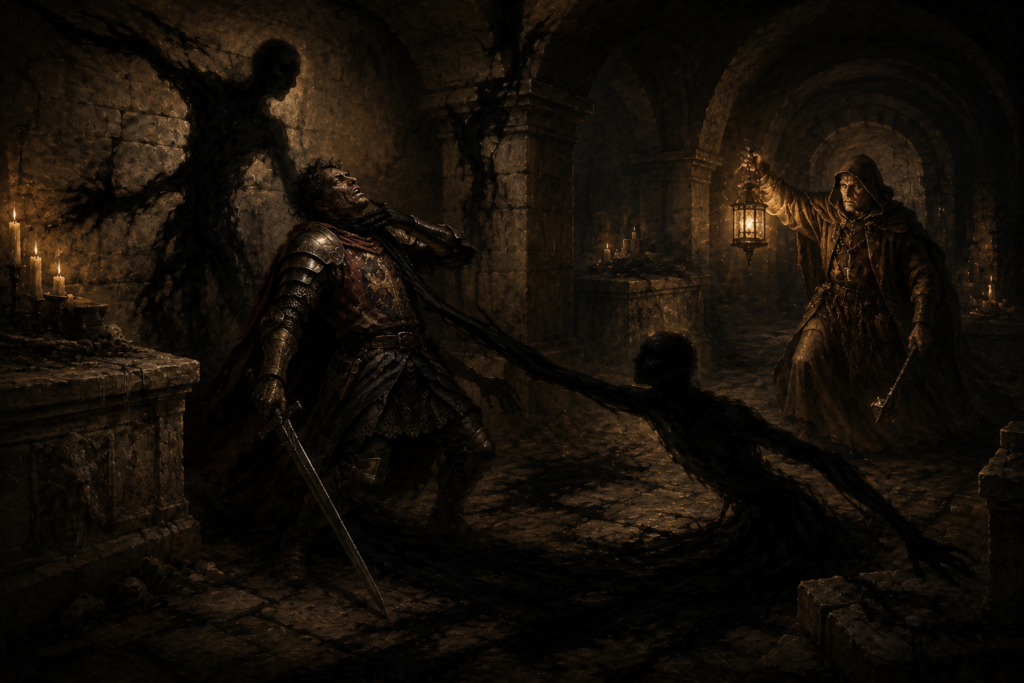
A shadow is the undead remainder of a person stripped down to hunger, outline, and absence. It is not a corpse that walks, a ghost that speaks, or a demon wrapped in darkness. It is the silhouette left behind when warmth, strength, and personhood have been eaten away, leaving a predatory absence that reaches from walls, floors, crypt corners, plague rooms, and gallows posts to steal the strength of the living.
Shadows are feared wherever death was hidden, denied, or made nameless. Their touch does not cut flesh like a blade. It drains the body from within, leaving victims trembling, weakened, and burdened by a terrible cold. In the worst hauntings, those slain by a shadow rise as new shadows, adding one more stolen outline to the dark.
Overview
A shadow is an incorporeal undead predator that clings to darkness, walls, floors, ceilings, and the uncertain border between light and absence. At first, it may seem no more than a trick of torchlight or a long stain across stone. Then it moves against the light, stretches where no body stands, and reaches with hands that have no substance yet can still steal a living creature’s strength.
Unlike a ghost, a shadow rarely possesses a full personality. It may preserve fragments of habit, posture, route, or fear, but most shadows are no longer coherent dead souls. A murdered guard may still follow a corridor. A plague victim may still gather near warmth. A hanged thief may still linger beneath the beam. These remnants are not speech or memory in the ordinary sense. They are the last burned habits of a life reduced to hunger.
Shadows work best as creatures of dread and attrition. Their threat lies not in obvious gore, but in the intimate horror of being weakened, isolated, and quietly consumed by something that should only have been a trick of light.
Appearance
A shadow resembles a human or humanoid silhouette, but only briefly and imperfectly. Its edges shiver, blur, and lengthen. It may cling partly to a wall, spill across a floor, or rise up a pillar as if the darkness itself is trying to stand.
Most shadows have no clear eyes, mouth, or flesh. Sometimes, in a flare of lantern-light, a detail becomes visible for a heartbeat: the outline of a noose, the bent posture of a prisoner, the ragged hem of a dead soldier’s cloak, or the shape of a hand spread desperately against a locked door.
A shadow should not look like smoke, a black skeleton, a robed spectre, or a tentacled magical cloud. Its horror lies in wrongness. It is a shadow that should belong to someone, but does not.
When a shadow draws near, candles dim, mirrors seem shallow, corners deepen, and a victim’s own shadow may pull strangely away from their feet. Animals often sense them first. Dogs whine, horses shy, and birds refuse to roost where such a creature hunts.
Habitat
Shadows haunt places where light is weak and witness failed. They favour crypts, plague houses, forgotten cellars, old courts, ruined keeps, sealed bedrooms, battlefields, execution grounds, mines, wells, and abandoned shrines. Any place where someone died hidden, denied, or unremembered can become fertile ground for a shadow.
Many arise from wrongful death, secret murder, denied burial, or deliberate erasure. A prisoner left to starve in a forgotten cell, a servant murdered behind a sealed panel, a soldier stripped of name and body in a ditch, or a condemned person executed on false testimony may leave more than grief behind.
Others are created deliberately. Necromancers, infernal binders, mirror-witches, cursed painters, assassins, and soul-thieves may tear a shadow away from a living or dying person and bind it as a servant. Such a creature may remain tied to a physical focus: a mirror, lamp, contract, portrait, noose, execution nail, or murder weapon.
In plague-haunted campaigns, a shadow can be a rare result of death combined with erasure. A sealed house where bodies were burned without rite, hidden without names, or denied public witness may produce such an undead remnant. This should be a charged exception, not the fate of every plague victim.
Ecology
A shadow is undead and has no natural place in the living world. It does not eat, drink, breathe, sleep, or age. It feeds by draining strength from the living, drawing bodily vitality into its own empty form.
New shadows are often simple and animal-like in behaviour. Older ones can become more cunning. They learn lamp routes, patrol rhythms, sleeping places, and the habits of those who dwell nearby. They understand enough to wait, stalk, and strike when the living are alone or weak.
Shadows sometimes gather in numbers where many deaths share the same darkness. A plague house sealed with the dying inside, a prison corridor used for quiet executions, or a battlefield chapel built over a trench grave may harbour several at once. They do not truly cooperate, but their hungers overlap and thicken the danger of the place.
Because a shadow has no body, destroying it leaves little behind. The remains of the haunting are found in the site: hidden bones, a rusted key, burial tokens, court records, plague tallies, a child’s shoe, a bent spur, a broken lantern, or some cursed object that tied the creature to the world.
Behaviour
Shadows are patient predators. They prefer to lurk beneath beds, along stairwells, behind doors, inside arches, or in the confused light at the edge of a lantern’s reach. They do not usually rush a group in the open unless driven, trapped, or desperate. Instead, they wait for the last person in a line, the watchman who stands alone, the wounded traveller, or the overconfident intruder who thinks the room is empty.
Often a shadow first announces itself by being almost seen: an extra silhouette in the room, a hand-shaped darkness on a wall, a patch of blackness moving slightly after everyone else has gone still. By the time the victim realises what is wrong, the creature is already close enough to touch.
Most shadows recoil from overwhelming light, radiant force, strong holy presence, and enemies able to strike incorporeal undead reliably. They are bold against the weak, the isolated, and the unprepared. Their predatory intelligence is simple but effective.
Combat Tactics
A shadow is most dangerous in darkness, dim corridors, cramped chambers, crypts, ruins, and lamplit interiors where it can approach from surfaces and angles the living do not expect. It exploits cover, poor visibility, and the party’s uncertainty about where it truly is.
It should rarely fight like a soldier. A shadow slips in, strikes, withdraws, and attacks again from another angle. It favours targets carrying light sources, rear-rank characters, wounded survivors, and anyone separated from the group.
Its strength-draining touch is its true threat. Even a surviving victim may find armour heavier, doors harder to force, weapons slower to lift, and retreat more urgent than pride. A single shadow creates fear. Several can create a death spiral if the party lacks light, turning, restoration, radiant force, or a disciplined withdrawal.
Mechanics Tabs
The rules below are mechanics compatible for different game editions.
Shadow, the Stolen Silhouette 5.5e / 2024
Shadow, the Stolen Silhouette Pathfinder 1e
Shadow, the Stolen Silhouette 5.5e / 2024-Compatible Version
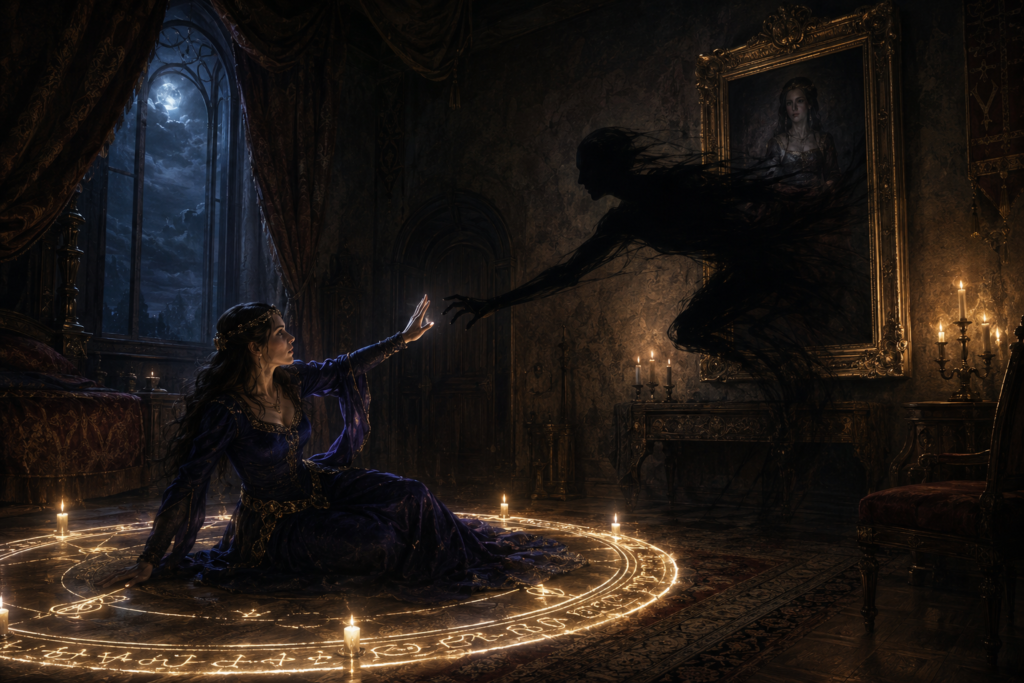
Medium Undead, Typically Neutral Evil
Armor Class 12
Initiative +2
Hit Points 16 (3d8 + 3)
Speed 40 ft.
| STR | DEX | CON | INT | WIS | CHA |
|---|---|---|---|---|---|
| 6 (-2) | 14 (+2) | 12 (+1) | 6 (-2) | 10 (+0) | 8 (-1) |
Saving Throws Dex +4, Wis +2
Skills Stealth +6
Damage Vulnerabilities Radiant
Damage Resistances Acid, Cold, Fire, Lightning, Thunder; Bludgeoning, Piercing, and Slashing from Nonmagical Attacks
Damage Immunities Necrotic, Poison
Condition Immunities Charmed, Exhaustion, Frightened, Grappled, Paralyzed, Petrified, Poisoned, Prone, Restrained
Senses Darkvision 60 ft., Passive Perception 10
Languages Understands the languages it knew in life but cannot speak
Challenge 1/2 (100 XP)
Proficiency Bonus +2
Traits
Incorporeal Movement. The shadow can move through creatures and objects as if they were Difficult Terrain. It takes 5 (1d10) force damage if it ends its turn inside an object.
Lightless Stealth. While in Dim Light or Darkness, the shadow has Advantage on Dexterity (Stealth) checks. In Bright Light, it has Disadvantage on Dexterity (Stealth) checks.
Sunlight Weakness. While in Sunlight, the shadow has Disadvantage on attack rolls, ability checks, and saving throws.
Undead Nature. The shadow does not require air, food, drink, or sleep.
Actions
Strength-Draining Touch. Melee Attack Roll: +4, reach 5 ft. Hit: 9 (2d6 + 2) necrotic damage, and the target must succeed on a DC 12 Strength saving throw or its Strength score is reduced by 1d4. This reduction lasts until the target finishes a Long Rest or receives magic that restores ability loss or ends a comparable undead affliction.
If this reduction lowers the target’s Strength to 0, the target dies. A Humanoid slain in this way rises as a shadow 1d4 hours later unless the body is blessed, exposed to direct sunlight for 1 hour, affected by suitable restoration magic, or given proper funerary rites before the transformation is complete.
Bonus Actions
Slip Behind the Light. While in Dim Light or Darkness, the shadow takes the Hide action.
Notes
Strength Drain Bookkeeping. If the table prefers less tracking, replace Strength score reduction with a cumulative -1 penalty to Strength checks, Strength saving throws, and attack rolls using Strength. If the penalty reaches -5, the target dies. This is simpler but keeps the creature’s identity intact.
Creating New Shadows. For a lower-horror campaign, victims rise only in cursed sites, plague houses, tombs, or places tied to the original haunting. For harsher undead-horror play, they rise wherever the creature slays them unless stopped.
Light Use. Ordinary torches and lanterns reveal the shadow, but they do not destroy it. Direct sunlight, powerful radiant effects, consecrated light, and magic meant to harm undead are the true counters.
Encounter Difficulty. A single shadow is a low-level threat. Several shadows are much more dangerous than their individual Challenge might suggest because Strength drain, stealth, incorporeal movement, and spawn creation compound quickly.
Shadow, the Stolen Silhouette Pathfinder 1e
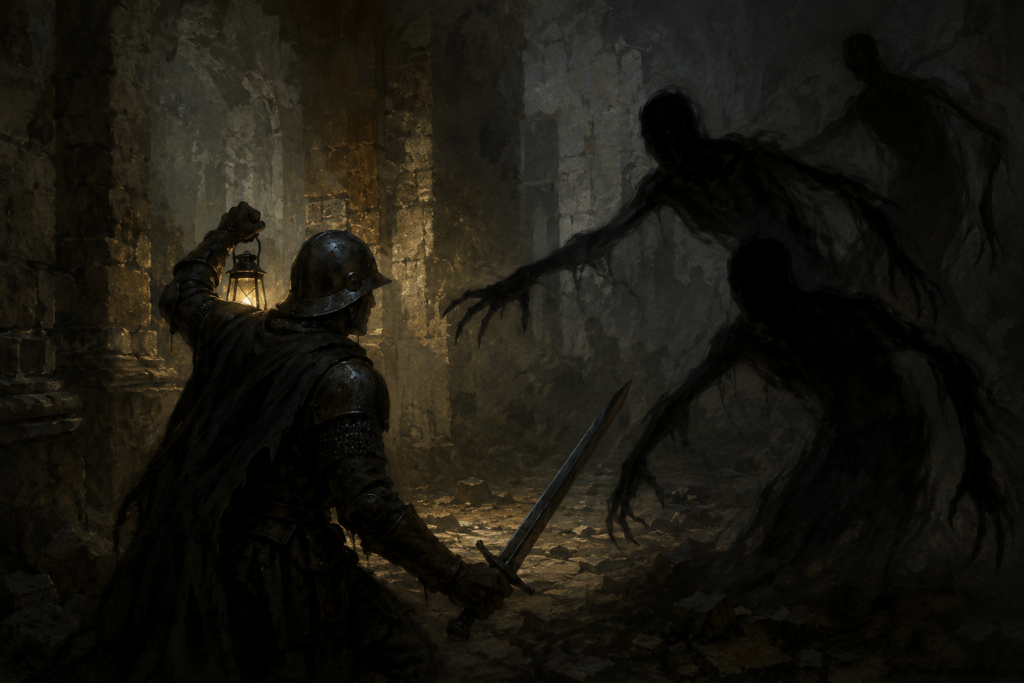
Long, dark fingers stretch out across the wall, reaching toward light, life, and all that they do not have, but long to possess. The shadows move and hunger, for their very essence is gluttony and greed.
The sinister shadow skirts the border between the gloom of darkness and the harsh truth of light. The shadow prefers to haunt ruins where civilization has moved on, where it hunts living creatures foolish enough to stumble into its territory. The shadow is an undead horror, and as such has no goals or outwardly visible motivations other than to sap life and vitality from living beings.
Rampant covetousness and grasping greed lead some people down the dark path of evil and betrayal, eventually ending in a reprehensible death scene or a lonely expiration. While most such petty and despicable souls travel on to their final rewards the same way everyone else does, in some cases gluttons, misers, and thieves waste away into nothing but shadows—undead things that reach and grab, but cannot hold. Over time, spellcasters have discovered that these avaricious souls make perfect servants and guardians, immortal creatures doomed to watch over “their” treasure for all eternity.
Shadows are incorporeal undead, distorted like their namesakes and able to float or slide silently along surfaces, blending in among the true shadows there. This allows them to approach unnoticed, and those trespassers not caught completely by surprise rarely get more than a glimpse out of the corner of an eye—a flicker of movement and the sense of something out of place—before they strike.
In addition to guarding the haunted ruins they lay claim to or serving more powerful undead capable of cowing them, shadows devote themselves to attacking any living creatures they encounter, draining their victims of all vitality with their chilling touch. Victims become weaker and weaker until they finally perish, but their suffering is only beginning. For as the victim of a shadow’s touch expires, its own shadow detaches from the corpse, taking on the same half-life as its killer, hungry for the essence of the living and operating under its killer’s command.
Like all undead, shadows are timeless creatures. As they have lost all concept of their previous life in the transition to undeath, the passage of centuries means almost nothing to them, and no one can say what shadows may do or think in the long wait between victims. However, unlike lesser undead, shadows do appear to “grow” over time. A shadow that has fed on the lives of many victims, or that dwells long enough in a place suffused with sufficient negative energies, may grow in power, becoming a greater shadow.
These “shadow lords” often command swarms of their lesser kin, typically spawn of their own making. Rarely is more than one greater shadow found in a particular place, as the creatures compete fiercely for prey. Some believe that in especially fallow times, shadows even consume their own, but this is almost certainly false, as consuming other undead would grant a shadow neither the energy it seeks nor a new spawn, and gangs of shadows have been found that survived sealed into lost tombs together for millennia.
What awaits powerful shadows is a question even the sages can only speculate about. Some believe shadow lords may eventually become shadow demons, drawn down into the Abyss by the weight of their sins to drown in the eternal darkness. Torn apart by the forces of chaos, they emerge as malevolent monsters of pure envy and avarice. Others claim shadow lords steal the vitality of the living to become more corporeal, eventually transforming into other undead creatures or half-real shades.
Shadow CR 3
XP 800
CE Medium undead (incorporeal)
Init +2; Senses darkvision 60 ft.; Perception +8
DEFENSE
AC 15, touch 15, flat-footed 12 (+2 deflection, +2 Dex, +1 dodge)
hp 19 (3d8+6)
Fort +3, Ref +3, Will +4
Defensive Abilities incorporeal, channel resistance +2; Immune undead traits
OFFENSE
Speed fly 40 ft. (good)
Melee incorporeal touch +4 (1d6 Strength damage)
Special Attacks create spawn
STATISTICS
Str —, Dex 14, Con —, Int 6, Wis 12, Cha 15
Base Atk +2; CMB +4; CMD 17
Feats Dodge, Skill Focus (Perception)
Skills Fly +11, Perception +8, Stealth +8 (+12 in dim light, +4 in bright light); Racial Modifiers +4 Stealth in dim light (–4 in bright light)
Languages Common (unofficial errata)
SPECIAL ABILITIES
Create Spawn (Su)
A humanoid creature killed by a shadow’s Strength damage becomes a shadow under the control of its killer in 1d4 rounds.
Strength Damage (Su)
A shadow’s touch deals 1d6 points of Strength damage to a living creature. This is a negative energy effect. A creature dies if this Strength damage equals or exceeds its actual Strength score.
ECOLOGY
Environment any
Organization solitary, pair, gang (3–6), or swarm (7–12)
Treasure standard
Other Variants
While most shadows steal strength from their victims, rare variants may drain different aspects of a target’s vitality. A variant shadow’s chilling touch may induce paralysis and numbness (Dexterity damage) or a kind of slow decay of the flesh (Constitution damage). The mere touch of a shadow can cause idiocy (Intelligence damage), madness (Wisdom damage), or an unnerving deadening of the victim’s personality (Charisma damage).
Any or all of these could also be preludes to the shadow’s true theft of Strength, further weakening a target and making it easy prey. Other variants include the following.
Distorted Shadow (CR +1): Not bound by the limitations of physical creatures, some shadows can flicker and distort like their namesakes, stretching out to touch victims over much greater distances. These shadows possess the Advanced creature simple template, but instead of gaining a bonus to natural armor, increase their reach with their incorporeal touch by 10 feet.
Hidden One (CR +1): While all shadows are stealthy, some are especially effective at concealing themselves in areas of dim and shifting light. Rather than making Stealth skill checks, these shadows simply have partial or even total concealment among normal shadows, adding a 20% miss chance to their already formidable ability to shrug off many mundane sources of damage.
Plague Shadow (CR +1): Plague shadows appear as Medium-sized shadows of animals associated with disease—typically rats or bats. Rather than simply draining a victim’s Strength on a hit, plague shadows also inflict a dreaded curse known as shadow blight. Victims of this supernatural disease quickly weaken and die, at which point they spawn new plague shadows to further spread the contagion.
A plague shadow has the Advanced creature simple template, but does not gain a natural armor bonus to its AC. Shadow blight: curse and disease; save Fortitude DC 16; onset 1 minute; frequency 1/day; effect 1d8 Strength damage, upon death, the victim becomes a plague shadow; cure successfully casting both remove curse and remove disease within 1 minute of each other.
Shadetouch Shadow (CR +0): Shadetouch shadows are infused with partially real shadowstuff from the Shadow Plane. They treat the Shadow Plane as their home plane (and thus gain the “extraplanar” subtype on the Material Plane). A shadetouch shadow lacks the typical shadow’s incorporeal touch—instead, it possesses two claw attacks that each deal 1d8 points of damage on a hit, in addition to the normal amount of Strength damage shadows inflict.
Vanishing Shadow (CR +1): Shadows dwelling in a place of strong negative energy or with a connection to the Shadow Plane can develop the ability to shadow slip through the Shadow Plane, vanishing into the darkness and reappearing some distance away. These shadows have the Advanced creature simple template—while they do not gain the bonus to natural armor that this template typically imparts, vanishing shadows possess blink as a constant spell-like ability.
Ecology
On their own, shadows arise from the souls of greedy but lackluster evildoers—those whose crimes are heinous, but who lack the rage of a spectre or the exultation in evil often found in wraiths. The bandit who unemotionally slits her victims’ throats because it’s convenient, the petty diplomat who orders a witch burning to cover up his adulterous affair, and the miserly headmaster who lets orphans starve to save a few coppers all make good candidates for becoming shadows.
Yet while such spontaneous transformations do occur, the vast majority of shadows are instead created by magic. Necromancers have long seen the value of relatively weak, pliable, and unambitious undead servants—especially incorporeal ones—and most shadows currently in existence were originally called to undeath by the spell create undead (or else by the life-draining attacks of other shadows created in this manner).
Shadows sap strength from the living in an effort to feed their dark hunger and satisfy their eternal desire to touch the world once again. Because death at the hands of a shadow means becoming one, places plagued by the creatures are either already desolate ruins, or else quickly become so once enough shadows have infested the area.
Newly created shadows seek out and drain the life from others, creating yet more shadows, until all living creatures have either fled or joined their ranks. This leaves shadow-haunted places isolated as word of the danger spreads, and ensures that the shadows there are ravenous when the next living beings appear.
Fortunately for the living, shadows rarely spread far from where they first appear. Creatures of twilight, they can withstand the sun’s rays far better than some of their incorporeal cousins (such as wraiths and spectres), though they are much less comfortable out in direct sunlight or wide open places where it’s harder for them to sneak up on their prey.
As such, a place consumed by shadows might lie only a few miles from a living settlement, with the shadows not bothering to cross the miles of open country, instead preferring to subsist off lone travelers and those unaware of their presence or the threat they pose.
Their tendency to hole up in dark places also gives adventurers a much-needed advantage, as although the shadows are incorporeal, they cannot pass directly through walls thicker than they are, meaning that sealing a shadow-haunted tomb with enough rock can effectively bottle the spirits up for eternity—or at least until the next foolhardy treasure-hunter ignores the warnings and opens the tomb up.
Also fortunate for the living is that although shadows can and sometimes do drain energy from animals or even vermin found in their lairs, only humanoid creatures that fall victim to their touch become shadows themselves. This is because of the nature of the humanoid spirit or soul and the magical similarity between the shadow and its prey. Consequently, unless truly bored and starved for energy and entertainment, shadows rarely bother to feed on livestock or mounts, reserving their hunger for humanoid prey.
Although their theft of strength is often called “feeding,” shadows do not “starve” and often continue to exist for decades or even centuries without prey. No longer living creatures, they have no physical needs, and are not even touched by some of the harsh environments that can rot or wear corporeal undead to dust. The only environments that harm them are ones with an abundance of positive energy, such as consecrated graveyards, undefiled churches, or other holy ground.
Habitat & Society
As most shadows are barely intelligent, they have little in the way of society beyond a simple hierarchy: the more powerful shadows dominate and control the weaker ones (often their spawn), who in turn control their own spawn, and so forth, with the most powerful shadow at the summit of a swarm of lesser underlings.
The conditions that create shadows may also influence their spread. Shadows created by a curse, for example, are
Shadowy Superstitions
Like all unnatural creatures, shadows spawn more than their share of old wives’ tales and campfire stories intended to frighten children. Adventurers may take a keen interest in these stories because they often talk about ways to survive a shadow attack—such as the boy who took shelter within a large clay pot inside an old temple, protected by being in total darkness—or ways to fight or destroy shadows, from attacking with the shadow of a weapon to “storing” the pure light of the sun in holy water.
Unfortunately for those selfsame adventurers, folktales are often contradictory, unclear, or just plain wrong, and there is no easy way to tell truth from fiction without hard-won experience.
Game Masters may wish to come up with some local legends about shadows, particularly among people who have dwelled near them for any length of time. Take a look at the Variants section for some possibilities. Such tall tavern tales can add a fun element to your adventure, and may provide the players with a valuable clue (or a dangerous falsehood) they can use later on.
Sample Lairs
Shadows live in all sorts of abandoned places. Presented below are a few sample lairs.
The Bandit-King’s Cave: The bandit-king Alzar Kagir and his brigands were rumored to have accumulated a great treasure trove over the years, hidden in a secret cave deep in the hills, where even the local militia hesitated to follow. Rather than the law, justice found the bandit-king in the form of betrayal at the hands of his gang, who poisoned him and sealed him in his cave of treasures.
They thought to unseal the cave some time later and divide the spoils, but did not reckon on the potency of their former leader’s greed or thirst for revenge. One by one, they perished as Alzar Kagir’s shadow moved among them, creating a new gang to safeguard his precious treasures for all time.
The Lost Souls Haven: Years ago, a young noblewoman lost in the woodlands beheld a holy vision on a hilltop and founded a small abbey there, whose sisterhood cared for all lost souls who came to its doors. Their kindness proved their undoing when a lost mercenary unit took advantage of their hospitality, only to rob and set fire to the abbey’s great hall with the sisters trapped inside.
But the shadows that danced in the hellish light of the flames visited upon the soldiers all of the pain they had inflicted, and left none alive. Now the Lost Souls Haven is a haunted place, avoided by all sensible folk. Some claim that innocent women can still find shelter there, but others say the shadows wreak their vengeance on all.
Silvershadow Mine: Once this mine produced plentiful silver for the dwarves who dug in its depths. Exactly what changed depends on who you ask: perhaps the dwarves dug too deeply, or were betrayed by the human communities they traded with. Whatever the case, miners began to disappear. Bad air and accidents were blamed at first, but it soon became clear that Silvershadow Mine was infested.
Shadows that should not have been there moved in the torchlight, and the final cries of the lost miners echoed in the tunnels. The dwarves sealed the mine and abandoned it, and the few lone prospectors and treasure-seekers who have gone looking for it have vanished into the shadows of the mountains, never to be seen again.
The Shadow-Puppet Theater: The theater once resounded with the laughter of children. Marallin’s Magical Lantern Shows amused and amazed them with shadows that moved, danced, talked, and sang. But in the hard years, fewer and fewer came to Marallin’s shows, and her only company was the shadows of the Magical Lanterns—shadows that did her bidding. So it was that the first children disappeared, and stories were told of their voices echoing in the old, abandoned building. Today their shadows can still be seen moving and capering on the stage, but with no trace of them—or old Marallin—anywhere else.
Shadows are often tied to a particular place, unable to leave it. They may haunt a house or bandit lair, or remain in a specific tomb, graveyard, or ruin. As creatures of avarice, shadows are possessive about their lairs, and often choose to stay there in order to guard something, even though their time is long since passed. A shadow might watch over the tomb of a forgotten loved one, liege-lord, or enemy, or might remain bound to some treasure from life.
Campaign Role
Shadows are easily used as “guardian” undead, tied to a particular location to serve as a threat for anyone going there. Shadows may haunt an abandoned village, lost mine, or long-buried tomb, waiting for a group of explorers to venture into their domain. Shadows have the advantage of existing in their environment without interacting with it; they need nothing, not even air or water, and leave few traces save for the remains of their previous victims.
This makes them effective monsters for “closed” environments where you wouldn’t find living creatures (such as a sealed dungeon). They can, however, show up in any sort of environment—while a shadowy undead figure might be expected in a spooky graveyard, an encounter can that much scarier if it occurs in an unexpected place, such as underwater in the hull of a sunken ship.
Shadows effectively enhance the environments they inhabit: they are frightening, difficult to spot, and good for putting adventurers (and their players) a bit on edge. Creatures of twilight, shadows are unaffected by most sources of light, and indeed often use the light shed by torches, lanterns, and sunrods to their advantage, mixing with and hiding among the other shadows.
Just the knowledge that shadows exist can be enough to get adventurers literally jumping at every flickering shadow, provided it’s described to the players in the right way. Lots of otherwise harmless things, including real shadows, might be mistaken for undead shadows—and of course, just when the heroes get complacent, it’s time for them to run into the real thing.
Unless following a more powerful undead creature or obeying specific instructions, shadows tend to be unimaginative, and stay in one place until something comes along to stir them up. If shadows do happen to move into a town, their quick reproduction rate—it takes less than 30 seconds for someone killed by a shadow to rise as one of them—makes them extraordinarily difficult to root out, yet it’s also not uncommon for a nest of shadows to take over a given building and ignore those right next to it.
Of course, this is little comfort to PCs who unintentionally release a nest of shadows from their hidden tomb, or who realize as the sun is setting that the shadows are moving of their own accord, and have the party surrounded…
Treasure
Shadows have two sorts of treasures: ones they held in life, and those they acquired as undead. Their greedy nature makes shadows possessive of their goods, even though they are long since past being able to appreciate or use most of them, and unable to even grab and move them with their incorporeal limbs.
The “treasures” a shadow held in life may or may not be valuable to anyone else. Certainly a shadow that was once a miser or a thief may have a rich trove hidden away somewhere, jealously guarded even in death. Yet a shadow that sought to grasp other things in life may not hold any “treasure” greater than a keepsake: perhaps a locket, a painting, a map, or a chest of faded and dried flower petals and old love letters.
Other treasures found in a shadow’s lair are those of the creature’s victims. Shadows care nothing for the corpses they leave behind, even their own former bodies. The bodies and any items they wore or carried are usually left to rot where they fell, since the shadows are incapable of moving them, even if they wanted to do so. In some of the dry tombs where shadows are found, the bodies may mummify. In others, they draw the attentions of scavengers. Thus, shadows and flesh-eating vermin coexist quite well.
Treasure and Remains
A shadow carries no treasure. It has no body, purse, pack, armour, or weapon. Its treasure lies in the place it haunts and the deaths that fed it.
For an ordinary encounter, place incidental remains: 2d6 gp, 3d10 sp, a rusted key, a cracked lantern, a burial token, a blood-stained knife, or a silver charm worth 10 gp. For a more significant haunting, the site might conceal a signet ring worth 25 gp, a reliquary worth 50 gp, a purse of 2d10 × 10 gp, legal records, a sealed confession, a plague tally, or a hidden strongbox left behind by a victim who never escaped.
If the creature was made deliberately, the most valuable object is often the binding focus: a shadow-stained ring, blackened mirror, grave-oil lamp, portrait without a painted shadow, infernal contract, execution nail, or preserved noose. Such an object may be worth 50–250 gp, though selling it carelessly may simply carry the haunting elsewhere.
Ending the Haunting
Destroying a shadow ends the immediate danger, but not always the deeper wrong. Some are merely undead predators and vanish when laid low. Others are symptoms of hidden murder, denied burial, plague secrecy, false judgement, or magical theft of personhood.
The straightforward answer is to destroy the creature with force, radiant power, turning, direct sunlight, or other magic capable of harming incorporeal undead. This is enough for wandering shadows, lesser spawn, or servants created by failed necromancy.
More serious hauntings require the cause to be answered. That may mean recovering hidden remains, naming the dead publicly, correcting a false sentence, opening a sealed cell, breaking a cursed lamp, burning a shadow-bound portrait, carrying blessed light through the site before dawn, or exposing the crime that depended on the dead remaining unremembered.
Use one concrete requirement instead of a vague “ritual.” A good haunting solution should feel table-usable and specific: place a burial coin in the mouth of a hidden corpse, cut down the gallows beam that still casts the wrong shadow, read the names of the dead at the town gate, burn the murder weapon at sunrise, or open every sealed shutter in the plague house while consecrated candles are still burning.
If the party destroys the shadow but ignores the cause, the site may remain spiritually unsafe. New shadows might form after another death, animals may refuse the place, torches may burn low, and survivors may continue losing strength in their sleep. This consequence should be used sparingly, but when it appears, it tells the players that this was not only a monster fight. It was an unresolved death.
Adventure Hooks
The Second Shadow
A respected magistrate casts two shadows at sunset. One belongs to him. The other lingers half a heartbeat behind, shaped like a prisoner who vanished from the town gaol years ago. Witnesses begin weakening in their sleep, and the magistrate insists the matter is witchcraft rather than law.
The Plague House Wall
A boarded house is reopened after a generation. No bodies remain inside, but every room bears the dark silhouettes of the dead upon the walls. At dusk, one of the stains detaches and crawls beneath a locked door.
The Gallows That Still Casts
The old gallows throws a shadow even at noon, though no body hangs from it. Anyone who stands beneath the beam hears a rope creak overhead. The creature grows active whenever the true murderer passes through town.
Historical and Mythic Context
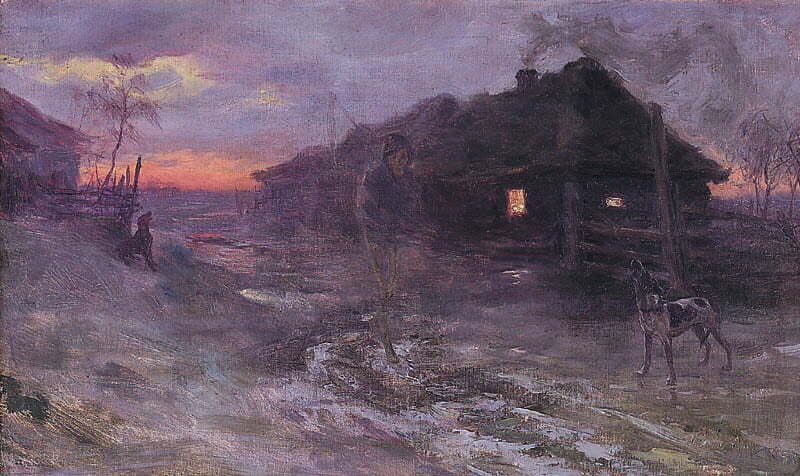
The shadow monster draws strength from older beliefs about the dead, the soul, and the disturbing idea that a person’s image or shadow might be more than a trick of light. In many traditions, a human being is not only body and breath but also a separable spiritual self, and sometimes that self has a visible double.
Britannica’s entry on the soul offers a useful broad starting point: the soul is the immaterial essence associated with life, identity, and survival beyond death. That concept lies near the heart of the fantasy shadow. The creature is frightening because it suggests a person can be reduced to a damaged remainder that still clings to the world.
Some traditions go further and treat the shadow itself as soul-like. Britannica’s discussion of shamanic worldviews describes traditions in which a person may possess several souls, including a shadow-soul or reflected double. Its entry on ört also preserves a Finno-Ugric idea of a shape or shadow corresponding to the individual soul. These ideas make the monster feel like a ruined part of personhood rather than merely animate darkness.
Classical myth also contributes strongly. The dead in Greek tradition are often imagined as shades, phantoms, or spirit-images dwelling in the underworld. Theoi’s page on eidolones gathers material on ghosts, phantoms, and image-like spirits, while its guide to the underworld gods gives the broader chthonic setting in which shades belong.
Darkness and oblivion deepen the theme. Theoi’s treatment of primeval powers such as Nyx and Erebus places darkness and night among the oldest forces in myth, while Lethe, the river of forgetfulness, gives a useful parallel for stories where the dead are not only killed but erased from memory, law, or proper burial.
In fantasy roleplaying, the shadow has become one of the clearest classic incorporeal undead. Its signature features are stealth, strength drain, fear of light, and the power to create more of its own kind. For a mythic late-medieval campaign, the strongest reading is neither “black ghost” nor “evil darkness elemental,” but the stolen silhouette of a dead life that was hidden, denied, or consumed.
Keep this reference growing
If this page helped with your reading or game, you can support its upkeep or explore the curated books.
Explore the Bookshop — epics, classics and stories behind imagined worlds.