
Vanth Psychopomp – Black-Winged Usher and Guardian of the Dead Road
When the dead road is threatened, the clerk steps aside and the black-winged usher lowers its scythe.
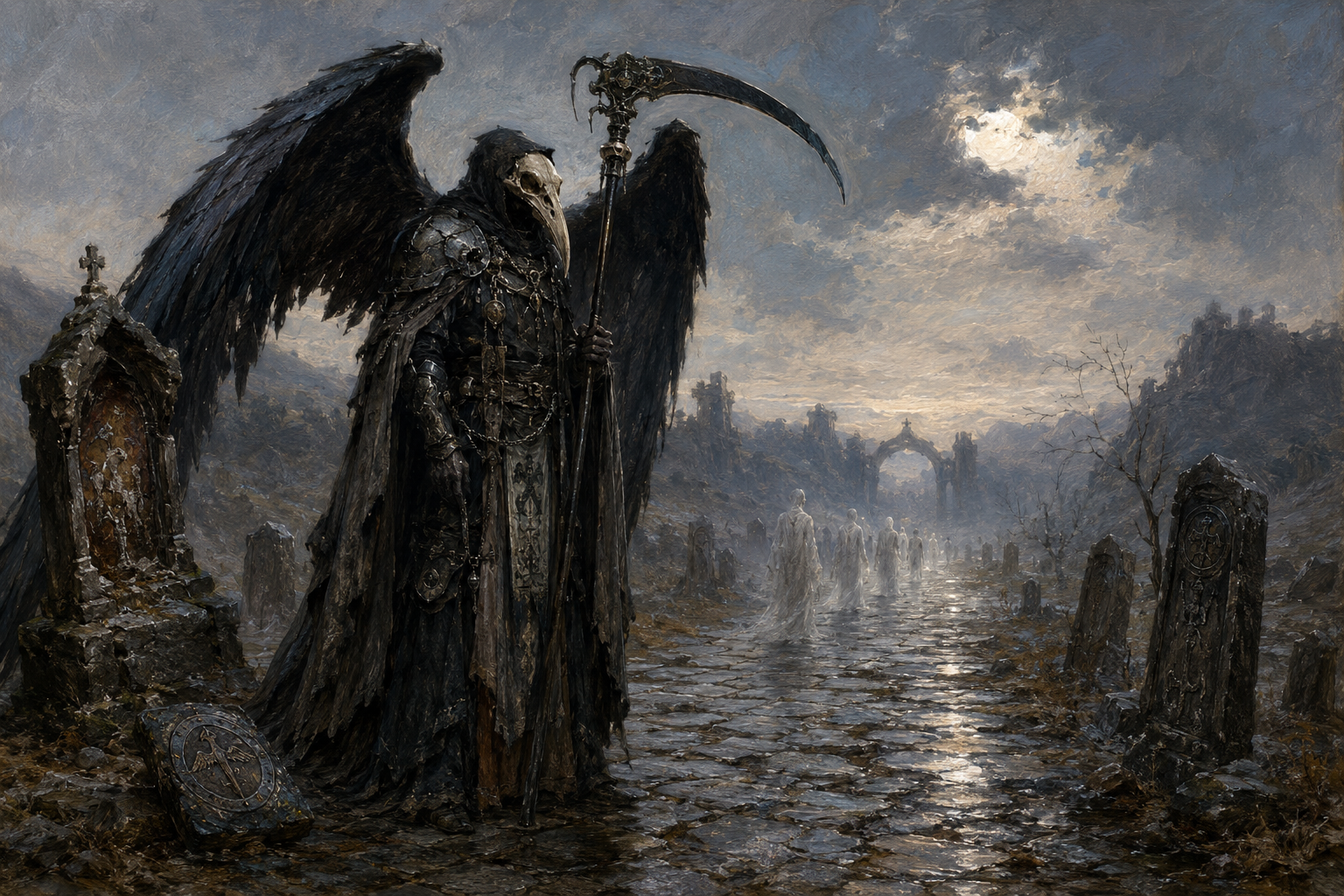
A vanth is a masked psychopomp of the dead roads: a black-winged guardian, soul-usher, and scythe-bearing enforcer of the afterlife.
Where a nosoi records death, a vanth defends its passage.
It appears as a tall, stooped, skeletal figure cloaked in ragged black wings and bearing a mask like the skull of a vulture. Its scythe is not merely a weapon. It is a sign of office: a black, adamantine badge of authority carried by one who stands between the dead and anything that would steal, devour, bind, bargain for, misdirect, or unlawfully delay them.
A vanth is not an angel of mercy, an undead reaper, or a demon of death. It is a neutral servant of passage and finality. It does not arrive because mortals are afraid of death. It arrives because something is interfering with what happens after death.
Necromancers, night hags, daemons, corpse-thieves, soul-binders, oath-breakers, and grave-robbers may all learn the same lesson: the roads of the dead have guards.
Quick Rules Reference
- Creature Role: Medium neutral psychopomp, death-road guardian, soul-usher, scythe-bearing enforcer.
- Best Use: Soul theft, necromancy, grave violation, haunted roads, death courts, battlefield aftermath, underworld crossings.
- Combat Role: Mobile guardian, reach striker, fear presence, anti-soul-theft defender.
- Primary Threat: It prevents interference with the dead and punishes those who obstruct passage.
- Campaign Function: Turns death, burial, soul travel, and necromancy into guarded jurisdiction.
- Do Not Use As: A generic grim reaper, undead skeleton, celestial angel, evil death demon, or random scythe monster.
Appearance
A vanth stands taller than most mortals, though its slumped posture can make it seem lower, closer, and more personal than its true height suggests. Its body resembles a blackened skeleton wrapped in sinew, old feathers, shadow, and ritual bindings. Ragged ravenlike wings hang from its shoulders and flare when it moves to strike, block, or descend from a road of the dead.
Its mask resembles a vulture’s skull: long-beaked, hollow-eyed, and pale against the darkness of its body. The mask is not decoration. It is the face of office. It hides expression, strips away personality, and makes the vanth less like a person than a duty given shape.
Every vanth bears a scythe. The blade is dark, heavy, and unnaturally clean even when the ground around it is mud, ash, grave-water, or plague rot. Some scythes carry marks from languages no mortal priesthood still reads. Others are notched with record-glyphs, passage seals, soul-tallies, or the authority of forgotten courts.
A vanth’s voice is hollow and carries too far. It may speak softly from across a graveyard and still be heard as if standing beside the listener.
Behaviour
Vanths are silent, stern, and difficult to move.
They do not posture, threaten unnecessarily, or enjoy fear. Their presence is frightening because it is impersonal.
It does not hate the necromancer it hunts. It does not pity the soul it escorts. It does not admire the adventurers who help it. It has a duty, and the world is simpler when duties are obeyed.
It may wait for days beside a tomb, road, shrine, battlefield, ferry crossing, plague gate, or burial mound, wings folded like a torn cloak. If a soul passes properly, the vanth does nothing. If something interferes, it moves with sudden, terrible precision.
They are especially hostile to creatures that steal, bind, eat, purchase, misdirect, falsify, or illegally delay souls. They also oppose undead when undeath prevents proper passage. They do not automatically destroy every ghost, revenant, or corpse-spirit they encounter. First they determine whether the dead are trapped, unwilling, unlawfully bound, or still completing a sanctioned duty.
A vanth is not death with a scythe.
It is the road beyond death made defensible.
Habitat
Vanths appear where the dead are vulnerable during passage.
They may guard old battlefields, river crossings, plague roads, mausoleums, graveyards, sacred groves, execution fields, charnel gates, ruined temples, haunted passes, underworld thresholds, and places where souls are often stolen before they can be judged.
They are also found where death has become strategically important:
- a necromancer’s corpse-market,
- a battlefield where the dead are being harvested,
- a noble crypt with a stolen heir’s soul,
- a plague road where the Red Death has disrupted burial,
- a ferry crossing haunted by unpaid dead,
- a sacred grove where bodies were hidden,
- a tomb used as a soul-trap,
- a battlefield where daemons raid the newly dead,
- a court where several powers dispute the same soul.
A vanth does not appear for every death. It appears when passage requires enforcement.
The Black-Winged Usher
It stands where the living can no longer claim ownership over the dead.
The body may belong to a family, lord, battlefield, temple, guild, court, or plague office. The soul does not. Once the soul loosens from flesh, other powers may argue over it, bargain for it, accuse it, defend it, misname it, or try to steal it. The vanth is the figure that lowers its scythe across the road and decides that no one passes until the passage is lawful.
This does not make the vanth merciful.
It makes the vanth necessary.
A village may fear a vanth at the cemetery gate, but that same village may pray for one when a night hag begins taking the dying before their last breath. A noble may curse the vanth that refuses to let his ancestor be questioned again, but beg for its protection when a rival house attempts to bind that ancestor into a sword. Adventurers may resent its silence until they realise the creature is the only thing stopping the dead from being collected like coin.
When a vanth appears, death is no longer private.
Something has stepped onto the road that should not be there.
Mechanics Tabs
The rules below are mechanics tabs for different game systems.
Vanth, Psychopomp 5.5e / 2024
Vanth Psychopomp, Pathfinder 1e
Vanth Psychopomp, Pathfinder 1e / 3.5e
Vanth Psychopomp 5.5e / 2024
Medium Psychopomp, Neutral
Armor Class: 17
Hit Points: 119 (14d8 + 56)
Speed: 30 ft., fly 50 ft.
Initiative: +4
Proficiency Bonus: +3
| STR | DEX | CON | INT | WIS | CHA |
|---|---|---|---|---|---|
| 20 (+5) | 18 (+4) | 18 (+4) | 13 (+1) | 17 (+3) | 16 (+3) |
Saving Throws: Dex +7, Con +7, Wis +6, Cha +6
Skills: Athletics +8, Insight +6, Intimidation +6, Perception +6, Religion +4, Stealth +7
Damage Resistances: Cold, Lightning, Necrotic, Poison
Condition Immunities: Frightened, Poisoned
Senses: Darkvision 120 ft., Lifesense 60 ft., passive Perception 16
Languages: Abyssal, Celestial, Infernal, Requian; understands the last words of the dead
Challenge: 7 (2,900 XP)
Traits
Psychopomp Nature. The vanth does not require food, drink, or sleep.
Lifesense. The vanth knows the location of living creatures, undead creatures, incorporeal spirits, and dead-but-unjudged souls within 60 feet, provided they are not behind total cover. This sense reveals category, not identity, guilt, alignment, motive, or legal status.
Death-Road Guardian. The vanth has advantage on saving throws against effects that would teleport, banish, charm, frighten, or magically compel it while it is guarding a corpse, soul, tomb, battlefield, graveyard, funeral procession, plague cart, or underworld threshold.
Reaper’s Scythe. The vanth’s scythe is magical while the vanth wields it. If the scythe is lost, stolen, or destroyed, the vanth can summon it back to its hand at the start of its turn, provided the scythe is on the same plane. If the scythe is destroyed or removed beyond the vanth’s reach by powerful magic, the vanth can call a new one at the next dusk.
Spirit-Cutting Blade. The vanth’s scythe can affect incorporeal undead, ghosts, and disembodied souls as though they were fully physical.
Actions
Multiattack. The vanth makes two Reaper’s Scythe attacks.
Reaper’s Scythe. Melee Attack Roll: +8, reach 10 ft., one target. Hit: 16 (2d10 + 5) slashing damage plus 7 (2d6) necrotic damage. If the target is undead, incorporeal, or magically bound to a soul-trapping effect, the extra damage is force damage instead of necrotic damage.
Vulture-Mask Bite. Melee Attack Roll: +8, reach 5 ft., one target. Hit: 10 (1d10 + 5) piercing damage plus 7 (2d6) necrotic damage.
Death-Road Decree. The vanth points its scythe at one creature it can see within 60 feet that has stolen, bound, commanded, consumed, purchased, trapped, falsified, or unlawfully delayed a soul. The target must make a DC 15 Wisdom saving throw. On a failed save, it has the Frightened condition for 1 minute. While frightened in this way, the target’s Speed is reduced by 10 feet, and it cannot willingly move closer to a corpse, soul, grave, death-rite, death-record, or soul-binding object it is guarding.
The target repeats the save at the end of each of its turns, ending the effect on itself on a success. A creature that succeeds on the saving throw is immune to this vanth’s Death-Road Decree for 24 hours.
Locate the Stolen Soul. The vanth chooses one corpse, grave, soul-fragment, undead creature, death-token, or soul-binding object within 60 feet. For 1 minute, the vanth learns the direction of the nearest creature or object currently interfering with that soul’s passage, provided the target is on the same plane. This sense gives direction, not exact distance or identity.
Once the vanth uses this action, it cannot use it again until the next dusk.
Invisibility of the Usher. The vanth becomes Invisible until it attacks, speaks above a whisper, blocks a soul’s passage, or unfurls its wings fully. This invisibility lasts for up to 10 minutes.
Bonus Actions
Scythe Recall. The vanth summons its scythe to its hand if the weapon is on the same plane and not held inside an artifact, divine prison, sealed underworld jurisdiction, or comparable ward.
Silent Wing. The vanth moves up to half its flying speed without provoking Opportunity Attacks.
Reactions
No Theft from the Dead. When a creature the vanth can see within 30 feet attempts to raise an undead creature, trap a soul, steal a corpse, consume a soul, falsify a death-working, or teleport away with a dead or dying creature, the vanth can make one Reaper’s Scythe attack against that creature. On a hit, the target must succeed on a DC 15 Constitution saving throw or the triggering effect fails.
Encounter Use
Use a vanth when death needs a guard.
It is not merely a scythe-wielding monster. It should enter scenes where someone is trying to interfere with the passage of the dead. The vanth may be an obstacle, ally, judge, pursuer, or silent third force depending on what the characters are doing.
A vanth works especially well when the party must:
- cross a guarded death-road,
- protect a soul from a night hag or daemon,
- stop a necromancer harvesting battlefield dead,
- recover a stolen ancestor from a noble crypt,
- defend a plague cart from corpse-thieves,
- escort a ghost to proper judgement,
- explain why they disturbed a grave,
- prove that an undead creature is trapped rather than willingly defiant.
The vanth is frightening, but it should not be stupid. It will parley if the characters respect the dead, produce lawful authority, offer useful evidence, or help restore passage. It attacks when something blocks, steals, eats, sells, corrupts, or falsifies the dead.
Vanth Psychopomp, Pathfinder 1e
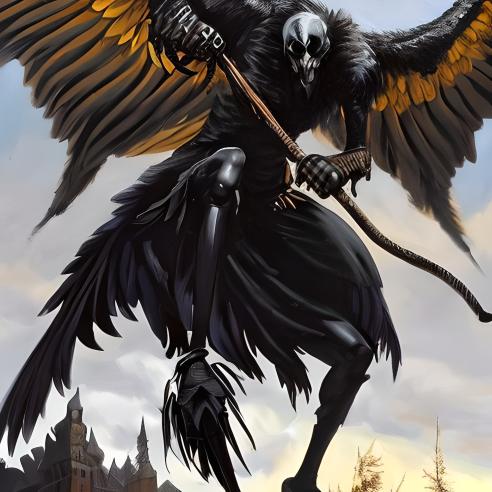
This looming black skeleton wraps itself in the wings of a giant black raven, and a vulturelike mask of polished ceramic gazes balefully from where its skull should be. Without a gesture, a wickedly curved Scythe appears in its elongated fingers.
Stern, silent, and cloaked in ragged wings, unsettling images of vanths haunt mortal depictions of death. Known as reapers, angels of death, or amzranei in some texts, members of this class of psychopomps serve as guardians of the Boneyard and watchers along the routes of the dead. They provide security atop Pharasma’s Spire and along the River of Souls, protecting the departed from those who see mortal souls as currency or delectable morsels. They also serve as death’s foot soldiers against whatever would disrupt the natural cycle of mortality, be it a plague of undeath or a good-aligned temple that dispenses resurrections too freely.
In times of great suffering and loss, Pharasma relies on the steely resolve and tireless nature of vanths to harvest the tormented souls of the dead before their agony transforms every battleground or plague quarter into a pit of undeath. Stern, silent, and cloaked in ragged wings, unsettling images of vanths haunt mortal depictions of death. Known as reapers, angels of death, or amzranei in some texts, members of this class of psychopomps serve as guardians of the Boneyard and watchers along the routes of the dead.
They provide security atop Pharasma’s Spire and along the River of Souls, protecting the departed from those who see mortal souls as currency or delectable morsels. They also serve as death’s foot soldiers against whatever would disrupt the natural cycle of mortality, be it a plague of undeath or a good-aligned temple that dispenses resurrections too freely. In times of great suffering and loss, Pharasma relies on the steely resolve and tireless nature of vanths to harvest the tormented souls of the dead before their agony transforms every battleground or plague quarter into a pit of undeath.
They appear as black skeletons with crowlike wings and masks resembling the heads of vultures, crows, and other carrion birds, – creatures that clear the mortal planes of corpses. Occasionally they cover themselves in ceremonial brass armor and tabards in funerary shades. Like all psychopomps, a vanth wears a funerary mask crafted from ceramic or polished stone in place of a face. Thanks to their slumped posture, vanths can look most adult humanoids in the eye, despite standing 8 feet tall when erect. They weigh approximately 400 pounds.
| Vanth CR 7 |
| XP 3,200 N Medium outsider (extraplanar, psychopomp) Init +3; Senses Darkvision 60 ft., Low-Light Vision, spiritsense; Perception +16 Aura fear (30-ft. radius, DC 18) |
| DEFENSE |
| AC 23, touch 13, flat-footed 20 (+3 Dexterity, +7 natural, +3 shield) hp 76 (9d10+27) Fort +11, Ref +6, Will +10 DR 10/adamantine; Immune death effects, disease, poison; Resist cold 10, electricity 10; SR 18 |
| OFFENSE |
| Speed 30 ft., Fly 50 ft. (average) Melee +1 adamantine Scythe +14/+9 (2d4+7/×4) or 2 claws +13 (1d6+4) Spell-Like Abilities (CL 10th; Concentration +11) At will – deathwatch, greater teleport (self plus 50 lbs. of objects only), invisibility (self only) 3/day – bestow curse (DC 16), locate creature, searing light (DC 16) |
| STATISTICS |
| Strength 18, Dexterity 16, Constitution 17, Intelligence 13, Wisdom 19, Charisma 17 Base Atk +9; CMB +13; CMD 26 Feats Cleave, Great Fortitude, Hover, Power Attack, Vital Strike Skills Acrobatics +12, Fly +13, Intimidate +10, Knowledge (history) +9, Knowledge (Planes) +12, Knowledge (Religion) +8, Perception +16, Sense Motive +16, Stealth +12 Languages Abyssal, Celestial, Infernal |
| SPECIAL ABILITIES |
| Fear Aura (Su) When within a 30-foot radius of a vanth, any creature with fewer than 10 Hit Dice that looks at the psychopomp must succeed on a DC 18 Will save or become shaken. A creature that successfully saves cannot be affected again by the same vanth’s aura for 24 hours. A vanth can activate or deactivate its fear aura as a free action. This is a mind-affecting fear effect. The save DC is Wisdom-based. Reaper’s Scythe (Su) They each carry a distinctive +1 adamantine Scythe as both a weapon and symbol of its duty. As a free action, one can summon this weapon from a personal demiplane or any other location and have it appear in its hands instantly. It can also dismiss its Scythe back to its personal demiplane as a free action. If a vanth’s Scythe is destroyed, it can summon a new one in 24 hours. |
| ECOLOGY |
| Environment any (Boneyard) Organization solitary, pair, or flock (2-12) Treasure standard |
Ecology
Few understand the origins of vanths. While most psychopomps graduate over the span of unfathomable ages from mortal souls and lesser psychopomps, vanths seem altogether distant and alien. Some stories claim they have always guarded the Spire, even before Pharasma came and crafted new servants in their image. Others whisper that all the vanths that ever were or will be ascended from the souls of a distant world of death-worshiping soldiers who spent every moment in life preparing themselves for the end and delighted in their planets final demise.
Habitat & Society
With an infinite flux of souls through the Bonelands, there’s an equally infinite number of these spirits who attempt to flee, rage against their assigned fate, or merely lash out in madness, only to be laid low by the tattered wings and flashing Scythes of vanths. Pharasmas reapers serve as fearsome
guardians of the dead and deaths assetssacred coves, forgotten cemeteries, and untended mausoleums.
Being inherently disturbing to the mortal psyche, vanths are rarely called on directly by churches in need of aid. Among the planes, most outsiders look upon vanths with scorn. They embody an unflinching dedication to duty, without interest in the strict letter of law or what is right, nor any great amount of self-determination. They do because they must, working out of a personal and obsessive sense of duty, not because they’re ordered to do so.
Their stalwart adherence to their cosmic role makes them far too lawful for chaotic outsiders to appreciate, while their cantankerous methods make lawful outsiders balk. Most insultingly, the suspicious reapers eye any and all who enter the Boneyard as potential threats. They follow visiting demons and angels alike, looming from the courts’ gothic eves and parapets, casting silent aspersions on even the best-behaved travelers.
Unlike most psychopomps, vanths show few mortal proclivities. They rarely speak, even to one another; when they do, their hollow voices carry farther than expected or is socially appropriate. They communicate among one another with slow, deliberate gestures plain enough for most creatures to understanda strange blend of elaborate human gestures and birdlike head bobs. Most show no interests beyond their immortal role. Even basic emotional reactions seem beyond vanths; they rarely display emotions of their own, and righteous anger or talk of love elicits little more than a confused cock of the head.
A vanth’s Scythe is a proud badge of its station, featuring otherwise unknown symbols that mirror the ancient writing found on many of the Boneyard’s forgotten tombs. Their Scythes reflect their role as harvesters of souls in times of great death, but more practically, they inflict bitter wounds and can sever the silver threads of unwanted astral visitors.
Unsurprisingly, vanths loathe astradaemons and descend on the great predators in large numbers. Thanks to the daemons plane-shifting abilities, these melees occasionally spill over into other planes, dragging countless outsiders into chaotic three-or four-way battles.
Section 15: Copyright Notice – Pathfinder 47: Ashes at Dawn
Pathfinder Adventure Path #47: Ashes at Dawn. © 2011, Paizo Publishing, LLC; Author: Neil Spicer.
Vanth Psychopomp, Pathfinder 1e / 3.5e
CR: 7
XP: 3,200
Alignment: N
Size and Type: Medium Outsider, Extraplanar, Psychopomp
Initiative: +4
Senses: darkvision 60 ft., lifesense 60 ft.; Perception +16
Defense
Armor Class: 21, touch 14, flat-footed 17 (+4 Dex, +7 natural)
Hit Points: 85 (10d10 + 30)
Saving Throws: Fort +10, Ref +11, Will +10
Defensive Abilities: spirit touch
Damage Reduction: DR 10/adamantine
Immunities: death effects, disease, fear, poison
Resistances: cold 10, electricity 10, negative energy 10
Spell Resistance: 18
Offense
Speed: 30 ft., fly 50 ft. good
Melee: +1 adamantine scythe +17/+12 (2d4 + 8/×4 plus spirit touch) or bite +15 (1d8 + 5 plus spirit touch)
Space/Reach: 5 ft./5 ft.
Special Attacks: fear aura, reaper’s scythe, vanth’s decree
Spell-Like Abilities: CL 10th; concentration +13
At will — invisibility self only
3/day — locate creature, searing light
1/day — dimension door, speak with dead
Statistics
| STR | DEX | CON | INT | WIS | CHA |
| 21 | 18 | 17 | 13 | 16 | 17 |
Base Attack: +10
CMB/CMD: +15 / 29
Feats: Combat Reflexes, Flyby Attack, Improved Initiative, Power Attack, Weapon Focus (scythe)
Skills: Acrobatics +17, Fly +21, Intimidate +16, Knowledge (planes) +14, Knowledge (religion) +14, Perception +16, Sense Motive +16, Stealth +17
Languages: Abyssal, Celestial, Infernal, Requian
Special Qualities: death-road guardian, reaper’s scythe, spirit touch
Special Abilities
Death-Road Guardian (Su). A vanth gains a +4 bonus on saving throws against charm, compulsion, fear, teleportation, and banishment effects while guarding a corpse, soul, tomb, battlefield, graveyard, underworld threshold, or place of death.
Fear Aura (Su). A creature within 20 feet of a vanth must succeed on a DC 18 Will save or become shaken for as long as it remains within the aura and for 1d4 rounds thereafter. A creature that succeeds is immune to that vanth’s fear aura for 24 hours. This is a mind-affecting fear effect. The save DC is Charisma-based.
Lifesense (Su). A vanth notices and locates living creatures, undead creatures, incorporeal spirits, and dead-but-unjudged souls within 60 feet. This functions like blindsight for that limited purpose. It does not reveal identity, alignment, guilt, motive, or legal status.
Reaper’s Scythe (Su). Every vanth carries a distinctive adamantine scythe as both weapon and symbol of office. While wielded by the vanth, the scythe functions as a +1 adamantine scythe. The vanth may summon the scythe to its hand as a free action if it is on the same plane. If the scythe is destroyed, the vanth can call a replacement after 24 hours.
Spirit Touch (Su). A vanth’s natural attacks and scythe attacks are treated as ghost touch weapons.
Vanth’s Decree (Su). Three times per day as a standard action, a vanth may level its scythe at one creature within 60 feet that has stolen, bound, consumed, purchased, trapped, falsified, or unlawfully delayed a soul. The target must succeed on a DC 18 Will save or become cursed for 1 minute. While cursed, the target takes a –2 penalty on attack rolls, saving throws, and skill checks, and cannot benefit from invisibility against the vanth. The save DC is Charisma-based.
Ecology
Environment: battlefields, graveyards, underworld roads, psychopomp courts, haunted crossings, sacred groves, tombs, plague roads, and places where souls are vulnerable
Organization: solitary, pair, patrol of 3–6, or black-winged line of 7–12
Treasure: double, usually including the vanth’s adamantine scythe, soul-ledgers, funerary seals, death-road tokens, grave keys, and relics seized from soul-thieves
Notes
A vanth should be run as a disciplined guardian, not a berserker. It does not attack merely because someone is near a corpse. It attacks when the dead are being stolen, exploited, corrupted, falsely claimed, or prevented from reaching their proper road.
Its scythe is a badge of office. Taking it should have consequences beyond treasure value. A mortal court may see a weapon. Underworld powers see stolen authority.
Treasure
It’s treasure should reflect its role as guardian, not hoarder.
Typical vanth treasure may include:
- Adamantine scythe: standard to the creature and central to its office.
- Black funerary seal: 100–300 gp; recognised by some underworld courts, spirit judges, or death cults.
- Death-road token: 50–250 gp; may grant safe passage through a haunted crossing or cemetery gate.
- Soul-thief’s chain: 200–600 gp; dangerous evidence seized from a necromancer, daemon, hag, or infernal collector.
- Grave key: 25–500 gp; value depends on the tomb, archive, or mausoleum it opens.
- Torn soul-ledger page: 100–1,000 gp; may prove that a soul was stolen, misjudged, sold, or diverted.
- Scythe-marked writ: priceless in the right adventure; establishes that a road of the dead, tomb, battlefield, or soul is under psychopomp protection.
A vanth does not carry treasure for luxury. Its possessions are weapons, writs, confiscated tools, passage seals, and marks of office.
Tactics
A vanth begins by watching.
It prefers to identify the interference before striking. If the enemy is a necromancer, soul-thief, corpse-stealer, daemon, hag, or undead master, the vanth moves directly against that source rather than wasting attacks on lesser servants.
In battle, it uses flight, reach, and fear to control space. It blocks escape routes, guards bodies, and punishes attempts to flee with stolen souls or corpse-bound magic. It is especially dangerous near thresholds: cemetery gates, bridges, tomb doors, battlefield roads, ferry landings, plague carts, and ritual circles.
A vanth does not usually pursue ordinary mortals who retreat and abandon their interference. It does pursue those who carry away the dead unlawfully.
Duties and Casework
A vanth is usually defined by the passage it has been sent to defend. These duties do not create separate breeds of vanth. They describe the kind of work occupying the creature’s scythe.
Death-Road Patrol
Some vanths patrol the roads followed by newly dead souls. They stand at crossroads, ferry paths, old bridges, grave lanes, battlefield tracks, plague roads, and places where spirits become confused or vulnerable.
Use death-road patrols when the adventure involves lost souls, haunted roads, spirit processions, night crossings, stolen names, or predators waiting along the way.
Tomb and Gate Watch
Some vanths guard tombs, mausoleums, underworld doors, sacred groves, ancestral gates, sealed death archives, and places where the dead are still owed privacy or judgement. They may remain in place for decades, appearing only when a boundary is violated.
Use tomb and gate watch duty when a party enters a forbidden burial site, disturbs a sealed ancestor, opens a necromantic gate, or must prove they have the right to pass.
Soul-Theft Response
Some vanths are sent where souls are being harvested, bottled, eaten, sold, forged into weapons, bound into undead, or diverted from judgement. These vanths are direct, severe, and difficult to negotiate with until the theft stops.
Use soul-theft response when the villains are night hags, daemons, necromancers, liches, infernal contractors, cursed nobles, battlefield scavengers, or anyone treating souls as currency.
Battlefield Enforcement
Some vanths walk battlefields after the living withdraw. They do not record every death like a nosoi. They guard the dead road against predators that arrive afterward.
Use battlefield enforcement when mass death attracts daemons, corpse-harvesters, false saints, necromancers, carrion spirits, or rulers trying to bind fallen soldiers into service.
Adventure and Worldbuilding Hooks
The Scythe at the Bridge
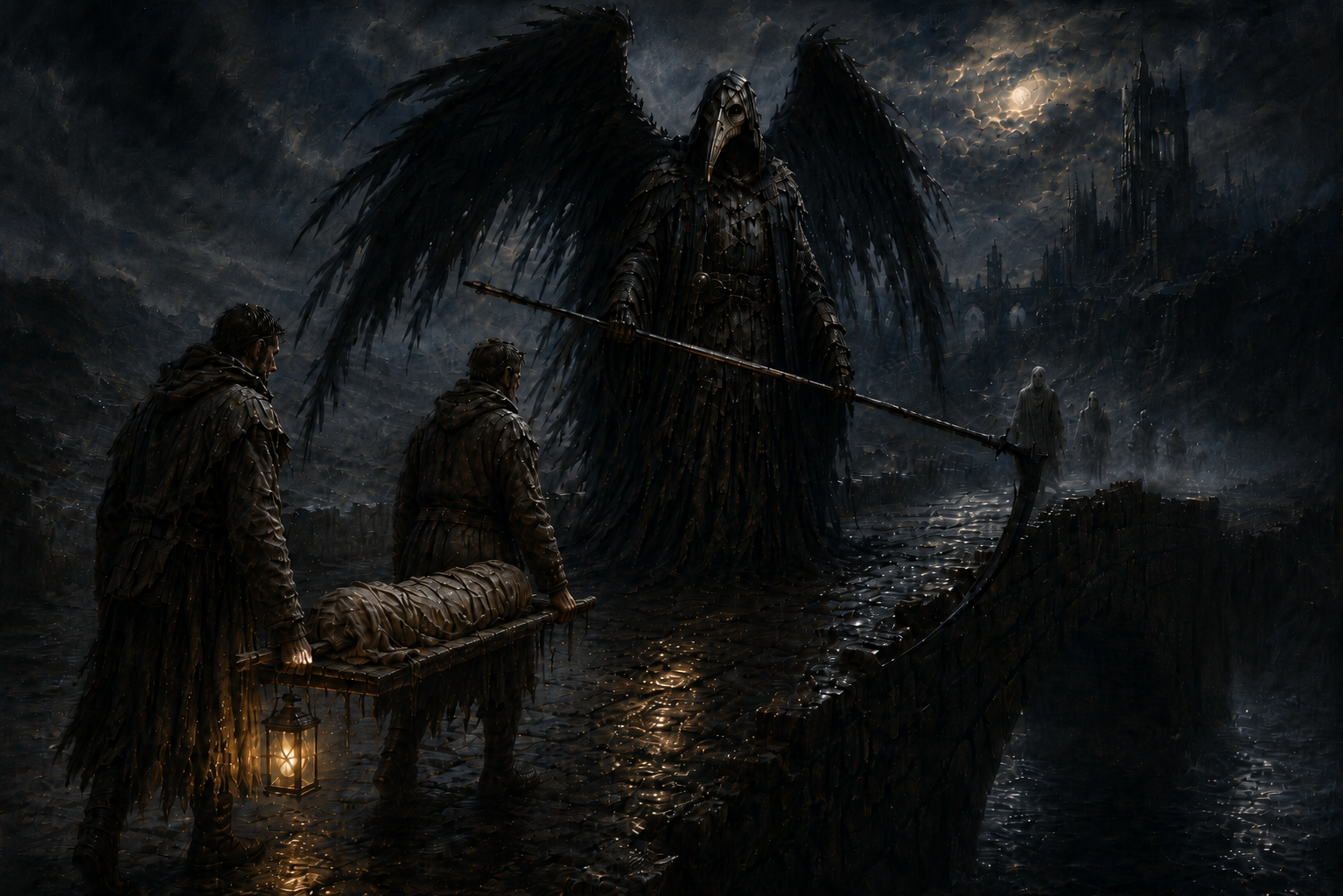
A black-winged vanth stands on a broken bridge at midnight and refuses passage to the living and the dead alike.
The village calls it a curse. The vanth says the bridge is being used twice: once by mourners, once by something that follows them home wearing the faces of the newly buried.
The Soldier Who Will Not March
After a battle, hundreds of souls move toward the grey road, but one soldier remains beside his body. A vanth will not force him onward until the obstruction is named.
The soldier is not afraid of judgement. He is waiting because his commander sold the company’s deaths before the battle began.
The Stolen Ancestor
A noble family asks the adventurers to remove the “monster” guarding their crypt. The vanth claims the family is trying to retrieve an ancestor whose soul was lawfully held as evidence in an older crime.
The ancestor may be the key to the family’s title, curse, or downfall.
The Hag’s Cart
A night hag travels behind plague wagons, collecting the dying before their final breath. A vanth has marked the road but cannot enter the town while the magistrates continue to sign false death certificates.
The party must expose the living bureaucracy that lets the soul-theft continue.
The Reaper’s Missing Scythe
A vanth’s scythe has been stolen and sealed inside a mortal reliquary. Without it, the vanth cannot enforce a particular crossing.
The thief does not want the weapon.
They want the road unguarded for one night.
When Vanths Appear
A vanth appears where death requires enforcement.
Not every death calls one. A death that needs memory may draw mourners, ghosts, or nosois. A death whose passage is threatened may draw a vanth.
Vanths are most useful where mortal law and afterlife law collide. They can stand between a court and a corpse, between a necromancer and a stolen soul, between a family tomb and the ancestor someone is trying to bind. They may protect a ghost from a hag, then insist that the ghost must still move on. They may help the living without becoming merciful in any ordinary sense.
A vanth reminds the living that the dead are not abandoned property.
A body may be claimed by kin, court, clan, guild, battlefield, plague office, crown, temple, or creditor. The soul passes under older jurisdiction.
A vanth arrives when that jurisdiction is challenged.
Consequences of Interfering with a Vanth
Harming a vanth is not merely fighting a monster.
A road of the dead may go unguarded. A tomb may lose its lawful watcher. A daemon may gain access to fresh souls. A ghost may be stolen before judgement. A plague field may begin producing undead because passage out of death has been blocked.
If the party defeats a vanth for good reason, they may still inherit its problem. Something was important enough to require a black-winged guard. Removing the guard does not remove the threat.
If the party protects or aids a vanth, it rarely offers gratitude. It may instead step aside, open a sealed road, return a stolen name, leave a scythe-mark on their warrant, or refuse to strike them the next time they meet at the edge of death.
Running a Vanth at the Table
A vanth should not be treated as a wandering executioner. It does not kill the dying for sport, harvest random souls, or attack every creature found near a corpse. It intervenes when the passage of the dead is obstructed, exploited, stolen, falsified, or unlawfully delayed.
A vanth is also not undead. Its skeletal form is a sign of deathly office, not a corpse animated by necromancy. It is a psychopomp: a neutral servant of passage, judgement, and afterlife order.
This distinction matters in play. A vanth may oppose a necromancer, night hag, daemon, corpse-thief, or soul-binder without being merciful in the ordinary sense. It may help adventurers recover a stolen soul, then refuse to let them question that soul again once the passage is restored. It may allow resurrection when the soul consents and judgement has not been sealed, but oppose resurrection used to conceal murder, evade consequence, break a lawful judgement, or damage the soul’s proper road.
A vanth can become an ally, but rarely a companion. It cooperates while the dead road is threatened. When the obstruction is removed, it leaves.
Source, Natural History, and Mythic Context
Vanth comes first from Etruscan myth and funerary art. In Etruscan tradition, Vanth is a winged chthonic figure associated with death, the underworld, and the passage of the deceased beyond mortal life. She is often shown in tomb art near scenes of death or transition, sometimes accompanying the dead, sometimes appearing with other underworld figures such as Charun. Unlike a simple monster of death, Vanth is best understood as a threshold figure: a presence at the boundary between the living world and the world below. For a general starting point, see Encyclopaedia Britannica’s discussion of Vanth in Etruscan religion and mythology.
That mythic origin matters. Vanth is not originally a generic grim reaper, undead skeleton, evil spirit, or heavenly angel. The older image is closer to a winged underworld guide, witness, and attendant of death. Her attributes in ancient art may include signs of passage, knowledge, or office, such as a torch, key, scroll, or weapon. These details make her especially useful for fantasy treatment because they connect death not only to fear, but also to journey, threshold, record, and authority.
The Pathfinder vanth is a later game adaptation of that older mythic material. Pathfinder reshapes the name into a class of neutral psychopomps: black-winged, masked guardians of the dead who carry scythes and protect souls from theft, predation, escape, or unlawful interference. For rules reference, see the Pathfinder 1e Vanth entry on Archives of Nethys and the Pathfinder 2e Vanth entry on Archives of Nethys.
In SpiralWorlds, both layers are useful. The Etruscan Vanth gives the creature its older mythic weight: the winged presence at death’s threshold. The Pathfinder psychopomp gives it a clear game role: the armed guardian of the roads of the dead. This entry treats the vanth as a neutral death-road enforcer, not as an undead creature, evil reaper, or celestial messenger.
The vanth is best used as the armed counterpart to quieter psychopomp functionaries. The nosoi records. The vanth guards. Its scythe, wings, mask, and silence all express the same idea: the road beyond death is not empty, and those who prey upon souls may find it defended.