
Monster, Lynx (Cat, Great), “The Silent Shadow of the Forest”
Lynx (Cat, Great), “The Silent Shadow of the Forest”
A spectral hunter of the wilds, striking with unmatched stealth and deadly precision.
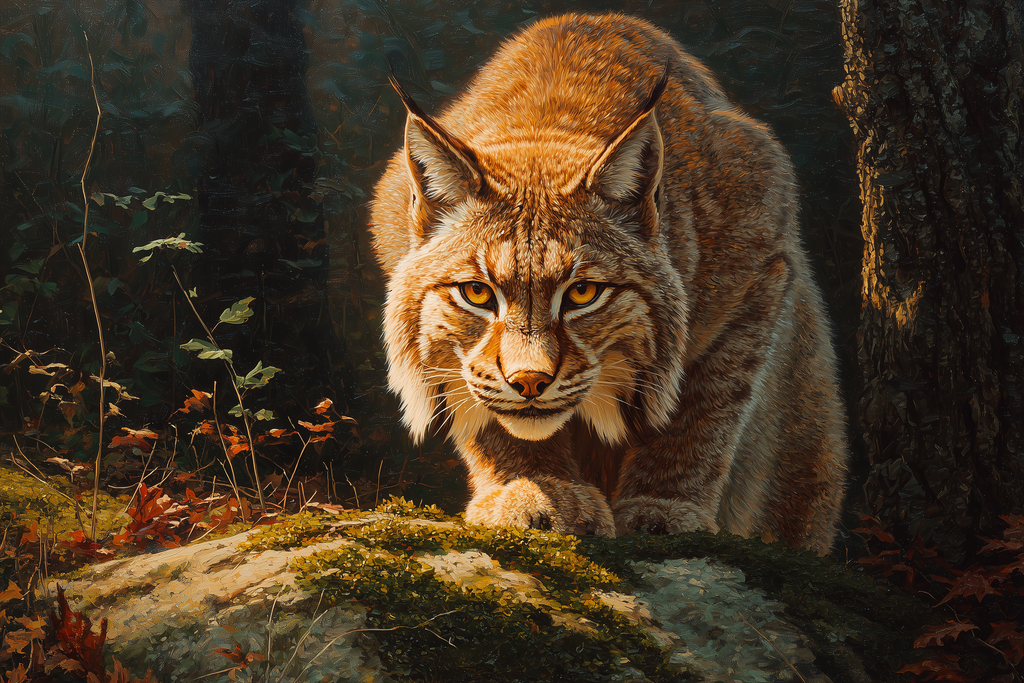
A medium-sized, tuft-eared feline predator, the lynx glides through forests and mountains with ghostly stealth. Its spotted coat and padded paws make it nearly invisible as it stalks prey, striking with lethal precision. Solitary, territorial, and patient, it prefers ambush over open combat, hunting hares, rodents, and birds. Driven by hunger and survival instincts, the lynx balances caution with deadly efficiency, embodying the cunning, grace, and spectral presence of the untamed wild.
Appearance:
The lynx has a compact, muscular frame with tufted black ears, piercing amber or gold eyes, and a short bobbed tail tipped in black. Its dense, spotted coat camouflages it perfectly in forest undergrowth, snow, or rocky terrain, giving it a ghost-like presence. Large, padded paws allow silent movement, while its alert posture signals both elegance and predatory readiness.
Behaviour:
Solitary and highly territorial, they are patient stalkers. They communicate sparingly through scent marks and low vocalizations, observing its surroundings with sharp awareness. Preferring ambush to open confrontation, it waits, watches, and strikes with decisive speed.
Habitat:
Found in boreal forests, mountainous regions, and rugged tundra, lynxes favor areas rich in cover and prey. They maintain extensive territories and avoid open plains, thriving in environments where stealth and camouflage are most effective.
Modus Operandi:
They hunt using stealth, timing, and rapid bursts of speed. They target small to medium prey such as hares, rodents, and birds, and will defend themselves fiercely if cornered. Ambush is their signature tactic, minimizing risk while maximizing lethality.
Motivation:
Guided by hunger, survival, and territorial instinct, the lynx’s actions revolve around sustenance and safety. It balances caution with aggression, embodying the wild’s elegance, cunning, and lethal efficiency.
Lynx 5.5e
Lynx, Pathfinder
Lynx
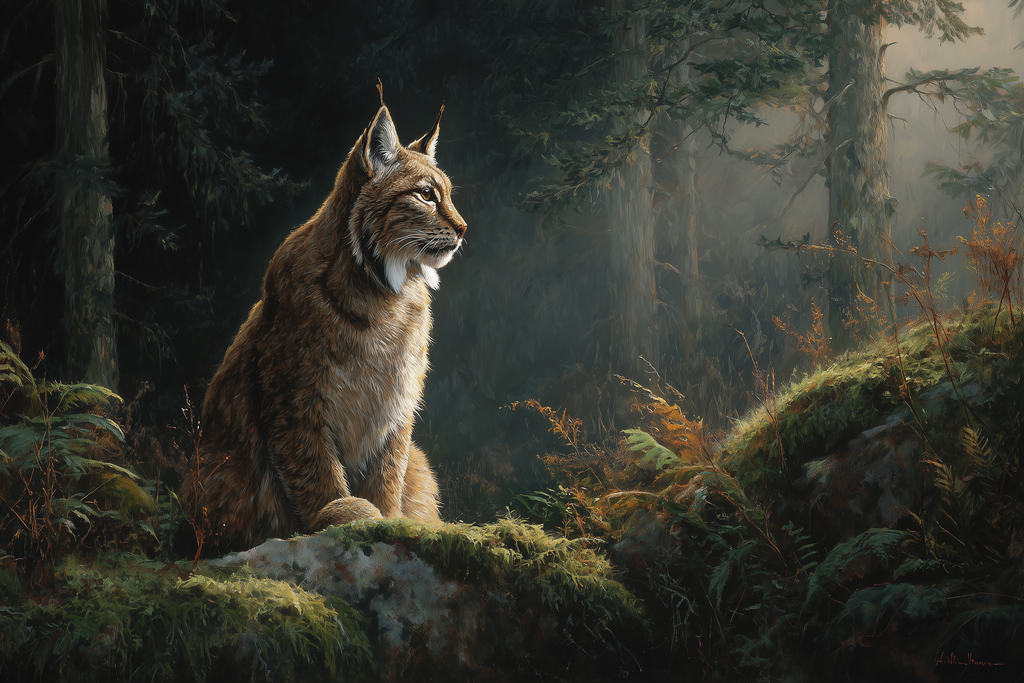
Medium beast, unaligned
Armor Class: 13 (natural armor)
Hit Points: 27 (6d8)
Speed: 40 ft., climb 20 ft.
| STR | DEX | CON | INT | WIS | CHA |
|---|---|---|---|---|---|
| 12 (+1) | 16 (+3) | 12 (+1) | 3 (−4) | 14 (+2) | 6 (−2) |
Saving Throws: Dex +5, Wis +4
Skills: Stealth +5, Perception +4
Senses: Darkvision 60 ft., passive Perception 14
Languages: —
Challenge: 1 (200 XP)
Traits
Keen Smell. It has advantage on Wisdom (Perception) checks that rely on smell.
Silent Stalker. It can take the Hide action as a bonus action, even when lightly obscured.
Pounce. If the lynx moves at least 20 feet straight toward a creature and hits with a claw attack, that target must succeed on a DC 12 Strength saving throw or be knocked prone. If the target is prone, the lynx can make one bite attack against it as a bonus action.
Actions
Multiattack. The lynx makes two attacks: one with its bite and one with its claws.
Bite. Melee Weapon Attack: +4 to hit, reach 5 ft., one target. Hit: 7 (1d8 + 3) piercing damage.
Claws. Melee Weapon Attack: +4 to hit, reach 5 ft., one target. Hit: 6 (1d6 + 3) slashing damage.
Behavior
Lynxes are solitary hunters, relying on stealth, patience, and ambush tactics. They prefer to stalk prey silently, pounce from cover, and retreat if outmatched. In combat, they attempt to knock opponents prone before delivering a decisive bite.
Habitat: Boreal forests, mountainous regions, and dense woodland. Territorial, they maintain hunting grounds rich in small to medium prey.
Lynx (Cat, Great)
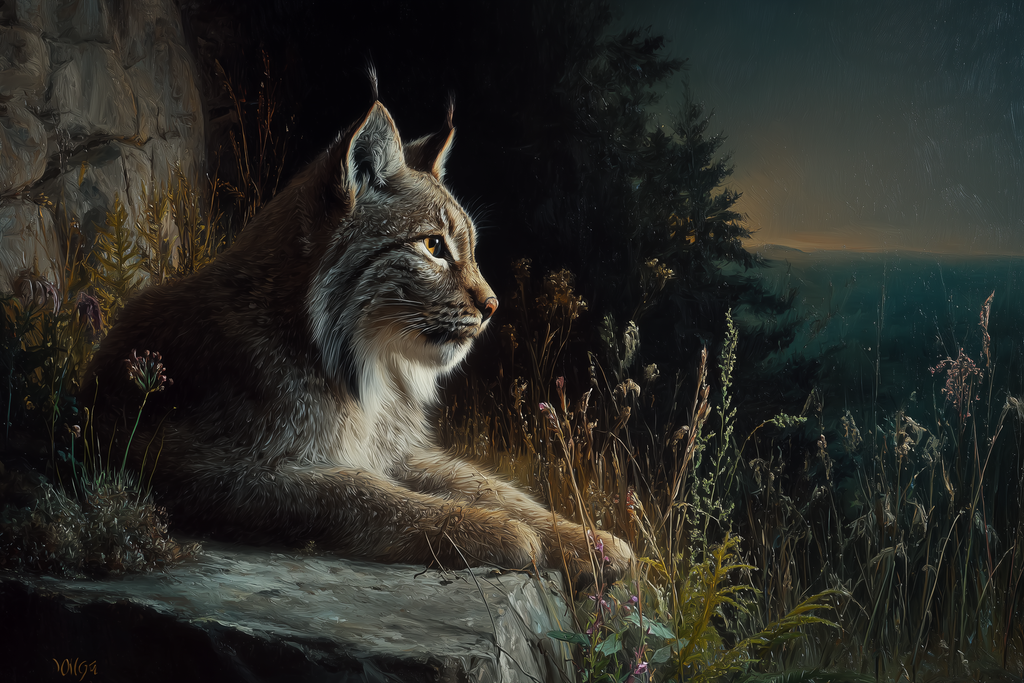
This long-haired cat has tufts of black hair growing form the tips of its ears.
The lynx is a member of the great cat family and makes its home in the colder regions of the world, most often in rocky areas above the tree line. They are generally solitary creatures and are excellent climbers.
The lynx, like other big cats, is territorial and a solitary hunter. Most of its hunting is done during the daylight hours, though some species hunt only at night. Its diet generally consists of small animals such as rodents, birds, fish, and rabbits. During the winter months its diet includes larger prey such as elk or deer. Prey that is killed is partially eaten and the remaining carcass is buried in thick underbrush or snow. The lynx returns over a period of 1d6 days to finish its meal.
They are generally solitary creatures, but occasionally a den is discovered that contains a male, female and 1d6 cubs. Cubs are generally ineffective and non-threatening in combat. Cubs are sometimes captured and sold on the market where they can be trained and raised.
A lynx has thick, gray fur that is spotted, striped, or plain. During the winter months through the summer months, its coat varies from spotted to plain. Its short tail is ringed and tipped with black fur. Its pointed ears are tipped with tufts of long black hairs and its eyes range from green to gray to brown. Its paws are large and covered with thick fur. This helps it distribute its weight when moving across snowy terrain. The average lynx is 2 1/2 feet to 4 feet long and weighs 20–40 pounds.
Lynxes stalk their prey and prefer to strike from ambush. They primarily use their bite attack in combat, only relying on their claws if they must. A lynx goes for the “kill shot” at first opportunity against its quarry, attempting to sink its teeth into its opponent’s throat.
Lynx CR 2
XP 600
N Small animal
Init +2; Senses low-light vision, scent; Perception +9
DEFENSE
AC 14, touch 13, flat-footed 12 (+2 Dex, +1 natural, +1 size)
hp 13 (2d8+4)
Fort +5, Ref +5, Will +1
OFFENSE
Speed 40 ft., climb 20 ft.
Melee 2 claw +4 (1d3+2 plus grab), bite +4 (1d4+2)
Special Attacks pounce, rake (2 claws +4, 1d3+2)
STATISTICS
Str 15, Dex 15, Con 15, Int 2, Wis 12, Cha 6
Base Atk +1; CMB +2 (+6 grapple); CMD 14 (18 vs. trip)
Feats Skill Focus (Perception)
Skills Acrobatics +10, Climb +10, Perception +9, Stealth +10 (+14 in heavy undergrowth or tall grass); Racial Modifiers +8 Acrobatics, +4 Stealth (+8 in heavy undergrowth or tall grass)
ECOLOGY
Environment cold forests, hills, mountains and plains
Organization solitary, pair or den (1–2 adults plus 1–6 cubs)
Treasure none
Caracal
The caracal is a small cat, very similar to the lynx, and is commonly referred to as the desert lynx (even though it doesn’t live in desert regions). The caracal uses the statistics for the lynx, but is found in warm or temperate plains and hills and does not have the snow move ability of the standard lynx.
Section 15: Copyright Notice
Lynx from the Tome of Horrors Complete, Copyright 2011, Necromancer Games, Inc., published and distributed by Frog God Games; Author Scott Greene.