
Spell, Spell Meld, “Concord of the Two Mysteries”
Spell Meld, “Concord of the Two Mysteries”
A high ritual of shared magical power, allowing two willing spellcasters to draw upon one another’s prepared mysteries without becoming one mind.

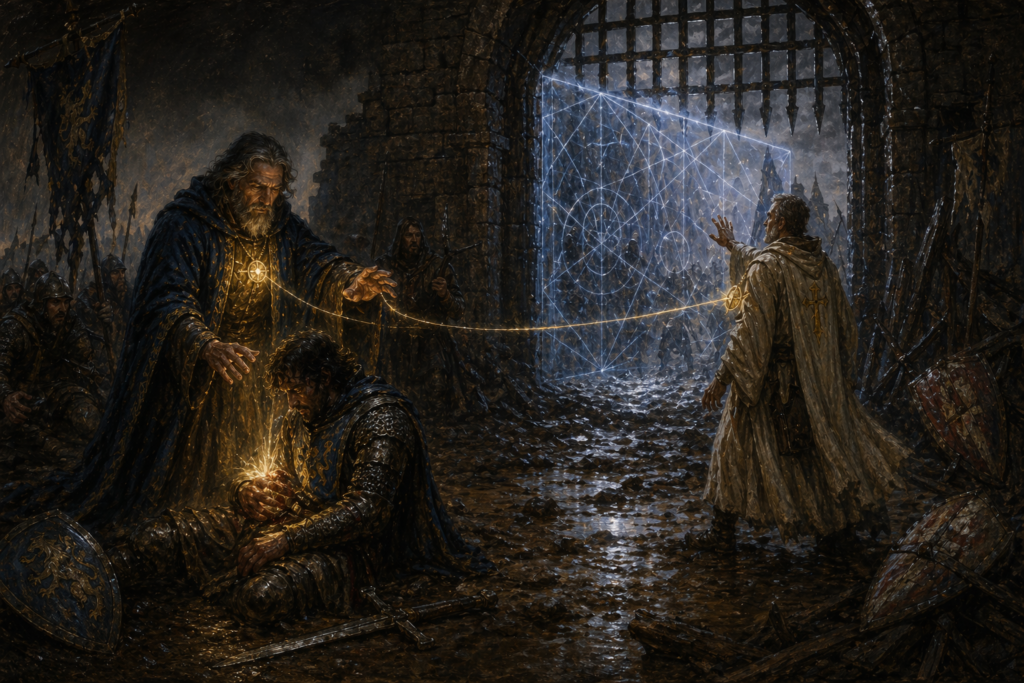
Some spells wound, shield, summon, or transform. Spell Meld belongs to the rarer class of magic that changes what spellcasters can become together. It does not create power from nothing. Instead, it opens a temporary bridge between two trained wills, allowing one caster to reach across the boundary of another’s tradition and cast from a shared body of prepared or known magic.
Overview
Spell Meld is a powerful cooperative spell for campaigns where high magic has weight, cost, and consequence. It allows two willing spellcasters to share access to one another’s spells for a limited time, provided each caster can still meet the normal demands of casting.
A cleric joined to a wizard might gain access to arcane wards, teleportation, or battlefield control. A wizard joined to a cleric might gain access to healing, restoration, or divine protection. The spell is strongest when it represents trust, alliance, desperation, or sacred duty rather than a casual optimisation trick.
Spell Meld should be treated as serious high magic. It does not grant extra spell slots, does not copy class features, does not hand over divine authority, and does not make either caster more powerful in raw resources. It temporarily expands what each participant may choose to cast.
Effect
You create a mystical bond between yourself and one willing spellcasting creature you touch. For the spell’s duration, both participants may cast spells that the other participant knows or has prepared, subject to strict limits.
A participant casting a spell through the meld must expend their own spell slot, use their own spellcasting ability, provide all required components, and be capable of casting a spell of that level. The spell does not grant another creature’s class features, spell slots, subclass features, metamagic, ritual casting, domains, invocations, spellbook access, divine privileges, pact benefits, or special methods of preparation.
If a spell depends on a feature the caster does not possess, the DM may rule that it cannot be cast through Spell Meld.
The bond ends early if either participant becomes unwilling, dies, is incapacitated, enters an antimagic field, or is no longer on the same plane of existence.
Spell Meld 5e / 2024
Spell Meld Pathfinder / 3.5e
Spell Meld 3.0
Spell Meld 5e / 2024
9th-Level Evocation
Casting Time: 10 minutes
Range: Touch
Components: V, S, M, F
Duration: Concentration, up to 1 hour
Available To: Cleric, Sorcerer, Wizard
Alternative Spell Name: Concord of the Two Mysteries
Material Component: Rare aromatic oils worth at least 250 gp, which the spell consumes.
Focus: A matched pair of gold lockets worth at least 5,000 gp each, worn by the caster and the willing spellcasting creature for the full casting and duration.
You touch one willing creature that has the Spellcasting or Pact Magic feature. For the duration, you and the target are joined by a mystical spellcasting bond.
While the bond lasts, each participant may cast spells the other participant knows or has prepared, provided all of the following are true:
- The caster expends one of their own spell slots of the spell’s level or higher.
- The caster is capable of casting spells of that level.
- The caster provides all required components.
- The spell uses the caster’s own spellcasting ability, spell save DC, and spell attack bonus.
- The spell does not require a class feature, subclass feature, divine authority, pact benefit, metamagic option, invocation, domain feature, ritual feature, or similar ability the caster lacks.
Spell Meld does not grant additional spell slots, prepared spells, known spells after the spell ends, class features, ritual casting, spellbook copying, Channel Divinity, Metamagic, invocations, pact boons, divine intervention, or similar benefits.
The spell ends early if either participant is no longer willing, dies, is incapacitated, enters an antimagic field, or is no longer on the same plane of existence.
At Higher Levels
This spell has no higher-level scaling.
Spell Meld Pathfinder / 3.5e

School: Evocation
Level: Cleric 9, Sorcerer/Wizard 9, Joining 8
Components: V, S, M, F, XP
Casting Time: 10 minutes
Range: Touch
Target: One willing spellcasting creature touched
Duration: 10 minutes/level
Saving Throw: Will negates, harmless
Spell Resistance: Yes, harmless
You create a powerful mystical bond between yourself and one willing spellcasting creature. For the spell’s duration, either participant may cast spells from the other participant’s known or prepared spells.
The creature casting the spell must expend one of its own spell slots or prepared spell uses of the appropriate level. The caster must provide any required material components, focuses, divine focuses, XP costs, and other requirements. The caster must also have an ability score high enough to cast a spell of that level.
Spell Meld does not grant bonus spell slots, prepared spell slots, spontaneous casting, domains, specialist wizard benefits, school powers, metamagic feats, item creation feats, familiar abilities, divine privileges, or any other class feature not directly included in the shared spell repertoire.
If either participant becomes unwilling, dies, falls unconscious, enters an antimagic field, or is separated onto another plane, the spell ends.
Material Component: Aromatic oils worth 250 gp, used to anoint the foreheads of both participants.
Focus: A pair of gold lockets worth at least 5,000 gp each, worn by both participants.
XP Cost: 500 XP.
Spell Meld 3.0

This spell joins the caster and a willing, spellcasting subject with a strong, mystical connection. Their spellcasting abilities pool together.
Book of Erotic Fantasy
Author: Gwendolyn F.M. Kestrel
Evocation
Level: Cleric 9, Sorcerer, Wizard 9, Joining 8
Components: V, S, M, F, XP
Casting Time: 10 minutes
Range: Touch
Target: Creature touched
Duration: 10 minutes/level
Saving Throw: Will negates (harmless)
Spell Resistance: Yes (harmless)
Either paticipant in the meld can cast spells from the other’s spell retinue. The caster must have an ability score sufficient to cast that level of spell and any material components or focuses required.
Material Component: Aromatic oils to anoint the participant’s foreheads (worth 250 gp).
Focus: A pair of gold lockets (worth at least 5,000 gp each) worn by both you and the melded creature
XP Cost: 500 xp
Why This Spell Is Dangerous in the World
Spell Meld is dangerous because it weakens one of magic’s oldest boundaries: the separation between traditions.
Arcane formulae, divine prayers, inherited sorcery, pact magic, and sacred rites are usually protected by training, bloodline, oath, patronage, or divine permission. Spell Meld does not erase those distinctions, but it allows two casters to reach across them. That alone can trouble temples, courts, guilds, patrons, and secret orders.
A royal wizard who can temporarily cast healing magic becomes harder to neutralise. A high priest who can command arcane walls and teleportation becomes a different kind of political force. Two rival traditions joined by Spell Meld may be able to solve a crisis that neither could survive alone — or conceal a forbidden alliance that threatens the balance of power.
The spell should feel rare, costly, and consequential. It is not merely useful. It changes who is allowed to touch another kind of magic.
Best Uses
Emergency versatility: Spell Meld lets two high-level casters cover one another’s weaknesses before a decisive confrontation.
Cleric and wizard alliance: One caster gains access to healing and restoration, while the other gains arcane control, movement, and defensive magic.
Siege defence: The spell is ideal before a battle in which both recovery and battlefield control may decide the fate of a gate, bridge, temple, or royal hall.
Planar crisis: Two casters from different traditions may need to combine their spell access to seal a breach, banish an outsider, open a guarded passage, or survive a hostile plane.
Sacred oath or political pact: The spell can mark a temporary alliance between rival colleges, temples, courts, or magical bloodlines.
Tactics
Spell Meld is not a normal combat opener. Its 10-minute casting time makes it a preparation spell for major encounters, dangerous journeys, sieges, rituals, and planned confrontations.
The strongest use is expanded access, not raw power. A wizard still spends wizard spell slots. A cleric still uses cleric spellcasting ability. A sorcerer still relies on their own resources. The spell’s value comes from having the right spell available at the right moment.
The conservative tactical ruling is simple: Spell Meld shares spell options, not spell resources.
That keeps the spell powerful without allowing it to become a universal class-feature bypass.
DM Notes
Spell Meld is campaign-shaping magic, so its limits should be clear before play.
The safest table rule is:
Spell Meld shares spells known or prepared. It does not share class identity.
This means the spell should not transfer another creature’s special spellcasting advantages. A wizard does not gain a cleric’s divine channeling. A cleric does not gain a wizard’s spellbook. A sorcerer does not gain another caster’s metamagic. A warlock’s pact features do not become common property.
For balance, do not allow Spell Meld to grant:
- additional spell slots;
- another creature’s spell save DC;
- another creature’s spell attack bonus;
- another creature’s prepared spell slots;
- permanent knowledge of the shared spell;
- ritual casting unless the caster can already cast that spell as a ritual;
- class features, subclass features, domains, invocations, metamagic, or pact benefits;
- access to spells above the caster’s normal maximum spell level.
Spell Meld works best when it creates dramatic cooperation under pressure, not when it becomes a shortcut around every spellcasting limitation.
Good Combinations
- Dispel Magic: Both participants gain broader defensive options against enemy enchantments, curses, magical traps, and battlefield control.
- Heal: An arcane caster with temporary access to major restoration magic can change the outcome of a climactic battle.
- Teleportation Circle: A divine caster joined to an arcane caster may help evacuate a temple, city hall, royal court, or besieged fortress.
- Wall of Force: A divine caster with temporary access to arcane containment magic becomes a far stronger battlefield defender.
- Gate: Spell Meld can support major planar rites where divine authority and arcane precision must work together.
- Antimagic Field: This is one of the spell’s most dangerous counters, since entering such a field may suppress or break the bond.
- Wish: In very high-level play, Spell Meld can allow a caster to reach for another participant’s most guarded magic, but the risks and limits of the spell still apply.
Using This Spell in Your Game
Use Spell Meld when trust matters.
It works especially well when two casters must cooperate despite rivalry, doctrine, fear, or old injury. A temple priest and a court wizard may need to defend the same city. A sorcerer and an archmage may need to finish a ritual neither fully understands. A druid and a sea-priest may need to calm a storm raised by powers older than either of them.
The spell also creates strong story hooks. Who is allowed to share magic this way? What does a temple forbid its priests from lending? What does a wizard academy consider theft? What happens if a patron, deity, or magical bloodline objects to its power being carried through another vessel?
Spell Meld should create possibilities, but also consequences.
Spellcasting Culture and Worldbuilding Hooks
In some courts, matched lockets prepared for Spell Meld are treated as emergency regalia. They are kept in locked reliquaries and brought out only during plague, siege, succession crisis, or planar disaster.
In temples, the spell may be permitted only between sworn companions or ritual equals. In wizard colleges, it may be condemned as a breach of magical property. Among fey courts, it may be treated as a binding exchange of trust. Devils may covet it as a way to compromise divine casters. Archmages may pay fortunes for a willing partner whose prepared spells fill the gaps in their own arsenal.
A pair of old lockets can become an adventure seed in itself. One may be stolen. One may be cursed. One may still remember a dead partner. A legendary pair may once have joined the founders of a realm, and using them again may awaken the unfinished bond between those ancient souls.
Keep this reference growing
If this page helped with your reading or game, you can support its upkeep or explore the curated books.
Explore the Bookshop — epics, classics and stories behind imagined worlds.