
Moly Herb — Magical Poison and Potion Purifying Plant
The leaf that makes poison and potion equally powerless.
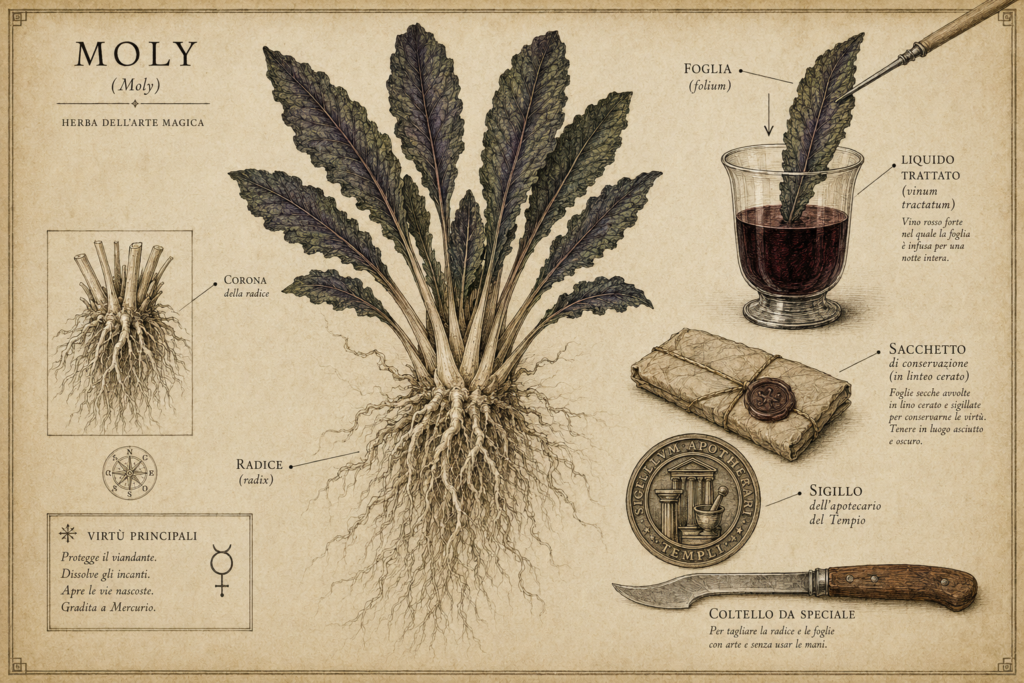
Overview
The Moly Herb is a rare magical herb known for one severe virtue: it strips liquid of hidden power. A single leaf placed in wine, water, broth, medicine, or a potion destroys any poison or potion property within it. The leaf is consumed in the process, leaving ordinary liquid behind.
That simplicity is why moly is feared as well as prized. It can save a ruler from poisoned wine, but it can also ruin a healing draught, erase the proof of a poisoning, or turn a sacred elixir into flavoured water. Moly does not judge the liquid. It purifies.
Its fame comes from ancient heroic tradition. Moly is the herb of divine warning, a plant placed between mortal flesh and sorcerous corruption. It is not a cure for every poison and not a general answer to magic. Its power is narrower, cleaner, and more dangerous: it makes a prepared liquid ordinary.
Physical Description
The Moly Herb has long, dark green leaves with a purple-black sheen along the veins and edges. The leaves are narrow, smooth, and faintly waxy, with a bitter scent when bruised. Fresh leaves feel cool even in warm weather and blacken quickly if cut with a dirty blade.
The root is pale, fibrous, and difficult to remove intact. Poor harvesting often kills the plant. Skilled herbalists lift only what they need, preserving the root crown so the bed may live another season.
Properly dried moly is pressed flat, wrapped in waxed linen, and stored in a sealed case. A dried leaf remains useful for up to one year if kept from damp. Old or badly stored moly grows brittle, loses its purple sheen, and becomes difficult to distinguish from common bitterleaf.
Moly Herb 5.5e / 2024
Moly Herb Pathfinder 1e / 3.5e
Moly Herb 3.0e
Moly Herb 3.0e

The magical herb Moly grows naturally and needs only to be found and cultivated.
Relics & Rituals: Olympus
© 2004 White Wolf Publishing, Inc. Distributed for Sword and Sorcery Studios by White Wolf Publishing, Inc.
By W. Jason Peck, Aaron Rosenberg, Christina Stiles and Relics & Rituals: Olympus team
Its long purple-tinged dark green leaves, when placed in liquid, remove both magical and poisonous properties, destroying any poison or potion contained therein. The moly is consumed in the process. The roots of the moly plant can also be used for neutralize poison spells.
Faint abjuration; CL -; none; Price 800 gp (per leaf); Weight: –
Moly Herb 5.5e / 2024
Wondrous Item, Uncommon Consumable
Price: 800 gp per leaf
Weight: —
When a moly leaf is placed into a liquid of up to 1 gallon, the leaf is consumed. After 1 minute, the liquid loses all poison and potion properties.
This destroys mundane poison, magical poison mixed into the liquid, and any potion, elixir, or similar magical liquid effect contained in it. The liquid otherwise remains physically unchanged. Wine remains wine. Water remains water. Broth remains broth.
Moly does not affect poison already inside a creature, venom on a weapon, contact poison on a surface, inhaled poison, disease, curses, acid, holy water, unholy water, permanent magic items, or magic not contained in the liquid itself.
If the liquid contains both poison and a beneficial potion effect, both are destroyed.
Using a Moly Leaf
A creature can place a moly leaf into a cup, flask, bottle, bowl, wineskin, small cauldron, or similar vessel as an action.
The liquid must remain in contact with the leaf for 1 minute. If the liquid is drunk before that minute ends, any poison or potion effect functions normally.
One leaf affects no more than 1 gallon of liquid. Larger vessels require additional leaves or must be divided into smaller quantities before treatment.
Moly Root
A fresh moly root can be used as a special material component when casting a spell that removes or suppresses poison, such as protection from poison or a similar spell.
When used this way, the root is consumed. If the spell targets a poisoned creature, the caster may end one nonmagical poison affecting that creature without needing to identify the poison first.
Moly Herb Pathfinder 1e / 3.5e
Wondrous Herb
Aura: faint abjuration
Caster Level: —
Slot: none
Price: 800 gp per leaf
Weight: —
When a moly leaf is placed into a liquid of up to 1 gallon, the leaf is consumed. After 1 minute, the liquid loses any poison or potion properties contained in it.
This destroys mundane poison, magical poison, potions, alchemical elixirs, magical draughts, and similar ingestible magical liquid effects mixed into the liquid. The liquid otherwise remains physically unchanged.
Moly does not neutralise poison already affecting a creature, venom on a weapon, contact poison on an object, inhaled poison, disease, curses, acid, holy water, unholy water, permanent magic items, or magic not contained in the liquid itself.
If a potion has been diluted into wine, water, broth, or another drink, moly destroys the potion effect.
Moly Root
The roots of the moly plant may be used as a special material component for neutralize poison. When used in this way, the root is consumed.
A caster using fresh moly root as part of neutralize poison gains a +2 circumstance bonus on any caster level check required to neutralise a poison effect.
Why Moly Matters
The Moly Herb changes poison from certainty into risk.
A court that keeps true moly is harder to murder at table. A temple that cultivates it becomes valuable to rulers, ambassadors, military commanders, and noble houses. A physician with one leaf can save a patient from a poisoned draught, but may also destroy the only magical medicine strong enough to help them.
A poisoner who knows moly is present must abandon the cup and choose another road: venom on a ring, a tainted needle, incense, contact poison, a cursed object, or a blade in the dark.
That is the heart of the herb. Moly does not end intrigue. It makes intrigue cleverer.
It is also dangerous because it erases evidence. Once moly has purified a drink, the poison or potion is gone. The victim may live, but the proof may vanish with the leaf.
Harvesting and Cultivation
The Moly Herb grows naturally and needs only to be found and cultivated, but true cultivation is slow, guarded, and easy to ruin. The plant resists careless transplanting. It grows best in stony sacred ground, temple herb beds, old upland gardens, and places where poison, healing, and divine warning have long histories.
A moly bed is rarely left unguarded. Temples protect it behind locked garden walls. Royal physicians keep it in sealed courtyards. Mountain shrines mark it with taboos. In dangerous courts, a moly garden may be more valuable than a jewel chest because jewels cannot stop poisoned wine.
Suggested Harvest Check
5.5e / 2024: DC 15 Wisdom (Survival), Intelligence (Nature), or Wisdom (Medicine) check.
Pathfinder 1e / 3.5e: DC 20 Knowledge (nature), Profession (herbalist), Survival, or Heal check.
Success: The harvester gathers 1d4 usable leaves and preserves the root crown.
Success by 5 or more: The harvester gathers 1d4+1 usable leaves and one usable root.
Failure: The plant is damaged; only 1 usable leaf is recovered.
Failure by 5 or more: The plant is ruined, and no usable leaves or roots are recovered.
A cultivated moly bed produces only a small number of usable leaves each year. This keeps the herb expensive and prevents it from replacing ordinary antidotes, temple medicine, or poisoncraft.
Use in Play
The Moly Herb is best used where trust is already damaged.
It belongs at royal feasts, treaty tables, infirmaries, besieged castles, merchant houses, shrine gardens, and alchemical workshops. It should not feel like routine adventuring gear. It should feel like the leaf someone produces when the room has gone silent and everyone is watching the cup.
Use moly when the question is not simply “is this poisoned?” but “what are we willing to destroy to be safe?”
Strong uses include a cupbearer testing the ruler’s wine before a feast, a temple physician cleansing a suspected poisoned draught, a besieged garrison using its last leaf on a ration sample, an alchemist proving that potion magic was hidden in ordinary wine, a priest destroying a love philtre before it reaches a marriage bed, or a villain forcing the court to waste moly on decoy cups before striking by another method.
Moly should not become a universal poison answer. It only works before the liquid is consumed, only on liquid, and only in limited quantity.
Failure, Risk, and Misuse
The Moly Herb’s danger is not that it fails. Its danger is that it succeeds without judgment.
It destroys healing potions as readily as poisoned wine. It can ruin magical medicine, erase a potion from evidence, spoil an expensive draught, or turn a carefully prepared elixir into flavoured water.
Common failures include using one leaf on a barrel and assuming the whole vessel is safe, treating a liquid after the victim has already drunk it, or destroying a potion before anyone knows whether it was medicine, poison, or proof.
The most dangerous misuse is deliberate. A murderer may add poison to one cup and a healing potion to another, knowing the household has only one leaf. A rival physician may “protect” a patient’s medicine by treating it with moly first. A courtier may ruin a diplomatic gift by claiming it smelled suspicious.
Value in the World
Moly is expensive because it answers two feared threats at once: poison and hidden potioncraft.
Kings, queens, ambassadors, temple orders, military commanders, merchant princes, and wealthy physicians are the most reliable buyers. Common folk may know the herb by reputation, but few ever see a true leaf.
Its trade is often watched. A servant carrying moly may be protecting a household, sabotaging a cure, or preparing to remove evidence. In courts where poison is common, possession of moly is almost a political statement: someone expects treachery.
The best moly is not sold in open markets. It passes through temple apothecaries, sworn herbalists, royal physicians, and brokers trusted by people rich enough to fear their own cups.
Trade, Cultivation, and False Moly
Fresh Moly Leaf: The most trusted form, used by temple physicians, royal households, and noble cupbearers. Fresh moly has the strongest bitter scent, the clearest purple-black veining, and is hardest to fake. It is usually kept close to where the plant is grown.
Dried Moly Leaf: The standard trade form. A true dried leaf is pressed flat, wrapped in waxed linen, and often sealed by a temple herbalist, royal physician, or sworn apothecary. It travels well, but its value depends heavily on trust.
Moly Root: Rarer than the leaf because harvesting the root can kill the plant. It is usually reserved for temple healers and spellcasters using poison-neutralising magic.
False Moly: Bitter purple-veined leaves from ordinary plants, sold to frightened nobles, minor courts, travellers, and anyone desperate enough to trust a seller without proof. False moly is common because a failed leaf may not be discovered until someone is already dying.
Historical Context
The Moly Herb comes from Greek heroic tradition. In the Odyssey, Hermes gives moly to Odysseus before he confronts Circe, whose drugs and enchantments have transformed his companions. That episode makes moly one of the clearest classical models for a plant that protects against both poison and sorcery. For background, see Encyclopaedia Britannica’s articles on Circe and Hermes.
In the campaign world, moly belongs naturally in the gardens of Hermes, Hecate, Apollo, Asclepius, Circe’s rivals, temple physicians, royal herbalists, and old households that have survived too many banquets. It is not merely an antidote plant. It is a sacred warning against the cup that has been made more than it appears.
Keep this reference growing
If this page helped with your reading or game, you can support its upkeep or explore the curated books.
Explore the Bookshop — epics, classics and stories behind imagined worlds.