
Rowboat — Ferry, Fishing and River Crossings
At a Glance
- Type
- Open boat propelled by oars
- Habitual waters
- Ferries, quays, quiet rivers, lakes and ship-to-shore passages
- Crew
- One or two rowers depending on craft and rules
- Use
- Short crossings, scouting, line handling and rescue
- Cargo
- Limited; people and freight must be balanced
- Threats
- Overloading, strong current, storm waves and capsizing
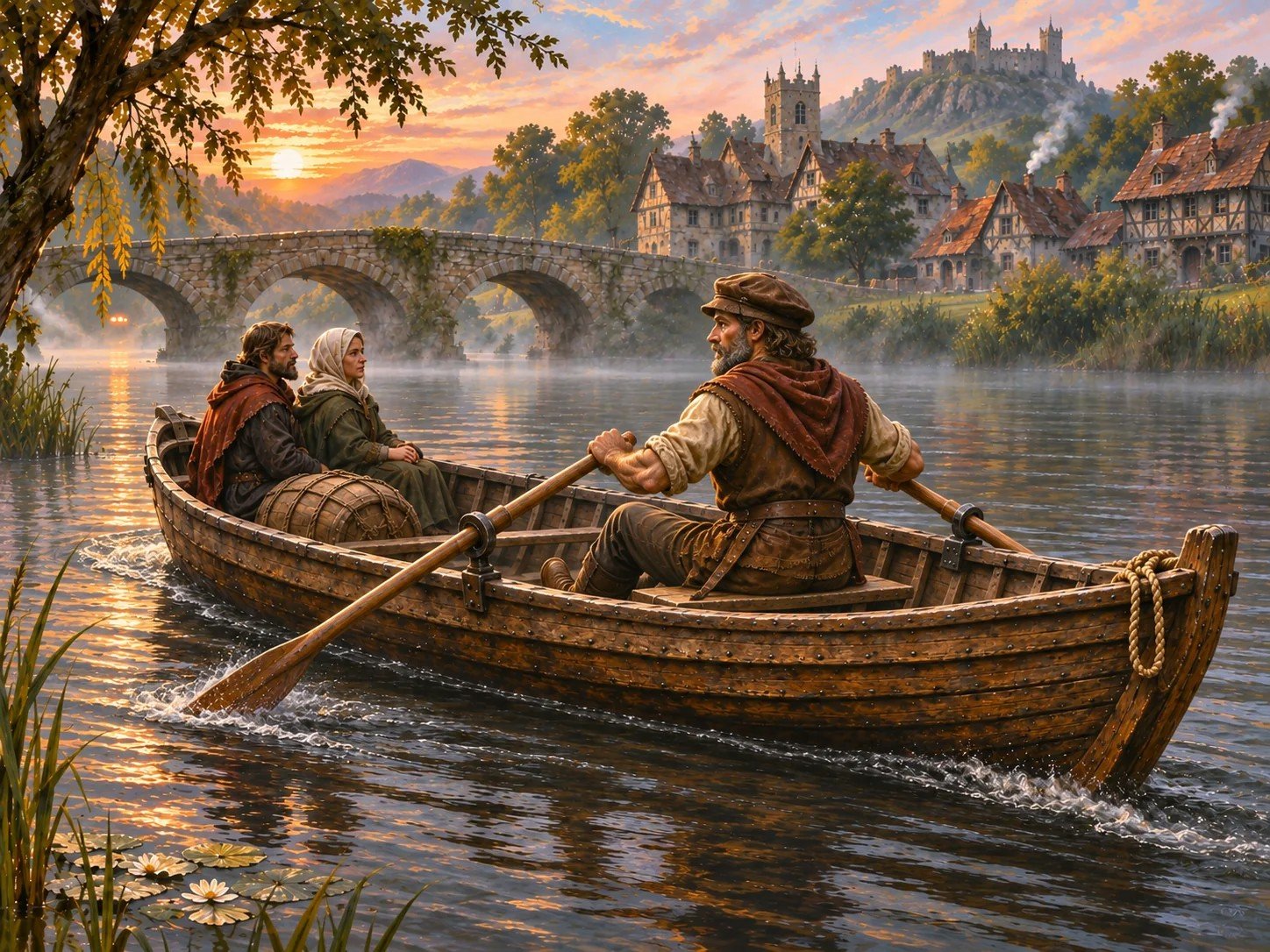
The ferryman’s oars scrape against the stones as the boat leaves the landing. Two travellers sit low beneath their rough cloaks, careful not to move. Behind them, the watch at the gate has discovered that its prisoner is gone; ahead, the river opens into reeds where the water is black and the bank vanishes in mist.
A rowboat is among the humblest and most useful vessels of 1454. It crosses a river without a bridge, brings a sailor ashore from a merchant ship and allows a fisherman to reach quiet shallows. A reliable boatman understands that the current may be stronger beneath a bridge than in open water, and that a passenger’s sudden movement can be more dangerous than the crossing itself.
Planking, Oars and Passengers
A narrow wooden hull is joined by ribs and benches, with one or more pairs of oars set into thole pins or rowlocks. A small anchor or line holds the boat at the shore; a bailer removes water that enters over the gunwale. Skilled boatwrights choose timber and seams to suit freshwater or coastal use.
Rowing: The ferryman sits on a thwart near the middle of the hull, facing the stern rather than the direction of travel. An oar rests in a rowlock or between thole pins on each side. The rower places both blades into the water and draws the handles toward his body, driving the boat bow-first behind him; he then lifts the blades, reaches forward and repeats. The passengers sit clear of the swinging handles and the path of the oar shafts.
Loading: Heavy sacks belong low and near the centreline. Passengers should board one at a time and remain seated while the rower brings the bow through the current. A boat crowded with armoured soldiers may sink before an enemy strikes.
Ship-to-shore: Rowboats ferry messengers and supplies when a larger vessel cannot reach a shallow dock. The boat must return against weather and tide. A crossing made at night risks collision with a hidden piling or another boat without lights.
The River Takes Its Toll
The Lantern in the Reed Bed. A boatman takes the party across a shallow estuary for half the usual fare. At the midpoint he stops rowing, points to an unlit lantern among the reeds and demands to know which passenger brought it aboard. His hand is shaking. The current is already carrying the boat toward the marsh.
Complications: A snapped oar leaves the boat drifting. A river guard claims the ferry has crossed a disputed border. A wounded passenger must be carried ashore without grounding the craft on mud. Storm waves turn a simple crossing into a fight to keep the bow into the water.
Rowboat — Vehicle Rules
Rowboat — D&D 2024
Official vessel: Rowboat.
| Ship | Rowboat |
|---|---|
| Speed | 1½ mph |
| Crew | 1 |
| Passengers | 3 |
| Cargo (Tons) | — |
| AC | 11 |
| HP | 50 |
| Damage Threshold | — |
| Cost | 50 GP |
Weight 100 lb.
Current: Add current speed (typically 3 mph) when going downstream. A rowboat cannot be rowed against significant current and may need to be towed from shore.
Damage and control: The equipment table supplies no damage threshold. Use appropriate ability checks for hazardous steering and the edition’s object and water rules for damage, swamping or a capsized boat.
Official reference: D&D 2024 Basic Rules — Airborne and Waterborne Vehicles.
Rowboat — D&D 2014
Official vessel: Rowboat.
| Ship | Rowboat |
|---|---|
| Speed | 1½ mph |
| Crew | 1 |
| Passengers | 3 |
| Cargo (Tons) | — |
| AC | 11 |
| HP | 50 |
| Damage Threshold | — |
| Cost | 50 gp |
Weight 100 lb.
Operating it: Rowers must work with the current; moving downstream adds the river’s speed (typically 3 mph), and a significant upstream current may require towing from shore.
Hazards: Water vehicle proficiency may be used for checks to avoid a rock, retain balance or prevent a collision under difficult conditions. No Pathfinder CMB, hardness or ramming damage applies.
Official references: D&D 2014 Basic Rules — Equipment; Dungeon Master’s Guide (2014), chapter 5.
Rowboat — Pathfinder 1e
Rowboat — Large water vehicle; Squares 3 (5 ft. by 15 ft.); Cost 50 gp.
Defense
AC 9; Hardness 5; hp 60 (broken 29); Base Save +0.
Offense
Maximum Speed 30 ft.; Acceleration 10 ft.; CMB +1; CMD 11; Ramming Damage 1d8.
Description
Propulsion current (water) or muscle (pushed; one or two Medium rowers, one of whom drives); Driving Check Survival; Forward Facing bow; Driving Device oars; Driving Space centre square; Decks 1; Capacity 1,000 lb. cargo or two passengers; Weapons None listed.
A rower faces the stern while moving the craft bow-first; the published Pathfinder driving skill is Survival, not Profession (sailor).
Official vehicle profile: Pathfinder Ultimate Combat — Water Vehicles. The carrack is explicitly a modified comparison, not a separate official vehicle.
Rowboat — D&D 3.5e
| Transport | Rowboat |
|---|---|
| Cost | 50 gp |
| Weight | 100 lb. |
| Dimensions | Small open craft |
| Crew | 1 rower |
| Capacity | Two or three Medium travellers, subject to load |
| Travel speed | 1½ mph |
The rower sits facing the stern and propels the craft bow-first with oars in rowlocks.
Operation: Use the edition’s overland and water movement rules, Profession (sailor) when relevant, and skill checks appropriate to the circumstances. Count the boat and equipment as objects when damaged.
Risk: An overloaded boat, rapid current or broken oar is an encounter obstacle, not a reason to import Pathfinder’s vehicle manoeuvre statistics.
Official reference: D&D 3.5e SRD — Transport, Rowboat.
Related Waterways and Sources
For larger river cargo see the Keelboat; for portable river crossing see the Coracle. Return to the Vehicles catalogue.
Section 15: Copyright Notice — Pathfinder Roleplaying Game Ultimate Combat © 2011, Paizo Publishing, LLC. Authors Jason Bulmahn, Tim Hitchcock, Colin McComb, Rob McCreary, Jason Nelson, Stephen Radney-MacFarland, Sean K Reynolds, Owen K.C. Stephens and Russ Taylor. The four editions’ mechanical figures are separately attributed; the travel material is new.
Keep this reference growing
If this page helped with your reading or game, you can support its upkeep or explore the curated books.
Explore the Bookshop — epics, classics and stories behind imagined worlds.