
Pocahontas (Matoaka) — Powhatan Intermediary
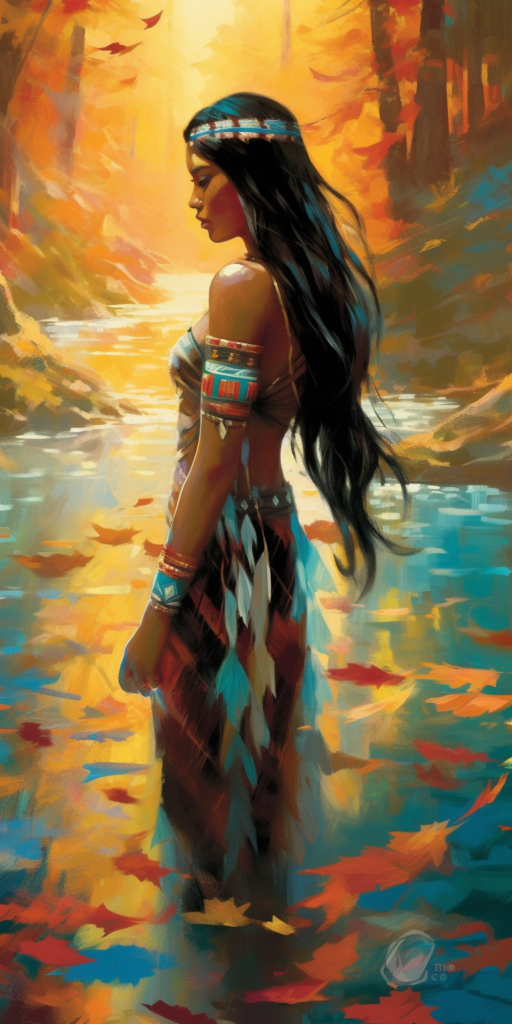
Pocahontas, also called Matoaka or Amonute, is a daughter of Wahunsenacawh, the paramount leader of the Powhatan polity on the Chesapeake. Her knowledge of both Powhatan communities and the English settlement makes her a valuable intermediary—but it does not give her unrestricted authority over either side. When settlers seize food or demand hostages, family ties and political leverage matter more than an outsider’s promises of friendship.
A message has reached the English settlement proposing an exchange of captives and weapons. Two versions of the terms name different prisoners. Pocahontas knows which relatives and messengers can speak for her father, but the English hold her under guard and expect her to interpret their demands. Someone must establish who altered the agreement before more people are taken.
At a Glance
- Identity: Matoaka (Pocahontas), daughter of Wahunsenacawh; a young Powhatan woman and political intermediary, human.
- People and homeland: The Powhatan-speaking communities of Tidewater Virginia; Werowocomoco and villages around the rivers of the Chesapeake.
- Immediate concern: Verify an exchange and protect people on both sides from retaliation, without giving up the Powhatan polity’s independence.
- Family: Her father Wahunsenacawh; his brother Opechancanough is an influential Powhatan leader with his own interests.
- Other relationships: Captain John Smith, the English commander whose later account of her supposed rescue is disputed; John Rolfe belongs to a later documented part of her life.
- Strengths: Languages, observation, knowledge of river routes and the ability to recognise what rival negotiators have left unsaid.
- Constraints: Captivity, limited leverage over soldiers and officials, divided interpreters and the risk faced by her relatives.
- Use in play: A hostage exchange, a missing letter, a guarded ferry or a meeting where mistranslation could lead to a raid.
Game Statistics
Pocahontas is an observant young political intermediary, not a supernatural huntress. She can bring two parties to a conversation, recognise a false message and find a route home, but guards, prisoners and rival leaders can still refuse her requests. The following original rule conversions do not turn Powhatan spiritual traditions into spells or enchanted weapons.
Pocahontas — 2024
Medium Humanoid (Human), Neutral Good
AC 12; Initiative +2 (12); HP 33 (6d8 + 6); Speed 30 ft.
Saves Wis +5, Cha +5; Skills History +5, Insight +7, Perception +5, Persuasion +7, Survival +5; Senses Passive Perception 15; Languages Powhatan and learned English; CR 1/4 (50 XP, PB +2, campaign encounter estimate); Gear Message pouch, simple staff, river-route notes and travel provisions.
Traits
Two Tongues. Pocahontas has Expertise in Insight and Persuasion (included). When translating between people, she may use an Intelligence (History) check to recognise differences between two written or spoken accounts; unfamiliar concepts and deliberately ambiguous promises still require investigation.
Attentive Listener. Pocahontas has Advantage on checks to remember the particular words of a conversation she personally heard. She cannot automatically detect lies or read minds.
Actions
Quarterstaff. Melee Attack Roll: +2 to hit, reach 5 ft.; Hit: 3 (1d6) Bludgeoning, or 4 (1d8) if two-handed.
Shortbow. Ranged Attack Roll: +4 to hit, range 80/320 ft.; Hit: 5 (1d6 + 2) Piercing. She carries a bow only when travelling or when such equipment is available, not while held captive.
Bonus Actions
Carry the Message (1/Short Rest). Pocahontas may take the Disengage action as a Bonus Action when moving to convey information, free a captive or escape immediate danger.
Reactions
Warning (2/Day). When an ally who can hear Pocahontas within 30 ft. is targeted by an attack from a creature she can see, she grants that ally +2 AC against that attack before the roll.
Encounter note: A low CR reflects ordinary human resilience. Her real value in play is political, not damage output.
Pocahontas — legacy 5e / 2014
Medium Humanoid (Human), Neutral Good; AC 13 (leather armour); HP 44 (8d8 + 8); Speed 30 ft.; STR 10 (+0), DEX 14 (+2), CON 12 (+1), INT 16 (+3), WIS 16 (+3), CHA 16 (+3); CR 1/2 (100 XP, PB +2; revised from the much stronger legacy conversion).
Saves Wis +5, Cha +5; Skills Insight +7, Perception +5, Persuasion +7, Survival +5; Languages Powhatan and learned English.
Swift Arrow. Ranged Weapon Attack +4 to hit, range 80/320 ft.; Hit: 5 (1d6 + 2) Piercing. Once per Short Rest after making this attack, she can make a second Shortbow attack as a Bonus Action if carrying two arrows and a bow. Knife. Melee Weapon Attack +4 to hit, reach 5 ft.; Hit: 4 (1d4 + 2) Piercing.
Guard a Messenger (Reaction, 2/Day). When an ally within 5 ft. is attacked, Pocahontas may grant that ally +2 AC against the attack if she can see the attacker. It does not allow her to teleport, become invulnerable or absorb damage at a distance.
Pocahontas can shoot and protect a nearby companion, but her greater influence comes from the words she can carry between communities and the people willing to hear them.
Pocahontas — Pathfinder 1e
CR 4 (1,200 XP); female human expert 6; NG Medium humanoid (human); Init +6; Senses Perception +14.
Defense
AC 12, touch 12, flat-footed 10 (+2 Dex); hp 33 (6d8 + 6); Fort +3, Ref +4, Will +10 (includes Iron Will).
Offense
Speed 30 ft.; Melee quarterstaff +4 (1d6, ×2); Ranged sling +6 (1d4, 50-ft. range increment); Special Attacks none. These are ordinary attacks; captivity may leave her unarmed.
Statistics
Str 10, Dex 14, Con 12, Int 16, Wis 16, Cha 16; BAB +4; CMB +4; CMD 16; Feats Skill Focus (Diplomacy), Alertness, Improved Initiative, Iron Will; Skills Diplomacy +15, Sense Motive +12, Perception +14, Knowledge (local) +12, Linguistics +12; Languages Powhatan, learned English.
Gear Simple clothes, message pouch, trading tokens and staff, where available. Her expertise lies in negotiation, local knowledge and languages. In an encounter she carries ordinary equipment, with no magic attack or supernatural defence.
Pocahontas — D&D 3.5e
Human expert 6; Medium humanoid (human), Neutral Good; CR 5 (campaign NPC estimate).
| Hit Dice | 6d6 + 6 (27 hp) |
|---|---|
| Initiative | +6 (+2 Dex, +4 Improved Initiative) |
| Speed | 30 ft. |
| Armor Class | 12 (+2 Dex), touch 12, flat-footed 10 |
| Base Attack / Grapple | +4 / +4 |
| Attack | Quarterstaff +4 melee (1d6, ×2) or sling +6 ranged (1d4, 50-ft. range increment) |
| Full Attack | Quarterstaff +4 melee, or sling +6 ranged; no second attack from BAB |
| Space / Reach | 5 ft. / 5 ft. |
| Saves | Fort +3, Ref +4, Will +10 (Iron Will) |
| Abilities | Str 10, Dex 14, Con 12, Int 16, Wis 16, Cha 16 |
| Skills | Diplomacy +15, Sense Motive +12, Spot +14, Decipher Script +12, Knowledge (local) +12 |
| Feats | Skill Focus (Diplomacy), Alertness, Improved Initiative, Iron Will |
| Gear | Staff, simple clothes and correspondence |
This is a human expert with knowledge and language skills, using 3.5e Hit Dice, class skills and ordinary equipment. Her most important ability is communicating a danger before a confrontation begins, not defeating professional warriors in melee.
What Is Pocahontas Doing Now?
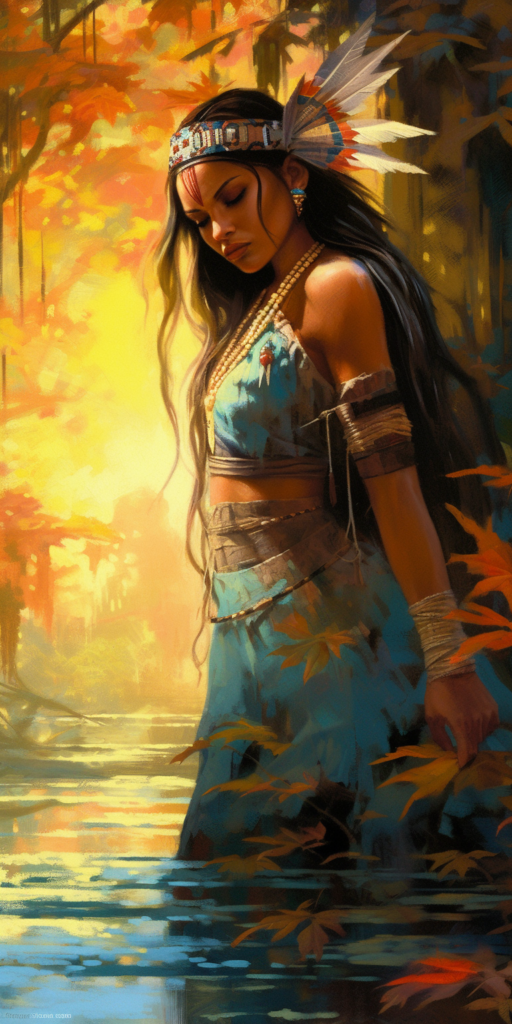
Two negotiators have carried different versions of a prisoner’s exchange to the English settlement. The English demand guns and captives; Powhatan messengers demand the safe release of people taken during a trading visit. Pocahontas has heard both versions. She knows which names are wrong but cannot simply walk out of her guarded lodging to correct them. The visiting party can help her reach the right witnesses or carry a trustworthy message upstream.
Her father must consider the safety of multiple towns, not just a single daughter. An English captain wants a public concession he can report as victory, while families waiting for prisoners need immediate reassurance. Pocahontas is trying to keep the exchange from becoming an excuse for another attack. Promises of peace are useful only if those with the power to act agree to them.
Encounters
- The missing name. A list of Powhatan prisoners delivered to a fort includes the wrong brother. The English commandant will not release anyone without a matching roster, and one of the prisoners is ill. The adventurers can compare messenger accounts, identify which clerk altered the list and arrange an exchange at a neutral landing before the commanders abandon the talks.
- Three boats at the river. A ferry is meant to carry a small delegation under safe-conduct. Three boats arrive instead, one carrying armed guards concealed beneath trading cloth. Pocahontas recognises a local insignia not mentioned in the agreement. The characters can ask the boats to ground separately, expose the deception or help the delegations withdraw without a volley of arrows.
Personality and Behaviour
Pocahontas notices who has answered a question and who has merely repeated a demand. She knows that gifts, visits and shared meals have political meanings and that a captain may understand those customs very differently. She can be playful among people she trusts, but captivity has taught her to measure the consequences of speaking in front of a guard.
She will challenge a flattering visitor who speaks of “saving” her people without asking what they want. She can cooperate with an English interpreter when that serves her relatives; cooperation does not mean she is free to leave or that colonists speak for the Powhatan polity. Her courage is expressed in judgments made under constraint, not in supernatural combat.
Relationships and Politics
Wahunsenacawh, the Powhatan paramount leader and her father, must weigh political obligations extending across many communities. Opechancanough, his brother and another influential leader, has his own responsibilities and may disagree about the English. John Smith knew Pocahontas, but the celebrated rescue tale he published years later is disputed. John Rolfe belongs to the later period of her captivity, marriage and journey to England. The English captain Samuel Argall was central to the documented kidnapping.
Neither the Powhatan towns nor the English settlement is a unified body with one opinion. Interpreters, traders, ship captains, kinship ties and the needs of individual households all affect whether a treaty can be kept. A prisoner-release mission is more interesting when each side has something specific it needs and something it fears losing.
Adventure Hooks
- The disputed ransom. A shipment of corn has been delivered as part of an exchange, but an English official says powder and muskets were promised instead. Pocahontas asks the party to locate the original messenger and determine whether the bargain was misunderstood, mistranslated or deliberately altered.
- The watcher at Werowocomoco. A canoe carrying a warning from the settlement vanishes on a tributary. A Powhatan scout says the route has been watched by unfamiliar men; an English trader claims the messenger simply fled. The party must decide which bank to search before a planned meeting goes ahead without the warning.
Equipment and Treasure
Pocahontas may carry simple clothing, a message pouch, trade goods and familiar tools for a river journey. She does not possess an enchanted dreamcatcher or a spellcasting staff by virtue of being Powhatan. Objects associated with her family or ceremonial life have meaning within their communities and should not be turned into anonymous treasure prizes.
Campaign Connections
For the wider region, consult North America and the Western NPC directory. The Humanoid reference provides classification context, while the rules panels above distinguish the three RPG systems and the retained 2014 adaptation. The work of interpreters and diplomats should be treated as play in its own right, not a compulsory prelude to combat.
Historical Record and Sources
Pocahontas—also called Matoaka and Amonute—was born around 1595 or 1596 and died in March 1617. She was a daughter of Wahunsenacawh, whose political authority encompassed numerous Powhatan communities in coastal Virginia. She became an intermediary during the early years of the English Jamestown settlement, but claims that she rescued John Smith from execution in 1607 are disputed. Smith’s famous version of the incident appeared long after the supposed event.
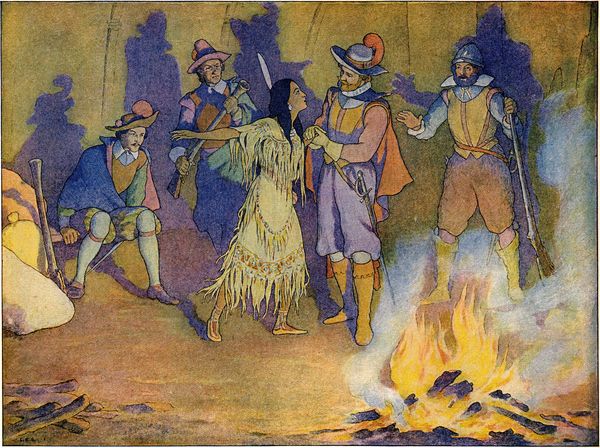
In 1613, Captain Samuel Argall seized Pocahontas and held her as leverage in negotiations over captives and weapons. During captivity she learned English customs, was baptised Rebecca, and married John Rolfe in April 1614. Their son Thomas was born in 1615. Taken to England in 1616 as part of a promotional tour for the Virginia Company, she became ill and died at Gravesend the following year. The documented kidnapping and her subsequent marriage should not be conflated with a fictional romance involving Smith.
Powhatan oral traditions include an earlier marriage to Kocoum, while surviving colonial records tell only part of her story. The National Museum of the American Indian and Historic Jamestowne record these interpretive differences. The prisoner-exchange scenes above are adventures set in a fantasy version of the Chesapeake, not assertions that these exact events took place in the surviving record.
- Historic Jamestowne — Pocahontas, Powhatan political context, captivity and family.
- Historic Jamestowne — Marriage and Captivity, Samuel Argall, contested Kocoum account and negotiations.
- National Park Service — Pocahontas: Her Life and Legend, disputed rescue and source traditions.
- Smithsonian National Portrait Gallery — Pocahontas, documentary evidence and later myths.
- National Museum of the American Indian — Pocahontas Resources, Indigenous perspectives and historical interpretations.
Edition Rules and Licences
The D&D 5.5e / 2024 conversion uses modified rules from the System Reference Document 5.2.1, © Wizards of the Coast LLC, available from D&D Beyond under the Creative Commons Attribution 4.0 International License. The retained 2014 fifth-edition panel also uses modified SRD 5.1 rules under that licence. These are original fantasy game statistics, not official adaptations of a historical person.
Pathfinder 1e and D&D 3.5e expert-class conversions use Open Game Content from the Pathfinder Core Rulebook and the D&D 3.5e System Reference Document under OGL v1.0a reproduced below. The original story, historical discussion and illustrations are not designated Open Game Content.
Open Game License version 1.0a and copyright notices
OPEN GAME LICENSE Version 1.0a
The following text is the property of Wizards of the Coast, Inc. and is Copyright 2000 Wizards of the Coast, Inc (“Wizards”). All Rights Reserved.
1. Definitions: (a)”Contributors” means the copyright and/or trademark owners who have contributed Open Game Content; (b)”Derivative Material” means copyrighted material including derivative works and translations (including into other computer languages), potation, modification, correction, addition, extension, upgrade, improvement, compilation, abridgment or other form in which an existing work may be recast, transformed or adapted; (c) “Distribute” means to reproduce, license, rent, lease, sell, broadcast, publicly display, transmit or otherwise distribute; (d)”Open Game Content” means the game mechanic and includes the methods, procedures, processes and routines to the extent such content does not embody the Product Identity and is an enhancement over the prior art and any additional content clearly identified as Open Game Content by the Contributor, and means any work covered by this License, including translations and derivative works under copyright law, but specifically excludes Product Identity. (e) “Product Identity” means product and product line names, logos and identifying marks including trade dress; artifacts; creatures characters; stories, storylines, plots, thematic elements, dialogue, incidents, language, artwork, symbols, designs, depictions, likenesses, formats, poses, concepts, themes and graphic, photographic and other visual or audio representations; names and descriptions of characters, spells, enchantments, personalities, teams, personas, likenesses and special abilities; places, locations, environments, creatures, equipment, magical or supernatural abilities or effects, logos, symbols, or graphic designs; and any other trademark or registered trademark clearly identified as Product identity by the owner of the Product Identity, and which specifically excludes the Open Game Content; (f) “Trademark” means the logos, names, mark, sign, motto, designs that are used by a Contributor to identify itself or its products or the associated products contributed to the Open Game License by the Contributor (g) “Use”, “Used” or “Using” means to use, Distribute, copy, edit, format, modify, translate and otherwise create Derivative Material of Open Game Content. (h) “You” or “Your” means the licensee in terms of this agreement.
2. The License: This License applies to any Open Game Content that contains a notice indicating that the Open Game Content may only be Used under and in terms of this License. You must affix such a notice to any Open Game Content that you Use. No terms may be added to or subtracted from this License except as described by the License itself. No other terms or conditions may be applied to any Open Game Content distributed using this License.
3. Offer and Acceptance: By Using the Open Game Content You indicate Your acceptance of the terms of this License.
4. Grant and Consideration: In consideration for agreeing to use this License, the Contributors grant You a perpetual, worldwide, royalty-free, non-exclusive license with the exact terms of this License to Use, the Open Game Content.
5. Representation of Authority to Contribute: If You are contributing original material as Open Game Content, You represent that Your Contributions are Your original creation and/or You have sufficient rights to grant the rights conveyed by this License.
6. Notice of License Copyright: You must update the COPYRIGHT NOTICE portion of this License to include the exact text of the COPYRIGHT NOTICE of any Open Game Content You are copying, modifying or distributing, and You must add the title, the copyright date, and the copyright holder’s name to the COPYRIGHT NOTICE of any original Open Game Content you Distribute.
7. Use of Product Identity: You agree not to Use any Product Identity, including as an indication as to compatibility, except as expressly licensed in another, independent Agreement with the owner of each element of that Product Identity. You agree not to indicate compatibility or co-adaptability with any Trademark or Registered Trademark in conjunction with a work containing Open Game Content except as expressly licensed in another, independent Agreement with the owner of such Trademark or Registered Trademark. The use of any Product Identity in Open Game Content does not constitute a challenge to the ownership of that Product Identity. The owner of any Product Identity used in Open Game Content shall retain all rights, title and interest in and to that Product Identity.
8. Identification: If you distribute Open Game Content You must clearly indicate which portions of the work that you are distributing are Open Game Content.
9. Updating the License: Wizards or its designated Agents may publish updated versions of this License. You may use any authorized version of this License to copy, modify and distribute any Open Game Content originally distributed under any version of this License.
10. Copy of this License: You MUST include a copy of this License with every copy of the Open Game Content You Distribute.
11. Use of Contributor Credits: You may not market or advertise the Open Game Content using the name of any Contributor unless You have written permission from the Contributor to do so.
12. Inability to Comply: If it is impossible for You to comply with any of the terms of this License with respect to some or all of the Open Game Content due to statute, judicial order, or governmental regulation then You may not Use any Open Game Material so affected.
13. Termination: This License will terminate automatically if You fail to comply with all terms herein and fail to cure such breach within 30 days of becoming aware of the breach. All sublicenses shall survive the termination of this License.
14. Reformation: If any provision of this License is held to be unenforceable, such provision shall be reformed only to the extent necessary to make it enforceable.
15. COPYRIGHT NOTICE
Open Game License v 1.0a Copyright 2000, Wizards of the Coast, Inc.
System Reference Document Copyright 2000–2003, Wizards of the Coast, Inc.; Authors Jonathan Tweet, Monte Cook, Skip Williams, Rich Baker, Andy Collins, David Noonan, Rich Redman, Bruce R. Cordell, John D. Rateliff, Thomas Reid, James Wyatt, based on original material by E. Gary Gygax and Dave Arneson.
Pathfinder Roleplaying Game Core Rulebook © 2009, Paizo Publishing, LLC; Author: Jason Bulmahn, based on material by Jonathan Tweet, Monte Cook, and Skip Williams.
Keep this reference growing
If this page helped with your reading or game, you can support its upkeep or explore the curated books.
Explore the Bookshop — epics, classics and stories behind imagined worlds.