
Joseph Montferrand — Big Joe Mufferaw, Folk Hero
Joseph Montferrand — Big Joe Mufferaw, Folk Hero
A vast-hearted French-Canadian river champion whose strength becomes dangerous because weaker men gather behind it.
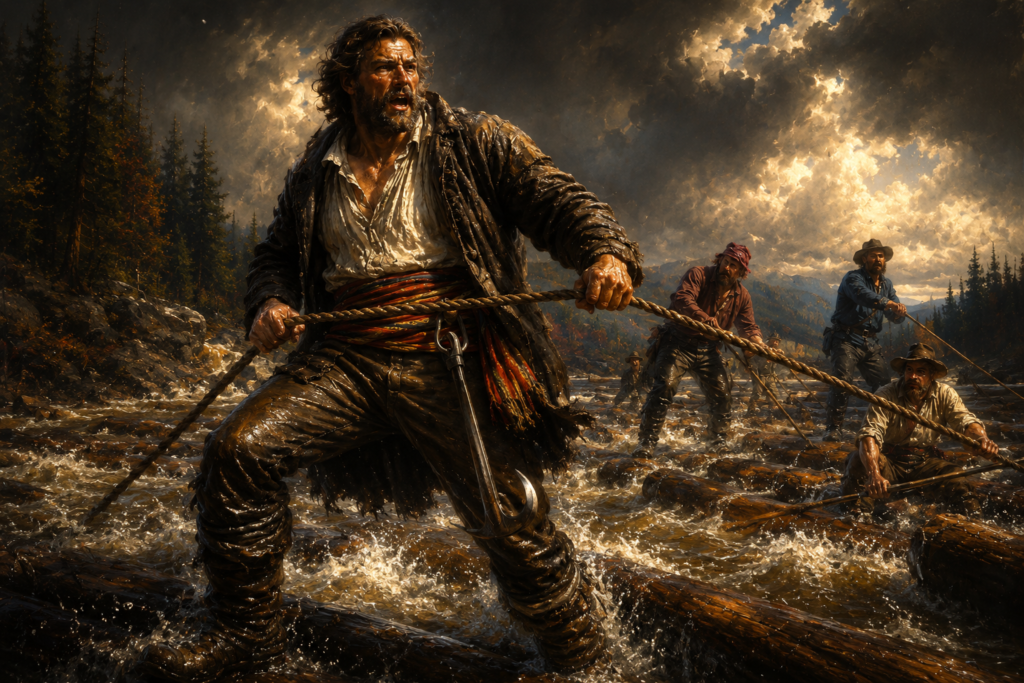
- Full Name: Joseph Favre dit Montferrand
- Common Name: Joseph Montferrand
- Aliases: Jos Montferrand, Joe Montferrand, Big Joe Mufferaw, the River Giant, the Timber-Road Champion
- Gender: Male
- Race: Human
- Occupation: Lumberman, raftsman, foreman, boxer, camp champion, folk defender
- Nationality: French-Canadian
- Region: Montréal, the Ottawa Valley, the Outaouais, river towns, logging camps, timber roads, raft convoys, taverns, winter camps, and frontier settlements
- Base of Operations: Wherever the timber road runs: frozen forests in winter, log drives in spring, river rafts in summer, and taverns full of dangerous men after payday
- Languages: French, working English, river-camp slang, trade terms of raftsmen and loggers
- Religion: River-camp rites, ancestor honour, household devotions, and practical reverence for water, winter, timber, and survival
- Alignment: Chaotic Good
- Affiliations: French-Canadian lumbermen, river drivers, voyageurs, timber foremen, poor labourers, bullied camp workers, and families dependent on the lumber trade
- Allies: Loyal raftsmen, French-Canadian workers, honest foremen, tavern keepers who owe him favours, frontier families, old voyageurs, and widows of dead river men
- Rivals: Abusive bosses, violent camp gangs, ethnic bullies, corrupt timber agents, tavern champions, debt collectors, hired strikebreakers, and predatory merchants
- Enemies: Men who prey on isolated workers, gangs who use numbers against one victim, employers who send exhausted men onto unsafe rivers, and brutes who mistake restraint for fear
Joseph Montferrand is the kind of man a logging camp invents even when he is standing directly in front of it.
He is real enough to leave boot marks in mud, blood on tavern floors, debts settled in coin, and half-drowned men alive on the riverbank. Yet every winter his story grows. One camp says he broke a gang with his bare hands. Another says he crossed a jammed river on rolling timber while the ice came apart beneath him. A third swears he lifted a loaded raft line alone while men twice as rich shouted orders from dry ground.
At the table, Joseph is not just a large brawler. He is a labour champion: a French-Canadian raftsman and camp foreman whose strength becomes political because weaker men gather behind it. He stands where law is absent, wages are stolen, men vanish into rivers, and company agents expect hungry workers to accept whatever danger is handed to them.
Joseph is not a “lesser historical man” enlarged by rumour. In the campaign, this is Joseph: a living folk hero whose strength, courage, temper, and river craft are already real at the table. Men argue about him because they cannot agree where ordinary strength ends and wonder begins. Some of the stories are exaggerated. Some are misunderstood. Some are true.
His power should feel human in texture but larger than ordinary life in effect. He sweats, bleeds, tires, eats, laughs, and can be wounded. Yet when the river breaks, the tavern turns, or the workers are cornered, he does what other men later insist must have been impossible.
Edition Tabs
Joseph Montferrand, Pathfinder 1e-Compatible Stat Block
Joseph Montferrand, Pathfinder 1e-Compatible Stat Block
Joseph Montferrand
Medium Humanoid, Chaotic Good
Armor Class 15
Initiative +2
Hit Points 136 (16d8 + 64)
Speed 35 ft., swim 30 ft.
Proficiency Bonus +4
| STR | DEX | CON | INT | WIS | CHA |
|---|---|---|---|---|---|
| 22 (+6) | 14 (+2) | 18 (+4) | 11 (+0) | 14 (+2) | 16 (+3) |
Saving Throws Str +10, Con +8, Wis +6
Skills Athletics +14, Intimidation +7, Perception +6, Survival +6
Senses Passive Perception 16
Languages French, English
Challenge 8
Traits
Legendary Labourer. Joseph has Advantage on Strength checks made to lift, shove, drag, break, climb, swim, hold a line, control a raft, or rescue a creature from water, mud, ice, timber, or collapsing structures.
Camp Champion. Joseph has Advantage on Charisma checks made to influence labourers, sailors, raftsmen, loggers, frontier workers, and the families of working people, provided he has not betrayed them.
Protector of His Own. When a creature Joseph can see within 10 feet of him is hit by an attack, Joseph can use his Reaction to reduce the damage by 10 (1d10 + 5). If the attacker is within his reach, Joseph may also shove the attacker 5 feet without requiring a separate roll.
River-Born Endurance. Joseph has Advantage on saving throws against exhaustion caused by cold, forced marching, swimming, starvation, thirst, or hard labour. He can hold his breath for twice the normal duration.
Brawler’s Footwork. Opportunity attacks against Joseph are made with Disadvantage while he is moving across logs, docks, tavern tables, raft platforms, shallow water, ice, or uneven camp ground.
Actions
Multiattack. Joseph makes three attacks, using Fist, Boot, Timber Hook, or Thrown Object in any combination.
Fist. Melee Attack: +10 to hit, reach 5 ft., one target. Hit: 13 (2d6 + 6) bludgeoning damage. If the target is Large or smaller, Joseph may push it 5 feet or knock it Prone.
Boot. Melee Attack: +10 to hit, reach 5 ft., one target. Hit: 15 (2d8 + 6) bludgeoning damage. If the target is Prone, the attack deals an extra 7 (2d6) bludgeoning damage.
Timber Hook. Melee Attack: +10 to hit, reach 5 ft., one target. Hit: 12 (1d12 + 6) piercing damage, and Joseph may pull the target up to 10 feet toward him if it is Large or smaller.
Thrown Object. Ranged Attack: +10 to hit, range 20/60 ft., one target. Hit: 17 (2d10 + 6) bludgeoning damage. Joseph must have access to a heavy loose object such as a log, bench, barrel, crate, chair, stone, tool chest, broken door, bundled firewood, or similar object. On a hit, a Medium or smaller target must succeed on a DC 18 Strength saving throw or fall Prone.
Clear the Tavern. Joseph chooses up to three creatures within 5 feet of him. Each target must succeed on a DC 18 Strength saving throw or take 14 (4d6) bludgeoning damage and be pushed 10 feet. On a successful save, a target takes half damage and is not pushed.
Break the Line. Joseph moves up to his speed in a straight line. During this movement, he may pass through the spaces of hostile creatures. Each creature whose space he enters for the first time must succeed on a DC 18 Strength saving throw or take 11 (2d10) bludgeoning damage and be knocked Prone. Joseph does not provoke opportunity attacks during this movement.
Bonus Actions
Set His Feet. Until the start of his next turn, Joseph has Advantage on Strength saving throws and cannot be knocked Prone unless he is Incapacitated.
Haul Them Clear. Joseph moves up to half his speed and drags or carries one willing, Grappled, Prone, or unconscious creature of Medium size or smaller without reducing his movement further.
Reactions
Not That Man. When a creature Joseph can see attacks an ally or helpless creature within 30 feet, Joseph may move up to half his speed toward the attacker. If he ends within reach, he makes one Fist attack.
Catch the Blow. When Joseph is hit by a melee weapon attack, he reduces the damage by 9 (1d10 + 4). If this reduces the damage to 0, Joseph may immediately attempt to Grapple the attacker.
Environmental Note
In timber camps, river scenes, taverns, docks, forests, warehouses, campsites, yards, and worksites, Joseph almost always has something suitable to throw. In sparse or formal locations, he cannot use Thrown Object unless the DM decides there is an appropriate heavy loose object nearby.
Joseph Montferrand CR 8
XP 4,800
Male human brawler 8
CG Medium humanoid
Init +2; Senses Perception +14
Defense
AC 20, touch 13, flat-footed 17
hp 112
Fort +12, Ref +8, Will +7
Defensive Abilities bravery of the camps, hard to move, river endurance
Offense
Speed 35 ft., swim 20 ft.
Melee unarmed strike +15/+10 (1d10 + 7), boot strike +15 (1d8 + 7), timber hook +15 (1d8 + 7)
Ranged thrown heavy object +11 (2d6 + 7)
Special Attacks clear the tavern, camp champion, powerful shove
Statistics
Str 24, Dex 14, Con 18, Int 11, Wis 14, Cha 16
Base Atk +8; CMB +15; CMD 27
Feats Catch Off-Guard, Endurance, Great Fortitude, Improved Bull Rush, Improved Grapple, Improved Unarmed Strike, Power Attack, Toughness
Skills Acrobatics +9, Climb +18, Intimidate +14, Knowledge (local) +8, Perception +14, Profession (logger) +15, Sense Motive +10, Survival +13, Swim +20
Languages French, English
Special Abilities
Bravery of the Camps. Joseph gains a +4 morale bonus on saving throws against fear while defending workers, companions, or helpless people.
Camp Champion. In a logging camp, tavern, dockside, raft convoy, or frontier settlement, Joseph gains a +2 circumstance bonus on Intimidate, Diplomacy, and Sense Motive checks involving labourers or working people.
Clear the Tavern. As a full-round action, Joseph may make one combat maneuver check and apply it as a bull rush attempt against up to three adjacent enemies. He does not move with the targets unless he chooses to do so.
Hard to Move. Joseph gains a +4 bonus to CMD against bull rush, drag, reposition, and trip attempts.
River Endurance. Joseph gains a +4 bonus on Swim checks and Constitution checks made to resist cold, exhaustion, drowning, forced marches, and nonlethal damage from environmental hardship.
Powerful Shove. When Joseph confirms a successful bull rush against a creature of his size or smaller, he may also knock the target prone. This ability represents his immense folk-hero strength and should be used sparingly outside dramatic tavern, dockside, or camp confrontations.
Thrown Heavy Object. Joseph may throw a loose heavy object such as a log, bench, barrel, crate, chair, stone, tool chest, broken door, or bundled firewood. If no suitable object is available, he cannot use this attack.
Alignment Note
Joseph is Chaotic Good because his justice is personal, physical, protective, and often outside official authority. He defends the weak and keeps faith with working people, but he does not wait for magistrates, company men, or formal law when someone is being beaten, cheated, or abandoned.
Neutral Good would make him too orderly and softened. Chaotic Neutral would miss the moral centre of the man. Joseph is not fighting because he enjoys violence. He is fighting because someone has decided the poor are safe to hurt.
How to Use Joseph in a Campaign
Joseph works best as a protector NPC with dangerous social gravity. He is not just someone the party hires; he is someone the poor trust before they trust nobles, merchants, magistrates, or adventurers.
Use him where labour, wilderness, identity, law, and violence overlap. He belongs in timber camps, river towns, taverns, winter roads, raft convoys, frontier markets, pay offices, ferry crossings, and courtrooms where workers are expected to lose.
The Camp Champion
The party arrives at a timber camp where Joseph has already become the informal law. The official foreman has authority on paper. Joseph has authority when men are cold, hungry, unpaid, injured, or afraid.
This makes him useful and dangerous. If the party needs the workers’ help, Joseph can provide it. If the party arrives as agents of a noble, merchant, company, or distant authority, Joseph may treat them as another threat until they prove otherwise.
The River Guide
No one knows the dangerous river route better. Joseph can get the party through rapids, hostile camps, winter crossings, timber jams, and treacherous stretches of water, but he will not abandon innocent workers to save noble cargo.
This makes him a strong temporary ally. He should solve river problems the party could not solve alone, but create moral problems they cannot avoid.
The Tavern Problem
A gang intends to humiliate a French-Canadian worker, foreign sailor, apprentice, or accused thief. Joseph intervenes. The party must decide whether they stand with the law, the crowd, the victim, or the giant.
This scene works best before combat starts. Let the room become quiet. Let everyone understand that one word, one bottle, or one shove will decide what happens next.
The Folk Hero Under Pressure
Timber agents, officials, and rival gangs want Joseph arrested, discredited, or killed because he makes exploited workers harder to control.
This plot should not be framed as “Joseph is in trouble, rescue him.” The stronger version is: Joseph can survive the ambush, but not the accusation. He needs witnesses, evidence, or restraint more than muscle.
The Living Legend
His feats may already be exaggerated by others, but the exaggeration does not make Joseph false. It means people are struggling to describe a man who keeps doing things they cannot comfortably explain.
Some stories are tavern lies. Some are fear talking. Some are true.
Signature Scene: The Paymaster’s Table
A timber company paymaster sits behind a plank table with armed men at his back. He claims the winter wages are delayed, reduced, or lost to debt, damaged tools, food charges, transport fees, and company-store accounts no worker was allowed to question. Outside, cold labourers gather in silence. No one has shouted yet. That makes the room worse.
Joseph enters last.
He is not drunk. He is not smiling. He does not begin by threatening anyone. He removes his gloves, places one dead worker’s ruined cap on the table, and asks for the man’s pay to be counted out first.
Run this as a social confrontation before combat. The paymaster has ledgers, guards, seals, contracts, and the appearance of law. Joseph has the camp’s trust. The party must decide whether to expose the fraud, restrain Joseph, back him publicly, protect the paymaster, or keep the workers from turning the office into a riot.
The scene should put pressure on everyone. If the party sides with Joseph too quickly, the paymaster can accuse them of inciting violence. If they side with the paymaster, the workers may see them as bought muscle. If they do nothing, Joseph’s restraint may run out before the truth appears.
Escalation: If the paymaster lies badly, Joseph breaks the table instead of the man. If a guard draws steel, the room becomes a battlefield. If the party produces proof, Joseph wins without throwing a punch, and the camp remembers who stood where.
Useful Checks:
DC 13 Wisdom (Insight): The paymaster is afraid, but not only of Joseph. Someone above him may have ordered the theft.
DC 15 Intelligence (Investigation): The ledgers include repeated charges against dead or missing workers.
DC 15 Charisma (Persuasion): The workers can be kept from rioting long enough for evidence to matter.
DC 16 Charisma (Intimidation): The guards hesitate if made to understand they will be blamed for the first blood.
DC 17 Dexterity (Sleight of Hand) or Intelligence (Investigation): A second ledger, hidden under loose boards or inside a locked drawer, proves the wage theft.
Outcomes:
If Joseph wins through evidence, he becomes a powerful ally and the workers trust the party. If the scene turns violent, Joseph may still win, but officials can use the bloodshed against him. If the party restrains Joseph while exposing the theft, he respects them grudgingly. If they protect the paymaster without uncovering the truth, Joseph will remember them as enemies of hungry men.
Personality
Joseph is warm in peace and terrifying in motion. He laughs easily, eats heavily, remembers insults against others more than insults against himself, and has little patience for men who use clever words to excuse cowardice.
He is blunt, proud, stubborn, and too ready to answer injustice with his hands. But he is not stupid. Joseph understands men, camps, debt, hunger, and fear. He knows when a fight is being arranged, when a witness is being intimidated, and when a boss is sending exhausted men onto water that will kill them.
His great flaw is that he believes some problems must be settled physically. In many places, he is right. In courts, noble houses, trade councils, and diplomatic rooms, that belief can put everyone around him in danger.
Motives
Joseph wants working people to survive the men who profit from them.
He wants French-Canadian labourers, frontier families, boatmen, and poor camp hands to be treated as human beings rather than disposable muscle. He wants pay honoured, bodies recovered, widows compensated, bullies answered, and dangerous men made afraid.
He does not seek office. He does not want to rule. But if no one else protects the camp, he will.
Fears
Joseph fears becoming only a story.
He knows legends make men careless. Young workers try to imitate him. Drunk men provoke fights in his name. Ballads turn injuries into jokes and deaths into punchlines. He fears that one day a boy will step into a fight he cannot win because he thinks Joseph Montferrand would have done it.
He also fears the river. Not openly, and never in a cowardly way. He respects it too much. He has seen strong men vanish under timber, ice, and brown water without drama, prayer, or farewell.
Secrets
- Joseph once killed or crippled a man in a fight that began as justice and ended as rage. He has never fully forgiven himself.
- He keeps money hidden for widows, injured workers, and families whose men died on the river.
- His enemies are collecting witnesses to portray him as a violent criminal rather than a defender.
- He knows where bodies, stolen wages, and company ledgers were hidden after a winter-camp cover-up.
- One impossible story about him is completely true, but Joseph refuses to say which one.
Adventure Hooks
The River Will Not Give Them Back
A timber jam has sealed the river below a winter logging camp, drowning the lower road, starving villages upstream, and trapping dozens of workers on the wrong side of the flood. Company men insist the jam is natural and order exhausted labourers to break it before the spring thaw destroys their profit.
Joseph disagrees. He has seen timber jams before. This one moves against the current at night. Tools left beside it are found hooked into the logs by their own handles. Men who climb onto the jam hear voices beneath the water calling them by name.
Joseph asks the party to help him open the river before desperate workers are sent to die. The task is not simply to smash logs apart. The party must find what lies under the jam: a crushed body hidden by the company, a drowned river-spirit, an unpaid death-debt, a murdered foreman, or something older that has learned to use timber as a grave.
If the party succeeds, Joseph earns the camp’s loyalty without throwing a punch. If they fail, the river takes men one by one, and every death makes the workers more willing to follow Joseph into open revolt.
The Dead Men’s Ledger
Joseph has found proof that dead workers’ wages are still being charged, reduced, transferred, and stolen. The company’s official ledger says the men died owing money. A hidden second ledger says the company kept their pay, charged their widows for burial, and sold their tools back to new labourers.
The ledger has vanished.
Joseph wants it recovered before the next pay table is called. He does not ask the party to fight for him. He asks them to prove the truth before he does something no court will forgive. The trail leads through company stores, locked pay offices, intimidated clerks, bribed constables, grieving widows, and workers who know too much but have families to feed.
The strongest version ends at The Paymaster’s Table. Joseph places a dead worker’s cap before the paymaster and waits while the party decides whether evidence, law, intimidation, or violence will rule the room. If the ledger is found, the camp becomes a witness. If it is destroyed, Joseph may become the only proof left.
The Footprint That Followed Him
After Joseph passes through a village, a single giant footprint appears in the wet clay outside the tavern. It is too large to be his. It is also wearing the same boot pattern.
At first, men laugh. Then more prints appear: beside a broken tollgate, outside a company agent’s house, at the edge of a river where no one saw Joseph cross, and finally in the locked yard where a strikebreaker is found half-buried in mud, alive but unable to speak.
Joseph denies making the prints. He is not lying.
Something has begun walking in the shape of his reputation. It may be a river power answering the workers’ need, a fear-born double made from tavern stories, a giant ancestor claiming kinship, or the campaign world itself giving body to the legend men have shouted into winter dark. The danger is not that Joseph is false. The danger is that his name is becoming strong enough to act without him.
The party must discover whether the footprint is protecting the poor, punishing the guilty, or learning to enjoy being feared. Joseph can face fists, ropes, and river ice. He cannot easily fight a thing made from what people believe about him.
Roleplaying Joseph at the Table
Use a big physical presence, but do not make every line about strength.
Joseph should speak like a man who measures people by conduct. He notices who carries weight, who eats last, who lies to the weak, who keeps their hands soft while others bleed, and who laughs when another man is humiliated.
Good Joseph lines:
“Pay the men first. Then we talk.”
“A river does not care how rich your father was.”
“You brought six men to frighten one boy. That tells me all I need to know.”
“I am not looking for a fight. I am standing where the fight has to pass.”
“Do not mistake quiet for permission.”
Equipment and Treasure
Joseph does not carry noble treasure. His possessions should feel earned, used, and practical.
Typical Gear: Heavy boots, wool coat, sash, work shirt, belt knife, timber hook, river pole, coiled rope, small purse, folded letters from workers’ families, and a token carried for luck on bad water.
Treasure:
- 35 gp in mixed wages, tavern winnings, and emergency coin
- A silver-buckled sash worth 25 gp, gifted by grateful workers
- A masterwork timber hook worth 75 gp
- A river charm, ancestor-token, or spirit-mark worth 50 gp to the right buyer
- A hidden fund of 200 gp reserved for widows, injured workers, and unpaid labourers
Montferrand’s Timber Hook
This heavy iron logging hook is a working tool before it is a weapon. Joseph uses it to catch logs, drag timber, pull rafts together, haul men from water, tear open jammed cargo, and wrench an enemy off balance. In his hands, the tool carries the whole grammar of the river: grip, pull, brace, break, and rescue.
In another character’s hands, it functions as a masterwork hook or improvised polearm-like tool. A character proficient with martial weapons may use it as a 1d8 piercing weapon with the trip property, subject to the system being used.
Source and Literary Context
Joseph Favre dit Montferrand, better known as Jos Montferrand or Joseph Montferrand, was a French-Canadian strongman, boxer, lumberman, foreman, and master raftsman associated with Montréal, the Ottawa Valley, and the Outaouais timber trade. Born in 1802 and dead in 1864, he became famous during his lifetime for physical strength, courage, and defence of French-Canadian workers in the rough world of the lumber industry. For a concise scholarly biography, see the Dictionary of Canadian Biography entry on Joseph Montferrand.
Montferrand’s reputation grew into one of the major French-Canadian folk-hero traditions. Parks Canada identifies him as a National Historic Person and describes his legend through strength, endurance, courage, resilience, altruism, and protection of French Canadians in the lumber trade. The name “Big Joe Mufferaw” belongs to this expanded folk tradition, where Montferrand’s already formidable reputation became larger than ordinary life. For the official designation, see Parks Canada’s Jos Montferrand National Historic Person page.
For the campaign, Joseph does not need to be separated into “history” and “legend” at the table. The historical record explains where the figure comes from; the game world decides what is true in play. Here, Joseph is the man the camps know: a working foreman whose authority comes from the river, the tavern, and the loyalty of men who have seen him stand between them and abuse.